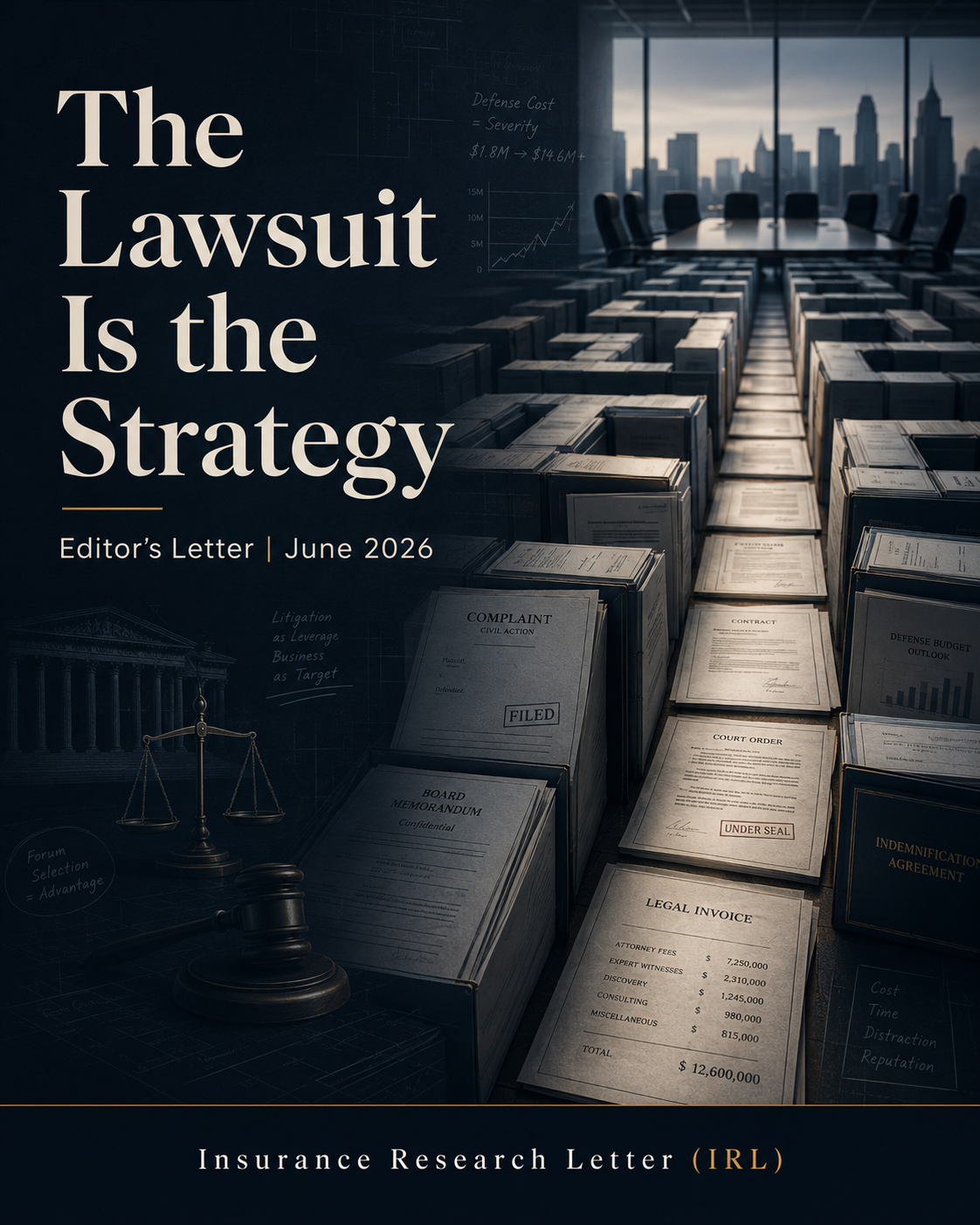
There was a time when litigation was treated as the consequence of risk.
A claim occurred. A dispute followed. Insurance responded.
That framework still exists, but it is no longer sufficient.
Increasingly, litigation is not simply the result of conflict—it is the strategy itself. The objective is not always to win in court. Sometimes it is to create cost. Sometimes it is to delay a project, pressure a settlement, force a board decision, damage a reputation, or exhaust an opponent’s willingness to continue.
For insurers, that distinction matters enormously.
The severity of a liability claim is no longer measured only by indemnity. Defense costs, management distraction, reputational exposure, venue selection, and litigation duration now shape outcomes just as much as the final judgment. In some cases, the process is the loss.
This is particularly visible in Strategic Lawsuits Against Public Participation—SLAPPs—where litigation is used less as legal remedy and more as operational pressure. But the principle extends far beyond formal SLAPP claims. It appears in employment disputes, shareholder actions, governance failures, activist campaigns, whistleblower allegations, cyber-related reputational claims, and public-facing executive decisions that attract legal attention regardless of ultimate merit.
That is one reason casualty markets remain firm even as other lines show signs of negotiation returning.
Property catastrophe and certain reinsurance layers are seeing more flexibility as capital returns and capacity expands. But casualty is not responding the same way. Long-tail uncertainty, social inflation, litigation funding, nuclear verdicts, and legal aggregation continue to challenge underwriting confidence. Reinsurers may be willing to deploy capital, but they are doing so carefully—because the problem is not simply frequency. It is predictability.
Underwriters are increasingly being asked to price behavior.
Governance quality, public visibility, management culture, and executive behavior increasingly shape casualty outcomes in ways traditional loss histories cannot fully capture. Loss history still matters, but it is no longer enough. In some cases, a poorly handled executive dispute that never reached formal litigation may reveal more than a clean five-year claims record.
This is where insurance becomes more than capacity—it becomes judgment.
Too much of our industry can feel like dogs watching television: you know something important is happening, but you are not quite sure what was said or why it matters. Casualty markets often create exactly that feeling. Everyone senses that litigation risk is rising, but many discussions still focus on rates rather than on the deeper structural change underneath.
This month, we focus on the legal process itself as a form of insured volatility. We examine how underwriters approach litigation designed to exhaust rather than resolve, how brokers should think about governance and reputational exposure, and why casualty aggregation increasingly comes from legal correlation rather than catastrophe correlation.
Because in 2026, one of the most expensive losses in insurance may be the lawsuit that was never really about winning.
It was about making sure someone else could not afford to continue.
— Alex Hodges
Editor, Insurance Research Letter (IRL)