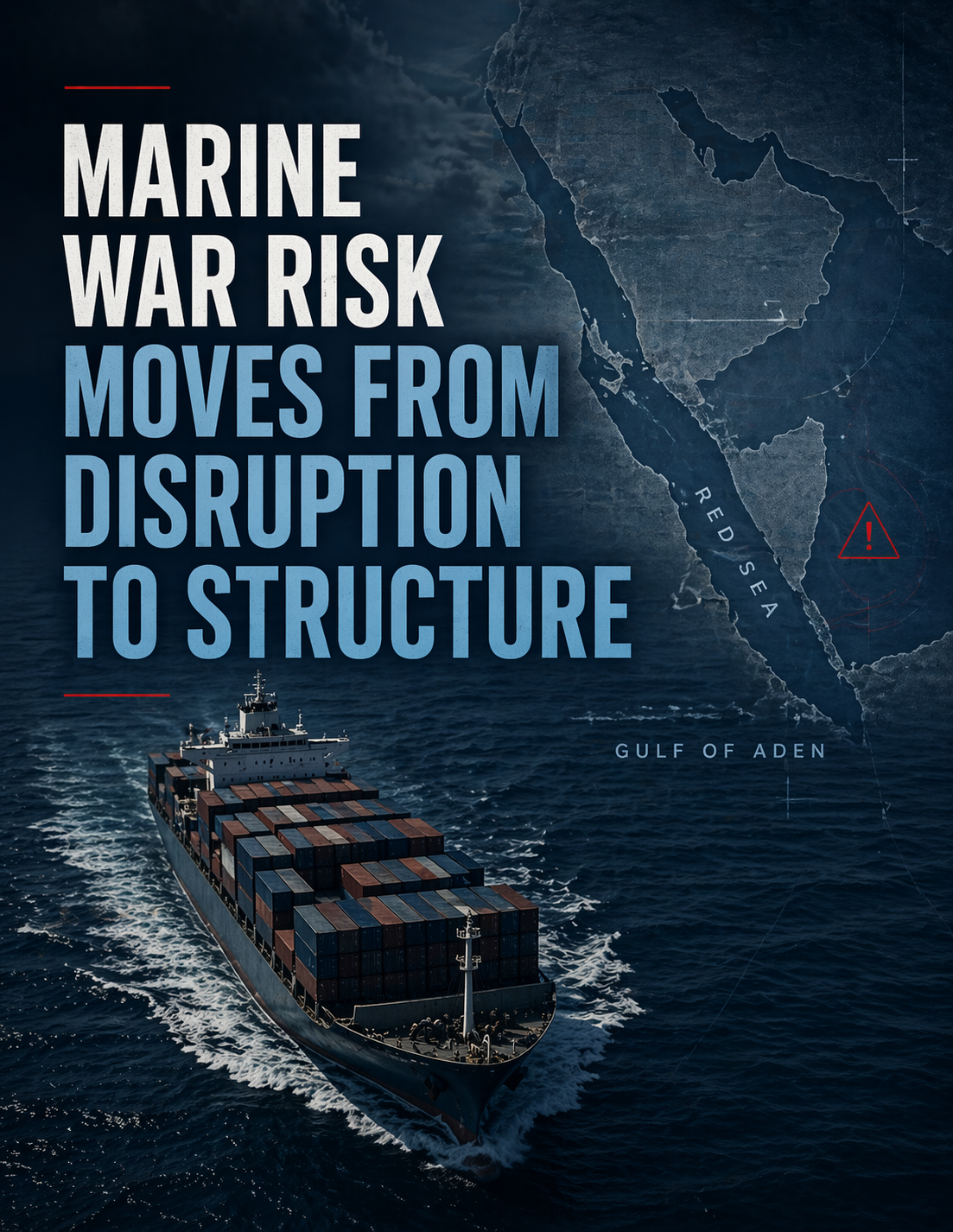
War risk is no longer temporary pricing—it is structural underwriting
What began as disruption in the Red Sea has become something more durable. Marine war risk is no longer being treated as a temporary surcharge layered onto hull or cargo cover. It is being underwritten—and priced—as a standalone exposure.
Voyages through the Red Sea and Gulf of Aden are now routinely subject to additional premiums, often assessed on a voyage-by-voyage basis. In many cases, transit requires explicit underwriting approval, with conditions attached.
Routing decisions, vessel profile, cargo type, and ownership structure are all being scrutinized more closely.
Capacity remains available. But it is no longer broadly accessible. It is selective, conditional, and increasingly dependent on how clearly the risk can be defined.
That distinction is important. The market has not withdrawn from marine war risk. It has adjusted how it engages with it.
Pricing, which moved sharply in response to attacks and disruption, has not reverted. While volatility remains, elevated war risk premiums are now being treated as a baseline rather than an exception. The shift is from event-driven pricing to structural pricing.
For underwriters, the issue is not simply the presence of conflict, but the persistence of exposure. Trade routes through the region are now viewed through a different lens—one that incorporates not only current conditions, but the potential for recurrence, escalation, and operational disruption.
Reinsurance reinforces this stance. War risk remains a sensitive class at the reinsurance level, and pricing discipline there continues to influence how primary markets deploy capacity.
Even in a scenario where tensions ease, the market is unlikely to revert quickly to prior pricing levels. Underwriting memory, recent loss experience, and the reassessment of strategic routes will continue to shape behavior. What has changed is not only the level of risk, but how it is perceived.
This is beginning to affect how marine programs are structured.
War risk is increasingly separated from core marine cover, priced independently, and subject to tighter conditions. Programs are becoming more modular, with specific attention paid to where exposure sits and how it is triggered. The result is a market where availability is less the issue than usability.
In that sense, marine war risk reflects a broader shift. The market is not simply responding to events. It is redefining how certain risks are categorized and controlled.
What was temporary is now being treated as structural.
Broker Advisory — Structuring Marine Risk in a Persistent War-Risk Environment
In the current environment, marine war risk needs to be treated as a defined and managed exposure, not an extension of standard cover.
Clarity is critical. Underwriters are increasingly focused on routing, cargo sensitivity, and operational controls. The more precisely these elements are articulated, the more constructively capacity can be engaged.
Separation can improve outcomes. Isolating war risk—whether by voyage, geography, or program layer—can help preserve flexibility in the broader placement. Where exposures are combined, underwriting responses tend to be more conservative.
Timing matters. Voyage-specific pricing and approval requirements mean that early engagement is becoming essential, particularly for high-value or sensitive cargo movements.
Structure should reflect behavior. Where routing decisions or operational changes are being made to manage risk, those should be clearly incorporated into the submission. Underwriters are responding not only to exposure, but to how it is being controlled.
📌 IRL Note: In marine, availability remains—but only for risks that can be clearly defined, separated, and managed.