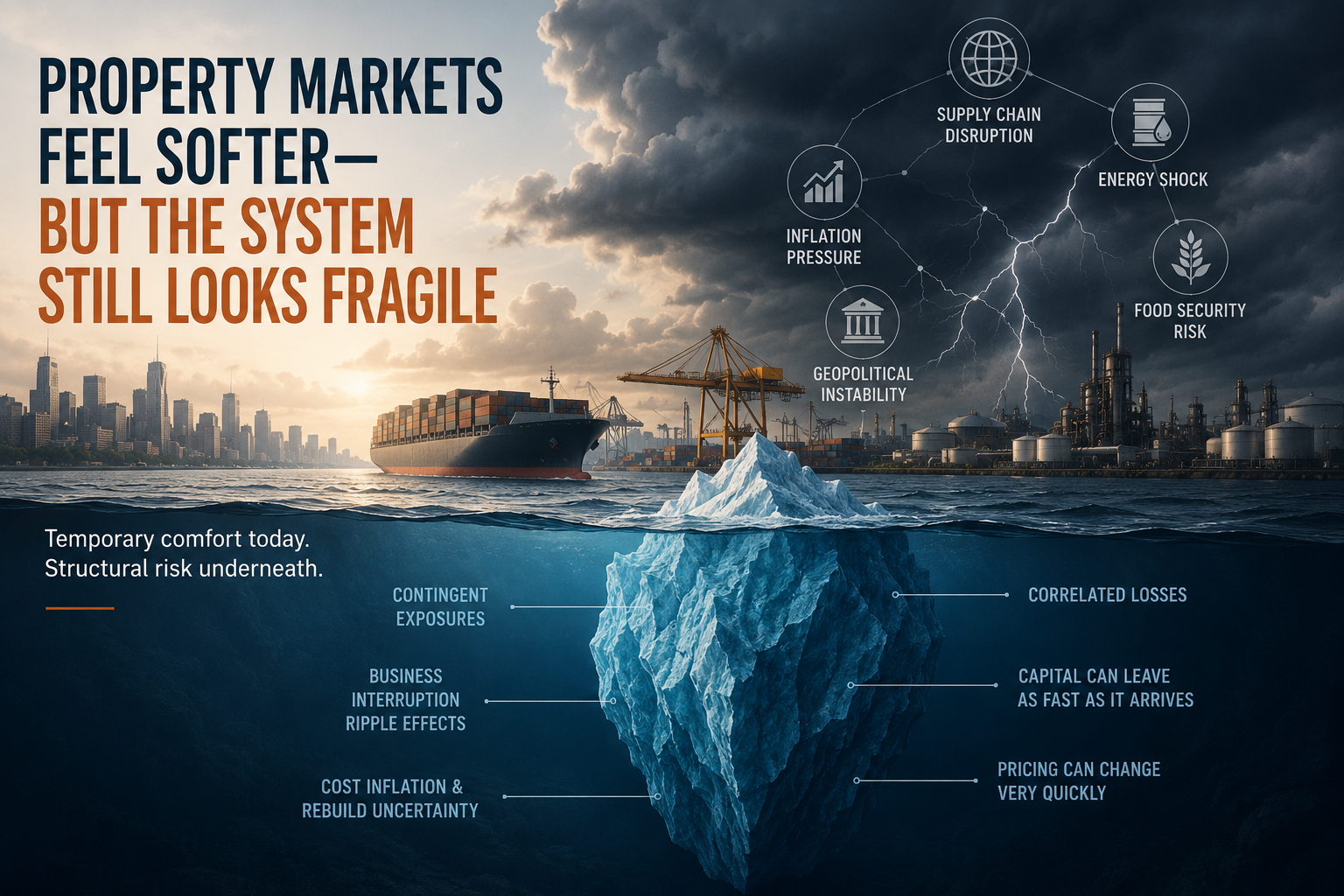
There is growing confidence across parts of the global property market that conditions are improving.
Capacity has returned. Reinsurance markets are more stable. Competition is increasing for desirable accounts. In some regions and occupancies, pricing has flattened or begun to soften. Buyers exhausted by years of rate increases are understandably welcoming the change.
But I think the market may be mistaking temporary comfort for structural stability.
To me, the current property environment still rests on a surprisingly fragile foundation—one that could change quickly if global supply chains suffer another meaningful shock.
The issue is not simply catastrophe activity.
It is correlation.
One major disruption involving energy, food exports, shipping lanes, semiconductor production, critical minerals, or industrial manufacturing could rapidly reintroduce inflationary pressure across the global economy. And inflation remains one of the most dangerous forces in property insurance because it destabilizes the assumptions underneath underwriting itself.
Repair costs rise unexpectedly. Construction timelines extend. Labor shortages intensify. Equipment replacement becomes uncertain. Business interruption periods lengthen. Contingent Business Interruption spreads outward through dependent suppliers and logistics networks.
Suddenly, what appeared adequately priced begins looking much less certain.
Oil is particularly sensitive because it moves through nearly every industrial process—transportation, chemicals, plastics, construction materials, logistics, manufacturing, and agriculture. Food disruptions create a different but equally serious problem by contributing to political instability, export restrictions, civil unrest, and persistent inflation pressure.
Neither remains isolated for long.
Over the years, I have come to believe that modern losses rarely stay isolated anymore.
A single geopolitical or supply-chain event can simultaneously affect marine, cargo, trade credit, contingent business interruption, political risk, casualty, and even cyber exposures. The same disruption may impact reconstruction costs, revenue continuity, logistics access, and liability disputes all at once.
That changes the behavior of capital.
Much of the “excess” capital currently supporting property markets is there because recent returns have been attractive. Reinsurance pricing improved sharply following the market corrections of 2023 and 2024. Higher interest rates strengthened investment income. Alternative capital returned seeking favorable risk-adjusted returns.
But capital is loyal to return—not to insurance.
And I think that point is often underestimated.
If volatility rises while returns weaken, some of that capital can leave as quickly as it arrived. The property market always looks well-capitalized—right up until a correlated event reminds everyone how quickly confidence can disappear.
This is why I remain cautious about the current softening narrative.
The market today is behaving as though recent underwriting discipline and improved capitalization have solved the structural problem. In reality, many of the underlying pressures remain: geopolitical instability, supply-chain concentration, inflation sensitivity, climate volatility, energy dependency, and increasingly complex contingent exposures.
The next correction may not require a record catastrophe year.
In my view, it may only require one event that reminds the market how quickly global disruption now spreads.
Property markets may feel softer today.
But underneath, they still look structurally nervous.