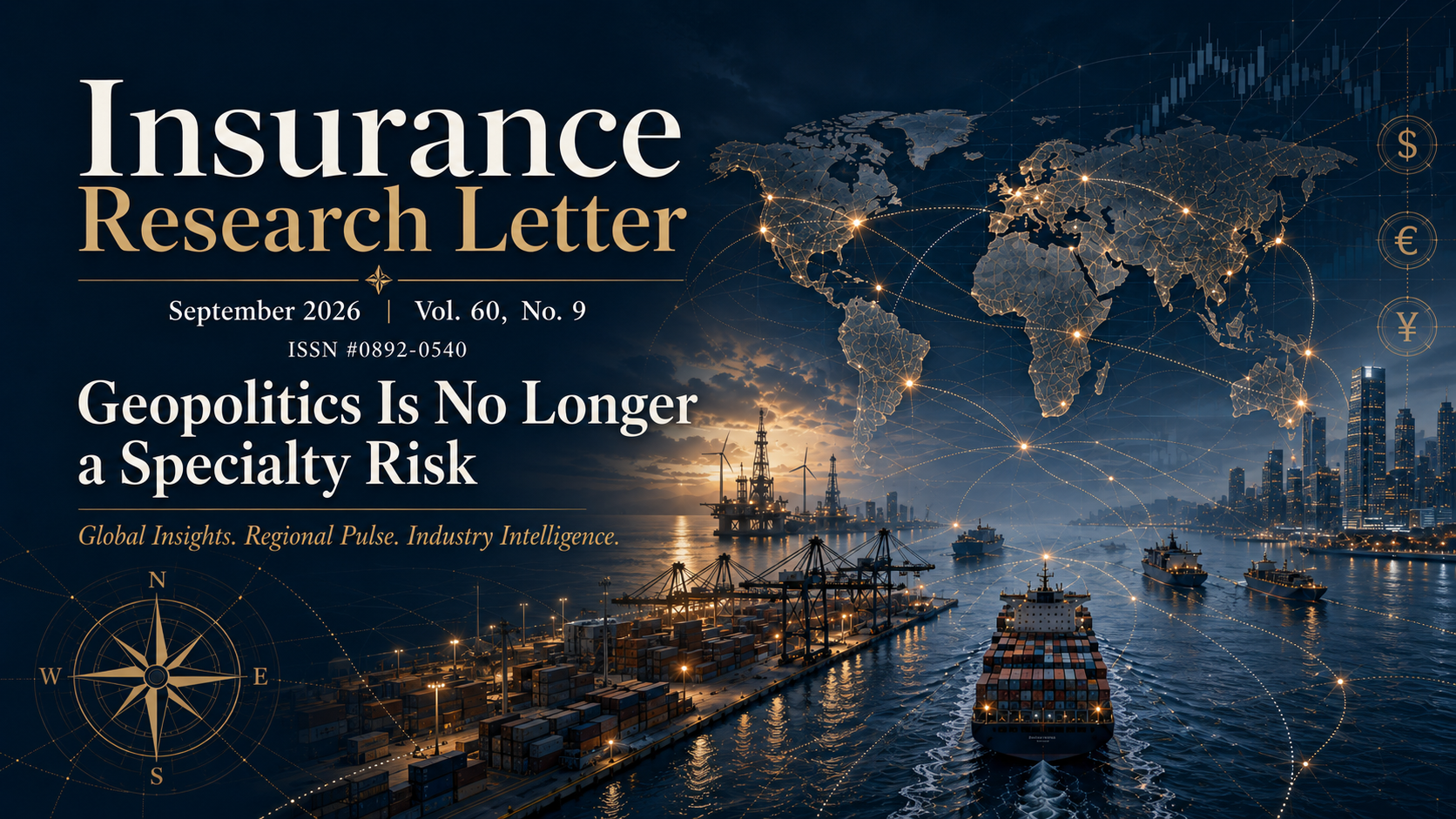
For years, the insurance industry could put geopolitical risk in a relatively convenient box.
Political risk specialists worried about expropriation, currency inconvertibility and government interference. Marine underwriters worried about war zones and shipping routes. Aviation markets watched airspace closures. Political violence insurers dealt with terrorism, strikes, riots and civil commotion. Trade credit insurers worried about counterparties and sovereign instability.
Most commercial insurance buyers could reasonably regard those exposures as specialized risks.
That distinction is becoming harder to defend.
The world in which multinational companies operate is increasingly being shaped by war, sanctions, trade restrictions, political intervention, energy disruption, shipping constraints and economic retaliation. The effects do not remain neatly inside the countries where the political event occurs.
They travel.
A company does not need property in the Persian Gulf to be affected by disruption in the Strait of Hormuz. It may depend on fuel that passes through it, petrochemicals produced in the region, a supplier that uses those materials, a vessel that changes route because of the conflict, or transportation costs that suddenly make an established supply chain uneconomic.
That is why the risk map is no longer the property map.
This matters particularly now because the insurance market is sending two very different signals.
On one side, commercial insurance conditions have become more favorable. Aon described the second quarter as broadly soft, supported by abundant capacity, strong competition and record industry capital. Well-managed risks continue to see attractive pricing and terms in many areas.
At the same time, Aon noted that geopolitical tensions, particularly in the Middle East, were affecting pricing, coverage and underwriting across marine hull and war, P&I, aviation, terrorism and political violence, while contributing to higher energy costs, claims inflation and supply-chain disruption.
That is an important contradiction for buyers to understand.
The insurance market can become softer while the risk environment becomes harder.
Last month, IRL looked at the Easy Renewal Trap. The argument was that better pricing should not be confused with a better insurance program. Capacity may return, competition may increase and the renewal may become easier, while values, business interruption assumptions, aggregation and local-policy weaknesses remain exactly where they were.
September takes that argument one step further.
Even if the insurance program itself has improved, the environment surrounding it may have changed.
Consider what is happening around the Strait of Hormuz. Shipping traffic has fallen sharply at times, energy companies have altered transportation arrangements, vessels face heightened security and sanctions concerns, and companies far removed from the immediate conflict are adjusting logistics and sourcing decisions.
The immediate insurance consequences are visible in marine and war risk.
The secondary consequences are much harder to map.
Energy costs affect manufacturing. Shipping delays affect inventory. Higher transportation expenses affect replacement costs. A supplier interruption can become a production interruption. Sanctions can affect payments, counterparties and claims handling. A change in trade policy can alter sourcing.
Political intervention can make a previously efficient supply chain suddenly impractical.
And many of those consequences do not begin with physical damage.
That creates an uncomfortable insurance question.
Where does the loss sit?
Property insurance traditionally begins with insured physical loss or damage. Business interruption usually depends on a defined trigger. Contingent business interruption may depend upon damage at a named or qualifying supplier. Marine policies have their own triggers and exclusions. Political-risk insurance responds to particular governmental acts. Trade credit addresses another part of the problem.
But the business experiences the disruption as one event.
The insurance program experiences it as several different coverage questions.
That difference is becoming increasingly important.
The economic effects can spread even further. S&P Global’s August outlook identifies a potential chain in which escalating conflict drives oil prices higher, inflationary pressure returns, monetary policy tightens, government mitigation costs rise, long-term interest rates increase and financial assets come under pressure.
None of those developments belongs exclusively to a war-risk underwriter.
They can influence property replacement costs, business interruption assumptions, casualty severity, investment results, credit conditions, construction costs, supply chains and corporate decision-making.
Trade policy adds another layer. Economic competition between major countries is increasingly being conducted through tariffs, sanctions, technology restrictions and targeted measures against particular industries and dependencies. S&P notes that China's response to U.S. trade restrictions is becoming more targeted, including measures involving technology dependencies and sanctions enforcement.
For multinational companies, geography therefore tells only part of the story.
A traditional risk map shows factories, warehouses, offices and distribution centers.
A modern dependency map needs to show something else.
Where does the company obtain energy? Which suppliers cannot easily be replaced? Which ports matter? Which shipping routes matter? Which banks process payments? Which countries supply critical components? Which governments can restrict those flows? Where are key contract manufacturers located? Which customers account for enough revenue that their disruption becomes the insured's problem?
Once those questions are asked, geopolitical exposure looks very different.
It also becomes much more difficult to separate from ordinary P&C risk.
This does not mean every company needs to buy political-risk insurance.
Nor does it mean the insurance industry can transfer every consequence of geopolitical instability. In fact, one of the more important lessons may be the opposite.
Some of the most significant consequences of geopolitical disruption may remain uninsured.
A shipping route can become uneconomic without a vessel being damaged. A supplier can become inaccessible without suffering insured property damage. A tariff can destroy the economics of a sourcing arrangement without triggering a policy. A sanction can prevent a transaction without producing a conventional insured event.
Insurance cannot solve every geopolitical problem.
But a good insurance program should at least understand where those problems intersect with the protection being purchased.
That creates responsibilities on all sides.
Risk managers need to look beyond owned assets and understand dependencies.
Brokers need to determine where those dependencies intersect with policy triggers, exclusions, territorial provisions, sanctions clauses, contingent business interruption coverage and claims-payment mechanics.
Underwriters need to understand that a seemingly ordinary property, casualty, marine or financial-lines account may carry geopolitical accumulation that is not apparent from the locations schedule.
And senior management needs to recognize that resilience is not simply the amount of insurance purchased.
It is the ability of the organization to continue operating when one of the assumptions supporting its business model stops working.
That may prove to be one of the defining insurance questions of the next several years.
For much of 2026, IRL has followed the changing relationship between capacity, underwriting judgment and program integrity. We have looked at where negotiation returned, who received flexibility, what casualty markets were really pricing, what happens when the claim tests the program, and whether easier renewals weaken discipline.
This month we widen the lens.
Because the next major test of an insurance program may not begin with a fire, hurricane, cyberattack or liability claim.
It may begin with a border closing, a vessel changing course, a government imposing a sanction, an energy price moving sharply, a supplier becoming unreachable, or a political decision made thousands of miles from anything appearing on the insured's property schedule.
The exposure may be global long before the loss is insured.
And that is why geopolitics is no longer a specialty risk.
The September question: What happens when geopolitical risk stops being something that occurs somewhere else and becomes part of the ordinary operating risk of almost every multinational business?
Alex Hodges
Editor, Insurance Research Letter (IRL)