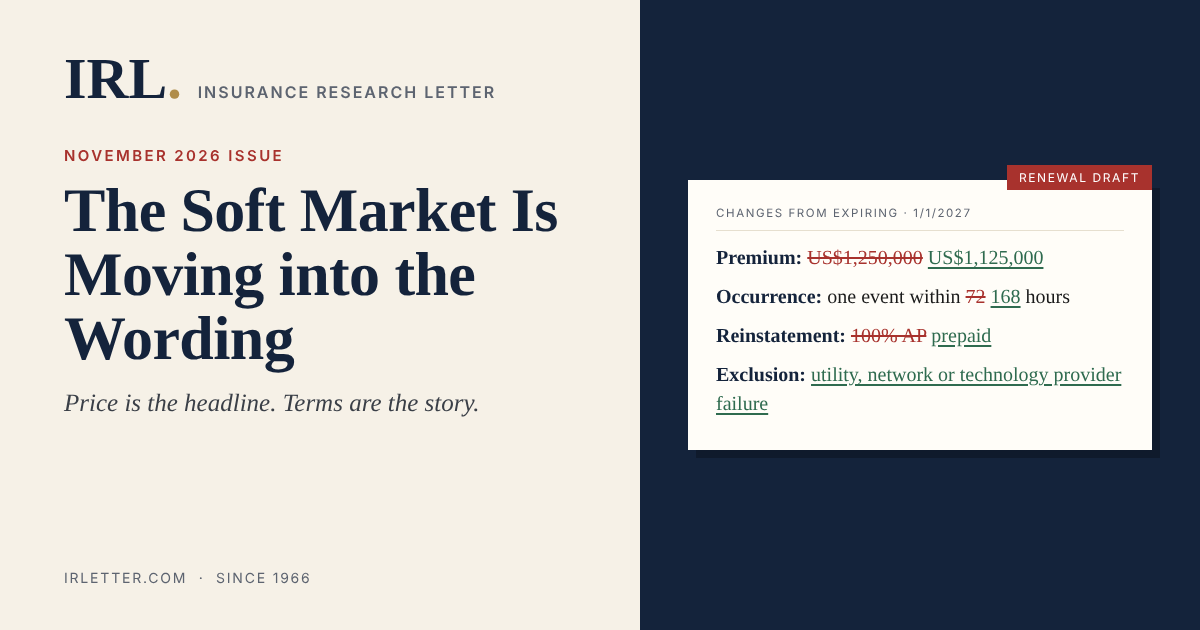
Competition is giving insurance buyers more than a lower premium to consider. As January 2027 negotiations develop, attention is turning to attachment points, reinstatements, aggregate protection and the wording that determines how much risk each party retains.
There is no settled view on how far prices will fall. Moody’s survey shows buyers still expecting further property reinsurance reductions. Fitch, meanwhile, expects the 1/1 renewals to be “increasingly focused on terms and conditions,” with cedants pressing for lower attachment points, higher limits and changes to clauses and definitions. Better protection and further price cuts can arrive together. Global Reinsurance
That is November’s argument: the soft market is moving into the wording.
The move works in both directions. For buyers, it is a substantial opportunity to repair weaknesses accepted when capacity was scarce. It also brings a risk: concessions and restrictions can change a program without anyone looking closely.
Ahead of 1/1, the conversations in Monte Carlo and Baden-Baden were about attachment points, limits, aggregate covers, reinstatements and definitions. Marsh Re expects a move toward prepaid reinstatements and more interest in multi-year arrangements. Primary markets are following the same path. Insurers are offering higher sublimits and lower deductibles to win business, while new endorsements and “clarifications” can narrow cover elsewhere in the same renewal.
What reinsurers concede at 1/1 shapes what insurers can offer their own clients through 2027. That is why the Commentary and Feature turn to the primary buyer.
The distinction matters because price and wording behave differently. Price is routinely revisited at renewal. Wording tends to carry forward. Wording tends to stick.
Changes to attachment points, event definitions and hours clauses can materially alter recoveries. They belong in the renewal summary, with an explanation of their effect on a plausible loss. Discussions that concentrate on premium can obscure their significance, and their consequences may become apparent only when several losses test the contract.
There is also a question of who benefits. The opportunity will not be shared equally. Marsh Re does not expect widespread reductions in retentions and sees more scope in selected French and Nordic placements. Well-performing portfolios are attracting the most appetite. Buyers still need to test what competing markets will offer for their own business.
And there is a mismatch worth watching. Moody’s buyer survey found that 86% of cedants expect casualty loss costs to rise again in 2027, yet only 14% plan to buy more casualty reinsurance. Property capacity is cheap and abundant. Casualty exposure keeps growing. The two are moving in opposite directions, and the softness on one side can make it easier to overlook the pressure on the other.
None of this is an argument against taking the savings. As we said last month, cheaper insurance can support growth, provided pricing remains adequate. The same principle applies to terms. Broader coverage and better structure are worth having, as long as they reflect the risk rather than the competition.
So, the question for buyers, brokers and underwriters this renewal season is not just “what did it cost?” It is “what improved, what was given up, and would the contract respond the way we expect when the loss arrives?”
Alex Hodges, Editor, Insurance Research Letter (IRL)