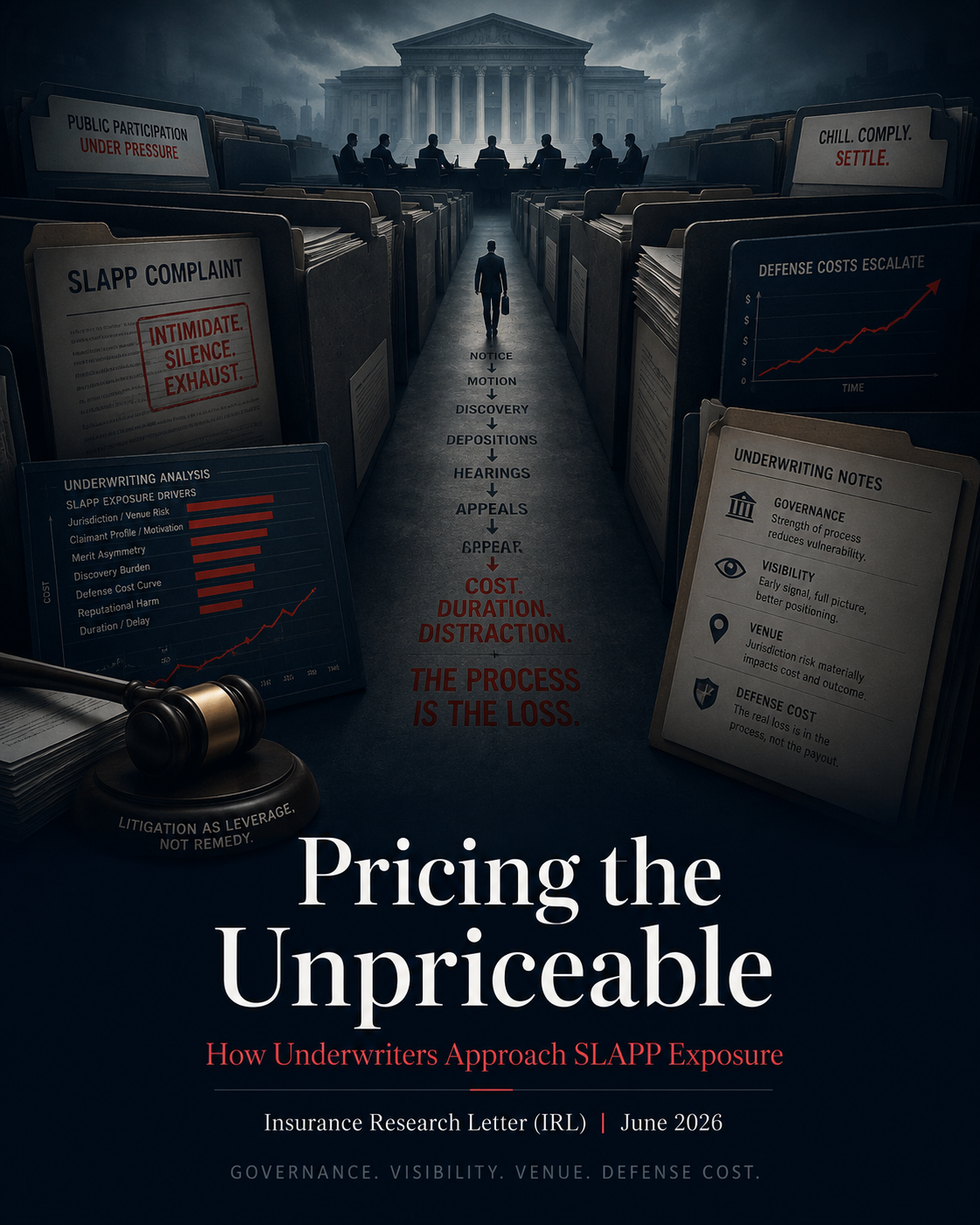
Underwriters do not price “SLAPP risk.”
There is no standalone form, no clean rating table, and no single submission question that reveals whether a company is vulnerable to litigation designed not to win, but to exhaust.
Instead, underwriters price behavior.
Strategic Lawsuits Against Public Participation—SLAPPs—sit inside broader liability structures: D&O, EPL, professional liability, media liability, management liability, and increasingly anywhere reputational conflict can become legal process. The underwriting challenge is not identifying a named peril. It is recognizing where ordinary legal disputes are likely to become expensive strategic battles.
That starts with visibility.
Public-facing companies, outspoken executives, controversial development projects, politically exposed boards, and businesses operating in socially sensitive sectors all carry a different litigation profile than firms with similar balance sheets but less external friction.
A company can have excellent financials and still present elevated legal volatility if it repeatedly operates where opposition is organized, motivated, and capable of sustaining pressure.
Visibility attracts duration.
That matters because defense cost is often the real loss.
Most underwriters today are less concerned with the theoretical maximum judgment than with how long a claim can remain alive. Multi-year litigation, parallel regulatory review, employment disputes tied to reputational issues, and shareholder reaction to governance failures all create severity before settlement is ever discussed.
A difficult claim is not always the one with the largest verdict.
It is often the one that refuses to end.
This is why venue matters so heavily.
Jurisdiction shapes severity as much as policy language. Certain U.S. venues carry reputational expectations, plaintiff-friendly dynamics, and jury behavior that materially change underwriting assumptions. A management liability account operating across multiple aggressive jurisdictions may present greater exposure than a larger account with stronger geographic discipline.
Venue is no longer a legal footnote.
It is a pricing variable.
Governance sits at the center of everything.
Underwriters want to know how decisions are made before they want to know how claims are paid.
Executive turnover, whistleblower handling, termination practices, and documentation discipline often reveal more about litigation sensitivity than a clean five-year loss run.
Some of the most expensive claims begin with preventable process failure.
Poor governance is often just delayed premium.
This is where retentions become strategic.
Higher retentions are increasingly used not simply for premium management, but to force internal discipline. If an insured retains meaningful defense exposure, underwriters believe decision-making improves. Low-retention structures on highly visible management liability risks often create the wrong behavioral incentives.
Retention is not just a financial tool.
It is an underwriting opinion.
Limits are also changing.
Markets are becoming more selective about where they deploy excess capacity because defense-cost erosion can destabilize towers quickly. A well-structured primary placement with strong governance may attract flexibility. A poorly defended risk with broad reputational exposure may find abundant nominal capacity but very little appetite for meaningful lead terms.
Capacity exists.
Confidence is what is scarce.
Litigation funding adds further complexity.
Third-party financing allows plaintiffs to sustain actions that would once have collapsed under cost pressure. This changes severity assumptions because the timeline of a dispute becomes less predictable. Defense strategy must now assume endurance on both sides.
For underwriters, the question becomes simple:
Can this insured survive being right?
That is often the real test.
For brokers, the implication is clear.
Submission quality now depends less on describing the policy and more on explaining the client. Governance presentation, management discipline, board process, and reputational controls must be part of placement strategy. A client with strong controls but average financial metrics may be more attractive than a larger account with unresolved leadership volatility.
The strongest renewal argument is often not improved pricing.
It is improved defensibility.
SLAPP exposure cannot be removed from the market because it is rarely a separate product problem. It is a leadership problem, a governance problem, and often a visibility problem.
That is why underwriters do not try to price the lawsuit.
They try to price what happens before it begins.