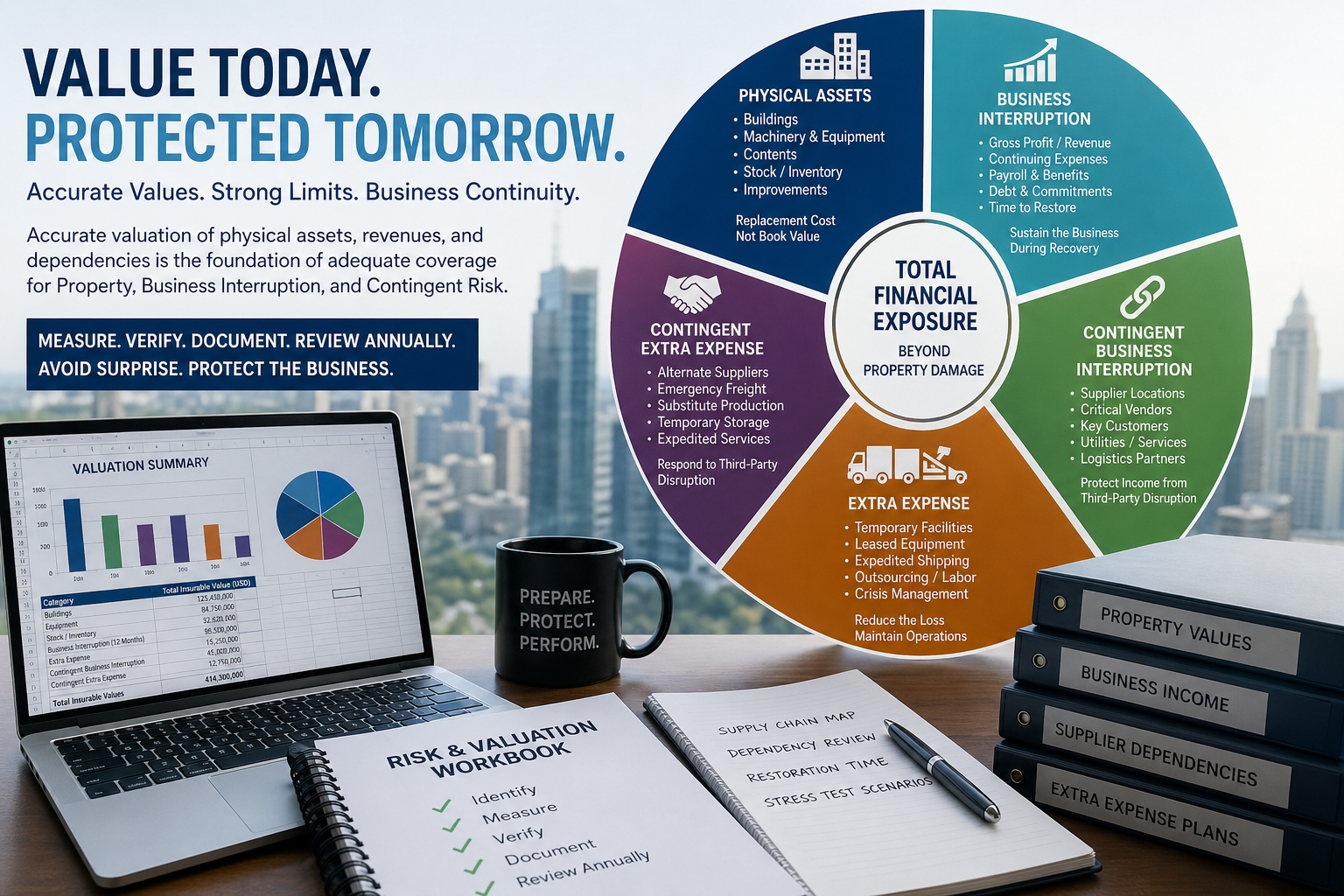
One of the most common and expensive mistakes in commercial property insurance is not a missing policy—it is inaccurate values.
The process of identifying and collecting values presents significant challenges. Several years ago, I spent months visiting a client’s international locations with physical damage and business interruption worksheets in hand. Every subsidiary and operating site was required to complete and return detailed reports to headquarters in New York. The exercise was time-consuming, often frustrating, and occasionally resisted—but it was necessary. Without reliable values, the entire insurance program rested on assumptions no one could confidently defend after a major loss.
Buildings are insured using last year’s numbers. Equipment schedules remain unchanged after capital investment. Revenue figures used for business interruption are carried forward from outdated financials. Inflation clauses create a false sense of security. And when a serious loss occurs, the insured discovers the problem was never the policy wording—it was the values behind it.
Property insurance begins with valuation.
If declared values are wrong, every discussion about limits, deductibles, coinsurance, sublimits, catastrophe modeling, and catastrophe recovery starts from the wrong foundation. The policy may be technically sound and still fail because the insured was never properly measured.
This applies not only to physical assets, but to income—and often the income exposure is larger.
A building can be rebuilt.
Lost income, damaged customer relationships, supply chain interruption, contractual penalties, market share erosion, and delayed recovery can be far harder to restore. Business interruption values are too often treated as secondary to property schedules, when they may be the most financially significant exposure on the program.
And even then, many insureds stop too early.
Business Interruption (BI), Extra Expense (EE), Contingent Business Interruption (CBI), and Contingent Extra Expense (CEE) must all be considered together.
They are related—but they are not the same.
Business Interruption addresses loss of income following direct physical damage to the insured’s own property.
Extra Expense addresses the additional cost required to continue operations or reduce the loss—temporary relocation, leased equipment, emergency outsourcing, expedited shipping, crisis response, or premium labor costs.
Contingent Business Interruption addresses loss of income caused by physical damage at a dependent property—key suppliers, critical customers, contract manufacturers, ports, utilities, or logistics partners.
Contingent Extra Expense addresses the added cost of responding to those outside disruptions—alternative suppliers, emergency freight, temporary warehousing, substitute manufacturing, or rapid sourcing at significantly higher cost.
This is where many programs fail.
The insured protects its own building but forgets that its real vulnerability may sit three countries away inside a sole-source supplier.
A plant may survive the storm.
Its revenue may not.
The problem is rarely negligence.
It is routine.
Renewals arrive quickly. Prior schedules are reused. Inflation guards are assumed to be sufficient. Finance and operations work from different assumptions. Brokers receive incomplete updates. Underwriters review what is submitted, not what was omitted.
The market then prices certainty that does not exist.
Annual valuation must be treated as a management discipline, not an insurance exercise.
For physical assets, this means replacement cost—not book value.
Accounting depreciation has almost no relevance after a fire, flood, explosion, or catastrophe event. Construction inflation, labor shortages, code upgrades, debris removal, and supply chain delays can materially change reconstruction costs in a single year.
A building insured correctly in 2023 may be materially underinsured in 2026 without any visible change to the structure itself.
Equipment requires the same discipline.
Machinery, tenant improvements, technology investments, and production-line upgrades often enter operations faster than they enter insurance schedules. In manufacturing, healthcare, hospitality, and logistics, replacement cost can differ dramatically from reported values.
Business interruption values require a different approach.
The question is not:
“What is annual revenue?”
The better question is:
“What would it cost if this operation stopped for twelve months—or longer?”
That requires a structured analysis:
gross earnings
continuing fixed expenses
payroll strategy
debt obligations
contractual commitments
seasonality
customer concentration
dependency on key suppliers
regulatory restart delays
production bottlenecks
inventory rebuild timing
realistic restoration periods
and management’s willingness to spend aggressively to preserve continuity
This is where Extra Expense and Contingent Extra Expense become critical.
If a supplier fails, will the company pay double for emergency sourcing?
Will it charter aircraft instead of using ocean freight?
Will it relocate production?
Will it lease temporary facilities?
Will it pay retention bonuses to keep critical staff during shutdown?
These are not theoretical questions.
They are underwriting questions.
How exactly are these values established?
Not from the insurance department alone.
Finance must provide revenue mapping and fixed-cost structure.
Operations must identify single points of failure.
Procurement must identify key suppliers and alternatives.
Legal may identify contractual penalties.
Claims history often reveals what prior disruptions actually cost.
Site visits matter.
Supply chain mapping matters.
A proper BI/CBI study often requires modeling by location, by supplier dependency, and by time-to-recovery assumptions—not simply applying a percentage to revenue.
For larger risks, formal business interruption worksheets, engineering studies, forensic accounting review, and broker-led exposure mapping are often essential.
The objective is not a perfect number.
It is a defensible number.
For brokers, valuation reviews should be one of the most important conversations of the year—not a spreadsheet request two weeks before renewal.
Underwriters are increasingly skeptical of values that show perfect stability during volatile inflation, labor disruption, and supply chain uncertainty.
Good valuation work improves pricing credibility, supports catastrophe modeling, strengthens reinsurance confidence, and reduces disputes after loss.
Most importantly, it protects the insured from discovering underinsurance at exactly the wrong moment.
Coverage is tested at the time of loss—not at renewal.
By then, it is too late to argue with last year’s numbers.
Valuation is not administration.
It is coverage.