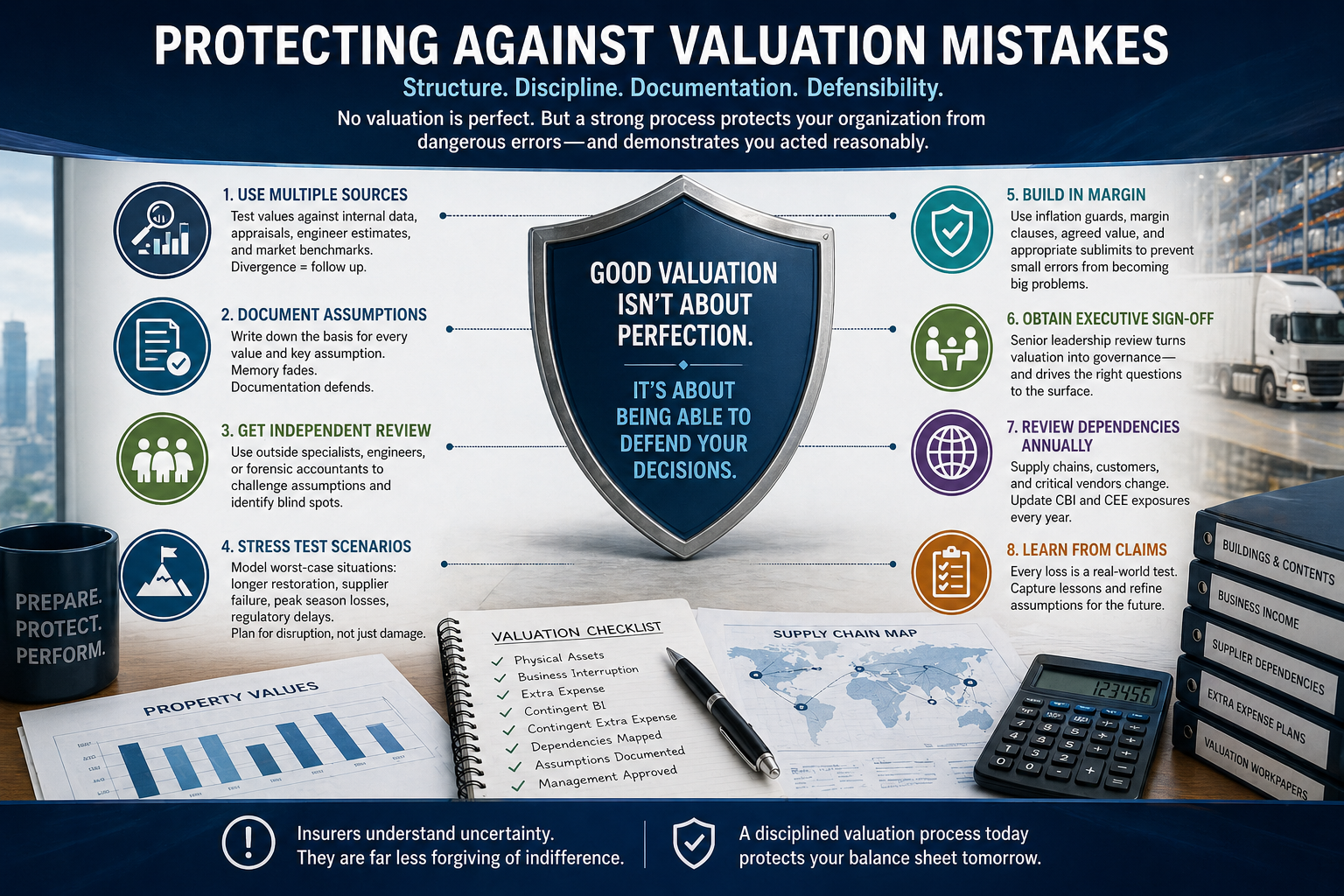
No valuation process is perfect.
Even the most disciplined risk manager, working with strong brokers, accountants, engineers, and operations leadership, can still face a major loss where actual costs exceed assumptions. Construction inflation spikes unexpectedly. Supply chains collapse. Restoration takes longer than modeled. A dependent supplier turns out to be more critical than anyone realized.
The goal is not perfection.
The goal is protection against dangerous error.
That protection comes from structure.
First, values should never rely on a single source.
Replacement cost should be tested against multiple references—internal capital budgets, contractor estimates, appraisals, engineering reviews, insurer valuation tools, and broker benchmarking. If several methods point in the same direction, confidence improves. If they diverge sharply, that is where attention belongs.
Second, documentation must be formal.
Assumptions should be written, not verbal. Why was a twelve-month indemnity period chosen? Why was a supplier considered replaceable? Why was payroll assumed to continue? Why was extra expense capped at a certain level?
During a claim, memory is weak evidence.
Documentation is much stronger.
Third, use independent review.
Large or complex accounts should periodically involve outside valuation specialists, forensic accountants, engineers, or business interruption consultants. Their purpose is not merely technical accuracy—it is challenge.
Internal teams often normalize assumptions that an outsider immediately questions.
Fresh eyes reduce expensive surprises.
Fourth, stress testing is essential.
Ask uncomfortable questions.
What if the largest location is lost during peak season?
What if the key supplier in Asia is unavailable for nine months?
What if local rebuilding requires ordinance upgrades?
What if the business reopens physically but cannot recover customers for a year?
Stress testing moves valuation from accounting into operational reality.
Fifth, structure limits with margin.
This is where policy design matters. Inflation guards, margin clauses, agreed value provisions, blanket limits, catastrophe buffers, and carefully designed sublimits can help reduce the consequences of imperfect forecasting. None replace accurate values, but they can prevent a modest error from becoming a catastrophic uninsured loss.
Coinsurance penalties are often where valuation mistakes become financially painful.
That should never be discovered after the fire.
Sixth, executive sign-off matters.
When senior leadership formally reviews and accepts valuation assumptions, the issue becomes enterprise governance rather than isolated insurance administration. It also forces better questions. Boards are often more willing to challenge interruption assumptions than insurance schedules.
That challenge is healthy.
Seventh, review dependent property exposure annually.
Contingent Business Interruption failures often come from assumptions that were true two years ago but no longer apply. A secondary supplier may have quietly become the primary supplier. A logistics route may have concentrated risk. A customer concentration issue may have intensified.
Dependency changes faster than most schedules.
Finally, claims reviews should become valuation reviews.
Every significant loss—whether insured or not—should be used to test assumptions. Did restoration take longer than expected? Were extra expenses higher than modeled? Did temporary relocation cost more than planned? Did supplier substitution fail?
Claims are the best valuation teachers.
For risk managers, the most important protection is not the spreadsheet.
It is the ability to show that the company acted reasonably, reviewed seriously, challenged assumptions, and made informed decisions.
Insurers understand uncertainty.
They are far less forgiving of indifference.
A valuation mistake may be survivable.
A valuation process with no discipline often is not.
The best protection is not pretending errors cannot happen.
It is making sure they are never careless.