https://doi.org/10.1016/j.arr.2024.102293Get rights and content
Under a Creative Commons license
open access
Highlights
- Collecting real-world evidence (RWE) may accelerate validation of gero-interventions.
- Quality of life (QoL) assays evaluate aspects of functional health and wellness.
- QoL is integral to healthy aging but not currently captured by aging biomarkers.
- Using QoL data as an endpoint can accelerate RWE data collection for geroscience.
- We propose the SF-36 as a well-suited QoL endpoint for geroscience clinical trials.
Abstract
With geroscience research evolving at a fast pace, the need arises for human randomized controlled trials to assess the efficacy of geroprotective interventions to prevent age-related adverse outcomes, disease, and mortality in normative aging cohorts. However, to confirm efficacy requires a long-term and costly approach as time to the event of morbidity and mortality can be decades. While this could be circumvented using sensitive biomarkers of aging, current molecular, physiological, and digital endpoints require further validation. In this review, we discuss how collecting real-world evidence (RWE) by obtaining health data that is amenable for collection from large heterogeneous populations in a real-world setting can help speed up validation of geroprotective interventions. Further, we propose inclusion of quality of life (QoL) data as a biomarker of aging and candidate endpoint for geroscience clinical trials to aid in distinguishing healthy from unhealthy aging. We highlight how QoL assays can aid in accelerating data collection in studies gathering RWE on the geroprotective effects of repurposed drugs to support utilization within healthy longevity medicine. Finally, we summarize key metrics to consider when implementing QoL assays in studies, and present the short-form 36 (SF-36) as the most well-suited candidate endpoint.
Keywords
Longevity
Geroscience
Quality of life
Real world evidence
Healthy aging
1. Introduction
Chronological age is the main non-modifiable risk factor for chronic disease and frailty (Niccoli and Partridge, 2012). The World Health Organization (WHO) reports that most people can expect to live up to 60 years in good health. However, after reaching age 60, it is estimated that they will live an average of 22 years more. To avoid an ever-expanding population of older adults with multiple chronic and debilitating conditions, there is a need to modify the aging process to promote healthy aging and optimize health at all ages (Wang et al., 2023). Fortunately, geroscience research is revealing that the process of biological aging, a reflection of damage accumulation and cellular dysfunction in the body, can be modulated (Barzilai et al., 2018). The goal of geroscience is to understand, target, and modulate fundamental biological aging processes to provide translational tools for fostering healthy aging in humans (Montano et al., 2022; Rolland et al., 2023).
In 2022, the Healthy Longevity Medicine Society introduced a new definition of what is now called healthy longevity medicine (HLM) as a discipline optimizing healthspan along the lifespan of an individual by targeting age-related processes. HLM embodies a multidisciplinary approach aimed at extending the healthy years of an individual’s life, preventing age-related diseases, and augmenting overall quality of life (QoL) through the amalgamation of diverse scientific and therapeutic strategies. The core principles of longevity medicine include the proactive detection and prevention of biological aging processes, personalized healthcare modalities tailored to individual needs, and the pursuit of an extended healthspan—the period of life lived in good health, free of frailty and disease (definitions proposed in Table 1).(Bischof et al., 2021; Rolland et al., 2023)
Table 1. Definitions of key terminology.
Key terminology Definition |
Adapted from (Keshavarz et al., 2023; Sun et al., 2022; Moqri et al., 2023)Geroscience clinical trialClinical trial aimed at demonstrating disease prevention and/or health optimization in human cohorts without frailty or disease (i.e. normative aging cohort). |
Adapted from (Kulkarni et al., 2022)HealthspanPeriod of life lived in good health and QoL, free of frailty, chronic disease, and disabilities of aging. |
Adapted from (Moqri et al., 2023)Real-world evidenceAn array of health and QoL data collected as unobtrusively as possible within a heterogenous population and in a real-world setting (i.e. outside of a clinical trial setting). |
Adapted from (FDA, 2023)Repurposed drugFDA-approved drug applied towards new therapeutic purpose / disease. |
Adapted from (Ashburn and Thor, 2004)Quality of Life assayEstablished clinical tools (typically self-reported questionnaires) for evaluating various aspects of functional health and wellness that are integral to QoL and healthy aging. |
Adapted from (Coe et al., 2022)Normative agingThe portion of aging (beginning in early adulthood) that precedes age-related disability, frailty, and disease. A normative aging cohort is considered “generally healthy”. |
Adapted from the Baltimore Longevity Study of Aging (NIH)Healthy longevity medicineThe practice of advanced personalized and preventative medicine, powered by biomarkers of aging, with the goal of optimizing healthspan by targeting aging processes across the lifespan. |
Adapted from HLMS https://hlms.co/ and Bischof et al., (2021))QoL: quality of life; FDA: Food and Drug Administration
The geroscience field is evolving at a tremendous pace. This is demonstrated within the preclinical realm, where geroprotective interventions, including personalized lifestyle modifications, supplements and repurposed drugs have been demonstrated to prolong lifespan and/or healthspan in animal models, leading to deceleration and possible reversion of age-related physiological decline (Gonzalez-Freire et al., 2020; Nielsen et al., 2022). Because repurposed drugs are already approved by the US Food and Drug Administration (FDA) with proven safety data and clinical protocols in place, there is considerable interest in testing their geroprotective potential in clinical trials aimed at demonstrating disease prevention and/or health optimization in human cohorts without frailty or disease (Table 1)(Kulkarni et al., 2022).
The Targeting Aging with Metformin (TAME) double-blind randomized-controlled trial (RCT) is one such trial designed to demonstrate the potential of repurposing metformin for longevity. The primary outcome of TAME is set to be the “time to event” of death and a cluster of age-related diseases, including cardiovascular events, cancer, cognitive decline, and dementia over a 6-year timeframe (Barzilai, 2017). However, this is an expensive and longer-term approach that could ultimately be circumvented by elucidating sensitive biomarkers that are predictive of age-related adverse outcomes and responsive to geroprotective interventions (Moqri et al., 2023). We propose that efforts to test and repurpose existing, safe geroprotective candidates should be immediately and greatly expanded beyond TAME, not only to have a more timely impact but also to increase the number of drugs potentially available to target aging in humans and mitigate the risks to the field, should any such trials fail to reach their desired outcome.
One way to do this effectively is by collecting “real-world evidence” (RWE) in which health data is collected from various sources within a heterogeneous population in a real-world setting (Table 1) (FDA, 2023). This trial design can be an effective tool to evaluate changes to healthspan metrics within a normative aging population as it is permissive to longitudinal data collection and can capture multiple data sources pertaining to health, daily life activities, and functionality (Chodankar, 2021; Dreyer, 2022; Rudrapatna and Butte, 2020). In particular, characterizing changes to biomarkers of aging is critical for demonstrating the effectiveness of geroprotective interventions on age-related outcomes within a realistic timeframe (Moqri et al., 2023).
The Biomarkers of Aging Consortium defines three main classes of aging biomarkers—molecular, physiological, and digital—to validate geroprotective interventions. Molecular biomarkers of aging, including -omics clocks, are proposed to be future gold standard endpoints for evaluating the efficacy of geroprotective interventions in normative aging cohorts; however, more data is needed to make sense of what aspects of aging these biomarkers are tracking and validate their influence on age-related outcomes (Moqri et al., 2023). In these early days of geroscience clinical trials, physiological biomarkers that evaluate clinical health metrics and functional performance remain the most reliable endpoints (May, 2023). We propose including QoL data within the physiological class of aging biomarkers because QoL assays are an important clinical tool for evaluating various aspects of functional health to distinguish healthy from unhealthy aging (Bottomley et al., 2019; Pais-Ribeiro, 2004). Further, QoL data facilitate the evaluation of key aspects of the real-world, functional consequences of geroprotective interventions that are not currently captured by the established classes of aging biomarkers, strengthening its case for inclusion.
In this review, we provide perspectives on the utility of QoL data as a candidate endpoint in geroscience clinical trials. In particular, we highlight the role of QoL assays to accelerate data collection in studies collecting RWE on repurposed drugs that aid in fostering healthy aging within normative aging cohorts. We underscore key metrics to consider when choosing appropriate QoL assays for such trials and emphasize the short-form 36 (SF-36) as the most well-suited candidate endpoint. Further, we provide evidence that QoL assays are currently underutilized as endpoints in geroscience clinical trials and propose that including QoL data, in conjunction with observed changes in the current biomarkers of aging, will provide additional information on healthspan-targeted interventions and their functional and real-world consequences.
2. Addressing the “Longevity Gap”: translating the promise of geroprotective interventions from animals to humans
The average global lifespan has more than doubled between 1800 and 2017 from 30 to 73 years(Roser, 2018) and children born today can expect to live 20 years longer than their grandparents born in the 1960 s(Hartenstein and Latkovic, 2022) Unfortunately, this increased life expectancy comes at a cost, as the share of our lives in poor health has not improved. For every extra year we have added to our lifespan, half of that may be in moderate or poor health (Coe et al., 2022). This is in large part the byproduct of a “healthcare” system that is overly focused on disease management at the expense of health optimization. Tackling one disease at a time leads to relatively smaller gains in healthy years as one disease follows another (Sierra et al., 2021). The expanding chasm between lifespan and healthy life is known as the Healthspan Gap, which is characterized by more time spent with poor QoL (Garmany et al., 2021). Based on the 2019 WHO health and life expectancy survey data, people spend an average of about 37% of their lives (20–30 years) in less-than-optimal health and 12% in poor health (Coe et al., 2022). These statistics suggest that the average individual spends more years in poor health and QoL today than ever before. This is reflected by an annual global healthcare spending of over $8 trillion USD, which is increasing faster than the gross domestic product (GDP) (Scott et al., 2021; Scott, 2023b; WHO, 2020a). The economic value of targeting aging was highlighted in a recent publication, which showed that delaying aging to increase healthy life expectancy by one year is worth $38 trillion USD in savings in the US alone (Scott et al., 2021).
The longevity field is redefining aging by distinguishing chronological age, how long we have been alive, from biological age, which reflects the health of all body organs, tissues, and cells as a function of time. Although chronological age is a leading risk factor for chronic disease, aging has classically been considered an inevitable process of degeneration and decay—a process that is stochastic and immutable. Therefore, clinical trials have primarily focused on validating drugs that address individual diseases rather than addressing the process of biological aging and the bouquet of pathologies emerging from it (Blagosklonny, 2023; Franceschi et al., 2018). A significant body of preclinical research demonstrates that the rate of biological aging can be modulated with geroprotective interventions that protect the body against the damages of the aging process by targeting fundamental molecular pathways that drive the biology of aging, known as the hallmarks of aging (HoA) (Table 1).(Keshavarz et al., 2023; Lopez-Otin et al., 2013, Lopez-Otin et al., 2023; Sun et al., 2022) There are currently 14 characterized HoA that describe the various damages and dysfunctions that accumulate within the body, eventually leading to frailty and disease.(Schmauck-Medina et al., 2022) This includes factors such as DNA damage, mitochondrial dysfunction, chronic inflammation, and loss of proteostasis, many of these being the focus for the discovery and development of molecular biomarkers of aging. Many of the HoA are strongly conserved between species, from single-celled organisms to mammals, catalyzing efforts for translating the promising preclinical data on geroprotective interventions from animal models to humans.(Lemoine, 2021; van der Rijt et al., 2020)
3. Metrics for validating candidate geroprotective interventions within geroscience clinical trials
The goal of geroscience clinical trials is to demonstrate the ability of geroprotective interventions to slow or reverse age-related phenotypes associated with biological aging, to prevent disease, optimize health, and ultimately improve QoL, thereby extending healthspan (Table 1).(Bischof et al., 2021) Once this is demonstrated, these interventions can be applied more rigorously on a personalized level in the clinic.
Observing significant differences in age-related clinical endpoints within a normative aging population is not feasible outside of large, longitudinal clinical trials. Running such lengthy trials to validate longevity interventions is expensive, resource-intensive, and an impediment to realizing the promise of longevity medicine within a tractable timeframe (Rolland et al., 2023). To validate geroprotective interventions in geroscience clinical trials, the longevity field would benefit from standardized health metrics that are quantifiable and sensitive enough to detect meaningful deviations from optimal health and QoL over time in individuals without frailty or disease.
Several ongoing efforts within the geroscience field are focused on elucidating sensitive and specific surrogate biomarkers of the aging process and validating their effectiveness for tracking age-related decline within tractable timeframes (Aging Biomarker et al., 2023; Moqri et al., 2023; Oh et al., 2023; Zhavoronkov et al., 2019). Measuring biological age requires sophisticated tools that evaluate molecular, cellular, and functional health changes associated with older chronological age and, more importantly, serve as metrics to predict multi-morbidity and adverse health outcomes.(Wu et al., 2021)
Aging biomarkers have been grouped into digital, physiological, and molecular classes by the Biomarkers of Aging Consortium. The digital biomarkers class includes measures typically obtained by wearable technologies such as tracking heart rate variability from smart watches and sleep quality from sleep monitoring rings. Physiological biomarkers are clinical measures of functional performance and physical characteristics that can include variables such as VO2 max, gait speed, cognitive assessments, and visceral adiposity from DEXA scans. Molecular biomarkers include single molecules (e.g. interleukin (IL)-6, NAD+) and omics measurements (e.g. epigenomic, proteomic, metabolomic) and can be reflective of changes to the HoA (Moqri et al., 2023). Within the class of molecular biomarkers, omics measurements have been utilized to generate biological age clocks, which have been increasingly used as candidate biomarkers of aging in geroscience clinical trials and are proposed to be future gold standard endpoints for evaluating the efficacy of geroprotective interventions in normative aging cohorts (Moqri et al., 2023; Zhavoronkov et al., 2021). In principle, if a test accurately measures biological age, it also estimates remaining healthspan, since biological age is the greatest risk factor for most functional declines and diseases.(Kaeberlein et al., 2015; Liu et al., 2023)
Efforts are being made in current geroscience clinical trials to measure molecular biomarkers and relate them to age-related health outcomes in humans; however, more data is needed to make sense of what aspects of aging these biomarkers are tracking, as well as their influence on age-related outcomes (Cummings and Kritchevsky, 2022; Galkin et al., 2020; Jansen et al., 2021; Palmer, 2022; Sandalova et al., 2023; Zhang, 2023). Collecting molecular biomarker data alongside physiological biomarkers is of particular importance as the latter is directly linked to clinical and functional declines in health and already accepted as endpoints for disease-focused clinical trials. While the currently defined class of physiological biomarkers include body type, physical performance, and cognitive performance, we emphasize including QoL data in this class because QoL assays are established clinical tools for evaluating various aspects of functional health and wellness that are integral to healthy aging but not currently captured by the established classes of biomarkers of aging (Coe et al., 2022; Moqri et al., 2023). This includes data across multiple dimensions, including physical, mental, and social domains of life (Kaplan and Hays, 2022; Williams and Wood-Dauphinee, 1989). Further, QoL assays have shown to be instrumental in quantifying and elucidating the nuances of functional decline within normative aging populations (Krawczyk-Suszek and Kleinrok, 2022).
The WHO defines healthy aging as “the process of aging while developing and maintaining the functional ability that enables well-being in older age”.(Wang et al., 2023) This suggests that older individuals can achieve healthy aging by enhancing their physical, social, and mental health to the maximum extent possible to facilitate their active roles in society (Wang et al., 2023). While molecular biomarkers provide mechanistic information characterizing how a healthspan-enhancing intervention is influencing the biology of aging, QoL assays provide descriptive insights pertinent to understanding how these changes affect an individual’s day-to-day experience and functioning, an important and often neglected component of healthspan (Baumhauer, 2017; Bottomley et al., 2019; Pais-Ribeiro, 2004). Additionally, QoL assays that evaluate multiple disparate aspects of health are particularly suited as endpoints within geroscience clinical trials because candidate geroprotective interventions, by their very nature, should prevent the emergence of multiple aspects of age-related physiological decline.
4. Accelerating validation of geroprotective interventions through collecting RWE on repurposed drugs
Efforts to translate insights from animal studies to human clinical trials are advancing with the goal of proving the safety and efficacy of geroprotective interventions that protect the body against the damages of the aging process, thereby extending healthspan. There are several promising longevity interventions, including, but not limited to, lifestyle interventions, supplements, drugs, gene therapy, and cellular reprogramming. Those interventions that may have the greatest impact on healthy longevity medicine in the immediate future are repurposed drugs (e.g. metformin, rapamycin, and canagliflozin), personalized lifestyle interventions (e.g. exercise, diet, and sleep optimization), and supplements (e.g. NAD+ boosters, alpha-ketoglutarate, and urolithin-A). In particular, FDA approved drugs with established human safety and efficacy data in multiple disease demographics, and demonstrated efficacy for enhancing lifespan and healthspan in preclinical studies are prime candidates to be repurposed in geroscience clinical trials (Table 1) (Kulkarni et al., 2022; Rolland et al., 2023).
The TAME trial was designed, in consultation with the FDA, as a robust proof-of-concept study to demonstrate the geroprotective benefits of metformin by evaluating “time to incidence” of a cluster of chronic diseases in elderly individuals.(Barzilai, 2017) The TAME trial is planned to provide a template for future studies validating FDA approved drugs with potential to be repurposed as geroprotective interventions; however, it is expensive, lengthy, and the outcome carries an outsized impact on prospects for the longevity field (Kulkarni et al., 2022; Rae, 2023). We propose the immediate expansion in efforts to assess and repurpose existing, safe geroprotective candidates beyond TAME. This would result in faster impact on the field, increase the number of potentially-available interventions to target human aging, and mitigate some of the risks to the field, should trials fail to reach their desired outcome.
One way to do this effectively is by collecting RWE in which an array of health and QoL data is collected from individuals as unobtrusively as possible, outside of a formal clinical setting. This trial design can be an effective tool for validating the safety and real-world functional consequences of geroprotective candidates, as it is permissive to accessing large datasets that reflect changes to health status, functional capacity, and QoL more rapidly and less expensively than brick and mortar trials. RWE trials can be prospective observational studies or RCTs, and may collect data from electronic medical records, medical claims, product or disease registries, and other sources (e.g. digital health technologies, health questionnaires, and adverse event reports).(FDA, 2023) The accessibility and convenience of such studies allows for tracking of a larger, more heterogeneous subject cohort across a diverse geographic and demographic range, and over extended periods of time.(Chodankar, 2021; Dreyer, 2022; Rudrapatna and Butte, 2020)
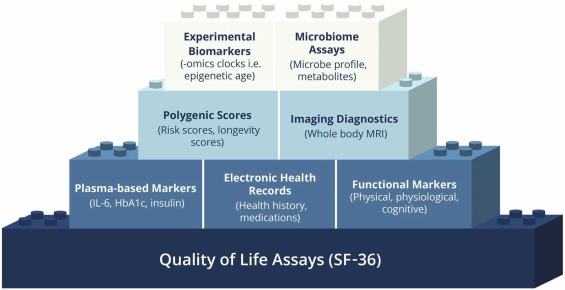
The advent of digital health has improved the accuracy and applicability of digital wearables and made classically inaccessible diagnostic tools accessible, which has strengthened the rigor of such studies.(Baumhauer, 2017; Kaplan and Hays, 2022; Touray, 2018) The future of RWE geroscience clinical trials will integrate several different health data points to inform the efficacy of geroprotective interventions on healthspan optimization (Fig. 1).
5. The role of QoL measures for collecting RWE in geroscience trials
5.1. QoL assays for characterizing normative aging
A few large longitudinal studies, involving thousands of individuals followed over several years to decades, have utilized QoL data as ancillary data points to support the characterization of the functional decline that accompanies the aging process in normative and healthy aging cohorts. These include the Baltimore Longitudinal Study of Aging, The Chinese Longitudinal Healthy Longevity Survey, The New England Longevity study, and the LonGenity centenarian study (Jopp et al., 2016; Kuo et al., 2022; Newman and Murabito, 2013; Poon et al., 2010; Yi, 2008). These studies on longevity and healthy aging most commonly use the short form 36 (SF-36) QoL assay which consists of 36 questions evaluating 8 distinct domains of health and wellness (Attafuah et al., 2021; Junaković et al., 2023; Selim et al., 2005; Tate et al., 2023; Yates et al., 2008).
One such study conducted by Krawczyk-Suszek et al. utilized the SF-36 to characterize normative aging over a 2-year time frame in more than 1000 healthy individuals over the age of 65 (Krawczyk-Suszek and Kleinrok, 2022). This study proposed that the SF-36 could serve as a tool to capture pre-disease states of sub-optimal health influenced by smoking status and other factors that impact biological age, such as employment status, location, and physical activity, among other lifestyle factors. Obtained data show that the QoL and functional capacity of the study group deteriorated over the two-year timeframe, despite the absence of chronic disease.(Krawczyk-Suszek and Kleinrok, 2022) This type of study illustrates the sensitivity of QoL measures as a metric for age-related health changes, even in healthy cohorts.
Another interesting demonstration of the utility of QoL assays in geroscience clinical trials is a multi-center cross-sectional study in which health-related QoL and a frailty index were utilized as metrics to evaluate healthspan in 586 companion dogs (Chen et al., 2023; McKenzie, 2023; Rolland et al., 2023) Even though this was not a human study, companion dogs are considered a robust model for human aging given their similar genetic heterogeneity, shared environmental exposures, and lifestyle habits (physical activity, diet) with humans (Creevy et al., 2022). This study showed that QoL was stable in young dogs but began showing yearly declines across most health domains (energy, happiness, comfort, and calmness) once the dog reached 7 years of age, which represents approximately mid-life for dogs (Rolland et al., 2023). Further, larger older dogs declined faster than smaller older dogs, consistent with the knowledge of canine biological aging (Kraus et al., 2013). Another important finding of the Canine Healthspan study was that the frailty index and QoL outcomes both identified the same age-related changes even though the frailty index was a medical assessment by a veterinarian and QoL was a questionnaire evaluating the owners’ perceptions of their dogs at home. This consistency is strong evidence for the validity of QoL assays in tracking age-related decline associated with accelerated biological aging (Chen et al., 2023; McKenzie, 2023).
5.2. QoL assays for chronic diseases of aging
With guidance from the FDA, patient-reported outcomes are increasingly being used within disease-focused clinical trials (Haslam et al., 2020). Many well-validated QoL assays have been developed for clinical trial endpoints assessing diseases likecancer, Alzheimer’s disease (AD), diabetes, cardiovascular disease, mental health disorders, and various syndromes (e.g. chronic fatigue and irritable bowel). In most clinical trials QoL assays are utilized as secondary endpoints supporting a primary biological endpoint that reflects disease progression (Megari, 2013). Some trials have applied QoL assays in individuals with heart failure, which revealed that lower QoL scores following cardiac procedures are predictive of increased incidence of morbidity and mortality (Megari, 2013). In oncology trials QoL data are used extensively as drugs are costly and may only result in modest gains in overall survival. Improved QoL during that time is an important consideration for evaluating a patient's functioning and wellbeing and therefore cost/effectiveness analysis.(Haslam et al., 2020) Further, the use of QoL assays opens new avenues for enhancing outcomes among cancer patients and survivors, giving new dimensions and tools for precision triage and predictions, and are a crucial aspect of post-treatment care. One example is the integration of QoL assessments to create functional profiles that monitor and enhance therapeutic decision making in this patient population (Anwar et al., 2014; Buiting and Olthuis, 2020; Sim et al., 2020). Increasingly, to enhance the quality of healthcare QoL data are leveraged to inform personalized health interventions, aiming at the proactive management of health and disease prevention, offering a promising avenue for improving the aging process for a diverse patient demographic (Tsang and Loh, 2020).
For longitudinal studies, administering QoL assays at multiple timepoints throughout the length of the trial can help determine both direction and magnitude of health changes (Jacobsen et al., 2002). Within geroscience clinical trials, collecting QoL data throughout the trial and at follow-up (post-intervention) can help determine if a participant is consistently benefitting and whether discontinuing treatment results in changes in the rate of age-related decline.
The reliability of these assays as endpoints within geroscience clinical trials largely depends on the types of questions selected and the training dataset utilized to develop the scoring system. While many QoL assays are designed to be sensitive to clinically important changes that are reflective of the progression of a specific disease indication, some are more generic, with questions and scoring systems designed to assess a broad range of health domains and detect age-related functional changes that are relevant to the progression of comorbid conditions or even changes within a normative aging population (Baumhauer, 2017; Bourdel et al., 2019; Megari, 2013; Siette et al., 2021). The latter tools are particularly interesting for use as endpoints within geroscience clinical trials.
The frequency of administration of QoL assays in clinical trials depends on the research questions and the length of the study. QoL data are typically collected at baseline (before intervention), followed with one or more assessments during the intervention trial, and often during post-intervention follow-up (Jacobsen et al., 2002). Administration every 3–4 months is common in clinical trials evaluating the efficacy of interventions addressing specific age-related diseases, such as type 2 diabetes and cardiovascular disease (Bourdel et al., 2019; Luscombe, 2000; Soriano et al., 2010; Vickers, 2006). Due to their feasibility of administration and low cost, QoL assays can be administered frequently and longitudinally within geroscience clinical trials characterizing how a geroprotective intervention influences the progression of the aging process. Within observational studies and registries, they can even be administered over the span of years, and may be used to follow up on the QoL of an individual post-intervention (as is often done in oncology trials) (Haslam et al., 2020).
5.3. Current and past use of QoL assays in geroscience clinical trials
To establish whether QoL assays are being used in previous, current, and planned geroscience clinical trials, we performed a search on clinicaltrials.gov. We assessed the use of the SF-36, EQ-5D, and WHO-BREF as outcome measures in trials; we excluded the 15-D from this search due to inaccuracy in retrieved records with this search term and the AQoL-8 for lack of records using this outcome measure. The search was performed in January 2024, and search terms for condition/disease were aging OR longevity OR healthspan. The results were filtered for adults (age: adult (18−64) and older adult (65+)), and we filtered out any studies with the status terminated, suspended, and withdrawn. We also filtered for trials open to healthy volunteers (Filter: accepts healthy volunteers). This search resulted in 1997 records of total geroscience interventional trials. To establish how many of these used the SF-36 as an outcome measure, we extended the search to include the search terms SF-36 OR SF36 OR short-form 36 for outcome measures within this dataset. This revealed 94 studies using the SF-36 as an outcome measure, which reflects 4.7% of the total number of geroscience interventional studies in adults. The outcome measure EQ-5D OR EuroQoL-5D revealed 29 studies, reflecting 1.5% of geroscience interventional trials using the EQ-5D. These data confirm the limited use of QoL assays in geroscience interventional trials. These data are limited to only reflecting trials registered at clinicicaltrials.gov, and have limitations regarding the use of the search terms in the records.
5.4. QoL assays for geroscience clinical trials
The Participatory Evaluation of Aging with Rapamycin for Longevity (PEARL) trial (clinicaltrials.gov: NCT04488601) is one example of a large, decentralized effort collecting RWE to characterize the effects of a promising repurposed drug on the aging process within a normative aging human population. The PEARL trial is a 12-month double-blinded, randomized, placebo-controlled study that was completed at the end of 2023, and the data resulting from this trial are expected to help validate the efficacy of rapamycin on reducing visceral adiposity, plasma biomarkers of metabolic health, several different biological age diagnostic tests such as epigenetic clocks, and effects on real-world functional health and QoL changes using a well-validated QoL assay (SF-36) (Konopka et al., 2023; Lu et al., 2019; Rondon Garcia and Ramirez Navarrro, 2018).
We propose that including QoL measures as endpoints in geroscience clinical trials can help validate healthspan-targeting interventions by demonstrating improvements in aspects of healthspan that are difficult to measure with biological markers, such as pain levels, fatigue, functional role limitations, factors affecting daily activities, and subjective measures of health, like emotional wellness and social functioning. Further, questionnaires can be administered frequently electronically and tracked alongside other health changes, exposures, and life events to more completely characterize changes in healthspan across longitudinal trial timeframes. More recent technological developments enable questionnaire links to be shared widely via tools such as smartphone apps, facilitating quick and large data collection efforts (Schatz, 2015). Collecting information on recent life events, such as changes in occupation, location, and loss of loved ones, will add further context to observed changes in QoL scores and biomarkers, since these events are known to temporarily affect metrics(Gerth van Wijk, 2005; Lu et al., 2019; Rondon Garcia and Ramirez Navarrro, 2018).
One common reservation about QoL assays is their accuracy in evaluating the efficacy of interventions compared to more objective clinical measures (Haraldstad et al., 2019; Lin et al., 2013). Studies suggest that, in some cases, QoL assays such as the SF-36 and the Patient-Reported Outcomes Measurement Information System (PROMIS) can rival gold-standard robust clinical technologies in the accuracy of evaluating objective health metrics like physical function (Lahoud et al., 2017). For example, one 52-week study compared physical function scores obtained using PROMIS with the GAITRite temporal and spatial gait-analysis system in 106 patients who underwent knee ligament construction (Baumhauer, 2017). The study found that functional outcome data from both assays were significantly correlated, but the PROMIS was not limited by a ceiling effect and could detect significant improvements in function 32 weeks beyond that of the GAITRite. The GAITRite system directly measures walking speed, cadence, stride length, and other gait parameters–costing $52,000 USD. The PROMIS is a QoL assay that includes a physical function questionnaire that is less than a fraction of the cost and takes one minute to complete (Baumhauer, 2017).
Another common reservation about self-reported questionnaires is their vulnerability to the placebo effect. Although research has suggested that the magnitude of placebo effect reported in studies is heavily influenced by how trials are conducted and patients informed, placebo responses are especially problematic in studies that rely on subjective patient-reported outcomes and can have detrimental effects on assay sensitivity. Studies suggest that within longitudinally designed trials, running 6 months to 1 year, the placebo effect can be expected to diminish over time (Hansen et al., 1996; Hróbjartsson and Gøtzsche, 2010). Further, methodologies can be leveraged to buffer the placebo effects, which involve integrating a pre-training period within the study design in which subjects do not receive any treatments and practice accurate self-reporting(Evans et al., 2021), including functional assessments that are less vulnerable to placebo, and neutralizing subject expectations before the study starts (Evans et al., 2021; Hodgins et al., 2018). Additionally, statistical methods can be utilized when analyzing data to help address the placebo effect, but these are outside the scope of discussion for this perspective (Kessels et al., 2019; Raman, 2020).
Intriguingly, recent evidence suggests that psychosocial questionnaire-based evaluation of an individual’s perception of their health status and age (i.e. subjective age) more accurately predicts the risk of disease than an individual’s chronological age, and subjective age is modifiable based on lifestyle interventions. AI-generated “subjective age clocks'' generated from large datasets reveal that self-reported questionnaires that evaluate an individual’s perception of their health may provide important insights for validating the efficacy of gerotherapeutic interventions on age-related outcomes.(Zhavoronkov et al., 2020) Studies such as these suggest that self-reported questionnaires that have been well-validated to characterize age-related outcomes may provide valuable information about the effects of healthspan-enhancing interventions in future trials.
6. Utilizing QoL data to operationalize intrinsic capacity and evaluate healthspan within geroscience clinical trials
The Mckinsey Health Institute has defined the four dimensions of health that make up healthspan as physical, mental, social, and spiritual (Hartenstein and Latkovic, 2022). The WHO has proposed a framework to measure various aspects of health that encompass healthspan called intrinsic capacity (IC). IC is a composite measure of an individual’s cognitive function, sensory function, locomotor function, psychological well-being, and vitality (WHO, 2020b). In March 2022, the Geroscience Task Force proposed operationalizing the IC framework as a composite primary endpoint in geroscience clinical trials (Rolland et al., 2023). The task force cited the Clinical Dementia Rating sum of boxes (CDR) assay, recently recommended by the FDA as an endpoint for AD prevention trials, as a precedent for their proposal (Rolland et al., 2023). The CDR assay is a composite cognitive score that collects data (via interview format) on various aspects of a patient’s life, including personal care, community affairs, home and hobbies, judgment, and problem-solving (Rolland et al., 2023). QoL assays have been shown to be sensitive to changes over time and have demonstrated both predictive and prognostic utility for assessing functional ability in various disease outcomes (Krawczyk-Suszek and Kleinrok, 2022; Siette et al., 2021). Well-validated QoL assays could be used within geroscience clinical trials (along with other clinical assessments) to monitor IC trajectories over time and predict disability and disease and, therefore, projected healthspan, similarly to the CDR sum of boxes score for AD.
7. Candidate QoL endpoints for geroscience clinical trials
7.1. Criteria for evaluating the validity of QoL assays for geroscience clinical trials
One of the main barriers preventing the integration of health-related QoL endpoints in research is a lack of consistency in the types of QoL assays selected within a specific health discipline as well as how they are analyzed and interpreted, making comparing results across different studies challenging (Bottomley et al., 2018). The geroscience field, which is still in its early stages, has a unique opportunity to integrate QoL questionnaires as endpoints to facilitate data collection and interpretation standardization moving forward (Tsang and Loh, 2020). Validated QoL questionnaires are suitable for longevity RCTs, observational trials, as well as n=1 trials.
We propose eight criteria for evaluating the validity of a QoL questionnaire, adapted to inform use as endpoints in geroscience clinical trials (Bourdel et al., 2019; Siette et al., 2021). A good geroscience endpoint can detect intervention-specific changes in a meaningful time period (responsiveness), measure changes even when these are small in a normative aging population (sensitivity), and provide reproducible results when used by various groups (reproducibility). Furthermore, for the evaluation of aging outcomes, an assay should have a scoring system that is validated in a large and relevant normative aging population (data quality), and the test should be generic, allowing for comparisons between people with various health backgrounds and conditions and/or the healthy population (disease non-specificity). Finally, the assay should have a manageable number of questions that can be answered in a limited time as well as being cost permissive and accessible (feasibility), the questions should pertain to age-related decline and dysfunction, avoiding the floor/ceiling effect (question quality), and reflect multiple different dimensions of health and QoL (multidimensionality) (Table 2) (Bourdel et al., 2019; Siette et al., 2021). Two criteria that require rigorous vetting before QoL assays can be used in geroscience trials are sensitivity and data quality.
Table 2. Evaluation of the utility of QoL assays for geroscience clinical trials.
Criteria for validity of QoL assays for geroscience trialsFeaturesSF-36EQ-5DWHOQOL
-BREFAQoL-815DResponsivenessAbility to detect intervention-specific changes in a meaningful period of time | |||||
SensitivityAbility to detect minor changes in health status within a normative aging population | |||||
ReproducibilityRepeated measurements in stable persons provide similar answers | |||||
Data qualityScoring system for questionnaire developed and validated in a large and relevant population dataset (e.g. normative aging cohort; diverse age, ethnicity and gender, representative of general population) | |||||
Disease specificityGeneric questions that allow for comparisons across diseases and between patient scores with those of the general public. Not disease-specific (e.g. general age-related outcomes) | |||||
FeasibilityManageable number of questions, minimal amount of time to completion, electronically administered, low cost/free, minimal complexity. | 36 questions | 10 minutes6 questions | 2–5 minutes32 questions 15–20 | minutes35 questions | 5 minutes15 questions |
5 minutesQuestion qualityQuestions that pertain to age-related decline, disability, and dysfunction. Avoid floor and ceiling effect (i.e. minimize number of respondents receiving lowest and highest possible score), adequate coverage of questions for each health domain | |||||
MultidimensionalityReflects multiple different dimensions of health and QoL pertaining to healthspan and healthy aging | 8 health domains | 5 health domains | 4 health domains | 8 health domains | 15 health domains, poor question coverage per health domain |
ChallengesWeaknesses of QoL assays as it pertains to application in normative aging cohort and geroscience trials | - | Too few questions, suffers from ceiling effect | Conflicting evidence for responsiveness | Conflicting evidence for responsiveness | Not freely available |
✅Meets criteria, ❌Does not meet criteria. 15D: 15-dimensional; AQOL-8: assessment of quality of life-8; EQ-5D: European Quality of Life 5 Dimension; SF-36: short-form 36; QoL: quality of life; WHOQOL-BREF: World Health. Organization Quality of Life - BREF; Table adapted from Siette et al., (2021) and Bourdel et al., (2019)
The data quality of QoL assays is largely determined by the dataset utilized to generate a scoring system. The scoring systems for QoL assays (typically Likert scales) are developed based on answers from subject cohorts within large, epidemiological public health studies. This must be considered when evaluating their effectiveness, similar to training datasets for biological age clocks (Bernabeu et al., 2023; Siette et al., 2021; Wang et al., 2023). Some examples of such studies are the Longitudinal Study of Aging (LSOA), the Health and Retirement Study (HRS), the National Health and Nutrition Examination Survey (NHANES), the Medical Outcomes study, the National Health Interview Survey (NHIS), and the Medical Expenditure Panel Survey (MEPS) (CDC, 2015; Kaplan and Hays, 2022; Pequeno et al., 2020; Sonnega et al., 2014; Stanziano et al., 2010; Weng et al., 2020; Yin et al., 2016). Those surveys trained in larger, more diverse cohorts within the context of a normative aging cohort are more generalizable and applicable for use in geroscience clinical trials than those trained in disease-specific, less diverse cohorts (Table 2) (Kaplan and Hays, 2022).
The sensitivity of QoL assays is another factor that must be validated for geroscience clinical trials as they involve a normative aging population rather than individuals with disease. The sensitivity of QoL assays can be tested by evaluating changes in QoL scores within large, longitudinal datasets (e.g. UK biobank) and how they predict age-related outcomes, morbidity, and mortality. The rapid evolution of the field of biological age diagnostics demonstrates how advancements in AI-based big data analytics have increased the impact of data from existing longitudinal datasets (Zhao et al., 2019; Zhavoronkov et al., 2021; Zhavoronkov et al., 2019). For QoL assays to be effectively utilized, the geroscience field needs to accept and standardize a core set of QoL measures reflecting multiple health dimensions and with determined validity, sensitivity, and reliability. Future geroscience clinical trials will have to further validate the sensitivity of QoL assays by observing how changes in QoL scores correlate with known changes in biomarkers of aging and health outcomes in response to geroprotective interventions.
7.2. Candidate QoL assays
Based on the evidence reviewed and the above criteria, we have identified a few QoL assays that stand out as particularly relevant for geroscience clinical trials application based on widespread utilization as a clinical tool (validated in clinical trials), broad utility and data quality (tested in diverse cohorts, including normative aging), sensitivity, and responsiveness within a normative aging cohort. These include the WHO Quality of Life-BREF (WHOQOL-BREF), European Quality of Life 5 Dimension (EQ-5D), Assessment of Quality of Life (AQoL-8), 15-dimensional (15D), and the SF-36.(Bourdel et al., 2019; Kaplan and Hays, 2022; Krawczyk-Suszek and Kleinrok, 2022; Siette et al., 2021) Refer to Table 2 for a summary of the strengths and weaknesses of these different tools and their potential application within geroscience clinical trials based on the eight defined criteria. For a more comprehensive evaluation of the history, strengths, challenges, and applications of available QoL assays for research and clinical trials in general, refer to Siete et al.(Siette et al., 2021) and Bourdel et al.(Bourdel et al., 2019)
Based on the evidence reviewed we found that some studies challenged the question quality and sensitivity of the EQ-5D as it consists of only 5 questions and is vulnerable to the ceiling effect (Table 2). The question quality of the 15D was similarly challenged leading to an observed ceiling effect in certain cohorts (Table 2). Further, there is some conflicting evidence on the responsiveness of the WHOQOL-BREF and AQoL-8 (Table 2). The SF-36 was found to be the most widely utilized and well validated generic QoL assay to date and is particularly useful for evaluating health decline in a normative aging population, as the scoring system for the questionnaire was developed based on the US general population within the Medical Outcomes Study (Table 2) (Abbasi-Ghahramanloo et al., 2020; Bourdel et al., 2019; Kazis et al., 2004; Krawczyk-Suszek and Kleinrok, 2022; Siette et al., 2021).
In a systematic review including 293 studies evaluating 29 QoL questionnaires, Siette et al. found that the AQoL-8, EQ-5D, and SF-36 were the most utilized QoL assays within primary care; the SF-36 was the most commonly utilized assay in aged care settings, and the EQ5D and SF-36 were the most commonly used questionnaires across various settings (including clinics, assisted living facilities, and residential aged care facilities).(Siette et al., 2021) Additionally, the SF-36 covered the largest range of health domains besides the WHOQOL-BREF.(Siette et al., 2021) Although superiority studies directly comparing the different QoL assays and their utility as clinical trial endpoints (especially within normative aging cohorts) are lacking, a few landmark studies comparing QoL assays have demonstrated the SF-36 as the best validated, across different diseases, regarding responsiveness, sensitivity, reproducibility, and question quality.(Kaplan and Hays, 2022; Siette et al., 2021) Based on results from our literature review on the utilization of QoL assays within geroscience clinical trials and the evidence evaluating alignment with the eight criteria defined above (Table 2), we propose the SF-36 as the most suitable QoL assay to be repurposed as an endpoint within geroscience clinical trials.
7.3. The unique value of the SF-36 for evaluating healthspan metrics
The SF-36 is a 36-item survey developed based on the Medical Outcomes Study and has been used for over three decades in clinical trial settings. The SF-36 evaluates multiple domains of QoL that provide a holistic picture of functional health and QoL. Individuals receive a score for each health domain that ranges from 0 to 100, with scores in the ranges 50–60 representing the “average score” for middle-aged adults in the US.(Ware, 1993; Ware and Sherbourne, 1992)
The eight health domains of the SF-36 include physical functioning, pain, energy and fatigue, emotional wellness, general health, social functioning, and role limitations due to physical and emotional health.(Jenkinson et al., 1993) While it is intuitive how some of these factors are integral components of healthspan (e.g. physical functioning, role limitations, and pain), research is revealing just how vital the other domains are. For example, recent research suggests that social isolation affects morbidity and mortality similarly to smoking 15 cigarettes daily.(Kidambi and Lee, 2020) Emotional wellness exists in a spectrum, and studies have shown that severe emotional health disorders can reduce lifespan by 10–25 years.(Pan et al., 2020) Studies have shown that chronic fatigue is correlated with the HoA, including poor mitochondrial health, metabolic dysfunction, and underlying inflammation.(Bland, 2017; Huth et al., 2020; Komaroff, 2017; Lakhan and Kirchgessner, 2010) This is especially relevant as low energy and fatigue affect over 1 in 5 adults in the US.(Yoon et al., 2023) Healthy aging and healthspan, by its very definition, is contingent upon the ability to maintain function throughout the aging process.(Wang et al., 2023) Compromised functional ability and role limitations are some of the most consequential byproducts of advanced biological age, alongside morbidity and mortality, and can serve as informative endpoints for assessing the real-world efficacy of healthspan-enhancing drugs within a normative aging cohort. When an individual’s functional capacity and typical roles become compromised, this is often accompanied by a diminishing sense of purpose, especially if a strong social support network is absent.(Colon-Emeric et al., 2013; Escobar-Bravo et al., 2012; Muhandiramge et al., 2022) A recent survey by the McKinsey Health Institute suggests that “purpose in life” is the top factor influencing individual health outcomes.(Ahlawat et al., 2023)
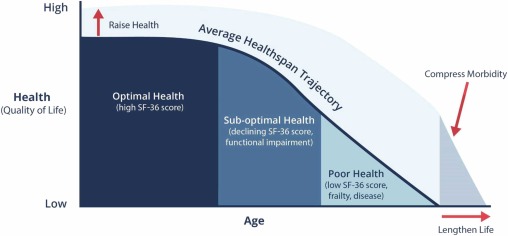
SF-36 scores have been shown to be effective in predicting outcomes of several different diseases and all-cause mortality. This includes heart disease, AD, metabolic disease, renal disease, cancer, and mental health outcomes.(Bjorner et al., 2013; Ding et al., 2020; Ezzati et al., 2019; Nilsson et al., 2020; Tapak et al., 2022) We propose that the SF-36 can also be useful for characterizing healthspan trajectories, specifically the transition from states of optimal health to sub-optimal health to poor health. Moreover, the SF-36 may serve as an accessible and reliable tool to evaluate the effects of healthspan-enhancing interventions in geroscience clinical trials, in which the goal is to raise health, lengthen life, and compress morbidity (Fig. 2). Thus, in our perspective, the SF-36 is a viable endpoint for generating RWE on the effects of geroprotective interventions on various facets of age-related functional decline that are often neglected within geroscience clinical trials.(Hayes et al., 1995; Jenkinson et al., 1993; Obidoa et al., 2010)
7.4. The risks of not including QoL measures as endpoints within geroscience clinical trials
If QoL measures are not integrated into geroscience clinical trials, we risk neglecting critical components of healthy aging and healthspan that encompass “real world” functional ability and the human experience. Factors that provide individuals with autonomy and agency in life, such as mental health, social functioning, and limitations in daily activities, play a critical role in both the biological and psychological process of healthy aging.(Kim et al., 2021; Saadeh et al., 2020)
The elucidation of reliable molecular biomarkers of aging will likely be the most important advancement for the longevity field, but a possible consequence of having a myopic focus on these markers is neglecting to consider the “real world” impact geroprotective and personalized lifestyle interventions have on patients’ lives. What good is a 5-year reversal in epigenetic age if that is not linked to a meaningful, real-world outcome? We propose including QoL data as an additional biomarker of aging within the physiological class of biomarkers, as QoL questionnaires play an important role in making sense of the “real world”, functional implications of changes in biological markers of aging that define the aging process.(Moqri et al., 2023)
The geroscience field is revealing several interventions that are thought to have overlapping roles in mitigating the risks of developing age-related disease and functional decline.(Gonzalez-Freire et al., 2020; Guo et al., 2022) QoL questionnaires allow for the tracking of changes to multiple distinct domains of functional health and QoL in response to longevity interventions using a single assay. In doing so, they may help distinguish the differential effects of healthspan-enhancing interventions for improving distinct functional aspects of age-related decline and healthspan.(Krawczyk-Suszek and Kleinrok, 2022)
Beyond its utility on the individual level, QoL scores have originally proven to be useful on the population level, where it has been used in health economics(McGuire, 2017) to inform how well different medical treatments improve patients’ lives, serving as a fundamental component of cost-effectiveness analysis (calculating metrics like quality-adjusted life years (QALY)) in the US and worldwide.(Prieto and Sacristan, 2003; Sanghera and Coast, 2020) This is another argument for integrating QoL into biological age determinants since the longevity dividend is largely dependent on the QALYs.(Scott, 2023a) Furthermore, QoL data, benchmarked against normative age group data, provide valuable insights for health policy and care standards, underscoring their significance in the holistic assessment of aging processes.(Kaplan and Hays, 2022)
The field of healthy longevity medicine is focused on the prevention of disease and frailty, but importantly, also the optimization of health in every stage of life.(Bischof et al., 2021) QoL questionnaires offer the opportunity for frequent and rapid data collection of the real-world impacts of longevity interventions in enhancing the lives of its users along their lifespan.
8. Conclusions
Empowered by promising research suggesting that the aging process can be slowed down, there is an emerging shift in how we view health on a public health level. Health status was (and in many ways, still is) characterized by the simple presence or absence of disease, with clinicians reactively applying interventions as disease arises. Health is now more broadly being recognized as a continuum characterized by the consequences of biological aging that consist of a broader composition of physical, mental, social, physiological, and functional capacity–even integrating components of well-being and purpose–irrespective of the presence of disease.(Zhao et al., 2021; Zhou et al., 2023)
While geroprotective interventions have been well-validated in animal models to improve lifespan and healthspan, designing and implementing geroscience clinical trials in humans is still a developing domain.(Rolland et al., 2023) Several rate-limiting factors challenge the field's ability to collect a sufficient amount of data that rigorously demonstrates the effectiveness of geroprotective interventions within normative aging cohorts. One of the major challenges is choosing the appropriate biomarkers and endpoint(s) that are predictive of adverse age-related outcomes, clinically acceptable, easy to collect, meaningful within the context of an individual’s life, and sensitive to change in a healthy population within a tractable timeframe. To address these challenges and accelerate data collection within the field, we highlight the value of utilizing QoL data as an endpoint within geroscience clinical trials that collect RWE on repurposed, geroprotective drugs. Further, we propose its inclusion in the current list of candidate biomarkers of aging as it facilitates the evaluation of key aspects of the real-world; functional consequences of geroprotective interventions that are not currently captured by the established classes of aging biomarkers.
In this review, we proposed a framework for the application of QoL assays in collecting RWE on the efficacy of repurposed, geroprotective drugs. We provided key metrics to consider when evaluating and selecting appropriate QoL assays and highlighted the evidence supporting the SF-36 as an ideal candidate QoL endpoint. Designing trials that utilize QoL assays alongside other technologies that collect real-world data (e.g. digital wearables, web-based cognitive tests, electronic health records, and at-home blood tests) may prove to have a more timely impact on the field and increase the number of drugs potentially available to target aging in humans (Fig. 1). Ideally, such trials will include a biobank that facilitates post-hoc measurement and analysis of an expanded array of aging biomarkers and biological aging clocks to help the field better understand their role as geroscience endpoints. Overall, this framework may play a critical role on the path to validating healthspan-enhancing drugs and their application in healthy longevity medicine.
Declaration of Competing Interest
none.
Acknowledgements
The authors would like to thank Francesca Compau for helpful discussions and generation of images.
References
- Abbasi-Ghahramanloo et al., 2020A. Abbasi-Ghahramanloo, M. Soltani-Kermanshahi, K. Mansori, M. Khazaei-Pool, M. Sohrabi, H.R. Baradaran, Z. Talebloo, A. GholamiComparison of SF-36 and WHOQoL-BREF in measuring quality of life in patients with type 2 diabetesInt. J. Gen. Med., 13 (2020), pp. 497-506, 10.2147/IJGM.S258953View in ScopusGoogle Scholar
- Aging Biomarker et al., 2023C. Aging Biomarker, H. Bao, J. Cao, M. Chen, M. Chen, W. Chen, X. Chen, Y. Chen, Y. Chen, Y. Chen, Z. Chen, J.K. Chhetri, Y. Ding, J. Feng, J. Guo, M. Guo, C. He, Y. Jia, H. Jiang, Y. Jing, D. Li, J. Li, J. Li, Q. Liang, R. Liang, F. Liu, X. Liu, Z. Liu, O.J. Luo, J. Lv, J. Ma, K. Mao, J. Nie, X. Qiao, X. Sun, X. Tang, J. Wang, Q. Wang, S. Wang, X. Wang, Y. Wang, Y. Wang, R. Wu, K. Xia, F.H. Xiao, L. Xu, Y. Xu, H. Yan, L. Yang, R. Yang, Y. Yang, Y. Ying, L. Zhang, W. Zhang, W. Zhang, X. Zhang, Z. Zhang, M. Zhou, R. Zhou, Q. Zhu, Z. Zhu, F. Cao, Z. Cao, P. Chan, C. Chen, G. Chen, H.Z. Chen, J. Chen, W. Ci, B.S. Ding, Q. Ding, F. Gao, J.J. Han, K. Huang, Z. Ju, Q.P. Kong, J. Li, J. Li, X. Li, B. Liu, F. Liu, L. Liu, Q. Liu, Q. Liu, X. Liu, Y. Liu, X. Luo, S. Ma, X. Ma, Z. Mao, J. Nie, Y. Peng, J. Qu, J. Ren, R. Ren, M. Song, Z. Songyang, Y.E. Sun, Y. Sun, M. Tian, S. Wang, S. Wang, X. Wang, X. Wang, Y.J. Wang, Y. Wang, C.C.L. Wong, A.P. Xiang, Y. Xiao, Z. Xie, D. Xu, J. Ye, R. Yue, C. Zhang, H. Zhang, L. Zhang, W. Zhang, Y. Zhang, Y.W. Zhang, Z. Zhang, T. Zhao, Y. Zhao, D. Zhu, W. Zou, G. Pei, G.H. LiuBiomarkers of agingSci. China Life. Sci., 66 (2023), pp. 893-1066, 10.1007/s11427-023-2305-0Google Scholar
- Ahlawat et al., 2023Ahlawat, H., Darcovich, A., Feehan, E., Maud, M., Nagarajan, N., Schabel, P., 2023. Aging with purpose: why meaningful engagement with society matters. https://www.mckinsey.com/mhi/our-insights/aging-with-purpose-why-meaningful-engagement-with-society-matters. (Accessed: December 22, 2023).Google Scholar
- Anwar et al., 2014S. Anwar, W. Tan, J. Yu, A. Hutson, M. Javle, R. IyerQuality-of-life (QoL) as a predictive biomarker in patients with advanced pancreatic cancer (APC) receiving chemotherapy: results from a prospective multicenter phase 2 trialJ. Gastrointest. Oncol., 5 (2014), pp. 433-439, 10.3978/j.issn.2078-6891.2014.070View in ScopusGoogle Scholar
- Attafuah et al., 2021P.Y.A. Attafuah, I.H.J. Everink, R.J.G. Halfens, C. Lohrmann, A. Abuosi, J. ScholsInstruments used to assess quality of life of older adults in African countries: a scoping reviewBMC Geriatr., 21 (2021), p. 344, 10.1186/s12877-021-02262-2View in ScopusGoogle Scholar
- Barzilai, 2017N.R. BarzilaiTargeting aging with metformin (TAME)743-743Innov. Aging, 1 (2017), 10.1093/geroni/igx004.2682Google Scholar
- Barzilai et al., 2018N. Barzilai, A.M. Cuervo, S. AustadAging as a biological target for prevention and therapyJAMA, 320 (2018), pp. 1321-1322, 10.1001/jama.2018.9562View in ScopusGoogle Scholar
- Baumhauer, 2017J.F. BaumhauerPatient-reported outcomes - are they living up to their potential?N. Engl. J. Med., 377 (2017), pp. 6-9, 10.1056/NEJMp1702978View in ScopusGoogle Scholar
- Bernabeu et al., 2023E. Bernabeu, D.L. McCartney, D.A. Gadd, R.F. Hillary, A.T. Lu, L. Murphy, N. Wrobel, A. Campbell, S.E. Harris, D. Liewald, C. Hayward, C. Sudlow, S.R. Cox, K.L. Evans, S. Horvath, A.M. McIntosh, M.R. Robinson, C.A. Vallejos, R.E. MarioniRefining epigenetic prediction of chronological and biological ageGenome Med., 15 (2023), p. 12, 10.1186/s13073-023-01161-yView in ScopusGoogle Scholar
- Bischof et al., 2021E. Bischof, M. Scheibye-Knudsen, R. Siow, A. MoskalevLongevity medicine: upskilling the physicians of tomorrowLancet Healthy Longev., 2 (2021), pp. e187-e188, 10.1016/S2666-7568(21)00024-6View PDFView articleView in ScopusGoogle Scholar
- Bjorner et al., 2013J.B. Bjorner, M. Lyng Wolden, J. Gundgaard, K.A. MillerBenchmarks for interpretation of score differences on the SF-36 health survey for patients with diabetesValue Health, 16 (2013), pp. 993-1000, 10.1016/j.jval.2013.06.022View PDFView articleView in ScopusGoogle Scholar
- Blagosklonny, 2023M.V. BlagosklonnyTowards disease-oriented dosing of rapamycin for longevity: does aging exist or only age-related diseases?Aging (Albany NY), 15 (2023), pp. 6632-6640, 10.18632/aging.204920View in ScopusGoogle Scholar
- Bland, 2017J.S. BlandChronic fatigue syndrome, functional mitochondriopathy, and enterohepatic dysfunctionIntegr. Med., 16 (2017), pp. 18-21View in ScopusGoogle Scholar
- Bottomley et al., 2018A. Bottomley, M. Pe, J. Sloan, E. Basch, F. Bonnetain, M. Calvert, A. Campbell, C. Cleeland, K. Cocks, L. Collette, A.C. Dueck, N. Devlin, H.H. Flechtner, C. Gotay, E. Greimel, I. Griebsch, M. Groenvold, J.F. Hamel, M. King, P.G. Kluetz, M. Koller, D.C. Malone, F. Martinelli, S.A. Mitchell, C.M. Moinpour, J.Z. Musoro, D. O'Connor, K. Oliver, E. Piault-Louis, M. Piccart, F.L. Pimentel, C. Quinten, J.C. Reijneveld, C. Schurmann, A.W. Smith, K.M. Soltys, R. Sridhara, M.J.B. Taphoorn, G. Velikova, C. CoensMoving forward toward standardizing analysis of quality of life data in randomized cancer clinical trialsClin. Trials, 15 (2018), pp. 624-630, 10.1177/1740774518795637View in ScopusGoogle Scholar
- Bottomley et al., 2019A. Bottomley, J.C. Reijneveld, M. Koller, H. Flechtner, K.A. Tomaszewski, E. Greimel, E.Qo.LiC.C.T.C.F. thCurrent state of quality of life and patient-reported outcomes researchEur. J. Cancer, 121 (2019), pp. 55-63, 10.1016/j.ejca.2019.08.016View PDFView articleView in ScopusGoogle Scholar
- Bourdel et al., 2019N. Bourdel, P. Chauvet, V. Billone, G. Douridas, A. Fauconnier, L. Gerbaud, M. CanisSystematic review of quality of life measures in patients with endometriosisPLoS One, 14 (2019), Article e0208464, 10.1371/journal.pone.0208464View in ScopusGoogle Scholar
- Buiting and Olthuis, 2020H.M. Buiting, G. OlthuisImportance of quality-of-life measurement throughout the disease courseJAMA Netw. Open, 3 (2020), Article e200388, 10.1001/jamanetworkopen.2020.0388View in ScopusGoogle Scholar
- CDC, 2015CDC, 2015. Longitudinal study of aging (LSOA). https://www.cdc.gov/nchs/lsoa/lsoa1.htm. (Accessed: December 22, 2023).Google Scholar
- Chen et al., 2023F.L. Chen, T.V. Ullal, J.L. Graves, E.R. Ratcliff, A. Naka, B. McKenzie, T.A. Carttar, K.M. Super, J. Austriaco, S.Y. Weber, J. Vaughn, M.L. LaCroix-FralishEvaluating instruments for assessing healthspan: a multi-center cross-sectional study on health-related quality of life (HRQL) and frailty in the companion dogGeroscience, 45 (2023), pp. 2089-2108, 10.1007/s11357-023-00744-2View in ScopusGoogle Scholar
- Chodankar, 2021D. ChodankarIntroduction to real-world evidence studiesPerspect. Clin. Res., 12 (2021), pp. 171-174, 10.4103/picr.picr_62_21View in ScopusGoogle Scholar
- Coe et al., 2022Coe, E., Dewhurst, M., Hartenstein, L., Hextall, A., Latkovic, T., 2022. At least six years of higher quality life for everyone is within reach, Adding years to life and life to years. McKinsey Health Institute.Google Scholar
- Colon-Emeric et al., 2013C.S. Colon-Emeric, H.E. Whitson, J. Pavon, H. HoenigFunctional decline in older adultsAm. Fam. Physician, 88 (2013), pp. 388-394View in ScopusGoogle Scholar
- Creevy et al., 2022K.E. Creevy, J.M. Akey, M. Kaeberlein, D.E.L. Promislow, C. Dog Aging ProjectAn open science study of ageing in companion dogsNature, 602 (2022), pp. 51-57, 10.1038/s41586-021-04282-9View in ScopusGoogle Scholar
- Cummings and Kritchevsky, 2022S.R. Cummings, S.B. KritchevskyEndpoints for geroscience clinical trials: health outcomes, biomarkers, and biologic ageGeroscience, 44 (2022), pp. 2925-2931, 10.1007/s11357-022-00671-8View in ScopusGoogle Scholar
- van der Rijt et al., 2020S. van der Rijt, M. Molenaars, R.L. McIntyre, G.E. Janssens, R.H. HoutkooperIntegrating the hallmarks of aging throughout the tree of life: a focus on mitochondrial dysfunctionFront. Cell Dev. Biol., 8 (2020), Article 594416, 10.3389/fcell.2020.594416View in ScopusGoogle Scholar
- Ding et al., 2020X. Ding, E.L. Abner, F.A. Schmitt, R.J. KryscioQuality of life scores predict incidence of dementia: Results from PREADViSEAlzheimer'S. Dement., 16 (2020), Article e037617, 10.1002/alz.037617Google Scholar
- Dreyer, 2022N.A. DreyerStrengthening evidence-based medicine with real-world evidenceLancet Healthy Longev., 3 (2022), pp. e641-e642, 10.1016/S2666-7568(22)00214-8View PDFView articleView in ScopusGoogle Scholar
- Escobar-Bravo et al., 2012M.A. Escobar-Bravo, D. Puga-Gonzalez, M. Martin-BaraneraProtective effects of social networks on disability among older adults in SpainArch. Gerontol. Geriatr., 54 (2012), pp. 109-116, 10.1016/j.archger.2011.01.008View PDFView articleView in ScopusGoogle Scholar
- Evans et al., 2021K. Evans, L. Colloca, M. Pecina, N. KatzWhat can be done to control the placebo response in clinical trials? A narrative reviewContemp. Clin. Trials, 107 (2021), Article 106503, 10.1016/j.cct.2021.106503View PDFView articleView in ScopusGoogle Scholar
- Ezzati et al., 2019A. Ezzati, A.R. Zammit, M.J. Katz, C.A. Derby, M.E. Zimmerman, R.B. LiptonHealth-related quality of life, cognitive performance, and incident dementia in a community-based elderly cohortAlzheimer Dis. Assoc. Disord., 33 (2019), pp. 240-245, 10.1097/WAD.0000000000000324View in ScopusGoogle Scholar
- FDA, 2023FDA, 2023. Real-world evidence. https://www.fda.gov/science-research/science-and-research-special-topics/real-world-evidence. (Accessed: December 22, 2023).Google Scholar
- Franceschi et al., 2018C. Franceschi, P. Garagnani, C. Morsiani, M. Conte, A. Santoro, A. Grignolio, D. Monti, M. Capri, S. SalvioliThe continuum of aging and age-related diseases: common mechanisms but different ratesFront. Med. (Lausanne)., 5 (2018), p. 61, 10.3389/fmed.2018.00061View in ScopusGoogle Scholar
- Galkin et al., 2020F. Galkin, P. Mamoshina, A. Aliper, J.P. de Magalhaes, V.N. Gladyshev, A. ZhavoronkovBiohorology and biomarkers of aging: Current state-of-the-art, challenges and opportunitiesAgeing Res. Rev., 60 (2020), Article 101050, 10.1016/j.arr.2020.101050View PDFView articleView in ScopusGoogle Scholar
- Garmany et al., 2021A. Garmany, S. Yamada, A. TerzicLongevity leap: mind the healthspan gapNpj. Regen. Med., 6 (2021), p. 57, 10.1038/s41536-021-00169-5View in ScopusGoogle Scholar
- Gerth van Wijk, 2005R. Gerth van WijkAssessment of quality of life: advantages and pitfallsClin. Exp. Allergy Rev., 5 (2005), pp. 32-35, 10.1111/j.1365-2222.2005.0080.xGoogle Scholar
- Gonzalez-Freire et al., 2020M. Gonzalez-Freire, A. Diaz-Ruiz, D. Hauser, J. Martinez-Romero, L. Ferrucci, M. Bernier, R. de CaboThe road ahead for health and lifespan interventionsAgeing Res. Rev., 59 (2020), Article 101037, 10.1016/j.arr.2020.101037View PDFView articleView in ScopusGoogle Scholar
- Guo et al., 2022J. Guo, X. Huang, L. Dou, M. Yan, T. Shen, W. Tang, J. LiAging and aging-related diseases: from molecular mechanisms to interventions and treatmentsSignal Transduct. Target Ther., 7 (2022), p. 391, 10.1038/s41392-022-01251-0View in ScopusGoogle Scholar
- Hansen et al., 1996B.J. Hansen, H.H. Meyhoff, J. Nordling, H.J. Mensink, P. Mogensen, E.H. LarsenPlacebo effects in the pharmacological treatment of uncomplicated benign prostatic hyperplasia. The ALFECH Study GroupScand. J. Urol. Nephrol., 30 (1996), pp. 373-377, 10.3109/00365599609181313View in ScopusGoogle Scholar
- Haraldstad et al., 2019K. Haraldstad, A. Wahl, R. Andenaes, J.R. Andersen, M.H. Andersen, E. Beisland, C.R. Borge, E. Engebretsen, M. Eisemann, L. Halvorsrud, T.A. Hanssen, A. Haugstvedt, T. Haugland, V.A. Johansen, M.H. Larsen, L. Lovereide, B. Loyland, L.G. Kvarme, P. Moons, T.M. Norekval, L. Ribu, G.E. Rohde, K.H. Urstad, S. Helseth, L. networkA systematic review of quality of life research in medicine and health sciencesQual. Life Res., 28 (2019), pp. 2641-2650, 10.1007/s11136-019-02214-9View in ScopusGoogle Scholar
- Hartenstein and Latkovic, 2022Hartenstein, L., Latkovic, T., 2022. The secret to great health? Escaping the healthcare matrix. https://www.mckinsey.com/mhi/our-insights/the-secret-to-great-health-escaping-the-healthcare-matrix. (Accessed: December 22, 2023).Google Scholar
- Haslam et al., 2020A. Haslam, D. Herrera-Perez, J. Gill, V. PrasadPatient experience captured by quality-of-life measurement in oncology clinical trialsJAMA Netw. Open., 3 (2020), Article e200363, 10.1001/jamanetworkopen.2020.0363View in ScopusGoogle Scholar
- Hayes et al., 1995V. Hayes, J. Morris, C. Wolfe, M. MorganThe SF-36 health survey questionnaire: is it suitable for use with older adults?Age Ageing, 24 (1995), pp. 120-125, 10.1093/ageing/24.2.120View in ScopusGoogle Scholar
- Hodgins et al., 2018G.E. Hodgins, J.G. Blommel, B.W. Dunlop, D. Iosifescu, S.J. Mathew, T.C. Neylan, H.S. Mayberg, P.D. HarveyPlacebo effects across self-report, clinician rating, and objective performance tasks among women with post-traumatic stress disorder: investigation of placebo response in a pharmacological treatment study of post-traumatic stress disorderJ. Clin. Psychopharmacol., 38 (2018), pp. 200-206, 10.1097/JCP.0000000000000858View in ScopusGoogle Scholar
- Hróbjartsson and Gøtzsche, 2010A. Hróbjartsson, P.C. GøtzschePlacebo interventions for all clinical conditionsCochrane Database Syst. Rev. (2010), 10.1002/14651858.CD003974.pub3Google Scholar
- Huth et al., 2020T.K. Huth, N. Eaton-Fitch, D. Staines, S. Marshall-GradisnikA systematic review of metabolomic dysregulation in chronic fatigue syndrome/myalgic encephalomyelitis/systemic exertion intolerance disease (CFS/ME/SEID)J. Transl. Med., 18 (2020), p. 198, 10.1186/s12967-020-02356-2View in ScopusGoogle Scholar
- Jacobsen et al., 2002P.B. Jacobsen, K. Davis, D. CellaAssessing quality of life in research and clinical practiceOncol. (Williston Park), 16 (2002), pp. 133-139View in ScopusGoogle Scholar
- Jansen et al., 2021R. Jansen, L.K. Han, J.E. Verhoeven, K.A. Aberg, E.C. van den Oord, Y. Milaneschi, B.W. PenninxAn integrative study of five biological clocks in somatic and mental healthElife, 10 (2021), 10.7554/eLife.59479Google Scholar
- Jenkinson et al., 1993C. Jenkinson, A. Coulter, L. WrightShort form 36 (SF36) health survey questionnaire: normative data for adults of working ageBMJ, 306 (1993), pp. 1437-1440, 10.1136/bmj.306.6890.1437View in ScopusGoogle Scholar
- Jopp et al., 2016D.S. Jopp, M.K. Park, J. Lehrfeld, M.E. PaggiPhysical, cognitive, social and mental health in near-centenarians and centenarians living in New York City: findings from the Fordham Centenarian StudyBMC Geriatr., 16 (1) (2016), 10.1186/s12877-015-0167-0Google Scholar
- Junaković et al., 2023I.T. Junaković, M. Nekić, N. ŠimićLifestyle factors, psychosocial resources, and mental health in older people0, nullGeroPsych (2023), 10.1024/1662-9647/a000330Google Scholar
- Kaeberlein et al., 2015M. Kaeberlein, P.S. Rabinovitch, G.M. MartinHealthy aging: The ultimate preventative medicineScience, 350 (2015), pp. 1191-1193, 10.1126/science.aad3267View in ScopusGoogle Scholar
- Kaplan and Hays, 2022R.M. Kaplan, R.D. HaysHealth-related quality of life measurement in public healthAnnu. Rev. Public Health, 43 (2022), pp. 355-373, 10.1146/annurev-publhealth-052120-012811View in ScopusGoogle Scholar
- Kazis et al., 2004L.E. Kazis, A. Lee, A. Spiro, 3rd, W. Rogers, X.S. Ren, D.R. Miller, A. Selim, A. Hamed, S.C. HafferMeasurement comparisons of the medical outcomes study and veterans SF-36 health surveyHealth Care Financ. Rev., 25 (2004), pp. 43-58View in ScopusGoogle Scholar
- Keshavarz et al., 2023M. Keshavarz, K. Xie, K. Schaaf, D. Bano, D. EhningerTargeting the "hallmarks of aging" to slow aging and treat age-related disease: fact or fiction?Mol. Psychiatry, 28 (2023), pp. 242-255, 10.1038/s41380-022-01680-xView in ScopusGoogle Scholar
- Kessels et al., 2019R. Kessels, R. Mozer, J. BloemersMethods for assessing and controlling placebo effectsStat. Methods Med. Res., 28 (2019), pp. 1141-1156, 10.1177/0962280217748339View in ScopusGoogle Scholar
- Kidambi and Lee, 2020N. Kidambi, E.E. LeeInsight into potential mechanisms linking loneliness and cognitive decline: commentary on "Health factors as potential mediator the longitudinal effect of loneliness on general cognitive abilityAm. J. Geriatr. Psychiatry, 28 (2020), pp. 1284-1286, 10.1016/j.jagp.2020.08.015View PDFView articleView in ScopusGoogle Scholar
- Kim et al., 2021E.S. Kim, R. Tkatch, D. Martin, S. MacLeod, L. Sandy, C. YehResilient aging: psychological well-being and social well-being as targets for the promotion of healthy aging23337214211002951Gerontol. Geriatr. Med., 7 (2021), 10.1177/23337214211002951Google Scholar
- Komaroff, 2017A.L. KomaroffInflammation correlates with symptoms in chronic fatigue syndromeProc. Natl. Acad. Sci. U. S. A., 114 (2017), pp. 8914-8916, 10.1073/pnas.1712475114View in ScopusGoogle Scholar
- Konopka et al., 2023A.R. Konopka, D.W. Lamming, R.P. Investigators, E. InvestigatorsBlazing a trail for the clinical use of rapamycin as a geroprotecTORGeroscience, 45 (2023), pp. 2769-2783, 10.1007/s11357-023-00935-xView in ScopusGoogle Scholar
- Kraus et al., 2013C. Kraus, S. Pavard, D.E. PromislowThe size-life span trade-off decomposed: why large dogs die youngAm. Nat., 181 (2013), pp. 492-505, 10.1086/669665View in ScopusGoogle Scholar
- Krawczyk-Suszek and Kleinrok, 2022M. Krawczyk-Suszek, A. KleinrokHealth-related quality of life (HRQoL) of people over 65 years of ageInt. J. Environ. Res. Public Health, 19 (2022), 10.3390/ijerph19020625Google Scholar
- Kulkarni et al., 2022A.S. Kulkarni, S. Aleksic, D.M. Berger, F. Sierra, G.A. Kuchel, N. BarzilaiGeroscience-guided repurposing of FDA-approved drugs to target aging: a proposed process and prioritizationAging Cell, 21 (2022), Article e13596, 10.1111/acel.13596View in ScopusGoogle Scholar
- Kuo et al., 2022P.L. Kuo, J.A. Schrack, M.E. Levine, M.D. Shardell, E.M. Simonsick, C.W. Chia, A.Z. Moore, T. Tanaka, Y. An, A. Karikkineth, M. AlGhatrif, P. Elango, L.M. Zukley, J.M. Egan, R. de Cabo, S.M. Resnick, L. FerrucciLongitudinal phenotypic aging metrics in the Baltimore Longitudinal Study of AgingNat. Aging, 2 (2022), pp. 635-643, 10.1038/s43587-022-00243-7View in ScopusGoogle Scholar
- Lahoud et al., 2017R. Lahoud, V. Chongthammakun, Y. Wu, N. Hawwa, D.M. Brennan, L. ChoComparing SF-36(R) scores versus biomarkers to predict mortality in primary cardiac prevention patients.Eur. J. Intern. Med., 46 (2017), pp. 47-55, 10.1016/j.ejim.2017.05.026View PDFView articleView in ScopusGoogle Scholar
- Lakhan and Kirchgessner, 2010S.E. Lakhan, A. KirchgessnerGut inflammation in chronic fatigue syndromeNutr. Metab. (Lond. )., 7 (2010), p. 79, 10.1186/1743-7075-7-79View in ScopusGoogle Scholar
- Lemoine, 2021M. LemoineThe evolution of the hallmarks of agingFront. Genet., 12 (2021), Article 693071, 10.3389/fgene.2021.693071View in ScopusGoogle Scholar
- Lin et al., 2013X.-J. Lin, I.M. Lin, S.-Y. FanMethodological issues in measuring health-related quality of lifeTzu Chi Med. J., 25 (2013), pp. 8-12, 10.1016/j.tcmj.2012.09.002View PDFView articleView in ScopusGoogle Scholar
- Liu et al., 2023W.S. Liu, J. You, Y.J. Ge, B.S. Wu, Y. Zhang, S.D. Chen, Y.R. Zhang, S.Y. Huang, L.Z. Ma, J.F. Feng, W. Cheng, J.T. YuAssociation of biological age with health outcomes and its modifiable factorsAging Cell, 22 (2023), Article e13995, 10.1111/acel.13995View in ScopusGoogle Scholar
- Lopez-Otin et al., 2013C. Lopez-Otin, M.A. Blasco, L. Partridge, M. Serrano, G. KroemerThe hallmarks of agingCell, 153 (2013), pp. 1194-1217, 10.1016/j.cell.2013.05.039View PDFView articleView in ScopusGoogle Scholar
- Lopez-Otin et al., 2023C. Lopez-Otin, M.A. Blasco, L. Partridge, M. Serrano, G. KroemerHallmarks of aging: An expanding universeCell, 186 (2023), pp. 243-278, 10.1016/j.cell.2022.11.001View PDFView articleView in ScopusGoogle Scholar
- Lu et al., 2019W. Lu, H. Pikhart, A. SackerDomains and measurements of healthy aging in epidemiological studies: a reviewGerontologist, 59 (2019), pp. e294-e310, 10.1093/geront/gny029Google Scholar
- Luscombe, 2000F.A. LuscombeHealth-related quality of life measurement in type 2 diabetesValue Health, 3 (Suppl 1) (2000), pp. 15-28, 10.1046/j.1524-4733.2000.36032.xGoogle Scholar
- May, 2023M. MayBiomarkers of aging remain elusive as researchers try to slow the biological clockNat. Med., 29 (2023), pp. 2673-2676, 10.1038/s41591-023-02560-9View in ScopusGoogle Scholar
- McGuire, 2017A. McGuireHealth state evaluation and utility theoryThe New Palgrave Dictionary of Economics, Palgrave Macmillan UK, London (2017), pp. 1-7View in ScopusGoogle Scholar
- McKenzie, 2023McKenzie, B., 2023. How scientists measure aging through healthspan, frailty and quality of life. https://loyalfordogs.com/posts/how-scientists-measure-aging-through-healthspan-frailty-and-quality-of-life. (Accessed: December 27, 2023).Google Scholar
- Megari, 2013K. MegariQuality of life in chronic disease patientsHealth Psychol. Res., 1 (2013), Article e27, 10.4081/hpr.2013.e27Google Scholar
- Montano et al., 2022M. Montano, K.K. Oursler, K. Xu, Y.V. Sun, V.C. MarconiBiological ageing with HIV infection: evaluating the geroscience hypothesisLancet Healthy Longev., 3 (2022), pp. e194-e205, 10.1016/s2666-7568(21)00278-6View PDFView articleView in ScopusGoogle Scholar
- Moqri et al., 2023M. Moqri, C. Herzog, J.R. Poganik, C. Biomarkers of Aging, J. Justice, D.W. Belsky, A. Higgins-Chen, A. Moskalev, G. Fuellen, A.A. Cohen, I. Bautmans, M. Widschwendter, J. Ding, A. Fleming, J. Mannick, J.J. Han, A. Zhavoronkov, N. Barzilai, M. Kaeberlein, S. Cummings, B.K. Kennedy, L. Ferrucci, S. Horvath, E. Verdin, A.B. Maier, M.P. Snyder, V. Sebastiano, V.N. GladyshevBiomarkers of aging for the identification and evaluation of longevity interventionsCell, 186 (2023), pp. 3758-3775, 10.1016/j.cell.2023.08.003View PDFView articleView in ScopusGoogle Scholar
- Muhandiramge et al., 2022J. Muhandiramge, S.G. Orchard, E.T. Warner, G.J. van Londen, J.R. ZalcbergFunctional decline in the cancer patient: a reviewCancers (Basel), 14 (2022), 10.3390/cancers14061368Google Scholar
- Newman and Murabito, 2013A.B. Newman, J.M. MurabitoThe epidemiology of longevity and exceptional survivalEpidemiol. Rev., 35 (2013), pp. 181-197, 10.1093/epirev/mxs013View in ScopusGoogle Scholar
- Niccoli and Partridge, 2012T. Niccoli, L. PartridgeAgeing as a risk factor for diseaseCurr. Biol., 22 (2012), pp. R741-R752, 10.1016/j.cub.2012.07.024View PDFView articleView in ScopusGoogle Scholar
- Nielsen et al., 2022J.L. Nielsen, D. Bakula, M. Scheibye-KnudsenClinical trials targeting agingFront. Aging, 3 (2022), Article 820215, 10.3389/fragi.2022.820215View in ScopusGoogle Scholar
- Nilsson et al., 2020E. Nilsson, K. Festin, M. Lowen, M. KristensonSF-36 predicts 13-year CHD incidence in a middle-aged Swedish general populationQual. Life Res., 29 (2020), pp. 971-975, 10.1007/s11136-019-02362-yView in ScopusGoogle Scholar
- Obidoa et al., 2010C.A. Obidoa, S.L. Reisine, M. CherniackHow does the SF-36 perform in healthy populations? A structured review of longitudinal studiesJ. Soc., Behav., Health Sci., 4 (2010), pp. 30-48, 10.5590/JSBHS.2010.04.1.02Google Scholar
- Oh et al., 2023H.S. Oh, J. Rutledge, D. Nachun, R. Palovics, O. Abiose, P. Moran-Losada, D. Channappa, D.Y. Urey, K. Kim, Y.J. Sung, L. Wang, J. Timsina, D. Western, M. Liu, P. Kohlfeld, J. Budde, E.N. Wilson, Y. Guen, T.M. Maurer, M. Haney, A.C. Yang, Z. He, M.D. Greicius, K.I. Andreasson, S. Sathyan, E.F. Weiss, S. Milman, N. Barzilai, C. Cruchaga, A.D. Wagner, E. Mormino, B. Lehallier, V.W. Henderson, F.M. Longo, S.B. Montgomery, T. Wyss-CorayOrgan aging signatures in the plasma proteome track health and diseaseNature, 624 (2023), pp. 164-172, 10.1038/s41586-023-06802-1View in ScopusGoogle Scholar
- Pais-Ribeiro, 2004J.L. Pais-RibeiroQuality of life is a primary end-point in clinical settingsClin. Nutr., 23 (2004), pp. 121-130, 10.1016/s0261-5614(03)00109-2View PDFView articleView in ScopusGoogle Scholar
- Palmer, 2022R.D. PalmerAging clocks & mortality timers, methylation, glycomic, telomeric and more. A window to measuring biological ageAging Med. (Milton), 5 (2022), pp. 120-125, 10.1002/agm2.12197View in ScopusGoogle Scholar
- Pan et al., 2020Y.J. Pan, L.L. Yeh, H.Y. Chan, C.K. ChangExcess mortality and shortened life expectancy in people with major mental illnesses in TaiwanEpidemiol. Psychiatr. Sci., 29 (2020), Article e156, 10.1017/S2045796020000694View in ScopusGoogle Scholar
- Pequeno et al., 2020N.P.F. Pequeno, N.L.A. Cabral, D.M. Marchioni, S. Lima, C.O. LyraQuality of life assessment instruments for adults: a systematic review of population-based studiesHealth Qual. Life Outcomes, 18 (2020), p. 208, 10.1186/s12955-020-01347-7View in ScopusGoogle Scholar
- Poon et al., 2010L.W. Poon, P. Martin, A. Bishop, J. Cho, G. da Rosa, N. Deshpande, R. Hensley, M. Macdonald, J. Margrett, G.K. Randall, J.L. Woodard, L.S. MillerUnderstanding centenarians' psychosocial dynamics and their contributions to health and quality of lifeCurr. Gerontol. Geriatr. Res., 2010 (2010), 10.1155/2010/680657Google Scholar
- Prieto and Sacristan, 2003L. Prieto, J.A. SacristanProblems and solutions in calculating quality-adjusted life years (QALYs)Health Qual. Life Outcomes, 1 (2003), p. 80, 10.1186/1477-7525-1-80View in ScopusGoogle Scholar
- Rae, 2023Rae, M., 2023. A TAME attempt to slow aging part 5: winning the game with a weak hand. https://www.sens.org/tame-attempt-slow-aging-part-5-metformin-win-game-weak-hand/. (Accessed: January 10, 2024).Google Scholar
- Raman, 2020R. RamanStatistical methods in handling placebo effectInt. Rev. Neurobiol., 153 (2020), pp. 103-120, 10.1016/bs.irn.2020.04.004View PDFView articleView in ScopusGoogle Scholar
- Rolland et al., 2023Y. Rolland, F. Sierra, L. Ferrucci, N. Barzilai, R. De Cabo, J. Mannick, A. Oliva, W. Evans, D. Angioni, P. De Souto Barreto, J. Raffin, B. Vellas, J.L. Kirkland, G.C.T.T. groupChallenges in developing geroscience trialsNat. Commun., 14 (2023), p. 5038, 10.1038/s41467-023-39786-7View in ScopusGoogle Scholar
- Rondon Garcia and Ramirez Navarrro, 2018L.M. Rondon Garcia, J.M. Ramirez NavarrroThe impact of quality of life on the health of older people from a multidimensional perspectiveJ. Aging Res., 2018 (2018), Article 4086294, 10.1155/2018/4086294Google Scholar
- Roser, 2018M. RoserTwice as long – life expectancy around the worldOur World Data (2018)Google Scholar
- Rudrapatna and Butte, 2020V.A. Rudrapatna, A.J. ButteOpportunities and challenges in using real-world data for health careJ. Clin. Invest., 130 (2020), pp. 565-574, 10.1172/JCI129197View in ScopusGoogle Scholar
- Saadeh et al., 2020M. Saadeh, A.K. Welmer, S. Dekhtyar, L. Fratiglioni, A. Calderon-LarranagaThe role of psychological and social well-being on physical function trajectories in older adultsJ. Gerontol. A. Biol. Sci. Med. Sci., 75 (2020), pp. 1579-1585, 10.1093/gerona/glaa114Google Scholar
- Sandalova et al., 2023E. Sandalova, J. Goh, Z.X. Lim, Z.M. Lim, D. Barardo, R. Dorajoo, B.K. Kennedy, A.B. MaierAlpha-ketoglutarate supplementation and BiologicaL agE in middle-aged adults (ABLE)-intervention study protocolGeroscience, 45 (2023), pp. 2897-2907, 10.1007/s11357-023-00813-6View in ScopusGoogle Scholar
- Sanghera and Coast, 2020S. Sanghera, J. CoastMeasuring quality-adjusted life-years when health fluctuatesValue Health, 23 (2020), pp. 343-350, 10.1016/j.jval.2019.09.2753View PDFView articleView in ScopusGoogle Scholar
- Schatz, 2015B.R. SchatzNational surveys of population health: big data analytics for mobile health monitorsBig Data, 3 (2015), pp. 219-229, 10.1089/big.2015.0021View in ScopusGoogle Scholar
- Schmauck-Medina et al., 2022T. Schmauck-Medina, A. Moliere, S. Lautrup, J. Zhang, S. Chlopicki, H.B. Madsen, S. Cao, C. Soendenbroe, E. Mansell, M.B. Vestergaard, Z. Li, Y. Shiloh, P.L. Opresko, J.M. Egly, T. Kirkwood, E. Verdin, V.A. Bohr, L.S. Cox, T. Stevnsner, L.J. Rasmussen, E.F. FangNew hallmarks of ageing: a 2022 Copenhagen ageing meeting summaryAging (Albany NY), 14 (2022), pp. 6829-6839, 10.18632/aging.204248View in ScopusGoogle Scholar
- Scott, 2023aA.J. ScottThe economics of longevity – An introductionJ. Econ. Ageing, 24 (2023), Article 100439, 10.1016/j.jeoa.2022.100439View PDFView articleView in ScopusGoogle Scholar
- Scott, 2023bScott, M.P., 2023b. Why U.S. healthcare spending is rising so fast. https://www.investopedia.com/u-s-healthcare-spending-rising-fast-5186172. (Accessed: December 22, 2023,Google Scholar
- Scott et al., 2021A.J. Scott, M. Ellison, D.A. SinclairThe economic value of targeting agingNat. Aging, 1 (2021), pp. 616-623, 10.1038/s43587-021-00080-0View in ScopusGoogle Scholar
- Selim et al., 2005A.J. Selim, G. Fincke, D.R. Berlowitz, D.R. Miller, S.X. Qian, A. Lee, Z. Cong, W. Rogers, B.J. Selim, X.S. Ren, A. Spiro 3rd, L.E. KazisComprehensive health status assessment of centenarians: results from the 1999 large health survey of veteran enrolleesJ. Gerontol. A. Biol. Sci. Med. Sci., 60 (2005), pp. 515-519, 10.1093/gerona/60.4.515View in ScopusGoogle Scholar
- Sierra et al., 2021F. Sierra, A. Caspi, R.H. Fortinsky, L. Haynes, G.J. Lithgow, T.E. Moffitt, S.J. Olshansky, D. Perry, E. Verdin, G.A. KuchelMoving geroscience from the bench to clinical care and health policyJ. Am. Geriatr. Soc., 69 (2021), pp. 2455-2463, 10.1111/jgs.17301View in ScopusGoogle Scholar
- Siette et al., 2021J. Siette, G.T. Knaggs, Y. Zurynski, J. Ratcliffe, L. Dodds, J. WestbrookSystematic review of 29 self-report instruments for assessing quality of life in older adults receiving aged care servicesBMJ Open, 11 (2021), Article e050892, 10.1136/bmjopen-2021-050892View in ScopusGoogle Scholar
- Sim et al., 2020J.A. Sim, Y.A. Kim, J.H. Kim, J.M. Lee, M.S. Kim, Y.M. Shim, J.I. Zo, Y.H. YunThe major effects of health-related quality of life on 5-year survival prediction among lung cancer survivors: applications of machine learningSci. Rep., 10 (2020), Article 10693, 10.1038/s41598-020-67604-3View in ScopusGoogle Scholar
- Sonnega et al., 2014A. Sonnega, J.D. Faul, M.B. Ofstedal, K.M. Langa, J.W. Phillips, D.R. WeirCohort profile: the health and retirement study (HRS)Int. J. Epidemiol., 43 (2014), pp. 576-585, 10.1093/ije/dyu067View in ScopusGoogle Scholar
- Soriano et al., 2010N. Soriano, A. Ribera, J.R. Marsal, C. Brotons, P. Cascant, G. Permanyer-Miralda, I.C.-Qs investigatorsImprovements in health-related quality of life of patients admitted for heart failure. The HF-QoL studyRev. Esp. Cardiol., 63 (2010), pp. 668-676, 10.1016/s1885-5857(10)70141-9View PDFView articleView in ScopusGoogle Scholar
- Stanziano et al., 2010D.C. Stanziano, M. Whitehurst, P. Graham, B.A. RoosA review of selected longitudinal studies on aging: past findings and future directionsS292-297J. Am. Geriatr. Soc., 58 (Suppl 2) (2010), 10.1111/j.1532-5415.2010.02936.xGoogle Scholar
- Sun et al., 2022Y. Sun, Q. Li, J.L. KirklandTargeting senescent cells for a healthier longevity: the roadmap for an era of global agingLife Med, 1 (2022), pp. 103-119, 10.1093/lifemedi/lnac030Google Scholar
- Tapak et al., 2022L. Tapak, F. Cheraghi, A. Sadeghi, N. Shirmohammadi, A. FeizybarnajiUsefulness of the SF-36 health survey questionnaire in screening for health-related quality of life among parents of children with cancer: latent profile analysisJ. Prev. Med. Hyg., 63 (2022), pp. E142-E151, 10.15167/2421-4248/jpmh2022.63.1.2279View in ScopusGoogle Scholar
- Tate et al., 2023R.B. Tate, A.U. Swift, E.H. Thompson Jr., P.D. St JohnLife course predictors of young men surviving to age 90 in a cohort study: the Manitoba follow-up studyCan. J. Aging, 42 (2023), pp. 13-19, 10.1017/S0714980822000186View in ScopusGoogle Scholar
- Touray, 2018M.M.L. TourayEstimation of quality-adjusted life years alongside clinical trials: the impact of 'time-effects' on trial resultsJ. Pharm. Health Serv. Res., 9 (2018), pp. 109-114, 10.1111/jphs.12218View in ScopusGoogle Scholar
- Tsang and Loh, 2020M. Tsang, K.P. LohThe importance of measuring health-related quality of life in older adultsThe ASCO Post, ASCO (2020)Google Scholar
- Vickers, 2006A.J. VickersMultiple assessment in quality of life trials: how many questionnaires? How often should they be given?J. Soc. Integr. Oncol., 4 (2006), pp. 135-138, 10.2310/7200.2006.017View in ScopusGoogle Scholar
- Wang et al., 2023Y.-R. Wang, H.-F. Lee, P.-L. Hsieh, C.-M. ChenDevelopment of the healthy aging perspectives questionnaire among older adults with chronic disease in TaiwanHealth Soc. Care Community, 2023 (2023), Article 8238748, 10.1155/2023/8238748Google Scholar
- Ware, 1993Ware, J.E., Jr., 1993. SF-36 health survey manual and interpretation guide. The Health Institute, New England Medical Center, Boston.Google Scholar
- Ware and Sherbourne, 1992J.E. Ware Jr., C.D. SherbourneThe MOS 36-item short-form health survey (SF-36). I. Conceptual framework and item selectionMed. Care., 30 (1992), pp. 473-483CrossRefView in ScopusGoogle Scholar
- Weng et al., 2020S.F. Weng, H.R. Hsu, Y.L. Weng, K.J. Tien, H.Y. KaoHealth-related quality of life and medical resource use in patients with osteoporosis and depression: a cross-sectional analysis from the national health and nutrition examination surveyInt. J. Environ. Res. Public Health, 17 (2020), 10.3390/ijerph17031124Google Scholar
- WHO, 2020aWHO, 2020a. Global spending on health 2020: weathering the storm. https://www.who.int/publications/i/item/9789240017788. (Accessed: December 22, 2023).Google Scholar
- WHO, 2020bWHO, 2020b. Healthy ageing and functional ability. https://www.who.int/news-room/questions-and-answers/item/healthy-ageing-and-functional-ability. (Accessed: December 22, 2023).Google Scholar
- Williams and Wood-Dauphinee, 1989Williams, J.I., Wood-Dauphinee, S., 1989. Assessing quality of life: measures and utility, in: Mosteller, F., Falotico-Taylor, J. (Eds.), Quality of Life and Technology Assessment: Monograph of the Council on Health Care Technology. Institute of Medicine (US) Council on Health Care Technology, Washington (DC).Google Scholar
- Wu et al., 2021J.W. Wu, A. Yaqub, Y. Ma, W. Koudstaal, A. Hofman, M.A. Ikram, M. Ghanbari, J. GoudsmitBiological age in healthy elderly predicts aging-related diseases including dementiaSci. Rep., 11 (2021), 10.1038/s41598-021-95425-5Google Scholar
- Yates et al., 2008L.B. Yates, L. Djousse, T. Kurth, J.E. Buring, J.M. GazianoExceptional longevity in men: modifiable factors associated with survival and function to age 90 yearsArch. Intern. Med., 168 (2008), pp. 284-290, 10.1001/archinternmed.2007.77View in ScopusGoogle Scholar
- Yi, 2008Z. YiIntroduction to the Chinese longitudinal healthy longevity survey (CLHLS)Z. Yi, D.L. Poston, D.A. Vlosky, D. Gu (Eds.), Healthy Longevity in China: Demographic, Socioeconomic, and Psychological Dimensions, Springer Netherlands, Dordrecht (2008), pp. 23-38CrossRefView in ScopusGoogle Scholar
- Yin et al., 2016S. Yin, R. Njai, L. Barker, P.Z. Siegel, Y. LiaoSummarizing health-related quality of life (HRQOL): development and testing of a one-factor modelPopul. Health Metr., 14 (2016), p. 22, 10.1186/s12963-016-0091-3View in ScopusGoogle Scholar
- Yoon et al., 2023J.H. Yoon, N.H. Park, Y.E. Kang, Y.C. Ahn, E.J. Lee, C.G. SonThe demographic features of fatigue in the general population worldwide: a systematic review and meta-analysisFront. Public Health, 11 (2023), Article 1192121, 10.3389/fpubh.2023.1192121View in ScopusGoogle Scholar
- Zhang, 2023Q. ZhangAn interpretable biological ageLancet Healthy Longev., 4 (2023), pp. e662-e663, 10.1016/S2666-7568(23)00213-1View PDFView articleView in ScopusGoogle Scholar
- Zhao et al., 2021J. Zhao, J.K. Chhetri, Y. Chang, Z. Zheng, L. Ma, P. ChanIntrinsic capacity vs. multimorbidity: a function-centered construct predicts disability better Than a disease-based approach in a community-dwelling older population cohortFront. Med. (Lausanne)., 8 (2021), Article 753295, 10.3389/fmed.2021.753295View in ScopusGoogle Scholar
- Zhao et al., 2019J. Zhao, Q. Feng, P. Wu, R.A. Lupu, R.A. Wilke, Q.S. Wells, J.C. Denny, W.Q. WeiLearning from longitudinal data in electronic health record and genetic data to improve cardiovascular event predictionSci. Rep., 9 (2019), p. 717, 10.1038/s41598-018-36745-xView in ScopusGoogle Scholar
- Zhavoronkov et al., 2021A. Zhavoronkov, E. Bischof, K.F. LeeArtificial intelligence in longevity medicineNat. Aging, 1 (2021), pp. 5-7, 10.1038/s43587-020-00020-4View in ScopusGoogle Scholar
- Zhavoronkov et al., 2020A. Zhavoronkov, K. Kochetov, P. Diamandis, M. MitinaPsychoAge and SubjAge: development of deep markers of psychological and subjective age using artificial intelligenceAging, 12 (2020), pp. 23548-23577, 10.18632/aging.202344View in ScopusGoogle Scholar
- Zhavoronkov et al., 2019A. Zhavoronkov, R. Li, C. Ma, P. MamoshinaDeep biomarkers of aging and longevity: from research to applicationsAging, 11 (2019), pp. 10771-10780, 10.18632/aging.102475View in ScopusGoogle Scholar
- Zhou et al., 2023J. Zhou, H. Chang, M. Leng, Z. WangIntrinsic capacity to predict future adverse health outcomes in older adults: a scoping reviewHealthcare, 11 (2023), 10.3390/healthcare11040450Google Scholar
Cited by (0)
© 2024 The Authors. Published by Elsevier B.V.