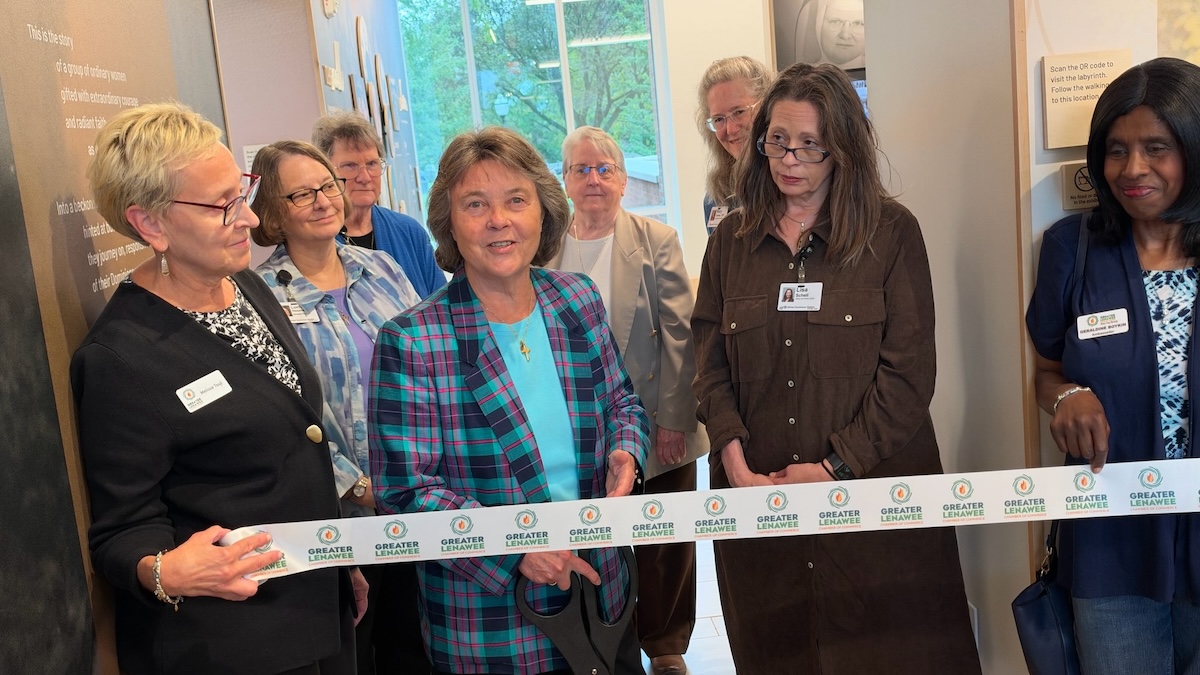
ADRIAN — Among the artifacts in the new Adrian Dominican Sisters History and Archive Center is a yellowed, typewritten sheet titled “Postulant’s Requirements.”
A young woman entering the congregation was instructed to bring black dresses, white nightgowns, black stockings, bath towels, handkerchiefs, a plain fountain pen, sewing supplies and a medium-sized trunk.
Her shoes were to be black oxfords — “not loafers, saddle shoes, or sport shoes.”
“Feminine extravagances,” including scented talcum powder and toilet water, were forbidden.
A typical day for postulants, novices and professed sisters before Vatican II began at 5:10 a.m. Morning prayer started at 5:30, followed by meditation and Mass. The day ended with night prayer at 8:30, “Profound Silence” at 9:30 and lights out.
Those details belong to an earlier era in more than a century of Adrian Dominican history. But the congregation’s new History and Archive Center is designed to do more than preserve what religious life once looked like.
Numbers of women entering religious congregations such as the Adrian Dominicans peaked in the 1950s and 1960s. While there are fewer women entering the congregation today, the center continues to tell the story of their history, present and future.
“That’s what this entire building is all about — the transmission of the Dominican charism and the vision,” said Lisa Schell, director of the History and Archive Center, during a recent tour.
Toledo-based The Collaborative designed the building, with construction by Krieghoff-Lenawee. Hunt Design of California developed the center’s museum and gallery spaces.
The project took about 18 months to complete, but conversations about the space began much earlier.
Schell said the congregation’s previous General Council began discussing the future of the Ratisbon building roughly eight to 10 years ago. The building, which had once housed priests serving the congregation and later was home to several sisters, did not meet current ADA standards and was costly to keep up and repair.
About five years ago, another need became increasingly clear: the congregation’s archives required more room, and its existing history center was dated and needed refreshing, Schell said.
The new building addresses both needs.
Archives and staff offices occupy the lower level, while the main floor houses the public history exhibit, A Place of Pilgrimage. Schell said the sisters wanted it to feel welcoming — more like entering a sister’s living room than walking into a formal museum.
The first gallery begins with the Dominican tradition, providing visitors with background on St. Dominic and the sisters’ spiritual lineage. It also tells the stories of three communities that eventually became one: the Adrian Dominicans, the Edmonds community from Washington state, which merged with Adrian in 2003, and Our Lady of Remedies from the Philippines, which followed in 2011.
Another gallery asks a question that Schell said surfaced repeatedly when community members were surveyed: Why would a woman become a sister?
Original letters from young women asking to enter the congregation help provide an answer.
“These are archival, original, primary source materials that we were able to resurrect out of the archive,” Schell said.
Old trunks, habits, photographs and personal accounts help visitors understand what religious life once looked like, but the center quickly moves beyond that early history.
The second gallery focuses on mission and ministry. Adrian Dominican Sisters have served in 31 countries and more than 1,100 locations through ministries including teaching, health care, pastoral work and preaching, Schell said.
A third gallery focuses on renewal and change, particularly the years surrounding Vatican II. Displays trace changes in community life, leadership and dress, including the evolution of the traditional habit, as sisters gained greater freedom to choose their names, education and ministries.
Photographs show another side of the sisters as well: rafting, hiking, running marathons, playing baseball, snowmobiling and shooting pool.
The images show women whose lives and ministries extended far beyond habits, convents and classrooms — and far beyond the “Motherhouse.”
Perhaps the most striking representation of those lives is a large digital presentation containing the names of 2,330 vowed members of the congregation, living and deceased, including members of the communities that later merged with Adrian.
“I wanted to make sure every woman is named and remembered,” Schell said. “I was able to find photographs for all but 74 of them.”
Throughout the center, visitors are continually directed back toward the future.
Research stations allow them to explore sisters and ministries, while a collection of more than 500 videos includes sisters telling their stories as well as archival footage. A video guest booth invites visitors to record their own responses and reflections.
Schell acknowledged that the center is not simply a memorial to something in the past. Instead, it is one way to continue the congregation’s work through its ministries, programs, associates and the people whose lives have been shaped by the sisters.
Artifacts show what women once packed into their trunks when they left home to enter religious life. Archives preserve what they wrote, taught, built and believed. Photographs and videos trace where they went and whom they served.
But the fourth gallery looks beyond that history, asking visitors to consider what happens next in the story of the Dominican mission.
For the Adrian Dominican Sisters, preserving the past is only part of the work.
The larger task is carrying it forward.
A Place of Pilgrimage is open to the public Monday through Friday from 9 a.m. to 4 p.m. Additional hours are offered the first weekend of each month, Saturdays from 10 a.m. to 2 p.m. and Sundays from noon to 4 p.m.