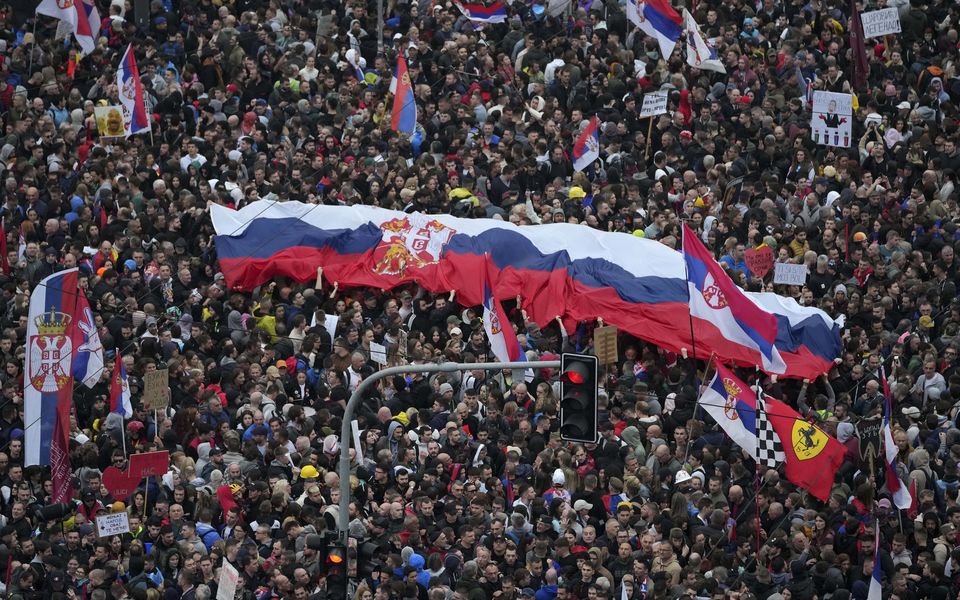
The popular movement that defeated Serbia’s autocratic regime in elections will keep politicians and academics busy for a long time, both with regard to its success on October 25 and for what comes next. How will a government with a comfortable parliamentary majority act when its MPs were selected by student assemblies, have no political experience and their movement has no shape or hierarchy? The unexpected, great success of the Student List warns that we should not underestimate it, that it would be wiser to see what we can learn from it.
In Greece, we ought to ask: How did the popular protests at the collapse of a roof at Novi Sad railway station in November 2024 trigger a continuous protest, which defeated the leader who had controlled everything in Serbia for the past 12 years? Whereas in Greece, overwhelming grief and mass protests after the Tempe train tragedy in 2023 did not lead to a similar outcome? Here, too, anger dominated politics for a long time, here, too, the political, state and personal responsibilities were evident.
The similarities between the protests in Greece and Serbia were focused mainly on the exasperation caused by the conviction that the political and state authorities, and businesses, don’t care about citizens. The death of 16 people at Novi Sad and 57 at Tempe, because they believed they could take a train without facing mortal danger, could not go without a response from the citizens. The differences between the two movements, though, are many, and they concern the nature and endurance of the protests and the political and social context in which they played out.
In Serbia, Aleksandar Vucic could not contain the anger; he chose to clash with the protestors, accusing them of being lackeys of foreign forces, thus energizing the students’ movement. The students, very correctly (as we see), did not cultivate any leading personalities who would have drawn the authorities’ fire. On the contrary, by ruling out personal ambitions they attracted people who shared their demand for freedom, justice, an end to corruption, and so on. Their careful handling of nationalism (always a strong factor in the region) kept from alienating supporters who might come from different political spaces. In other words, the Serb students beat the political system by refusing to become part of it.
In Greece, the exact opposite happened. Various opposition parties tried to commandeer and exploit popular anger, adopting every just demand, but also promoting every exaggeration and conspiracy theory. The government, while expressing sorrow and remorse, used every institutional means to defend itself. And the most charismatic figure to arise from the tragedy, Maria Karystianou, chose to confront the political system on equal terms and was swallowed by it.
The river of rage dried up in the channels of vanity.