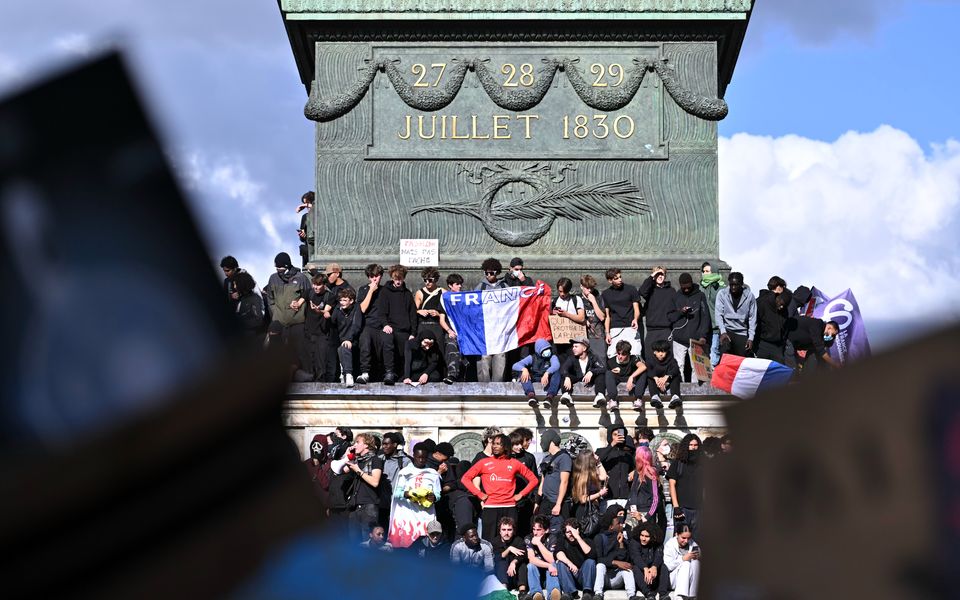
Violent protests in France always raise questions as to the health of democracy in the land which inspired a spirit of revolution in many nations. The French uprising is not the only one at this time, as the discontent of young people is being expressed through mass demonstrations in Spain, Portugal, Albania, and Serbia, among others.
France today is not giving birth to ideas, as it did at the end of the 18th century, with the Revolution, and the early 19th, with Napoleon. If the protests, the clashes, the looting of shops and the burning of public buildings show anything, it is disillusion and anger at dashed expectations. The days of fire in France are weighted with symbolism, with the focus on the statue of Marianne, the personification of the Revolution, dressed with the yellow vest of workers, with the marble representations of Liberty, Equality and Brotherhood at its base damaged and smeared with paint. The protestors declare that they consider these values meaningless, betrayed.
The time is very different from that of the Revolution, which marked the beginning of the old world’s fall. The overthrow of the French monarchy and the years of violent ferment in politics and society gave hope to other people that they, too, could dare to take their fate into their own hands and fight for freedom and equality. The Greeks “were the most effective recipients of the ideas and values of the French Revolution regarding the rights of nations,” Paschalis Kitromilides writes in his 2022 book, “The French Revolution and Southeastern Europe.” This was because the Greeks had the merchants, intellectuals and professionals who could absorb these new values in a functional way. And so, 1789 opened the way for the Greek Revolution in 1821.
The historical framework is useful for evaluating today’s developments. Those who commandeered the school pupils’ protests appear to be the “French chapter” of the international movement of violent protest. Their dress and choreography, the “coordinated defiance,” their nihilism and anti-capitalist spirit expressed through looting and rage against the (ostensibly betrayed, ostensibly lacking) democracy, against the merchants, intellectuals and professionals, is a familiar part of Greece’s landscape since the restoration of democracy in 1974. We have seen this repeatedly: before the 2008 riots, after a teenager was killed by a police officer, as well as after the years of the crisis. The ideas of the French protestors will not spread here, whoever is behind their masks. Disillusion, rage, the deconstruction of today’s “old” world are already everywhere. The only question is where and when we will see the next explosion. And whether – in an age in which tyranny, inequality and privileges of the few are returning – democracy will survive.