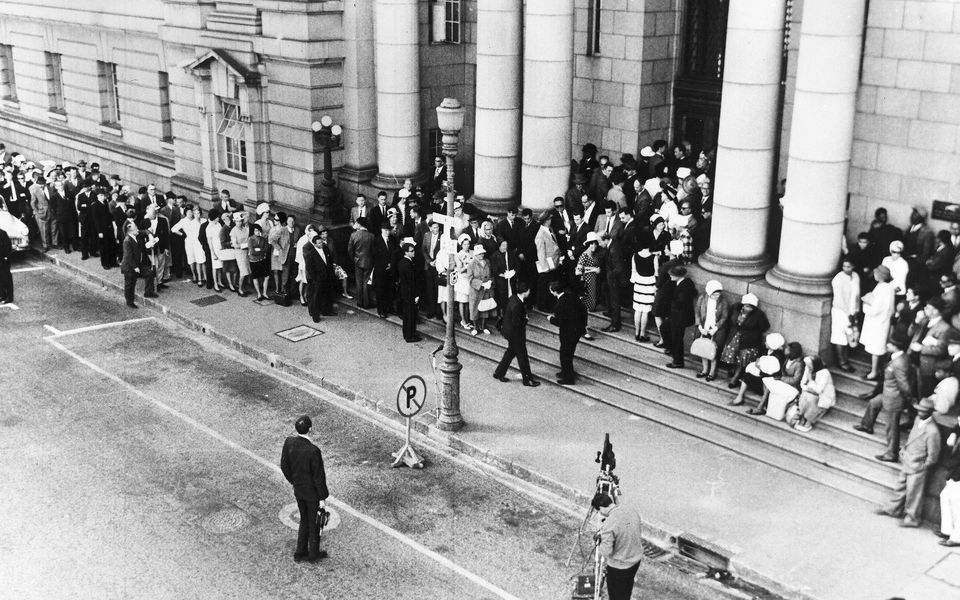
On a bare patch of earth, save some dry weeds and a broken stone with the number 59 on it, in the graveyard of an African town, a Greek Orthodox Bishop conducted a Trisagio memorial ceremony and the leadership of the South Africa Communist Party laid wreaths. The October 9 occasion was a significant step toward restoring the memory of a man who sacrificed himself by striking against the monster of systemic racial segregation by murdering the architect of apartheid, prime minister Hendrik Verwoerd in parliament in Cape Town, on September 6, 1966.
The presence of the Metropolitan of Zambia and Mozambique, Ioannis, and of the SACP secretary-general, Solly Mapaila, was not by chance. In the grave lies Dimitris Tsafendas, who was born in Mozambique in 1918, of a Cretan father (Michalis Tsafandakis) and a Mozambican mother (Amelia Williams). From a young age, Tsafendas had joined the Communist Party in the struggle against colonialism.
His tragedy is not only that after committing the murder (aged 48), he spent the rest of his life (33 years) behind bars, but also that his sacrifice was not recognized, at least not until recently. He was forgotten, as the whole world accepted the regime’s claim that Verwoerd’s assassination was not a political act but the work of a madman. This narrative was chosen to avoid a trial in which Tsafendas would have been able to expand on his motives. In this way, too, Tsafendas avoided almost certain execution. But, without being tried, he was held in the country’s harshest prisons.
When a democratic government was elected in 1994, he was moved to a psychiatric hospital. He died there in 1999, aged 81. Like his grave, his existence was forgotten. Until 2018, when a political scientist from Durham University in England, Harris Dousemetzis, published his book, “The Man who Killed Apartheid,” the product of nearly 20 years of research. Having learned of Tsafendas from Bishop Ioannis, who, as a priest, had visited the prisoner, Dousemetzis examined the archives of South Africa, Mozambique, and Britain, among others, combing through some 12,000 pages of documents and interviewing 137 subjects. Among his findings was Tsafendas’ statement to police shortly after his arrest. “I did believe that with the disappearance of the South African prime minister a change of policy would take place,” Tsafendas had declared. “It was my own idea to kill him. I did not care about the consequences … I was so disgusted with the racial policy that I went through with my plan to kill the prime minister.” This was not heard in court.
In the last years before his death, there had been some stirrings of interest in Tsafendas, but it took Dousemetzis’ work to prove that not only did Tsafendas know what he was doing, he had also committed himself to the struggle against colonialism at an early age.
On October 9, Bishop Ioannis (Tsaftaridis) set up a wooden cross on the bare grave outside Krugersdorp, with the Communist Party’s banner with hammers and sickles serving as a backdrop to the ceremony. “Dimitri, this is your cross now,” the bishop said. The Communist Party is planning to have Tsafendas’ remains exhumed and laid in a grave that it will build in the cemetery’s Heroes’ Acre.