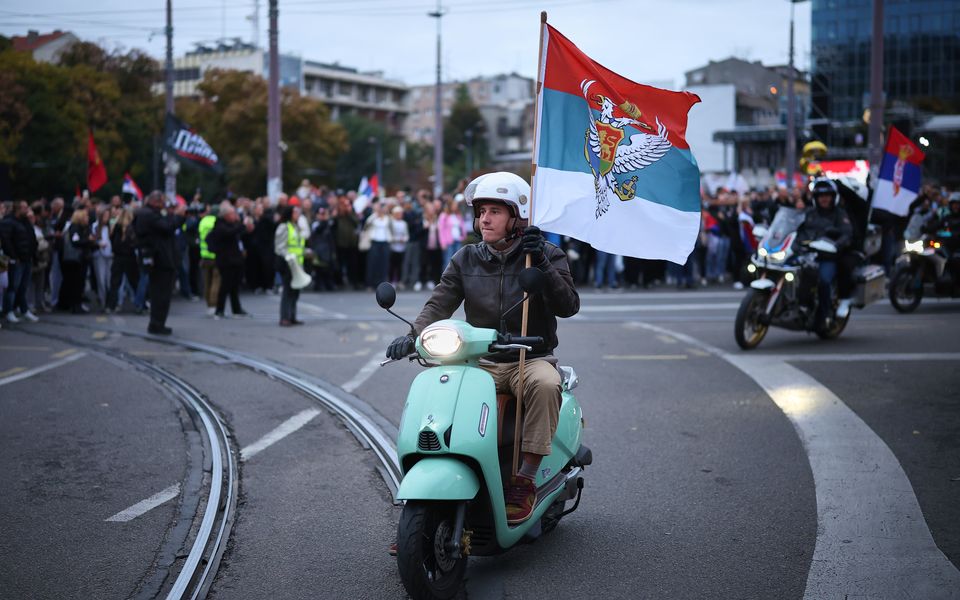
In Serbia on Sunday and in Israel on Tuesday, young voters will play a decisive role in national elections and, by extension, in their country’s future.
A wave of youthful frustration is sweeping across the world, threatening the political establishment from the streets of Albania and France to the world’s largest democracy, India. The causes of movements and their aims may differ but they have something in common. “Although their political stances differ, they’re all united in the belief that the time has come for South African youth to emerge from the sidelines to play decisive roles in shaping their communities and futures,” the Daily Maverick newspaper commented on the candidates, who are under 30 years old and contesting municipal elections in South Africa on November 4. The same applies elsewhere.
In Serbia, this feeling has been evident for two years, since November 2024, when part of the roof of the train station at Novi Sad collapsed, killing 16 people and setting off youth protests that spread across the country and did not stop. According to polls, in Sunday’s vote, the Student List could beat the party of veteran Aleksandar Vucic, who is running for prime minister after serving as president for two terms. The Serbian students’ movement differs from others in that from the start it has refused to establish leaders. It persisted with this in the run-up to the election, excluding students from running for parliament, along with other likely leaders, such as the popular rector of Belgrade University.
The movement demands the rule of law, press freedom and an end to corruption. Although this reflects the European Union’s principles, the students are wary of the Union, because for years it has been in a transactional relationship with Vucic, on issues such as access to lithium reserves and the Serb president’s close ties with Vladimir Putin. If the Student List wins, there will be significant changes in a country that has been under Vucic’s control since 2014 (first as prime minister and then as president). Political instability would have severe consequences not only for Serbia but for the broader region, too. (And a strong but leaderless political bloc in parliament would be especially interesting).
Israel’s youth have other concerns and other inclinations. In Tuesday’s elections, Prime Minister Benjamin Netanyahu’s fate is in the balance. Polls show his rival Gadi Eisenkot leading, but neither appears capable of winning a majority in the 120-seat Knesset. More than 500,000 young Jewish citizens (there are Palestinian citizens, as well) will be voting for the first time. They are reported to be more right wing than people over 55 years old, with 16% of them supporting the extremist national security minister, Itamar Ben Gvir, one of Netanyahu’s coalition partners. About three-quarters of these young people describe themselves as right wing or center right. “They have grown up under a series of wars with no personal experience of efforts to achieve peace. But for the most part, they have been socialized into the most extreme terms of the debate (as) legitimate to discuss: annexation, settlement expansion and – after 7 October – annexation of Gaza,” political analyst Dahlia Scheindlin told the BBC.
Here we can see the depth of the wound caused by division and violence – when young people who could forge ties of friendship, who could break the cycle of hostility, do not get to know similarly-aged people of the “other side” under conditions of peace, but do so only through conflict or through narratives on the enemy’s inhumanity. The natural thing would be for the young to question their elders and seek solutions to the dead-ends into which they are being led.
In Serbia, many years of autocracy have pushed the youth to seek freedom and justice. This is the driver of the “Cockroach” movement in India today, as it constitutes the gravest threat to Prime Minister Narendra Modi. In Albania, South Africa and elsewhere, the “enemy” is corruption. In Western Europe it is dashed expectations and inequality. In Greece, it is chronic dysfunction and injustice (among others). In Israel, the stakes are existential, and this makes it very difficult to ease the tension within the country and across the region.
In many countries, disruption is coming, as a necessary revival after the bankruptcy of political systems. In others, extreme reaction grows. And no one knows what comes next.