Translated transcript of interview with Dr Marthie Momberg, broadcast on eNuus on Sunday 1 August.
INTRO:
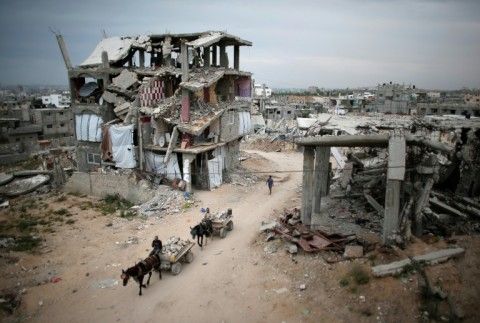
Israel bombed Gaza City this weekend and dozens of Palestinians have already been killed.
With the humanitarian disaster worsening by the day, Israel’s actions are increasingly being condemned.
Dr Marthie Momberg is a researcher at the Beyers Naudé Centre for Public Theology [at Stellenbosch University].
In 2011 she monitored and reported human rights violations in Israel and Palestine, on behalf of the World Council of Churches.
She is also the author of the book 21 Voices: Why the Palestinian Struggle is a Global Matter.
Momberg shared her insights about the crisis with eNuus.
VOICEOVER
For many people, the war in Gaza began with Hamas’s attack on Israel on October 7, 2023.
It will end, they say, when Hamas releases the last Israeli hostages.
Dr Marthie Momberg disagrees.
DR MARTHIE MOMBERG, Research fellow: Faculty of Theology, SU
“It’s an emotional and a desperate argument that sounds reasonable, but it’s not accurate and it’s unrelated to the truth. Israel has actually always, or decades, let me rather say, they’ve had military occupation of Israel and Palestine, which means a low-level war. Because people are being murdered, their houses are being razed, their infrastructure destroyed, decisions are made about how much they’re allowed to eat, where they’re allowed to live, who they’re allowed to marry. Every part of their lives are regulated, and all of it is illegal.
“So it is literally the only trump card Hamas has. And that doesn’t justify them kidnapping civilians, because that isn’t allowed under international law. At the same time, we need to look at ourselves and say, the Palestinian resistance has gone through so many phases, but we, the world, failed them repeatedly. So what is left for the Palestinians? Hamas has said, if they get a guarantee that the war will end completely, they will release all of the prisoners, the hostages. And Israel refuses to give that guarantee.”
VOICEOVER
Israel often claims that it has a right to defend itself — especially when the IDF’s actions in Gaza are criticised.
DR MARTHIE MOMBERG, Research fellow: Faculty of Theology, SU
“According to international law, a party, in this case Israel, which is occupying another country, Palestine, can never, under no circumstances, lay claim to a right to defence, because they are the aggressor. They are allowed to police [the area], it was wrong of Hamas to capture civilians, they are allowed to police. But they may not launch a military intervention, and they may under no circumstances declare war against the people they are occupying! It’s like a rapist telling his victim, you scratched my eyes because I did this and that, now I’m going to kill you and that’s my right to defence. That’s what it comes down to. It’s as crass as that. So no, on legal grounds, they have absolutely no right to self-defence. They are the aggressor, and they’ve been the aggressor.”
VOICEOVER
Last week, Israel launched a new offensive to occupy Gaza City.
But Prime Minister Benjamin Netanyahu and his cabinet’s actions, Momberg says, is merely a continuation of the initial occupation of Palestinian land in 1948.
DR MARTHIE MOMBERG, Research fellow: Faculty of Theology, SU
“So that plan has been action since then, but at a slower pace and with the layer of varnish of diplomacy, and negotiations, and a supposed two-state solution, all of which is window-dressing. All ways to fool the public. The difference now, is that that layer of varnish is gone. Netanyahu and Smotrich and the rest of his cabinet, are saying openly what they’ve been doing all along, and these actions are increasing.”
VOICEOVER
The three months she spent as a human rights monitor in 2011 opened her eyes, she says.
She worked in the West Bank and east Jerusalem, and says attacks by Jewish settlers on Palestinians had already begun to increase.
DR MARTHIE MOMBERG, Research fellow: Faculty of Theology, SU
“I saw, every single day, how land was confiscated, how people were killed, how Palestinians were killed, their olive groves cut down or burned, their homes razed, their animal shelters and roads destroyed, their children, the little girls being pawed at and molested, in front of oour eyes. We recorded it and reported it to the UN. Every single day. And it was at that time that I realised that I, as a South African who did nothing to end apartheid over here, I cannot stay silent again. I will lose all of my integrity if I don’t talk about it.”
VOICEOVER
Something she only learned then, Momberg says, is that not all Jews are Zionists or supporters of the state of Israel.
While writing her book she conducted interviews with 21 people, which included both South African and Israeli Jews.
DR MARTHIE MOMBERG, Research fellow: Faculty of Theology, SU
“Some of them did use to be Zionists. What I found very interesting is that these people’s values didn’t shift, they just realised that in Israel those values are only applied selectively, only to fellow Jews, not to others. If I say that I am a person who wants to be embody human dignity, truth, justice, equality, and love for my fellow human beings, then I can’t — and this is what they also say — then I can’t look at myself in the mirror every morning, if they don’t apply those values to all people.”
VOICEOVER
Louise Ferreira, eNuus.