
Woke mayhem at McCarter & English and bare-knuckle politics in Essex County, N.J. threaten the 2026 NYC SEAL swim. But no one counted on a man who wouldn’t quit.
Hundreds of swimmers churn through the tidal estuary of New York Harbor, bright orange safety buoys bobbing beside them. Rescue boats and jet skis pitch and yaw around the racers and sun glints off the water. Coast Guard and police boats idle on the outskirts of the action, while Lady Liberty stands tall over the highly choreographed chaos of the NYC SEAL swim, which brings together hundreds of Navy SEALs, veterans, police officers, and firefighters for a tough multi-sport race.
The event, which over seven years has raised millions of dollars for charity, is an unabashed celebration of brawn, pride, grit, strength, and patriotism—everything that Americans are being taught to despise. Many swimmers wear knives and daggers strapped to their legs in honor of teammates lost in battle.
Conceived in 2019 by retired Navy SEAL and attorney William D. Brown Jr. as a means of recharging the bonds between former warriors, aiding their transition into civilian life, and supporting the families of the fallen, Brown says that competing together in tests of strength and endurance helps former fighters, many carrying battle scars both visible and invisible, “meet where they’re strongest—in action, outdoors, shoulder to shoulder. It mirrors the teamwork of military and first responder units, rebuilding the brotherhood and trust often lost after leaving service.”

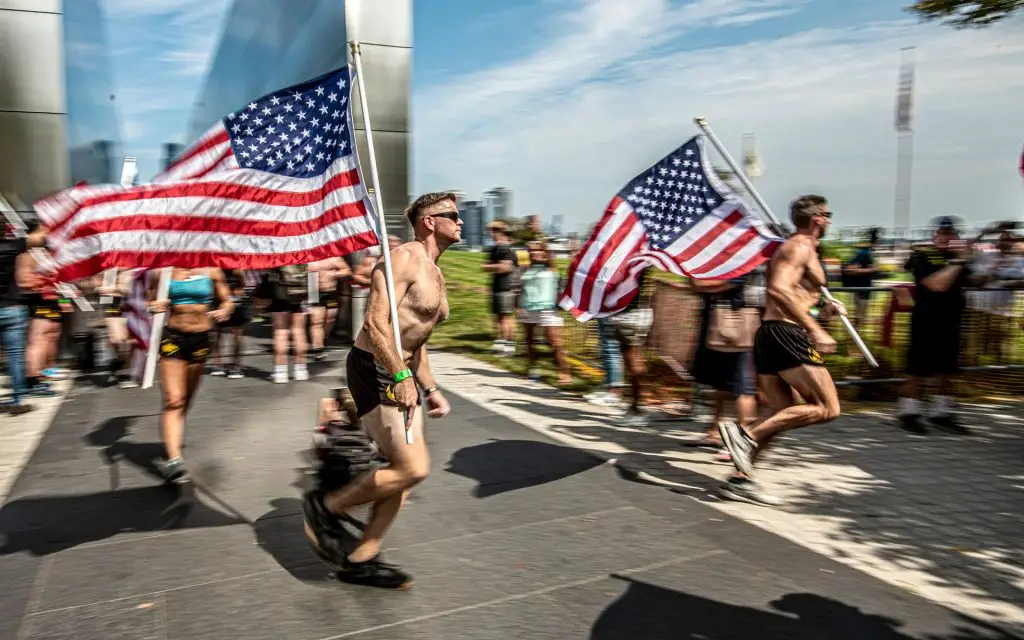
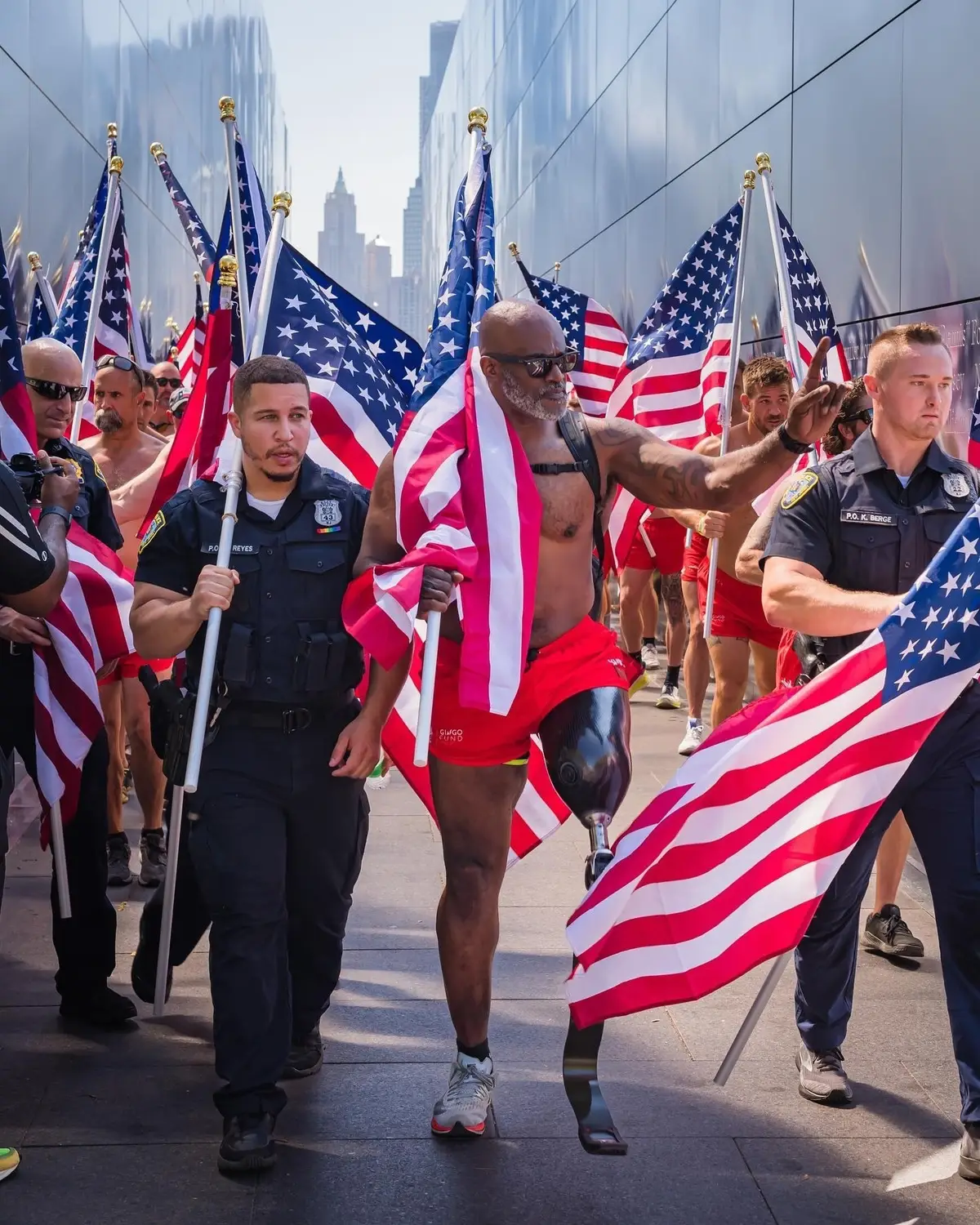
The race begins at Liberty State Park in N.J., where swimmers plunge fins first into the cold water, then stroke a total of 3.2 miles to the Statue of Liberty, then over to Ellis Island, and climb out of the water at South Cove Marina in Manhattan. Beside each island monument, they stop at anchored barges, where they do 100 pushups and 22 pull-ups—the latter figure representing the number of veterans estimated to commit suicide every day in America. The pushups by Liberty Island honor the nation’s freedoms, and those at Ellis Island are dedicated to those who journeyed to America for a better life. After climbing from the water, the competitors jog with flags to the World Trade Center site to complete final exercises in memory of 9/11.
I came to know of the NYC SEAL swim in 2024 through a family friend, Amir Shpilman, a former member of the Israeli SEAL team, Shayetet 13. I stood with Shpilman’s family and other Israelis at the end of the race, not quite a year after the Hamas slaughter of Oct. 7, and our throats tightened with emotion as we caught sight of the Israeli flags bobbing into view at the head of the line of competitors running along Liberty Street in lower Manhattan, a field of Stars and Stripes behind them.
“Bill surprised us, recalled Shpilman. “He told me, ‘You guys go to the front, I want to send a message to the entire world’.”
“We were moved beyond words,” he said. “It came at a moment in the war when we felt everyone was against us, but our U.S. SEAL brothers embraced us, asked us to run in front with our flags, with hundreds of SEALs at our backs. The message to us, SEAL to SEAL was loud and clear: ‘You are not alone. We know what you are going through and we know the truth is with you.’”
But the future of the SEAL swim, benefitting hundreds of veterans, first responders, and families of the fallen, not to mention a dozen grateful Israelis, is now threatened by a witch’s brew of woke intolerance in Big Law and small-time New Jersey political gamesmanship. At the moment, it appears that the eighth annual NYC Navy SEAL swim, scheduled for this August, may never take place.
Brown envisaged the NYC SEAL swim as a way to honor those who lost their lives on 9/11 and in the ensuing 25-year-old war on terror. A young sailor in uniform on 9/11, Brown was sent to Iraq in the early, chaotic days of the Global War on Terror, and was a first responder in 2004 to two suicide bombings in Baghdad’s Green Zone, where he witnessed firsthand the screams of burned victims and saw the bloody, dismembered remains of those killed in the blasts. He quickly understood the civilizational threat of jihadism.
Perhaps as a result of his first-hand experiences of the Middle East, Brown has long been an active advocate for Israel and the Jewish people. In September 2024, he drove to Baruch College to help a small group of Jewish students stand up to a mob of pro-Palestinian demonstrators who vastly outnumbered them. He also led a team of SEALs to provide security and support for high-profile marches at Columbia University and USC, and coordinated rallies for Jewish students at CUNY and Columbus Circle on Oct. 7, 2024.
Brown had “a rough and tumble” childhood in the Delaware river towns of south Jersey. Born with a cleft palate, he struggled as a child to form words. He was teased for it, and he wound up in youth detention for fighting. “I was the black sheep of the family. Nobody thought I’d turn out to be anything.” He says the Navy saved his life.
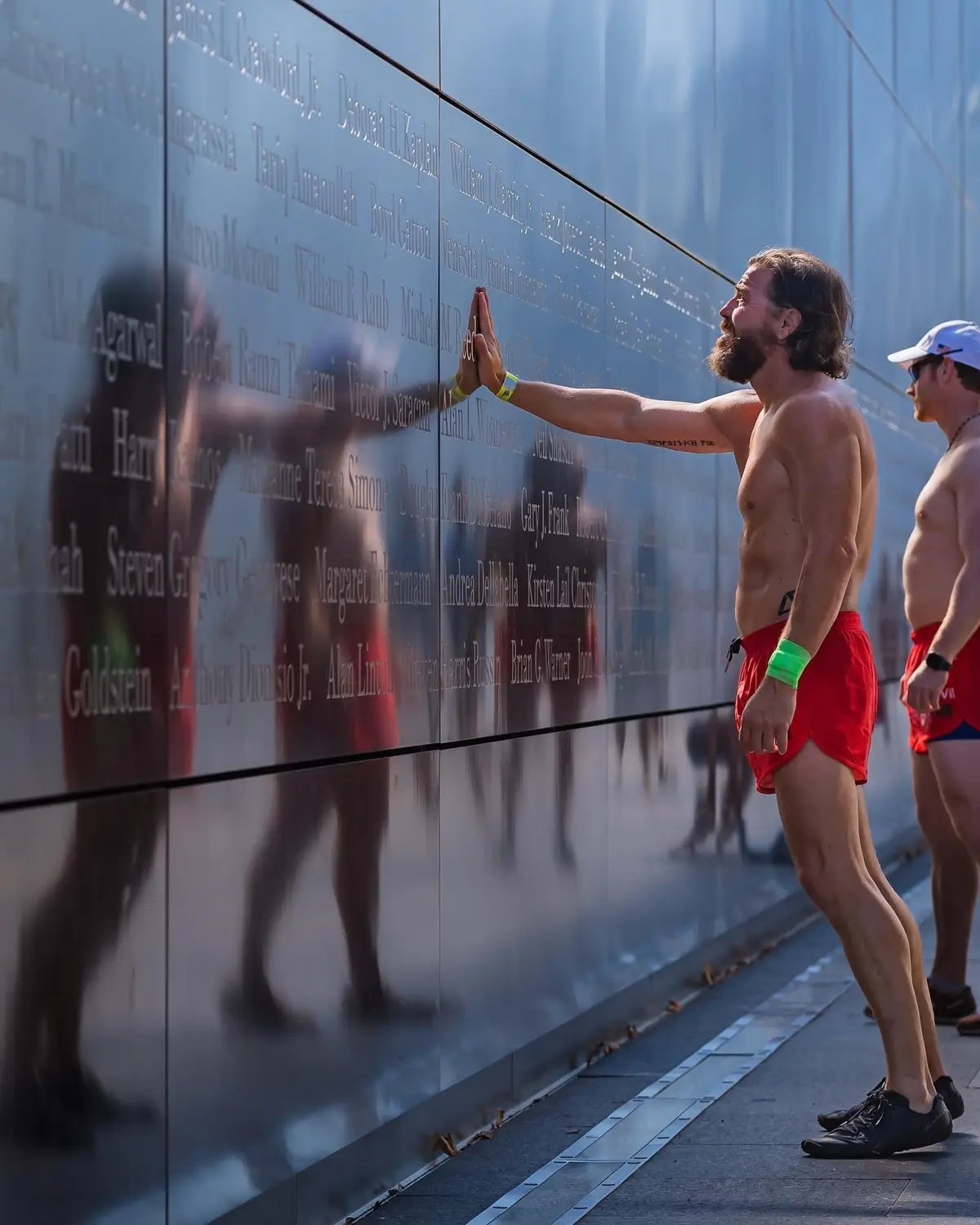
SEAL training weeds out 75% of applicants during its 27-week course, which is known as one of the most rigorous military programs of selection and training in the world. Cadets wash out of the program with stress fractures and broken bones, ACL and shoulder tears, hypothermia and pneumonia, after pushing their bodies to the breaking point.
Mental strength is what makes the difference. A few days before starting Basic Underwater Demolition/SEAL, Brown tattooed his chest with Friedrich Nietzsche’s famous maxim: “Whatever doesn’t kill me makes me stronger.”
Although he’d had a chaotic youth, he completed his first New York City marathon at 17 with his father. “Physically, I was pretty good to go.” But he was behind academically, and had a speech impediment, which made some people think he was “dumb.” But he had always been a good chess player, even getting in some practice with the guards in juvie. David Goggins, who has been called the “toughest man alive” for his accomplishments in the military (qualifying as a SEAL, an Army Ranger, and an Air Force Tactical Air Controller) and as an extreme athlete, credited Brown as the person who “lit a fire” under him during Hell Week.
In his bestselling memoir Can’t Hurt Me, Goggins describes sharing a front position in boat crew with Brown. “He was hard as hell and exactly the kind of guy I signed up to go to war with,” he wrote. “I made sure we were the two men at the front, where the boat is at its heaviest.” They pushed each other through a week of misery under incessant harassment, into and out of the freezing ocean, chafed, covered with sand, with a total of five hours sleep over seven days. Chris Kyle, the future “American Sniper,” was also in the boat with them, but Brown was the one Goggins called “the baddest man in Class 231.”
Both men found redemption from childhood wounds—Goggins survived a physically abusive father and racist attacks from the KKK—by pushing themselves to find an extra gear. And both overcame early troubles with speech—Goggins stuttered as a child—to become outspoken advocates for the human potential unlocked by the extreme effort and self-discipline of the warrior creed.
Brown served five and a half years as a SEAL and after eight years in the Navy, he was honorably discharged. Already married with a son, he studied political science at Rutgers University in Camden, where he founded the college’s first military and veterans student group, and helped establish the Jeremy Kane Endowed Scholarship, in honor of a 22-year old Jewish lance corporal in the Marine Corps who was killed by a suicide bomb attack in Afghanistan in 2010. Brown then raised $20,000 by running from Rutgers Camden to Rutgers New Brunswick (65 miles) to help fund the Scholarship.
A class in Constitutional law gave his professional life direction. “It was really a love story,” he says, and it led him to law school. It’s not for nothing that he wears the words “Liberty” and “Freedom” tattooed on his forearms; for most of his life he has lived by the oath to protect them.
In 2017, Brown joined New Jersey’s oldest law firm, McCarter & English, where he worked for seven years in the bankruptcy and commercial litigation department. There, he says he experienced some uncomfortable moments that underlined the difference between the military life he had led and the civilian professional world he had now joined. He would go on to describe these moments in a civil complaint. He says, for example, that an equity partner approached him in an elevator at McCarter’s Newark office and asked, without provocation or context, “How many people have you killed?” Per Brown, his answer was that he had always tried to represent his country honorably and was proud of his service. The lawyer later apologized and acknowledged that he had been “out of line.” The following year, the partner donated $1,000 to the NYC SEAL swim as a peace offering.
At annual cabin retreats for firm employees, Brown says he was disgusted by racist comments fueled by excessive drinking. He claims in his same complaint that one senior partner sent emails to other senior firm attorneys making light of one attorney’s having urinated on another and then attempted to downplay it by referring to it as a “golden shower.” Brown was shocked the lawyer faced no disciplinary action whatsoever, as they would have in the military.
He wondered if the differences between himself and his colleagues were the result of military service being so rare. According to 2019 statistics, veterans constituted only 1.67% of the attorneys in law firms of 251 or more lawyers nationally. In New Jersey, less than 1% of 1% of the population serves in the military, and most of those in Jersey had served in Korea or Vietnam. As an Iraq veteran, Brown was a minority within a minority.
Consequently, he tried for years to be included on McCarter & English’s DEI committee but, according to his complaint, he was repeatedly rebuffed. For six consecutive years, Brown says he was excluded from the firm’s annual Diversity Retreat—despite being a member of a federally protected class—a veteran. He claims that “all other federally protected classes had representation” on the DEI Committee but not veterans.
His example undercuts DEI’s very premises, because the whole concept of American possibility has been redefined as a fiction, an impossible, even cruel, hoax.
One year, after receiving numerous emails about the firm’s celebration of LGBTQ+ history month, Brown asked why no acknowledgement of 9/11 had been made, the day that sent him across the world into combat and led to the deaths of eight of his close friends. He claims that he was rebuked for his question by a DEI Committee member and prominent LGBTQ+ advocate, who suggested he was homophobic.
Brown was stunned. Little did his colleague know that Brown had shown his support for the gay community by swimming in South Jersey’s Cooper River directly alongside a Gay Rights Parade to show his support. “I have no issues with how consenting adults love and care for each other,” he responded.
Brown says multiple humiliations, from petty to outrageous, continued, reaching a peak in 2021, when Brown was suddenly assigned to what his complaint describes as a “high-volume caseload defending against allegations of child sexual abuse by the Catholic Church and its dioceses.” By that time, he was the father of a young girl, and though Brown acknowledged the constitutional right of accused parties to a vigorous defense, he “struggled with the moral dilemma of defending perpetrators of child sexual abuse,” and asked to be reassigned. He noted that these defense assignments were “outside the scope of work assigned to attorneys in the Bankruptcy Group” and that “no other attorneys in the Bankruptcy Group were assigned child sexual abuse defense matters in comparable volume or frequency.” His complaint says that his requests were ignored.
“In my opinion, the intent was clear,” he said. “Make the work so unbearable that they were hoping I’d self-select my way out of the firm.”
For two years, Brown performed the work asked of him. In time, he says that he came to identify with the abuse victims, “people who had been silenced, dismissed, and overpowered by one of the most powerful institutions on earth.” He was surprised to come to understand that though the victims had yet to beat their abusers in court, the simple act of telling their stories had been the first step.
“That lesson has never left me,” and he regrets defending the abusive priests.
In December 2023, Brown wrote a LinkedIn post about his opposition to violent ideologies in the U.S. and abroad: “In the 90’s the promotion of antisocial values and the glorification of violence and drugs portrayed in gangsta rap had a huge negative influence on many young and easily impressionable American black youth,” he wrote. “It’s my opinion that there’s also a radical culture within the Islamic world that promotes antisocial values and glorifies violence. This has had a devastating impact on millions of young and very easily influenced lives.”
Within days, Brown says that McCarter & English fired him, citing his post, which it claimed “promoted negative stereotypes of Muslim and Black Americans.”
Brown returned fire. He sued McCarter & English for wrongful termination, accusing it of subjecting him to a hostile work environment and discrimination as a veteran. His complaint accused the firm of terminating his employment not for his posts, which, far from “promoting negative stereotypes of Muslim and Black Americans,” he argued, expressed deeply-held views formed from his life experiences, both as a troubled youth who attended majority-Black schools and as a combatant in the war against terror. “I have seen the result of violent ideologies close up.”
The claim of an improper post was a pretext, he argued in the filing. The firing was in fact retaliation for his having complained, during a recent annual review, about being excluded from diversity efforts and for being paid significantly less than “similarly situated non-veteran employees.” He believed McCarter & English subjected him to a hostile work environment because he was an Iraq war veteran and held conservative views. He claimed that McCarter & English underpaid him by nearly $500,000 and ultimately fired him in retaliation for his advocacy for veterans.
After Brown’s firing, he says that a McCarter employee contacted him privately and expressed fear of being fired himself simply for “liking” Brown’s LinkedIn posts, describing “political oppression” at McCarter and lamenting that “freedom of speech doesn’t exist anymore.” Brown included the message in his complaint.
‘This reminds me of a movie called The Godfather’
“Their woke ideology and agenda turned their hearts cold toward me,” Brown says. (McCarter, for its part, has denied the allegations in Brown’s lawsuit and pledged to “clear the names” of the individual partners and employees accused of offensive behavior.)
Brown believes that his request to join DEI threatened to fracture the firm’s woke ideology. He was white, male, and able bodied. How could he be part of the DEI structure, which is supposed to level the playing field for the under-represented, the disabled, the overlooked? Had they given him a chance, they would have seen that Bill Brown, before joining the Navy, fit the definition of a young man likely to be overlooked—under-educated in poor schools, suffering from a speech impediment caused by a congenital condition, and in trouble with the law. But, taking the traditional route of young men with an unclear future, he submitted to the harsh discipline of a military order, fighting his own deficiencies and boosting his strengths. His example undercuts DEI’s very premises, because the whole concept of American possibility—“lifting oneself up by his bootstraps”—has been redefined as a fiction, an impossible, even cruel, hoax.
Infuriated by Brown’s suit, McCarter & English leveled the big guns at him, and hired as its defense counsel the firm of O’Toole Scrivo, whose founder and managing partner is Kevin O’Toole, a powerful New Jersey politician who over a 30-year career had worked his way into Jersey’s political elite—serving as mayor of Cedar Grove, N.J., then being elected a New Jersey Assemblyman, then a State Senator. But the kicker is that since 2017, he has served as the Commissioner of the Port Authority of New York and New Jersey—the agency whose cooperation is essential to the running of the SEAL swim in New York Harbor. The lawyer whose firm was hired to oppose Brown in court holds his finger over the abort button for the NYC SEAL swim.
Days after filing his suit, Brown says he received a text message from the Port Authority’s site safety manager, Patrick Donovan, telling him not to speak publicly against O’Toole, or his law firm. Brown would later submit a sworn declaration quoting what he described as Donovan’s communication: “Please be aware though that you cannot post, send or do anything else negative towards him [O’Toole] or his firm. If you do I will be out of the event along with all Port Authority assets and access to the WTC.”
Brown says the message was clear: “Shut up about O’Toole Scrivo or lose your swim.”
The move, he says, was breathtaking. He believed he could reach only one conclusion, “A government employee used his control over Port Authority assets and access to the World Trade Center—the sacred ground where 2,977 Americans were murdered on Sept. 11, 2001—as leverage to silence a veteran advocate and leader in the SEAL community who had the courage to file a lawsuit.”
For the sake of the swim, Brown remained silent. But he says that O’Toole retaliated anyway, and Brown eventually offered his account in the sworn declaration filed in his case. Per his account, officials of the Port Authority swiftly informed the Navy SEAL Foundation that it would not support the 2026 NYC SEAL Swim if Brown participated in the event, which he had created, nursed, and grown over seven years. The Navy SEAL Foundation subsequently terminated its contract with Brown and withdrew from participating in the 2026 NYC SEAL Swim.
Joe Palermo, a former Port Authority employee who is now Senior Director at Amtrak, told Brown that Patrick Donovan told him he was being pressured by Port Authority “leadership” and was worried about losing his own job, Brown added in his declaration filed in court.
“Seven years of charity work for 9/11 survivors, Gold Star families, and veterans in jeopardy,” Brown wrote on a LinkedIn post, where he has 30,000 followers.
Brown’s SEAL friend Rob Sweetman wrote: “This reminds me of a movie called The Godfather.”
Brown responded: “My heart’s broken.”
On Jul. 11, 2025, Brown’s suit against McCarter & English was trimmed by a state court judge who, in a 30-page decision, allowed him to proceed against his former firm with claims filed under the Uniformed Services Employment and Reemployment Rights Act, but dropped the count that relied on the N.J. Law Against Discrimination (NJLAD) because, as McCarter had argued, New Jersey had never specifically adopted “veterans” as a protected class, though the law protected people from discrimination based on race, sex, religion, disability, sexual orientation, and even hairstyles. (The NJLAD had protected “liability for service in the Armed Forces,” but that phrase was defined narrowly to cover people currently subject to recall, like reservists and Guard members. It didn’t unambiguously cover veterans who had completed their service. A 2017 change known as the Christie amendment expanded the scope of those protections but didn’t change the definition. Brown claims McCarter & English took advantage of this loophole to defend his firing.)
So Brown began a campaign to close that gap. He organized a march of veterans and their families, strollers draped with American flags, through the streets of New Jersey. He spoke to veterans at various events. “I told them the truth, that the law firm that fired me argued in court that they are not a protected class,” and that in New Jersey, “discrimination against them is legal.”
He met personally with every New Jersey senator and assembly member, one by one, telling them about his case, explaining why the NJLAD needed to be amended, and asking them to do the right thing by New Jersey’s veterans. He was relentless.
And he won. The New Jersey Legislature voted unanimously—Senate 37-0, Assembly 71-0—to amend the N.J. Law Against Discrimination to include veterans as a protected class, based on the discussion of his own case. Governor Phil Murphy signed it into law on January 20, 2026. Brown had previously organized “Operation Full Court Press,” in which he led hundreds of SEALs to Washington, D.C. to line the Dirksen meeting room for Pete Hegseth’s successful confirmation hearings for Secretary of Defense. As he points out, “being a SEAL is extreme.”
Brown, now a partner at the Parlatore Law Group, which specializes in veterans’ matters, swiftly filed an 18-count First Amended complaint on February 16, 2026, adding as defendants, The Port Authority of New York and New Jersey, Kevin J. O’Toole, and Patrick Donovan in their personal and professional capacities.
And this is where the story goes off the deep end.
On Feb. 28, 2026, a process server attempted to serve Kevin O’Toole with Brown’s amended suit at the commissioner’s home in Cedar Grove, N.J. O’Toole answered the door, but the process server accidentally asked for the wrong man, Patrick Donovan, the subject of his next service. O’Toole told him that nobody named Donovan lived there, that he had lived there for 20 years, and he closed the door.
When the process server realized his mistake, he returned to the house, but O’Toole did not respond. The process server called out: “If you can hear me, Mr. O’Toole, I have to come back anyway.” He described what happened next in a sworn affidavit for Brown’s case. He drove on and stopped on the side of the road a few blocks away to write up his notes. Within a few minutes, a police cruiser pulled up beside him, and the driver, who identified himself as a Cedar Grove police officer, Lt. Jason Rivers, told him not to attempt service again at the O’Toole’s residence.
Both men appeared to understand that command was of dubious legality. Rivers’s body cam footage recorded the process server, Joshua T. Lee, telling Rivers that he was just doing his job. Lee said to Rivers, “It doesn’t work that way. You know! You’re a police officer.” A process server is required to use “due diligence”—usually three attempts—to complete the service of legal papers. Lt. Rivers told him not to return to the house, that the owners didn’t want him on their property.
And then Officer Rivers made a second troubling request. He asked the process server to lie and say that he had served the papers, though he hadn’t, and told him to serve O’Toole through the Port Authority lawyers, “Okay then say you did it because—go through the attorneys.”
The very next day, the process server, Lee, attempted to serve Patrick Donovan. Lee swore in another affidavit submitted in Brown’s case: “I heard the dog barking at the door, and I heard other voices inside of the residence, but no one came to the door. I then looked over to [sic] window to the living room and saw someone trying to duck out of sight.”
Brown quickly filed a public records request regarding the interaction. Those records turned up a police incident report, which stated that the Cedar Grove police chief had “received a call from the Port Authority” reporting that “a process server was refusing to leave the property.” In his sworn declaration, Brown said that two law enforcement officers who looked over the body camera reel and the incident report suggested that the body cam footage was likely edited to cut out the identity of the Port Authority official who had called Chief Pumphrey—presumably O’Toole—and that the incident report seemed to be retroactively written and submitted after Brown’s record request had been made.
‘Seven years of charity work for 9/11 survivors, Gold Star families, and veterans [is] in jeopardy’
Brown argued in court that “both Port Authority defendants were evading service on consecutive days.” The evasion, he believes, was “coordinated.”
Brown filed a motion to disqualify O’Toole from representing McCarter & English on the grounds of conflict of interest. Brown charges that O’Toole used his role as Port Authority Commissioner to protect his client, McCarter & English, and O’Toole’s own son, who is a lawyer at the firm. In addition, he argues, O’Toole “is a named co-defendant in [his] action on seven counts, faces compensatory and punitive damages in his individual capacity, [and] has personal and financial interests that are directly adverse to McCarter’s defense.”
Brown also requested a referral of the law firm of O’Toole Scrivo, LLC, to the Office of Attorney Ethics for an investigation of its continued representation of McCarter & English LLP, and he said he submitted a criminal referral to the Federal Bureau of Investigation and a formal complaint to the Port Authority Office of Inspector General.
Which is where things might have lingered, until March, when Brown, according to his declaration, received an email from a Captain Eileen O’Toole, Kevin O’Toole’s sister—a 25-year law-enforcement veteran and the first female Captain in the Cedar Grove Police Department. She told Brown that she had read about his case and was reaching out because she had been subject to a similar pattern of behavior from her brother. On Mar. 27, 2024, she claimed in a sworn statement, submitted in Brown’s case, that after a family dispute, her brother blocked her ascension to the job of police chief of Cedar Grove, N.J. after she had officially been promised the job. She said that her brother is “an individual of considerable political power” who “uses whatever institutional power is available to him … to punish anyone who opposes him or falls out of his favor.” She further stated that he has “cultivated relationships with Cedar Grove officials and law enforcement that…he may have used for personal purposes unrelated to any apparent legitimate governmental function.”
Specifically, she claimed that he “has used the Port Authority Police as personal protection on many occasions, to the point of overnight postings of officers outside of his house and his law firm. Upon further information and belief, he has also contacted Cedar Grove Police supervisors directly.”
She contended that “the actions Kevin O’Toole has taken against Mr. Brown—including the use of a Port Authority employee to send threatening text messages, the withdrawal of Port Authority support from a charity event for veterans and 9/11 survivors, and the use of the Cedar Grove Police to stop a process server at Kevin O’Toole’s residence—are entirely consistent with what I believe to be the pattern of retaliatory conduct I have personally experienced and witnessed over many years.”
She wrote that Kevin O’Toole had also harassed her husband, Michael Kraynanski, a police officer with the Caldwell Police Department, and had even got his own younger brother, John O’Toole, arrested in Pennsylvania by the Cedar Grove, N.J., police.
She further asserted that Lt. Rivers—the same officer who stopped Brown’s process server—was told to “swear his loyalty to [Kevin O’Toole] if he was hired on the force.” She also noted how she believed that her great trouble finding a lawyer who would represent her in her lawsuit against him and others, which she filed on Jul. 19, 2022, and which was covered widely in the press, was attributable to her brother’s power in Essex County, New Jersey. (Kevin O’Toole has previously denied his sister’s claims, and both he and the Port Authority have similarly denied Brown’s allegations against him and other Port Authority employees.)
In response, McCarter & English is now performing a full-court press against Brown. After stalling for 14 months on any substantial response to Brown’s suit, both McCarter & English and the Port Authority separately filed removal notices, two minutes apart, yanking the case from state court to federal court, where the firm’s reputation and political contacts may help the perception of its case and put Brown—who is now representing himself—at a disadvantage. They did so on the very same day that Brown filed the recently released Cedar Grove public records suggesting that the Port Authority had called the local police to block service on O’Toole.
On Apr. 8, 2026, the Port Authority Law Department quietly withdrew as Kevin O’ Toole’s personal defense counsel, causing O’Toole to hire his own lawyers, at his own expense, at Calcagni & Kanefsky LLP. Brown believes this move is significant, as the Port Authority’s own bylaws compel the agency not to indemnify commissioners for conduct involving “actual fraud, actual malice, willful misconduct or intentional wrongdoing”—in other words, conduct akin to what Brown alleges in his case.
Meantime, the clock is ticking down on the 2026 SEAL swim; because of tidal conditions in the Harbor, it can only take place during a narrow window in August. The Battery Park City Authority in April denied Bill Brown’s request for a permit for the NYC SEAL swim. Strangely enough, Patrick Donovan, the Port Authority employee who Brown says sent the text about not speaking out against Kevin O’Toole, was copied on the denial email, despite not being on any of Brown’s original permit request emails. Says Brown, “It’s me against two of the best law firms in New Jersey. But I have no choice but to continue.” As far as he’s concerned, “The NYC SEAL Swim serves people who gave everything or lost someone who did. This event honors them. And I will do everything in my power to protect it.”