
Eddie Killing, 60, of Detroit has been sober for 16 years.
During that time, he completed his bachelor’s degree at Wayne State University and received “a plethora” of certifications, including as a community health worker. And he's close to finishing a master’s degree.
“I was able to kind of build some resilience, get my life back together,” he said.
Now, Killing works as a peer recovery coach with the Detroit Recovery Project, a nonprofit that provides substance use prevention, treatment and recovery services.
“I get to bring my expertise ... how I became a productive citizen, how I can identify with that individual who's experienced what I experienced years ago," he said.
Today, seeing peer recovery coaches like Killing in treatment facilities and emergency departments is increasingly common.
“Things are starting to get better," he said. "The medical profession is now seeing people as people.”

Killing is a success story at a time when Black men in Michigan are not seeing the same gains as the rest of the population in overcoming drug addiction, statistics show.
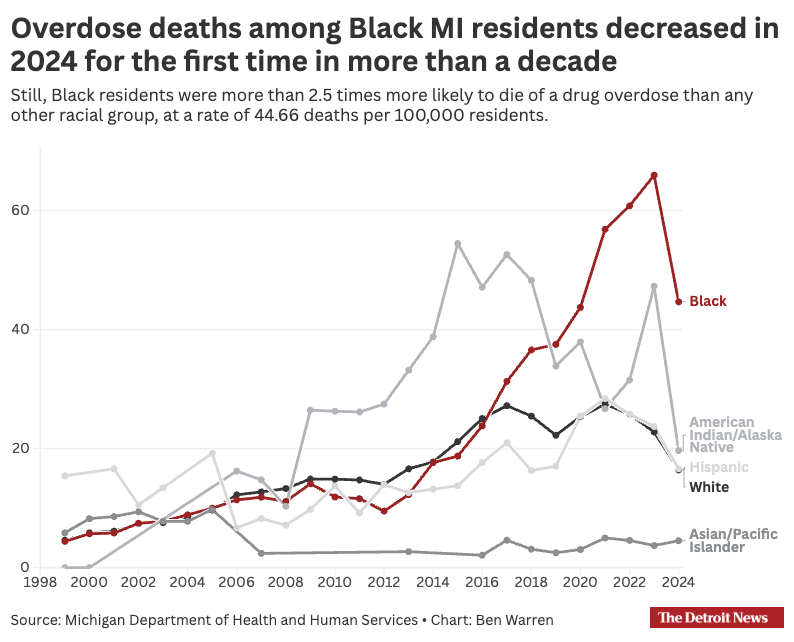
Around 2,000 Michigan residents died from drug overdoses last year, the lowest overdose death toll in a decade. But older Black men still bear the brunt of the opioid epidemic, according to preliminary 2024 data from the Michigan Department of Health and Human Services.
Overdose deaths in the state declined by more than 30% from 2023, driven by the first drop in the fatal overdose rate among Black residents in years. Experts said the widespread availability of the overdose-reversing medication Narcan is largely responsible for the trend.
Despite the improvement, Black Michiganians died from overdoses at a rate 2.7 times higher than their White peers — 44.66 deaths per 100,000 residents to 16.42 deaths. And Black men between the ages of 60 and 69 had the highest five-year average rate of fatal overdoses among all groups.
"The overall picture is that overdose deaths are down. You really have to look for some of the hidden data that certainly suggests that individuals of color are continuing at much higher rates of overdose deaths," said Joel Smith, the substance use prevention and treatment director at Southwest Michigan Behavioral Health.
At the state level, Dr. Natasha Bagdasarian, Michigan's chief medical executive, said "one of the things we can start doing is start targeting our resources, prevention, messaging, treatment availability and our harm reduction programs to this particular demographic."
Fewer deaths at epidemic's 'epicenter'
Nearly 50% fewer Detroit residents died from overdoses last year than in 2023, according to state health department projections.
And opioid-related deaths fell by a little more than a third, said Dr. Kanzoni N. Asabigi, vice president of integrated health at the Detroit Recovery Project, who reviewed figures from the Michigan System for Opioid Overdose Surveillance, a database maintained by the University of Michigan's Injury Prevention Center.
"The trend is generally a decrease in the number of overdoses and overdose fatalities at the local level and also statewide, so this is really, really good and welcome news," said Asabigi, who served as an epidemiologist in the Detroit health department for almost two decades.
The number of times naloxone, commonly known as Narcan, was administered in Detroit also fell, from 2,300 incidents in 2023 to 1,539 in 2024, a 33% decline.
Despite the declines, Asabigi said Detroit is still "the epicenter for this opioid epidemic." And racial disparities continue to plague Wayne County, where the city is located.
Black residents make up around 37% of Wayne County's population, but account for more than half of all incidents where naloxone is administered to reverse an overdose.
"We still have a lot more work to do to make sure that, you know, we don't have any overdose fatalities," Asabigi said. "That's the ideal."
Why racial disparities persist
Black men across Michigan are less likely to access harm reduction resources, according to Bagdasarian, the state medical chief.
"This could be because of stigma," she said. "This could be because in some of the communities where they live, there are fewer apparent resources available."
And older people who use substances can be hit hard by a drug supply that is overwhelmed with synthetic opioids like fentanyl, which is 50 times more powerful than heroin.
"We also know that older individuals, they may not be able to metabolize drugs in the same ways they did when they were younger," Bagdasarian said.
Dr. Andrew King, an addiction specialist who's the medical director for a Detroit opioid treatment center, said the average age of his patients is around 60.
Older patients, King said, are "not the picture that forms in people’s minds about who uses drugs. They’re a silent, significant portion of people who use."
King said his older patients may be retired, lonely, depressed or have chronic pain issues. This group can be "a really easy target for drug dealers," he said, especially when they have a consistent income such as Social Security benefits.
Drug use is "rampant" in some senior living apartments, King said. "Nowadays, the drug dealer will come directly to their door," he said.
When overdoses occur, Black men older than 60 are nearly three times more likely to refuse emergency medical services than White men that age, according to a state health department report.
Part of that stigma comes from "historical skepticism of the medical community doing the right thing for the African American community," King said.
Among the experiences his patients have had in hospitals, King described "being blown off, being labeled as a drug-seeker, not having pain addressed because of their higher drug use, believing they should suffer and have withdrawal because 'you deserve it.'"
"There's a lot of disappointing things we've seen," he said.
But a new generation of doctors has started to address these biased practices: "They seem to get it a lot better than previous generations," King said.
One big change is that recovery coaches with direct experience, such as Killing, are present in the emergency department.
“For the most part, there's a lot of guilt, a lot of shame that comes along with substance use; people just don't want people to know the depths of the addiction," Killing told The Detroit News.
His firsthand experience, he said, "is important to helping others through the treatment and recovery process. It allows the empathy to come through. It allows the compassion to come through.”
'Every single overdose death is preventable'
Bagdasarian attributed much of last year's decline in overdose deaths to the widespread distribution of naloxone, which can reverse overdoses if applied quickly. The state health department has distributed 1.3 million naloxone kits into Michigan communities so far, and around 30,000 of them have been used, she said.
"If you think about each one of those kits as preventing a death, that's a huge success," Bagdasarian said.
Other medications, like buprenorphine and methadone, can treat withdrawal symptoms and help people trying to quit using dangerous opioids. But they can be a tough sell to some patients.
"The main misconception that people have is that it is replacement, that you’re trading one addiction for another," said King, the addiction specialist.
Some patients come into his clinic "really suspicious of methadone because they don't want to 'get hooked' on it," he said.
"Much of this therapy is not a quick fix and requires a patient's effort and time," King wrote in an email. "However, it does offer significant comfort, and clearly, it's safer and very much changes the risk of death, increases functionality and generally increases quality of life."
"We don’t want people to die from an overdose, he said. "We want someone to live a rich, healthy life without drug use."
Across Michigan, buprenorphine prescriptions are up more than 20% from the beginning of 2020 to the end of 2023, state data shows.
But Amanda Scott, vice president of prevention services at the Detroit Recovery Project, said not enough clinics are located in Detroit.
"Medical access is really difficult when you're in Detroit," Scott said. "You have to get to the pharmacy, and you have to have an ID" to pick up a prescription. And even getting to a pharmacy can be a challenge for people who don't have a car.
"The closest pharmacy could be two bus rides away," she said.
State data from 2022 shows that prescription rates were comparatively low in the ZIP codes where the most residents suffered fatal overdoses.
That year, for example, doctors prescribed more units of buprenorphine per resident in Redford Township, in the northwest corner of Wayne County, than in the Detroit neighborhood of Boynton, even though Boynton residents were more than twice as likely to die from drug overdoses.
In some cases, pharmacies are a stumbling block.
"There's a lot of pharmacies in Detroit that just refuse to keep (medication for opioid use disorder) in stock. They will not order it," Lauren Judd, a family nurse practitioner who works for the Detroit Recovery Project, said during a recent town hall in Detroit on addiction and recovery.
The Overdose Prevention and Engagement Network, based at the University of Michigan, aims to close that gap.
People with opioid use disorder usually have to attend one or more in-person appointments before receiving medication like buprenorphine. But starting in September, OPEN will offer same-day prescriptions over the phone through a pilot program in partnership with Packard Health, a federally qualified health center in Washtenaw County.
OPEN will also cover the cost of medication for patients who don't have insurance and provide transportation to a pharmacy to pick it up. The pilot program will focus on people leaving Michigan's correctional facilities before expanding statewide.
Powerful opioids make things worse
Increasingly powerful opioids have hit Black men the hardest. In 2023, opioids were involved in more than 70% of fatal overdoses. And opioid overdoses were more common among Black men than any other group.
While White men over 65 years old used synthetic opioids in just over half of all fatal overdoses, Black men who died of overdoses used them more than 80% of the time.
Sometimes, people don't even know they are using opioids.
Megan Phillips, director of substance use disorder services for Oakland Community Health Network, said, "we are seeing a significant increase in overdose deaths with people who have stimulant use disorders."
"People take cocaine and crack cocaine, and it’s cut with fentanyl, and they don’t know it," Phillips said.
There is also evidence of carfentanil, an opioid 100 times more powerful than fentanyl, making a return to Michigan's drug supply. Its higher potency can cause even individuals with a high tolerance for opioids to overdose.
After causing more than 100 deaths in Michigan in 2016 and 2017, carfentanil mostly disappeared from the state's drug supply until it surfaced again in late 2023. Now, it's back, associated with 11 deaths in Michigan since January, in Ingham, Livingston, Eaton, Genesee, Oakland and Wayne counties.
"It is incredibly potent and worrying for folks who are already at risk," Bagdasarian said. "That's another reason why I'm worried about losing some of the momentum that we've made."
'The odds are in your favor'
The optimism about the positive trend in overdose deaths was evident last week at a town hall at the Garden Theater in Detroit sponsored by the Detroit Recovery Project.
Speakers and panelists expressed excitement about the strides Detroit has made in fighting the opioid crisis.
"This isn't just another meeting. It's a community coming together. United by compassion. In a shared goal, saving lives," Dr. Andre L. Johnson, the recovery project's founder and CEO, said in his opening remarks.
And they shared their anxiety about the future.
Dr. Corrie Vilsaint, an independent public health researcher formerly affiliated with Harvard Medical School, noted in her keynote speech that African Americans, "the group that has rising overdose rates, are the least likely to get medication, the least likely to get overdose prevention."
It's also becoming increasingly difficult to study these disparities, Vilsaint said, as federal cuts to the National Institutes of Health and a crackdown on diversity, equity and inclusion initiatives put a damper on her work. In her presentation slides, she used only the first letters to designate the names of minority communities.
"I'm just going say that we lost some of our freedom of speech," Vilsaint said. "My work is now being censored."

But Vilsaint had some good news, too. More than 70% of individuals with substance use disorder will eventually achieve full sustained remission, she said.
"The odds are in your favor," Vilsaint told the town hall crowd.