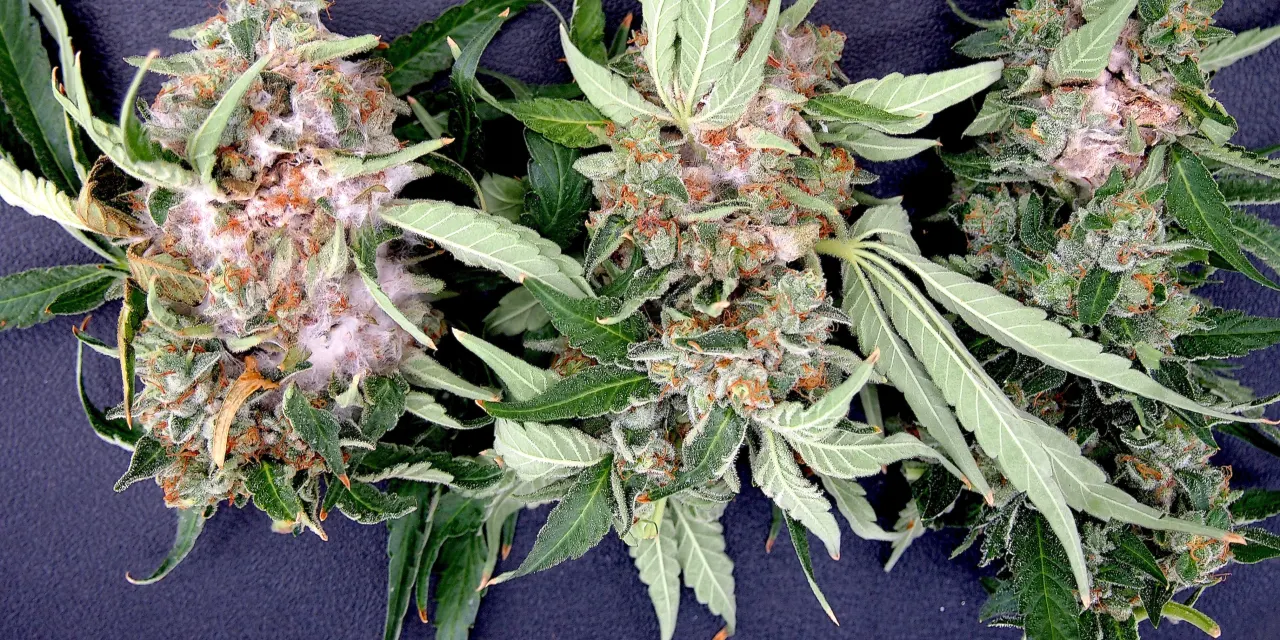
Marijuana’s humid growing conditions are a paradise for dangerous mold. States where marijuana is legal make growers hire laboratories to check for concentrations of mold and other contaminants that can sicken or kill. But laboratories in many states appear to underreport concentrations of contaminants, a Wall Street Journal analysis found.
A disproportionate share of the samples were reported to contain levels of mold just under legal limits compared with the share of samples containing levels of mold just over legal limits, the analysis of over two million mold-testing results from nine states found.
The improbable pattern suggests tainted samples are being cleared for sale, statistical experts said. The findings reveal a system that isn’t reliably monitoring for dangerous substances in legal marijuana.
“This is something that would not be expected if you took measurements of mold and reported them out in a way that was done without knowledge of the legal threshold,” said Joseph Hogan, a biostatistician at Brown University.
Growers, labs and regulators appear to be exposing people who use legal marijuana to dangerous contaminants, said Tess Eidem, senior research associate in the Environmental Engineering Program at the University of Colorado, Boulder.
“There’s no way to know what’s going on when you get a system that doesn’t play by the rules,” she said.
The Journal requested mold-testing data from the 37 states with medical or recreational marijuana programs. The Journal received data from 18 states, ranging from 2014-2024, but didn’t include data from nine that wasn’t comprehensive.
Molds including Aspergillus and Fusarium as well as the toxins they produce can cause infections, dangerous immune responses and even death. Marijuana users are nearly four times as likely as nonusers to be infected with fungi including Aspergillus, a 2020 review of insurance claims showed.
“The spores are so small that when you take a deep breath, you can pick them up into the lungs, ” said Zamir Punja, a professor of plant biotechnology at Simon Fraser University in British Columbia.
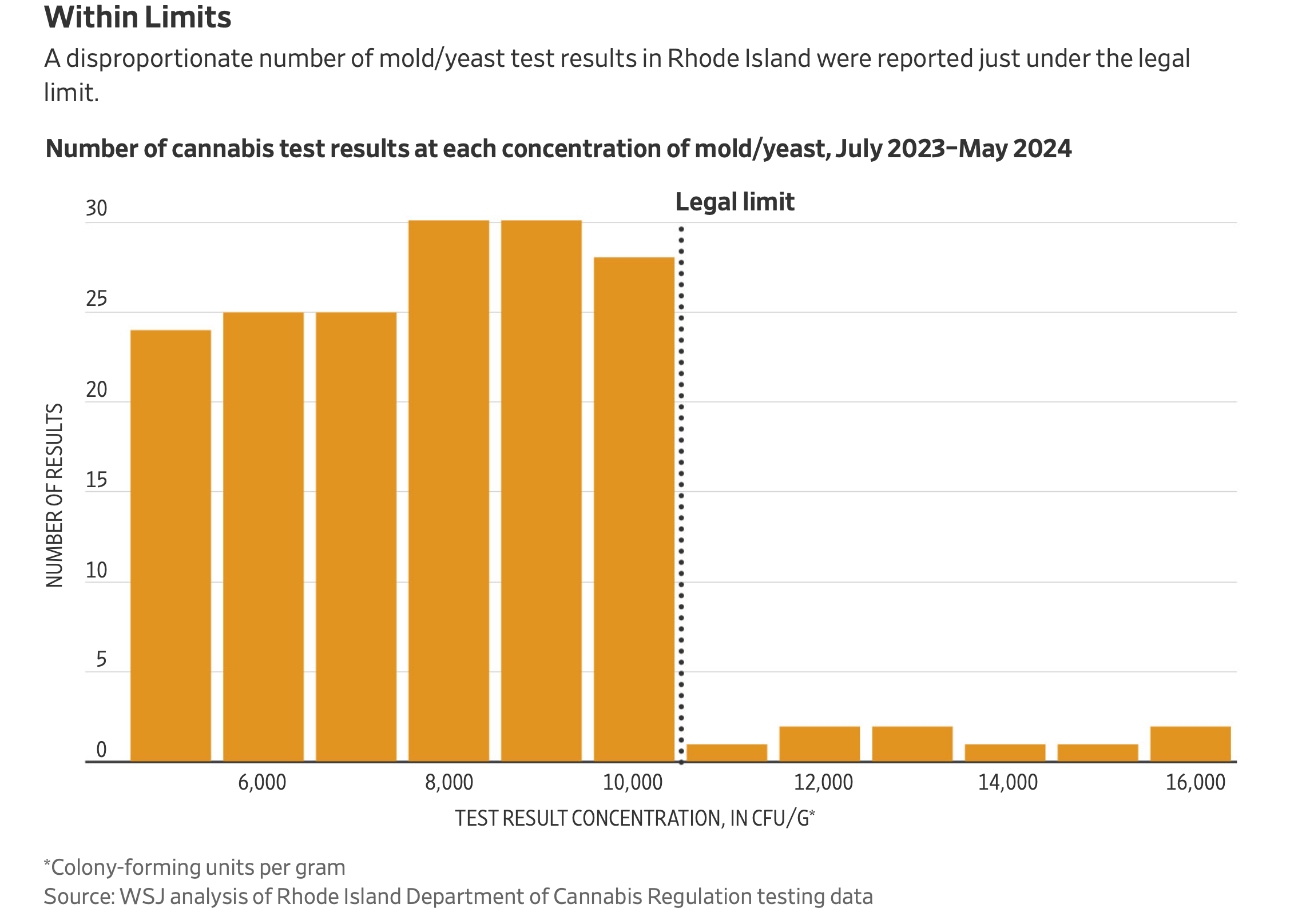
In the test results the Journal analyzed, labs in Colorado, Massachusetts and Rhode Island were four times more likely to report results just under legal limits than just over.
Colorado’s revenue department said it monitors and audits labs closely. The cannabis-control commission in Massachusetts said environmental factors and different testing methods can produce atypical results. Rhode Island’s cannabis-control commission said it would welcome a nationwide standard for testing marijuana.
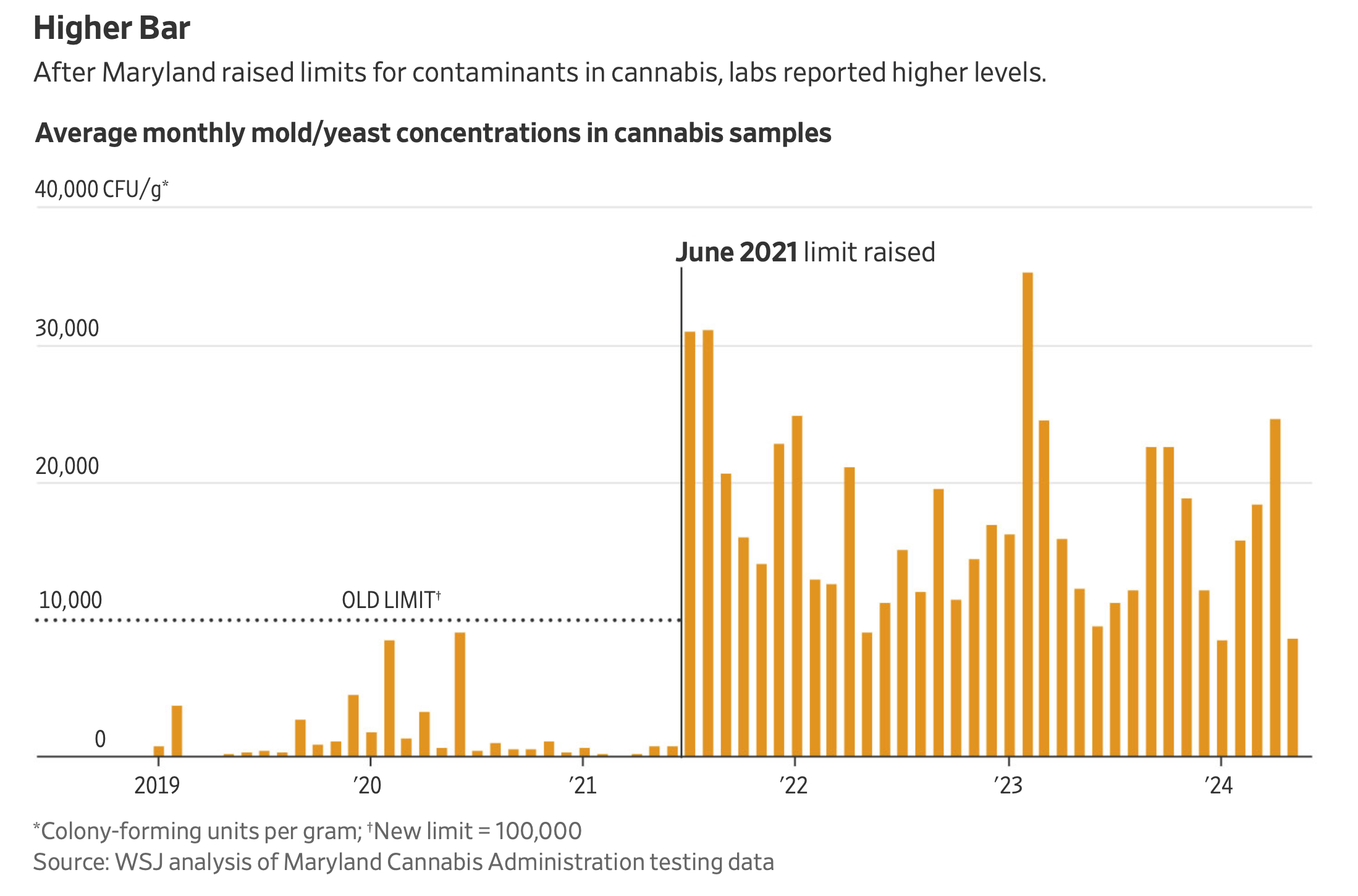
Maryland in 2021 raised its legal limit by a factor of 10. Average mold concentrations reported by labs in the state increased in kind. Maryland’s Cannabis Administration said its testing standards are evolving.
Hazy standards
Most states set the limit on yeast and mold content in cannabis at 10,000 “colony forming units” of yeast and mold per gram, a measure of cells that could form harmful growths. Labs use one of two tests: a lab culture or PCR testing. Lab cultures document live microorganisms that proliferate on a plate. PCR tests search for their DNA fingerprints. Only a few states review the methods that labs use.
The regulations were modeled on those for other crops because there is little research on the cultivation of marijuana. It remains illegal federally even as states have allowed its use and sale. The long-term health effects of marijuana use are only beginning to get a closer look from researchers.
“We’re conducting a big experiment without enough knowledge, ” said David Miller, a professor who studies fungal toxins at Carleton University in Canada.
Discrepancies between what companies report on marijuana packaging and the content of those products are an example of inaccuracy and fraud in the cannabis-testing market, the National Academies of Sciences, Engineering and Medicine said in a September report.
Bad for business
Labs that passed a larger share of samples received more business over time, the Journal’s analysis showed. Labs that detected less mold year-over-year tested 28% more samples the next year, the data from 2014-2024 showed. Competitors that reported more contamination year-over-year tested 50% fewer samples over the same period.
From April 2021 through 2023, labs in Massachusetts that failed fewer tests than in the previous year tested a median of 84% more samples during the next 12 months.
A processing plant in Holyoke, Mass., owned by Florida-based Trulieve tested 80% of its samples at the lab Steep Hill Massachusetts between May 2021 and January 2022. Trulieve’s failure rate for mold contamination at Steep Hill during that time was one-sixth the failure rate at labs that processed the rest of its samples.
Trulieve said it selected state-licensed labs based on factors including capacity, turnaround time and pricing. Steep Hill’s methods were approved by the state’s cannabis-control commission, said Shannon Hoffman, regional director of operations at Green Analytics, the lab’s current name. She wouldn’t comment on specific customers.
Lorna McMurrey worked at the Trulieve plant while Steep Hill was testing most of its samples. She died at age 27 after suffering an asthma attack there on Jan. 4, 2022. Her family filed a wrongful-death lawsuit against Trulieve, claiming moldy cannabis dust contributed to her respiratory attack.
The lawsuit alleges that a leaky HVAC system caused mold to grow on the marijuana in the processing plant. A machine that workers used to grind cannabis spewed dust that contained visible mold, the suit says.
“They did not protect my daughter,” said Laura Bruneau, McMurrey’s mother.
Deana Apualatl, who worked with McMurrey at the plant, said workers often ran the grinding machine without a filter. Workers including McMurrey wore bandanas as face coverings while the grinder threw dust in the air, Apualatl said.
Trulieve said technicians at the facility were trained to prevent and detect contaminants including mold. Trulieve said McMurrey’s death wasn’t related to mold.
The Occupational Safety and Health Administration and the Massachusetts Cannabis Control Commission said McMurrey died from asthma and an allergic reaction to cannabis dust.
OSHA tested air quality inside the facility in April 2022 and found it safe. OSHA didn’t test the air for mold. OSHA said it doesn’t have a standard for airborne mold levels. Samples of cannabis Trulieve said it was processing the day McMurrey died contained mold and yeast levels below legal limits, OSHA said. Trulieve closed the Holyoke plant in 2023. The commission in June fined Trulieve $350,000 for violating workplace safety regulations and failing to properly train workers exposed to cannabis dust before McMurrey’s death.
Second opinions
Michigan in February 2021 required labs to have testing methods validated by the Association of Official Agricultural Chemists, a nonprofit that vets scientific methods. That month, 14% of raw-plant samples exceeded the state’s limit for mold. A month earlier, 3% of samples were reported to contain illegal concentrations of mold.
Michigan is among about 10 states opening reference laboratories to test marijuana. Claire Patterson, director of Michigan’s new reference lab, said such validation will help protect consumers.
“People selling products they know are contaminated don’t have a place in this industry if we want this industry to survive long-term,” she said.