
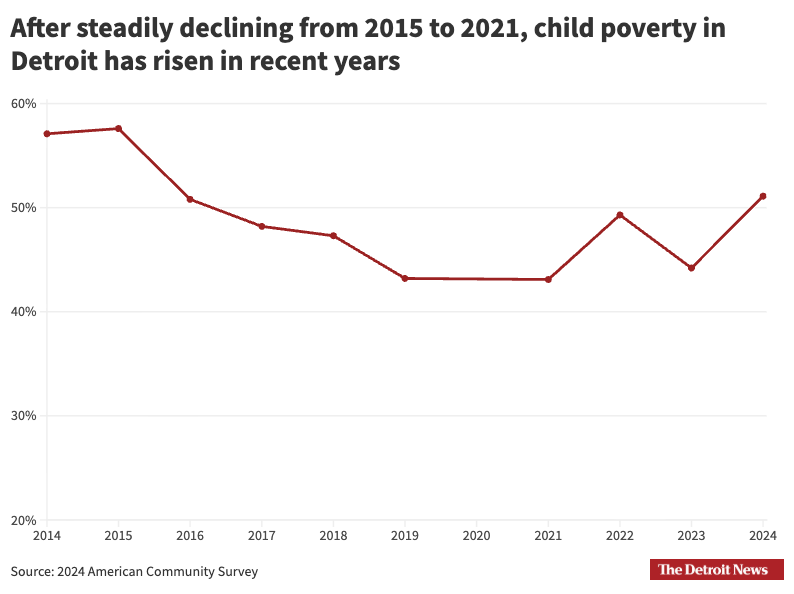
More than half of all children living in Detroit fell below the poverty line in 2024, threatening nearly a decade of progress in the city's fight against child poverty, straining nonprofits that provide key services and leaving young students further behind in school.
The city's 51% child poverty rate last year was three times the national average, according to data released by the U.S. Census Bureau in September. It was the highest of any city in Michigan, with more than 65,000 people, and higher than any major city in the Midwest.
"That’s a meaningful increase. It’s also a symbolic one. You’ve officially eclipsed 1 in 2 kids in poverty," said Luke Shaefer, who directs the Poverty Solutions team at the University of Michigan, a group of researchers who work with Michigan communities on evidence-based policy to combat poverty.
Detroit's poverty rate across all residents increased to 34.5% in 2024, up from 31.9% the year before, making it the poorest city with more than 500,000 people in the country. The national rate fell to 10.6% in 2024 from 11.1% the year before.
But the data shows that the increase affected children more than any other group.
The poverty rate among Detroiters from 18 to 64 years old increased by a little more than a percentage point, and the poverty rate for those 65 and older increased by 2.5 percentage points. The child poverty rate jumped nearly 7 percentage points.
The issue has become a flashpoint in the campaign to decide Detroit's next mayor, with the two general election candidates presenting different visions of how to empower a city that for years was one of America's most economically depressed.
What's behind the rising poverty rate
Shaefer isn't surprised that more children in Detroit are living in poverty than a few years ago.
"Families with kids report the hardest time putting food on the table, paying the rent. They have trouble paying the utility bills," he said.
The forces behind the increasing child poverty rate are similar to the reasons poverty increased in Detroit across the board over the last few years, Shaefer said. He pointed to the transition from "one of the best labor markets ever" to one where the unemployment rate in the city is nearly 10%.
"Inflation is a factor, too. When you’ve got more mouths to feed, that magnifies the challenge," Shaefer told The Detroit News.
During the COVID-19 pandemic, programs like rental assistance helped families with young kids stay out of poverty, said Jennifer Erb-Downward, the director of housing policy for the Poverty Solutions team.
Now that those programs are gone and the federal government has made cuts to federal programs like Medicaid, the health care program for low-income residents, and SNAP benefits, she said, "that's a lot of families in Detroit that are going to be struggling."
"Having children is both an economically vulnerable point in time and a more costly period of time. It's a double-edged sword," Erb-Downward said.
Recent increases disrupt decade of improvement
When the city filed for bankruptcy in 2013, 59% of children lived below the poverty threshold about four years after the end of the Great Recession. By 2019, thousands of children had escaped poverty, and the citywide figure reached a low of 43%, where it remained until 2021.
It has since been a bumpy road. The child poverty rate rose to 49% in 2022 and surpassed 50% in 2024 for the first time in eight years.
Cichon Johnson, a mother of two who lives on Detroit's east side, said clothing is one of the most significant costs she deals with these days.
“They outgrow their clothes so fast that every season they have to buy new clothes,” Johnson said about her two sons. “That’s outside of rent, utilities, all that costs an arm and a leg.”
Consumer price data from the federal government bears this out, too. September inflation figures showed that prices for everyday items rose 2.9% in August, up 0.2 percentage points from the month before.
Johnson, 43, works with kids who have autism — like her two boys, who were diagnosed at a young age — as a behavioral technician. She homeschooled her sons until recently, after being frustrated by the lack of support for neurodivergent students in public school.
One place Johnson has found support raising her sons, at no cost, is the after-school program at the nonprofit SAY Detroit, which runs extracurricular programs out of a former city recreation center in the city's Osborn neighborhood.
The SAY Play program has been particularly helpful for son Karter, who made the transition to public high school this year.
“That program has helped me tremendously, because now he’s in his first year of high school," Johnson said. "That gave him a stepping stone to being acclimated to being around other kids and communicating with them.”

Providing services to kids in difficult economic straits has long been a focus of Detroit's nonprofit community.
"When we're talking about poverty, we're talking about educational achievement, access to jobs, training, and employment," says Eric Reed, director of SAY Detroit's Play Center.
SAY Play confronts the basics
When a young person shows up to Reed's program, he told The News, they start with the basics. "The first thing we do when you come through the door is we feed you," he said. "Before we do activities, we make sure they're fed."
SAY Play's after-school activities span from the academic to athletic, holding kids to a 3.0 grade point average pledge, while giving them access to football and baseball fields.
And when his team recognizes students with needs beyond the scope of their program, Reed said they refer kids and their families to another arm of SAY Detroit or a nonprofit partner.
"If we find out a kid is experiencing housing insecurity, for example, we connect them with the right resources," Reed added.
Starting in January, this network of referrals and collaboration will be formalized with a focus on Detroit's east side neighborhoods. SAY Detroit will work with the Center for Family Development, Pretty Brown Girl, Black Marriage Movement and the Black United Fund. The effort is funded by a grant the groups will receive from the Wayne County Youth Assistance Program over a three-year period.
Reed said he's waiting on the county to establish the exact funding amount, but the five organizations plan to start coordinating services in January.
"Having these types of partnerships will be a huge help to reduce these trends in tons in terms of increased poverty," Reed said.
'People are struggling'
Osborn is also home to one of 18 "hubs" run by the organization Brilliant Detroit, which provides services like literacy support, as well as essential items such as diapers, clothing and formula for families with young children.
“People are struggling, I can definitely see that," said Cindy Eggleton, the organization's co-founder and CEO. "There was some support during COVID, but now that’s gone. You could see that it (child poverty) was going to go back up again.”
“Families are looking for literacy help always. They’re also looking for food, diapers, formula, things that are hard to purchase regularly when your income is low or nonexistent."
And recently, Brilliant Detroit's "blessing boxes" — stores of non-perishable food available to anyone who needs them — are being used more and more.
"We find ourselves filling these boxes all day long,” Eggleton said.
Still, Eggleton said she believes Detroiters will persevere through difficult economic times. “Detroit has some of the best people in the world. Our motto is with, for, and by them," she said.
“The promise and the beauty of Detroit will come out.”
Detroit's anti-poverty efforts
Melia Howard, the deputy mayor of Detroit, said Mayor Mike Duggan's administration is working to combat poverty by providing essential services to Detroiters and creating new city programs to help young people gain job skills and buy a home.
"I’ve watched as the Duggan administration worked hard to provide residents with the reliability of basic services,” Howard said.
Still, the deputy mayor recognized the struggles some residents face: "I’m a single parent, so I understand how difficult it is."
Job training efforts through programs like Grow Detroit's Young Talent, Howard said, "allow young folks to explore an opportunity they might not have seen before."
And providing pathways to homeownership for renters — like the Make it Home program, which helps renters purchase their home if it goes into foreclosure — allows the city's residents to build wealth, she added.
"So many young folks in their 20s have done that program," Howard said.
Poverty takes a toll on test scores
The increase in child poverty in Detroit also spells trouble for student educational achievement.
Poverty Solutions' Erb-Downward, whose research includes work on homelessness and education, said the data shows "a clear and direct line between poverty and educational struggles."
Students who are actively homeless face the steepest obstacles, followed by formerly homeless kids, then those who are economically disadvantaged, she said.
Students who have never experienced homelessness and are not economically disadvantaged attend school more frequently and show a higher proficiency in both reading and math, Erb-Downward said.
The most recent Michigan standardized test scores showed that third graders in Detroit public schools who were economically disadvantaged were less than half as likely to score proficient in both reading and math.
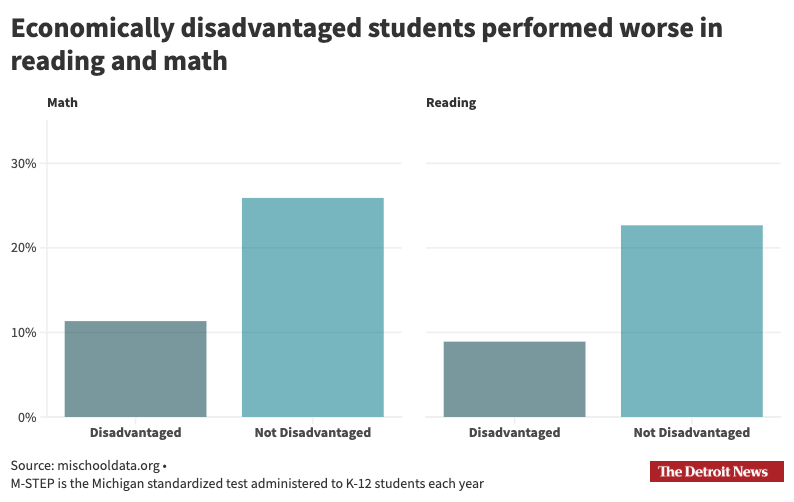
"I think that we are going to see those increasing poverty rates turn into housing insecurity and into those worse educational outcomes," Erb-Downward said.
Despite the discouraging trends, there are a slew of ways to support kids experiencing poverty in school, she said.
Erb-Downward pointed to better rates of identifying homeless students through their schools, something for which she credits homelessness liaisons in Detroit public schools. She said another school district program that provides basic necessities like winter coats, food and shoes to both students and their families looks promising.
"There has been a huge uptick in use of the program," Erb-Downward said, "and I think it's an excellent model."
Poverty on the campaign trail
The U.S. Census Bureau released the 2024 poverty figures in the midst of this year's campaign to elect Detroit's first new mayor since Duggan took office in 2014.
City Council President Mary Sheffield and the Rev. Solomon Kinloch Jr., senior pastor of Detroit-based Triumph Church, have made combating poverty a key part of their arguments for why voters should send them to the Manoogian Mansion.
“I have had the responsibility to eulogize children that died because of homelessness and childhood poverty…," Kinloch wrote in a statement to The News. "When three generations of a family are sleeping in a car in a casino parking lot and we lose two kids, even as the family reached out for help, that must serve as a call to action."
Kinloch was referring to the deaths of Darnell Currie Jr., 9, and his sister, A'Millah, 2, as they slept in their family's van in the Hollywood Casino parking garage in Greektown in February. The deaths were ruled accidental, caused by carbon monoxide poisoning, the Wayne County medical examiner's office said in March.
Kinloch said Duggan and the City Council have not done enough to address the city's poverty.
"When you see the numbers increasing and realize that more than half the kids in our city are living in poverty," he wrote, "it’s obvious that the current mayor and the city council president have not prioritized or addressed the issue with the appropriate resources or urgency."
Sheffield defended her record on poverty, pointing to the progress the city has made over the last decade.
"As Detroit began and now completes its rebound from bankruptcy, I have remained focused on ensuring that the recovery of our basic quality of life systems was prioritized," she wrote in a statement to The News."
"I know there is no silver bullet for poverty," she said.
Sheffield pointed to community violence intervention programs, down payment assistance and business development efforts during her tenure on the council.
"But despite this progress," she said, "I know there is much more to do."
Kinloch said his mayoral administration would focus on affordable housing, job training and keeping kids in school.
Direct cash payment to moms
Both Sheffield and Kinloch told The News they would be open to conversations about bringing the Rx Kids direct cash contribution program, which operates in cities like Flint and Kalamazoo, to Detroit.
The program, which started in Flint in 2024, provides $1,500 to mothers during pregnancy and an additional $500 per month to families with newborns for six to 12 months after the baby is born.
Rx Kids is funded by a combination of public and private sources, including the Michigan Department of Health and Human Services, the Charles Stewart Mott Foundation and the Stryker Johnson Foundation, each of which has provided $5 million or more, according to the program's website.
Shaefer, the Poverty Solutions director, who co-directs the Rx Kids program with Dr. Mona Hanna of Michigan State University, noted families "are actually the poorest right around the birth of the child."
"We want them to have everything they need while they’re pregnant and through the first year," he said. "Families use the money to get to their prenatal appointments, to put food on the table, to buy books and diapers."
Asked if he would support that program in Detroit, Kinloch responded: "Yes, I am receptive to these types of programs and would welcome a conversation as mayor."
Similarly, Sheffield wrote: "Yes, the program seems promising based on the recent data. I am looking forward to more conversations on this very important topic.”
Shaefer was enthusiastic about the idea of expanding the program to Michigan's largest city.
"I was so excited for this to be a program that started in Flint," he said. "But, boy, it would just make me grin from ear to ear if we brought it to all those cute Detroit babies."
Michigan Senate Majority Leader Winnie Brinks, D-Grand Rapids, submitted a $100 million funding request to the state budget Thursday morning to fund the Rx Kids program statewide. The funding would have to be approved by the Senate to go into the final budget.