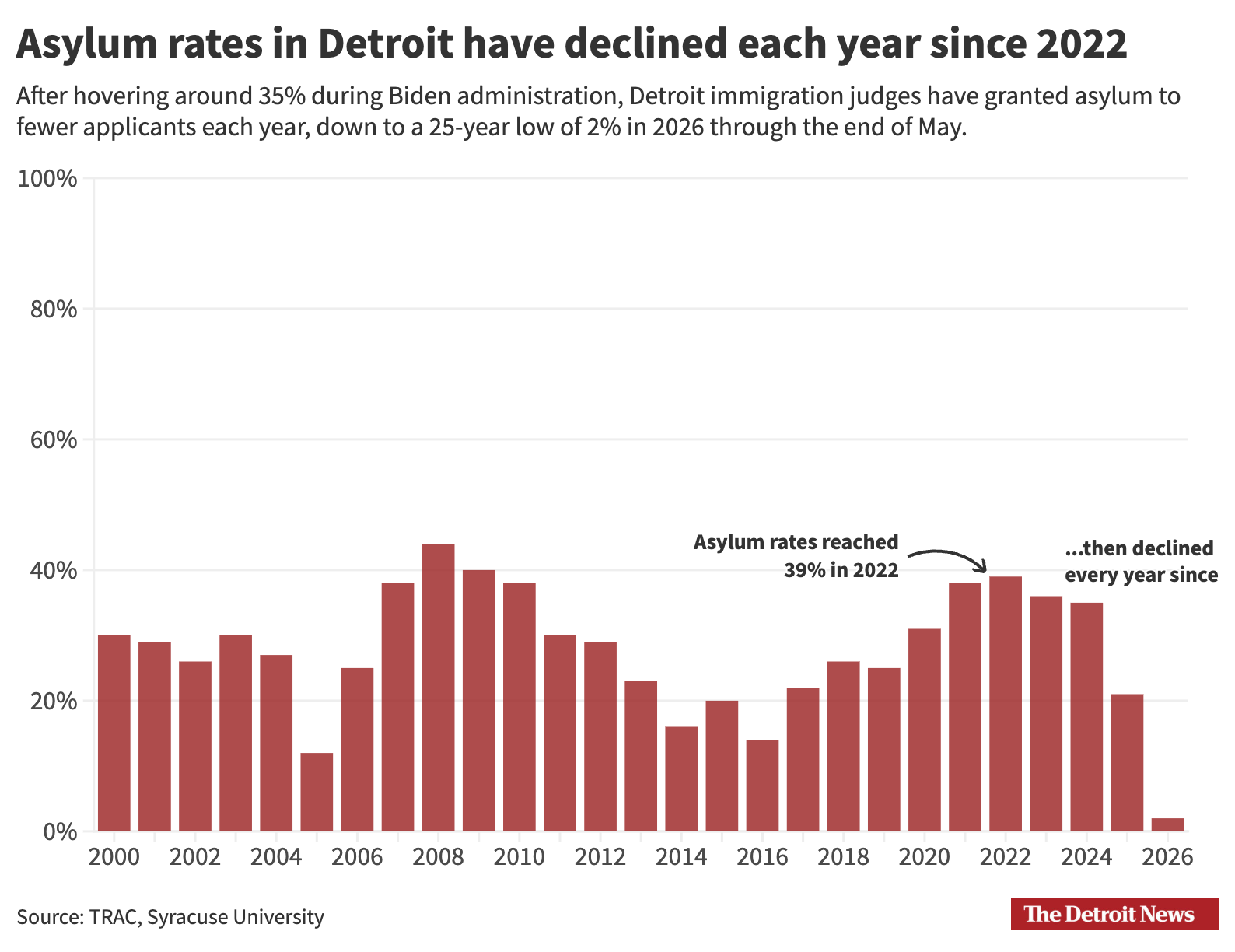
Immigrants applying for asylum in Detroit's immigration court in 2026 are granted relief in only 2% of cases, the lowest rate of successful claims at any time in the past quarter-century.
Through the end of May, just four out of 205 non-detained immigrants had won their asylum cases in Detroit, while only two of 185 detained immigrants succeeded.
The unusually low rate is due to shifts in the makeup of immigration court judges, new rulings by the Board of Immigration Appeals and last-ditch asylum cases from immigrants denied other types of relief, immigration lawyers and a legal expert told The Detroit News.
One detainee in ICE custody at the North Lake detention center in west Michigan told The News in a recent telephone interview that she has run out of hope that she can stay in the United States.
"Here inside the detention center, I haven’t seen a single person who received asylum," said the woman, whose name is being withheld because she fears retribution from her home country in Central America. "Most have strong cases and were rejected."

The woman arrived in the United States in 2023 after claiming persecution for her involvement in a pro-democracy movement. She obtained Temporary Protected Status, which allowed her to remain in the U.S. legally and obtain work authorization.
"I followed all the laws of this country," she said. Still, she was taken into ICE custody on her way to work in September 2025 and brought to North Lake, where she had been for seven months by the time of the interview.
"It’s very complicated, honestly, complicated and unfair, because most of us are here following the process and they don’t let us leave even on bond," she said in Spanish during the May interview. "They want everyone to sign their deportation, to leave. I understand that's what they want."
Now, the woman will be deported after immigration court and federal court judges rejected her asylum claim and two petitions for her release.
Like her, all 166 detained immigrants who received an asylum decision from the Detroit immigration court last year were denied relief.
“TheBoard of Immigration Appeals decisions reflect straightforward interpretations of clear statutory language," Kathryn Mattingly, press secretary for the Office of Policy in the Executive Office of Immigration Review (EOIR), told The News in an email.
"President Trump and the Department of Justice will continue to enforce the law as it is written to defend and protect the safety and security of the American people," she wrote.
Detroit area asylum record reflects Trump's more restrictive policy
The state of asylum in Detroit's immigration court, which handles most cases in Michigan, reflects the new status quo in U.S. immigration policy.
Despite record demand — millions of asylum applications remain pending — the Trump administration has shifted toward a highly restrictive asylum policy in the last 18 months.
The Department of Homeland Security and the Department of Justice have removed protected status, ushered in mass hearings and expedited deportation proceedings for hundreds of thousands of immigrants.
In a statement to The News, the Department of Homeland Security stressed that "a pending asylum case does NOT confer any type of legal status in the United States."
"If a person enters our country illegally, they are subject to detention. Each illegal alien receives due process," the statement said. "We encourage every person here illegally to take advantage of this offer and reserve the chance to come back to the U.S. the right legal way to live the American dream. If not, you will be arrested and deported without a chance to return.”
The U.S. Supreme Court ruled in favor of the Trump administration in two immigration-related cases in late June, deciding that Homeland Security could limit the number of people claiming asylum at the southern border and end Temporary Protected Status for Haitians and Syrians.
As a result of those policy changes, immigration court judges across the U.S. have granted asylum at an unusually low rate. About 5% of applicants have been granted relief so far in 2026, compared with 9.7% last year, according to data collected by the Transactional Records Access Clearinghouse at Syracuse University.
In Detroit, asylum rates have dropped each year since 2022, when asylum claims were successful 39% of the time during the administration of Democratic President Joe Biden. Last year, the Detroit immigration court granted relief 21% of the time, before dropping to around 2% in 2026 through the end of May.
Detention matters less in asylum cases, data shows
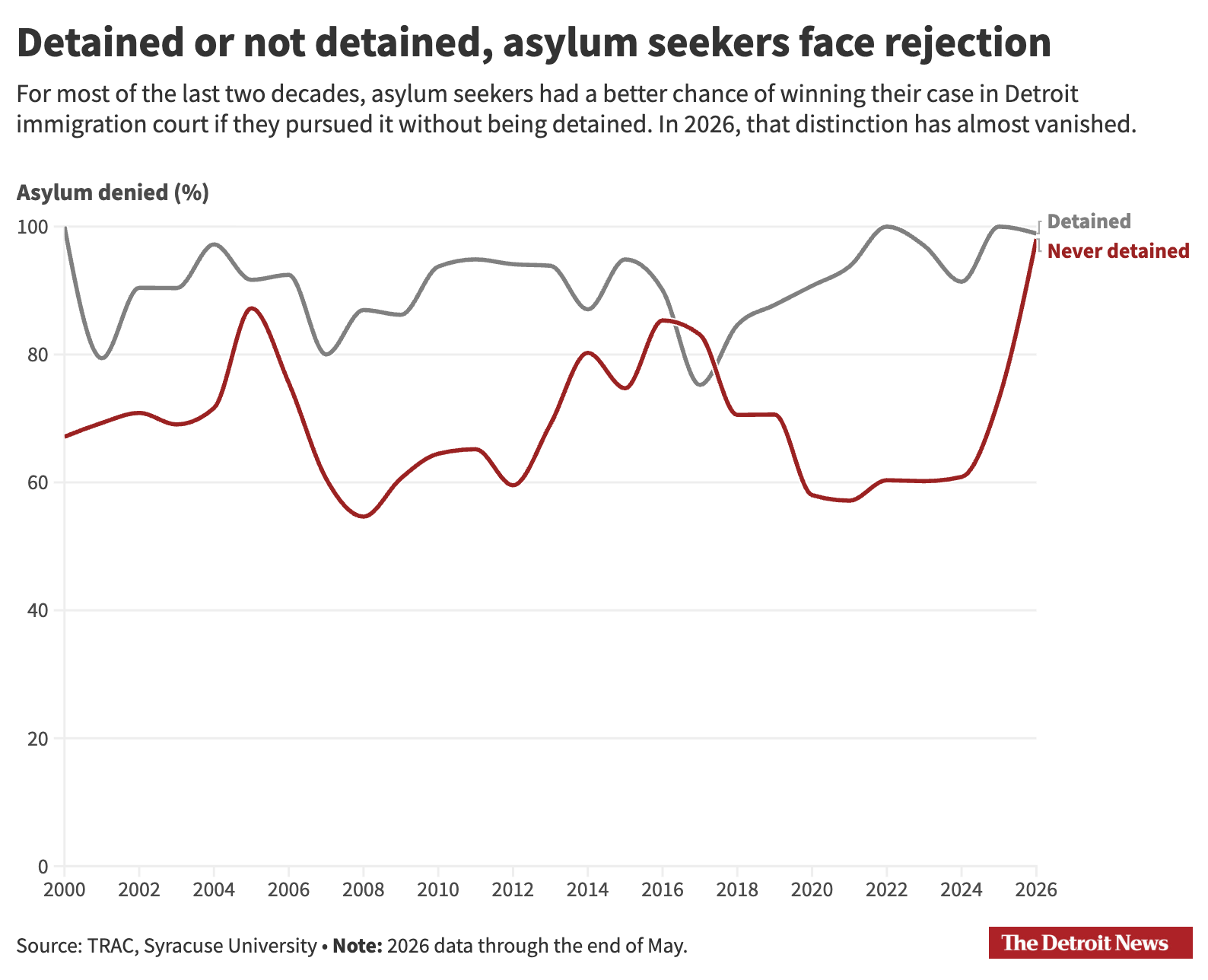
One major reason for declining asylum rates is that the applicants who are not in ICE custody can no longer expect to win cases at a higher rate than their detained peers.
Last year, non-detained asylum seekers in Detroit faced rejection 73% of the time, compared with a 100% denial rate for those in detention. But through the first five months of 2026, that advantage has eroded. Since the beginning of this year, about 98% to 99% of asylum seekers were denied relief, regardless of their detention status.
“The advantages of being non‑detained were that you were more likely to have an attorney and not be on a fast track," said David Thronson, an immigration law professor at Michigan State University.
“As they move cases quickly and demand more evidence, more corroboration and quicker filings, they’re chipping away at the advantages that used to come with not being detained."
Immigration judge turnover reshapes asylum rulings
When asylum seekers enter a courtroom — or often these days, log on to a virtual hearing — they are less likely than ever to face a judge who grants asylum at a higher-than-average rate.
"There has been, for lack of a better word, a purge of immigration judges," Thronson said.
“Immigration judges who had a background representing immigrants … have found themselves out of a job, and those with a history of denying claims have a more prominent role now,” he said.
Immigration judges are not part of an independent judiciary. Rather, they are employees of the Department of Justice, which Thronson said allows them to be hired and fired "at will."
David Paruch, a longtime Detroit immigration judge with a background representing immigrants in court, retired in 2025. Before his time on the immigration court, he practiced immigration law in a private practice and was a member of the American Immigration Lawyers Association. Paruch could not be reached for comment.
None of the four judges who have joined the court since Paruch left have recent experience in immigration law, according to biographies released by the Executive Office for Immigration Review.
“The new judges they hired don’t know immigration law very well. They have no immigration law experience," said Stephanie Blumenau, a Detroit-based immigration lawyer.
She recalled arguing an asylum case before one of the newly appointed judges: "I was ... trying to not only present my case but just get the judge up to speed on immigration law."
“It used to be the case where you wouldn’t be a judge unless you had years and years and years of immigration law," Blumenau said.
Regardless of their legal background, immigration judges undergo classroom and job training before and during their tenure on an immigration court. The EOIR evaluates their performance in the job for conduct and impartiality.
The new Detroit judges have always ruled against applicants in defensive asylum cases, the most common type of asylum case on which they are asked to rule.
Christopher Cooper, appointed in April by Acting Attorney General Todd Blanche, ruled on 61 defensive asylum cases through the end of May. He did not grant relief in any of them. Cooper was primarily a private practice attorney in Illinois and Indiana before his appointment, according to a biography released by the EOIR.
Another newcomer, Jill K. Krishnan, heard 50 defensive asylum cases during the same period and did not grant relief. A third new judge, John Moriarty, most recently a Ph.D. student at the Van Andel Graduate School of Statesmanship at Hillsdale College in Michigan, oversaw one case, denying relief.
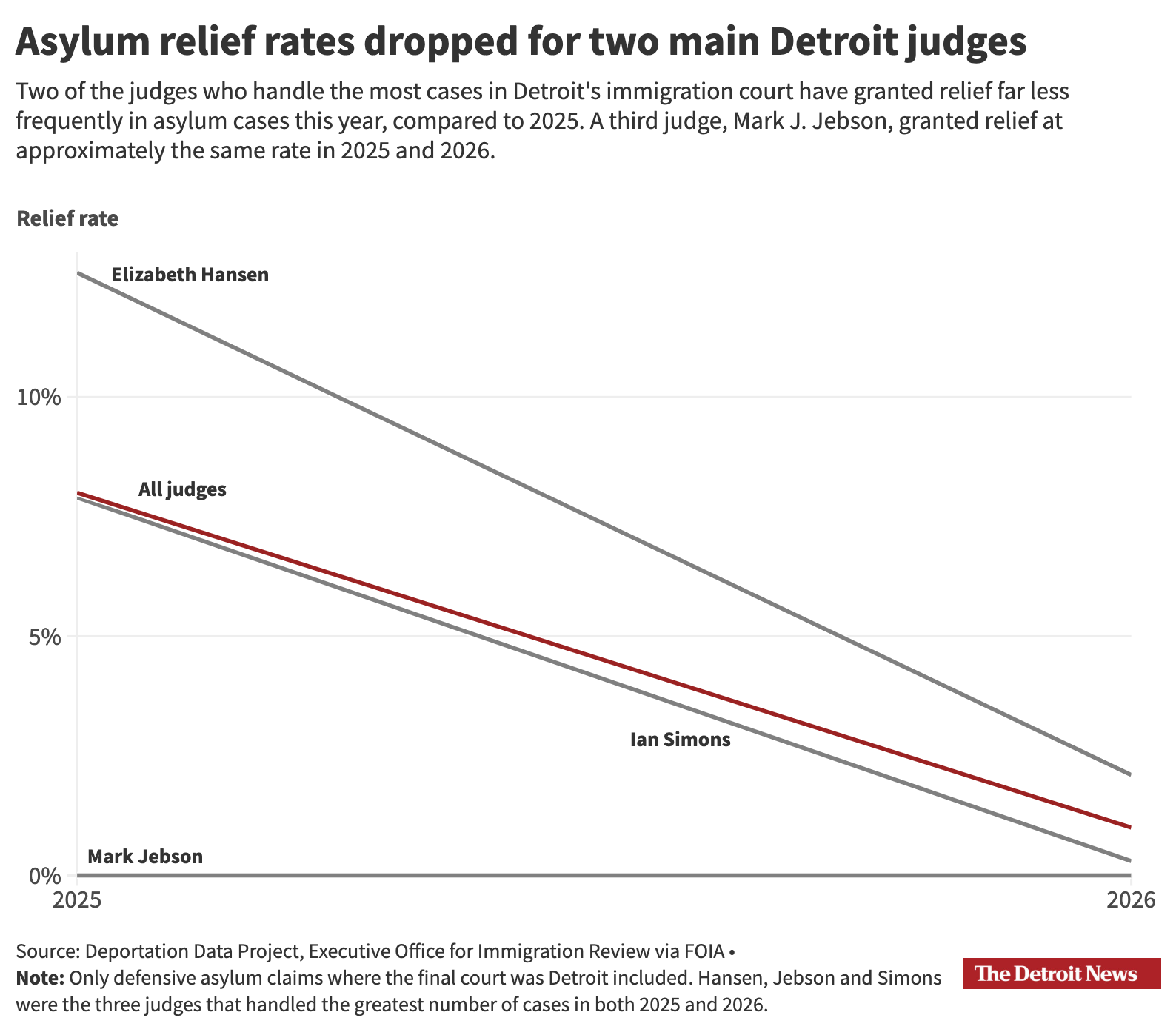
Even long-tenured immigration judges, such as Katherine Hansen, who was appointed to the immigration court in Bloomington, Indiana, in 2017, and Ian Simons, appointed to the Detroit court in 2016, have granted asylum at lower rates in 2026 than they did last year.
The judge who has served on the Detroit immigration court the longest, Mark J. Jebson, didn't grant relief to any defensive asylum applicants in either year.
"Reducing the immigration court backlog remains one of the highest priorities for this administration. The Justice Department is restoring integrity to our immigration system by hearing cases fairly, expeditiously and uniformly, in accordance with the law," according to Mattingly, the EOIR spokesperson.
How we analyzed the data
The Detroit News analyzed data on asylum case outcomes produced by the Transactional Records Access Clearinghouse, hosted at Syracuse University, using a methodology created by Joe Yerardi of the Philadelphia Inquirer and Julia Ingram of CBS News.
Additional data on judge-by-judge case outcomes was provided by the Deportation Data Project, which acquired it through a Freedom of Information Act request to the Executive Office for Immigration Review, which oversees all US immigration courts. The rates of granting relief for each judge and the change in those rates from 2025 to 2026 were calculated using that data set.
More asylum seekers file urgent claims as approval rates fall
The lower relief rates among Detroit's long-tenured immigration court judges likely reflect more than just pressure from the current presidential administration.
“As the government cuts back on Temporary Protected Status, we’re funneling people into last‑chance, desperate claims for asylum because that’s all they have left,” said Thronson, the MSU immigration law professor.
During the Biden administration, hundreds of thousands of immigrants from such countries as Cuba, Nicaragua and Haiti were permitted to enter the U.S. with Temporary Protected Status.
But that pathway is now closed to most, leaving would-be applicants to seek relief through the asylum process instead.
Thronson added: "We probably have more people being thrown into removal proceedings who might have had other forms of relief.”
The female North Lake detainee who spoke to The News was one of those immigrants whose protected status was revoked before her asylum claim could be processed.
Cesilie Cordovilla, an Ann Arbor immigration lawyer who has represented the woman throughout her time in the U.S., said she thought her client had a good case for asylum.
"We had a pretty decent set of preliminary evidence. It wasn't hard to put her case together at all," Cordovilla told The News.
"Of all my clients, she’s just the sweetest, she’s the most innocent, the most responsible, a really low-key, relaxed person who I never had to worry about," Cordovilla said.
In September 2025, before Cordovilla's client was able to attend an asylum interview with the USCIS office in Chicago, she was taken into ICE custody.
"One day she was going to work, she was riding with someone else — apparently ICE was searching for someone in the area, and she was just the collateral damage," Cordovilla said.
After waiting more than two years for an asylum hearing, the woman got her day in court just after Christmas in 2025. Despite what Cordovilla described as a "really strong" asylum case, the judge denied her claim.
"I’m not naive to think that our immigration court systems always result in the just end to a case, but it was shocking to me. ... I was 99% sure that we were going to win," Cordovilla said.
After working closely with the woman for three years, Cordovilla was heartbroken by the outcome. She said her client has decided she doesn't want to be detained and has withdrawn her appeal.
Now, Cordovilla worries about what will happen when the woman returns to her home country in Central America.
"I think when she arrives to the country, and she’s investigated as everybody is when they arrive ..., she’s going to be interrogated."
Cordovilla said she hopes "at the very least, maybe they don’t remember who she is."