
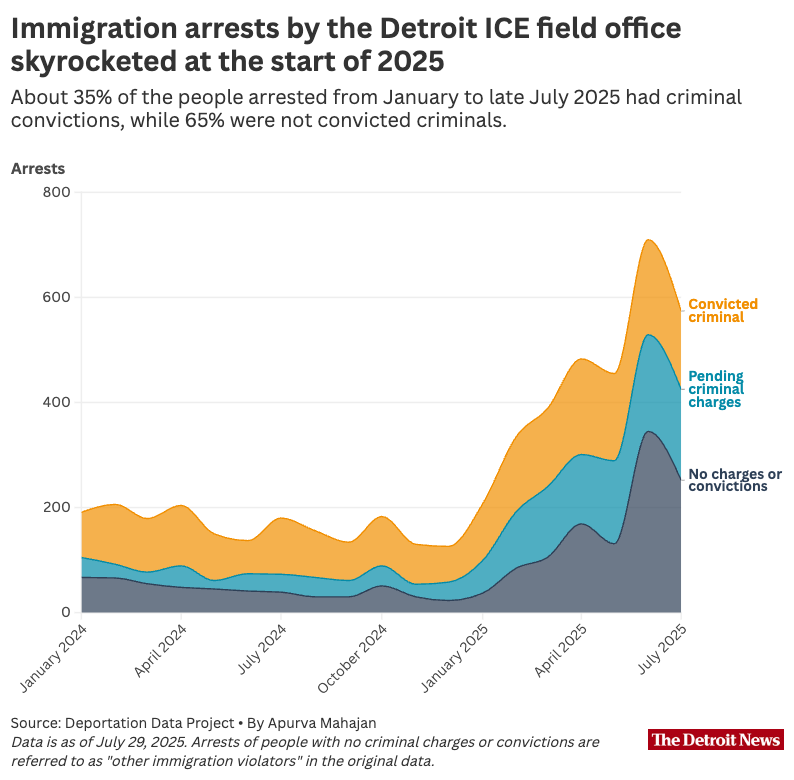
More than six months into a national crackdown on illegal immigration touted as targeting violent offenders, immigrants who have never been convicted of a crime now make up the majority of those arrested by Detroit's U.S. Immigration and Customs Enforcement field office.
Close to two-thirds or 65% of the more than 3,100 people the Detroit ICE office arrested from January through late July of this year either had pending charges or were never charged with a crime, according to a national deportation database analyzed by The Detroit News.
Last year, more than half of all immigrants detained by the agency were convicted criminals.
The News analyzed arrests, detention requests and deportations handled by ICE's Detroit field office using data compiled by the Deportation Data Project, a database maintained by a team of lawyers and academics. The group publishes anonymized immigration enforcement data obtained through Freedom of Information Act requests to government agencies, including ICE and U.S. Customs and Border Protection.
“The detainment, arrest, and deportation of individuals with no criminal record — including minors — without due process, is deeply disturbing and antithetical to our country’s values," said U.S. Rep. Debbie Dingell, an Ann Arbor Democrat whose southeastern Michigan district includes Ypsilanti and Ann Arbor, in a statement. "We need more information about who is being targeted, and why."
Since entering office for his second term, President Donald Trump has pledged to target violent criminals through mass deportations and sweeping arrests. The Republican Trump administration's hard-line immigration policies have drawn criticism from immigrant rights groups around the country.
In an email statement to The News, a spokesperson from ICE's media relations office wrote that the agency is "focusing on the worst of the worst, and the data shows that our targeted enforcement does just that.
In response to The News' analysis, the spokesperson added: "The actual number of criminals is likely much higher, as 'non-criminal' accounts only for those without U.S. convictions."
Individuals who have a criminal record in other countries likely make up a small fraction of the immigrants deported by ICE, said Marie Celentino, an immigration law professor at the University of Detroit Mercy's law school."
"Of course, it's certainly possible an individual has a criminal record in their home country," Celentino wrote in an email to The News, "but that is clearly not the reason ICE is carrying out these arrests."
"For example, many, if not most, of the individuals who are being arrested at immigration court were already previously processed and released by DHS (Department of Homeland Security) when they first arrived in the United States," the law professor added. "If they had foreign criminal convictions that made them a danger to the community, DHS would not have released them in the first place."
ICE arrested more than 136,000 people nationally between January and late July, already surpassing last year's 105,000 arrests. The rate at which the agency has arrested people with no criminal convictions across the country has jumped from less than half in 2024 to about 60% through the first seven months of this year.
Assistant Department of Homeland Security Secretary Tricia McLaughlin, in a statement to The News, said Homeland Security Secretary Kristi Noem "is reversing (President Joe) Biden’s catch and release policy that allowed millions of unvetted illegal aliens to be let loose on American streets."
"This Administration is once again implementing the rule of law," McLaughlin said.
Paths to ICE detention
In Michigan this year, immigrants with criminal records and those with no pending charges or prior convictions have typically been detained through two separate programs.
ICE has primarily targeted people with prior convictions or pending charges through requests to local jails or probation and parole programs.
The agency this year sent more than 700 detainer requests to local, state and federal detention facilities across the state. The requests allow ICE to be notified in advance of a release date or to hold immigrants for up to 48 hours longer so the federal Department of Homeland Security can take them into custody.
Less than 5% of all people named in detainer requests to Michigan jails this year were convicted of violent crimes, defined by the FBI's National Crime Information Center as murder, rape, robbery and aggravated assault. Another 2% were charged with drug crimes. The most common conviction listed as "most serious" for individuals listed in the detainer database viewed by The News was driving under the influence of alcohol.
But enforcement operations on the street often target immigrants without criminal records. About 65% of the immigrants who were detained by ICE's Detroit office through street arrests, traffic stops and other non-jail related enforcement operations had no convictions or pending charges, according to the Deportation Project data.
One Michigan woman from Haiti, whose Haitian husband has been detained since August, told The News he has not committed any crimes and was in the country legally under a humanitarian program that has since been ended by the Trump administration.
“The mass deportation process was to target criminals, that kind of people, but my husband is not one of them,” said Taicha, who lives in Lansing, who spoke to The News through a translator.
She asked that her last name not be used out of concern over future targeting by federal immigration authorities. Her case is being handled by the Michigan Immigrant Rights Center, a Ypsilanti-based legal resource center for immigrants that operates across the state.
Taicha, who works at a General Motors Co. plant in Lansing, said she has a green card; her husband, Mike, entered the United States in October 2023, using the CBPOne mobile app to apply for asylum. He was accepted under a Biden administration humanitarian program that permitted more than half a million Cuban, Haitian, Nicaraguan and Venezuelan nationals to stay and work in the United States legally.
He applied for temporary protected status in 2024, but the application was still pending in June of this year, when the Trump administration ended the program that allowed him to stay in the United States legally, she said.
In early August, Mike and Taicha got lost on a road trip from Lansing to visit Mike’s mother in Boston, she said. They made a wrong turn, which sent them onto the Detroit bridge plaza for the Ambassador Bridge going toward Canada. Customs and Border Protection checked their status at the border and detained Mike, who was no longer protected by the parole program, said Taicha and Christine Sauvé, policy and communications manager at the Michigan Immigrant Rights Center.
“They accused him of living illegally for two years,” Taicha said. “I think he’s been unlawfully detained.”
CBP held Mike for four days before transferring him to the North Lake Processing Center, a privately run ICE facility in west Michigan, near Baldwin. There, Taicha visited him twice; he was losing weight, she said, the result of too little food and the stress from his detention.
But being at North Lake was far better than Mike’s current situation, Taicha told The News. Now, he’s being held at the Winn Correctional Center in Louisiana, where she said “the situation is extremely harsh.”
The distance is having more than an emotional toll on Taicha. Phone calls to the Louisiana facility are expensive. She said she pays a minimum of $50 for a single call, with an additional $6 charge for every 20 minutes. She’s had to send Mike money to purchase a brush, drinking water and even a plate.
“I would live in fear if he goes back to Haiti,” Taicha said.
Mike left for the United States after his brother was kidnapped by a gang in 2023, and she said he would be a target if he returned.
“I believe my husband does not deserve any of this,” she said.
Families are afraid to speak publicly about their loved ones being detained because they are worried about possible negative repercussions, Sauvé wrote in an email to The News.
"It can be fear of retaliation by ICE, that they will somehow make their detained family member's situation worse, or fear of possible targeting of other family members for enforcement," she added.
"This fear is entirely rational and understandable, but sadly it means members of the broader public don't fully know what families are going through, and all the ways detention and deportation affect our immigrant neighbors," Sauvé said.
Whether they are transferred from a local jail or apprehended on the street, immigrants arrested by ICE in Michigan are usually held in one of five detention facilities around the state, including the North Lake Processing Center, a privately run 1,800-bed facility in Lake County, which opened in mid-June.
North Lake houses around 400 detainees, according to the Michigan Immigrant Rights Center. The other facilities — jails in St. Clair, Monroe, Calhoun and Chippewa counties — housed a combined 362 people as of early August, according to ICE statistics.
Who should be deported?
Republicans in Michigan's congressional delegation have expressed support for detaining undocumented immigrants, whether or not they have a criminal record.
"While ICE is primarily focusing on those with criminal records, the previous administration illegally allowed millions more into our country, who should also be subject to our nation’s laws," U.S. Rep. John Moolenaar, R-Caledonia, said in a statement.
In the GOP-controlled Michigan House, Republican lawmakers have introduced legislation to prohibit “sanctuary” policies at the local level.
State Rep. Angela Rigas, a Republican who represents parts of Allegan, Barry, and Kent counties, co-sponsored the bills. She said such policies, condemned by the Trump administration, "have been used to protect dangerous criminals."
"There is no justifiable excuse for harboring illegal aliens," Rigas said, "as every single person that enters our country illegally is a criminal because they broke the law and must be deported. It’s really that simple.”
But immigration advocates said the picture is more nuanced.
Sauvé, the immigration advocate, wants people to consider the impact of deportations on families and communities.
"It's incredibly painful and pretty devastating for families whose loved one has been detained or removed at this point," Sauvé said. "Sometimes that's the breadwinner, sometimes that's the legal guardian for children."
In other cases, it is children who are ushered out of the country. In at least 40 cases handled by the Detroit field office, ICE deported children younger than 16. The two youngest were an Ecuadorian girl born in 2022 and a Honduran girl born in 2021.
"U.S. Immigration and Customs Enforcement does not separate families or deport U.S. citizens, but removable parents — absent indications of abuse or neglect — can choose to take their children with them, regardless of the children’s immigration statuses," an ICE spokesperson told The News.
Parents who choose to leave their children in the U.S. have the option to designate a third-party caregiver, the ICE spokesperson said.
That decision, Sauvé said, can make for "very difficult conversations that families have." In more cases, children are being left alone and neighbors or other adults must navigate the process of trying to find care for the children, she said. This could include foster care or federal care, which Sauvé called "very destabilizing for children."
Traffic stops, court hearings end in arrest
Some Michigan police departments have signed what are called 287(g) agreements to work directly with ICE.
In Berrien, Calhoun and Jackson counties, officers cooperate with ICE under what's known as the Warrant Service Officer model, which allows ICE to train local police officers to execute warrants for immigration violations on immigrants already in police custody, according to the agency's website.
Police departments in Roscommon and Genesee counties and the city of Taylor in Wayne County go one step further. They've agreed to work with ICE under the Task Force Model, which permits local police to act as a "force multiplier" for federal immigration authorities, giving them the ability to enforce immigration laws.
State Rep. Jamie Thompson, a Republican who represents parts of southern Wayne County and northern Monroe County, praised local law enforcement agencies that are working with ICE. Thompson co-sponsored the House bills banning sanctuary policies.
"Their work with ICE means they are better equipped to protect the community, and if they run across someone who has committed a crime that is not in the country legally in their day-to-day activities, they report that to ICE," Thompson said.
But even outside of these jurisdictions, immigration advocates say, routine traffic stops can end in an ICE arrest.
The Michigan Immigrant Rights Center's Sauvé said "even outside of those formal agreements, what we're seeing is more local law enforcement agencies just taking those actions of their own accord."
Sometimes, Sauvé said, officers in departments that don't have a 287(g) agreement call Customs and Border Protection or ICE agents for help with interpretation, such as in the case of 18-year-old Maykol Bogoya-Duarte, a Colombian native who was in his senior year at Western International High School in Detroit when he was detained.
A Rockwood police officer pulled over Bogoya-Duarte — who did not have a criminal record — for a
traffic stop on his way to a school field trip. The officer called U.S. Customs and Border Protection because of a language barrier, according to a police report.
Bogoya-Duarte lost his appeal to stay in the U.S. for six months and was deported to Colombia in June.
Earlier this week, though, a case that started in a similar manner to Bogoya-Duarte's has taken a different course, after the Michigan chapter of the ACLU secured the release of one of its clients, 46-year-old Detroit resident Juan Manuel Lopez-Campos, on bond.
Lopez-Campos was detained in June after he was stopped by a Romulus police officer for an alleged traffic violation.
Lopez-Campos, who is from Mexico and has lived in the U.S. since at least 1999, does not have a criminal conviction, according to the ACLU, and his five children are U.S. citizens. He has a pending first-time misdemeanor charge for driving without a valid license.
The ACLU's Michigan chapter filed a federal lawsuit in August, arguing that Lopez-Campos was being denied his constitutional right to a bond hearing while being held in Monroe County Jail. He was released on Wednesday after U.S. District Judge Brandy R. McMillion ruled in the organization's favor earlier in the week.
“I am happy to finally be with my family with the help of my legal team. I hope to continue to fight my case,” Lopez-Campos said in a statement issued by the ACLU.
ICE agents have also started to show up at immigration court hearings and routine check-ins, said Celentino, the immigration law professor. She runs an immigration law clinic at the University of Detroit Mercy and said her clients are worried they will be detained at the courthouse even if they are there for an official hearing.
The agency has broad detention authority, meaning “pretty much anyone in proceedings could be detained," Celentino said. Among her clients, the University of Detroit Mercy law professor said, “the sentiment is just constant fear of being detained when they step out of their house.”
Often, the attorney representing ICE in an immigration hearing will ask the judge to dismiss the case, said Julie Powers, executive director of Immigration Law and Justice Michigan.
"We're telling folks do not go to these appointments without an attorney present," Powers said. "What we've been told anecdotally is that there's been a lot of pressure put on immigration judges to vacate these cases. They'll dismiss the case, and folks will be immediately detained."
Not deported to their home country
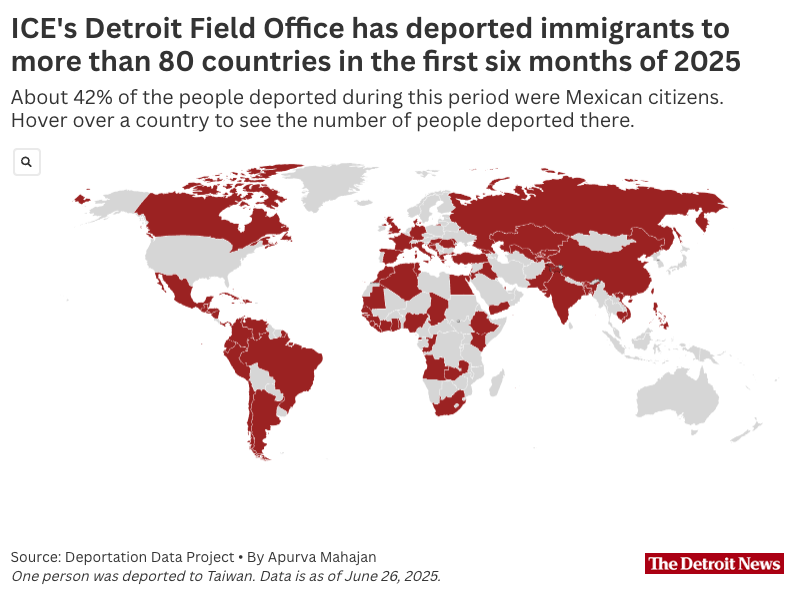
ICE's Detroit field office has deported at least 2,300 people through late June, though the Deportation Data Project creators said deportation figures are likely an undercount. About 42% of those deported were Mexican citizens.
Not all immigrants deported by ICE have been sent to their home countries.
In at least 73 cases handled by the Detroit field office this year, people were deported to a third country — somewhere they didn't have citizenship. This included 1 in 5 of the 227 total Venezuelans deported by the office, many of whom were sent to Honduras, Colombia, Mexico, Panama and El Salvador.
Twenty-six — over half of the Venezuelans deported to third countries — were sent to Honduras.
"Honestly, it seems like a tactic of cruelty," Sauvé said. "The administration's goal here is to make the process so horrendous and difficult ... to deter others from even attempting to enter the country."
Dingell, the Democratic congresswoman, opposes the practice, saying, "national security matters, but I do not believe the deportation of individuals without criminal records, to countries where they are not citizens, makes our country or our communities safer."
According to the data on deportations analyzed by The News, two people arrested by the Detroit ICE office were likely part of a group of more than 230 Venezuelan men who were sent to El Salvador's infamous CECOT prison in March, after the Trump administration alleged they were members of Tren de Aragua, a feared Venezuelan gang.
One of the men was Luis Alfredo Núñez Falcón, who had been living in Detroit for about a year, working construction and shoveling snow in the winter, according to his wife, Orianny Vasquez, who spoke to the Colombian news outlet La Opinión.
Falcón had no criminal record in the United States and had a pending asylum application when he was detained.
Vasquez told the Colombian outlet that her husband was labelled a gang member for his tattoos of a rose and a clock. Experts on Tren de Aragua have cast doubt on the use of tattoos alone to draw ties between immigrants in the United States and the criminal organization.
Falcón was released along with the rest of the Venezuelan deportees held in the Salvadoran prison in July, the result of a prisoner swap between Venezuela and the U.S. During their four months inside CECOT, ProPublica has reported, the men said they endured intense physical and psychological abuse.
The Department of Homeland Security's McLaughlin called the third-country deportation agreements "essential to the safety of our homeland and the American people.”
"If an illegal alien's home country is not taking them, they're not taking them for a reason: they are dangerous criminals," McLaughlin said.
Immigration rights advocates see no end in sight as ICE arrests continue to outpace those from 2024 in Michigan and across the country through the end of July.
"We're exhausted," said Powers, an immigration advocate.
"I just wish people would step out of the echo chamber and remember that these are our neighbors," Powers said. "These are our coworkers, these are people who share a pew in our faith communities. These are kids who go to school with our children."