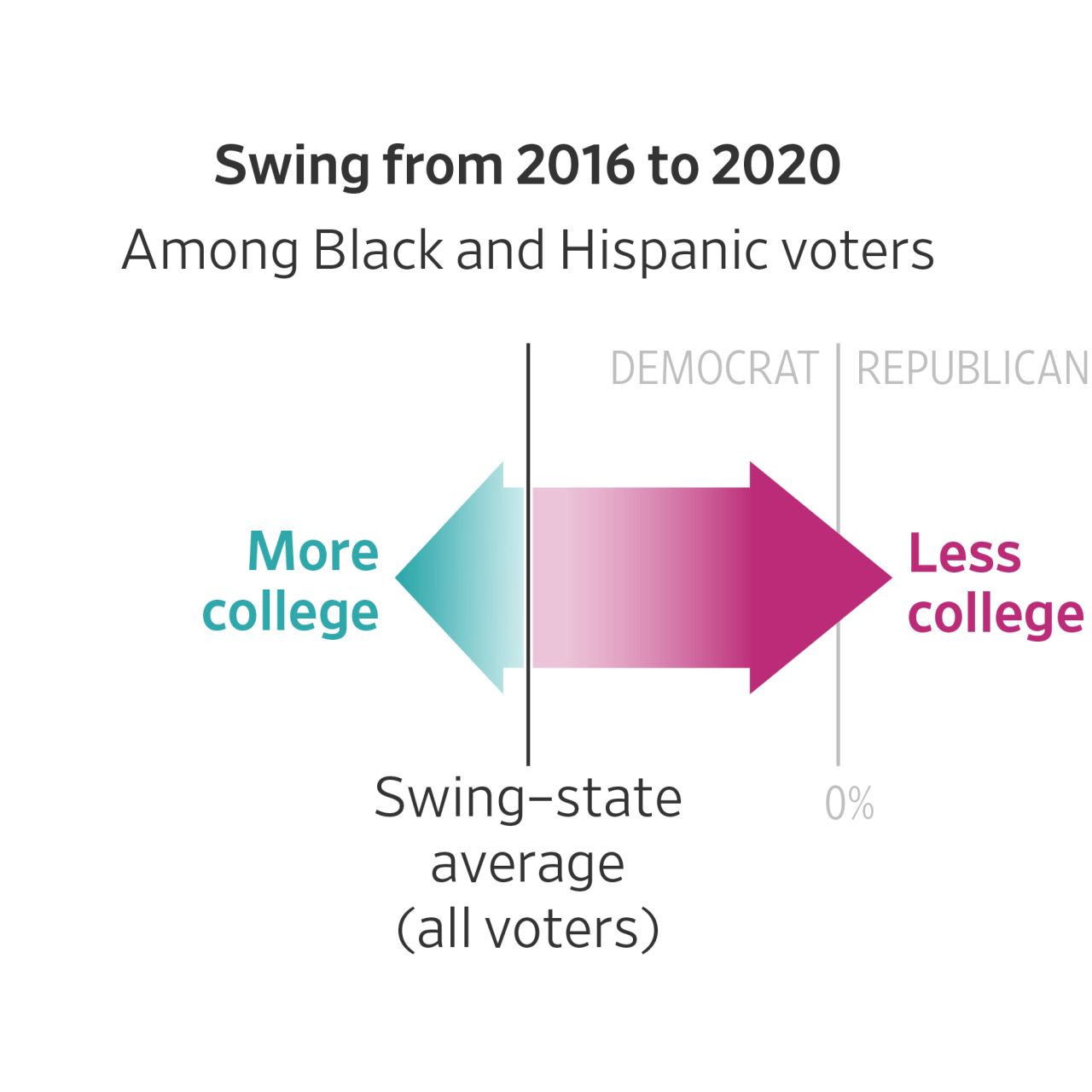
For Democrats seeking to win key swing states next month, a troubling pattern is emerging within Black and Hispanic communities: the college diploma divide.
Support for the Democratic Party rose in highly educated Black and Hispanic neighborhoods between 2016 and 2020, but it stagnated or even declined in similar less-educated areas, a Wall Street Journal analysis of granular voting and demographic data found.
In 2020, key swing states shifted toward Joe Biden from 2016 by 3.1 percentage points, and his support in highly educated Black and Hispanic communities increased an additional 1.3 percentage points. His performance lagged behind by 3.6 points in similar neighborhoods with low college graduation rates.
“College education is becoming a bigger factor than race and ethnicity,” said Mike Madrid, a GOP strategist and senior fellow at the University of California, Irvine’s, School of Social Ecology, who reviewed the Journal’s findings.
This divergence around education in Black and Hispanic neighborhoods persisted during the 2022 midterm elections, the Journal found, and mirrors a familiar pattern among white voters, where educational attainment has become a political fault line.
The findings help explain polling trends that have shown support slipping for Democrats among Latino and Black voters. While majorities in both groups still support the Democratic Party, Journal polling shows the GOP has made inroads among these voters in recent years. A nationwide Journal poll from August shows that 83% of Black voters and 59% of Latino voters prefer Vice President Kamala Harris over former President Donald Trump. But in 2020, Biden ran 10 points better among Black voters and six points better among Latinos.
Carlos Odio, co-founder of Equis Research, a Democratic-aligned firm that focuses on Latino voters, cautioned against oversimplifying the role of education in voting. Odio noted that among Latinos, lower educational attainment often correlates with being less partisan, making these voters more susceptible to swings between parties, rather than indicating a firm shift toward Republicans.
Increasing economic pressures during the Covid-19 pandemic coupled with the belief that Trump would reopen the economy faster contributed to some Latinos moving away from Democrats in 2020, Odio said.
The Journal’s analysis doesn’t capture which voters within a neighborhood are driving its shift, and neighborhoods with high levels of education tend to have lower concentrations of Black and Hispanic voters, raising the possibility that educated white voters are contributing some of the changes.
The Journal found that a neighborhood’s college attainment remained the strongest predictor of its shift, even when taking into account other factors such as race, ethnicity and income.
Madrid, the GOP strategist, said he believes Democrats have recognized this dynamic. He pointed to Harris’s shift away from rhetoric around identity and toward a stronger stance on issues such as border security.
“When race becomes your emphasis for either party, you lose them, ” Madrid said. “They don’t see the world that way.”
Methodology
To analyze the impact of education on voting patterns, the Journal combined precinct-level election results from six swing states—Arizona, Georgia, Michigan, Nevada, Pennsylvania and Wisconsin—with tract-level census data, which represents geographic areas of a few thousand people.
Tracts don’t perfectly align with precincts, which determine where people vote. The Journal calculated the overlap between the two geographies to estimate how a census tract voted. The Journal then broke tracts into three equal parts for percent non-Hispanic Black, percent Hispanic and percent with at least a bachelor’s degree.
Reporters pinpointed four distinct kinds of tracts: those in the top third for percent Black or percent Hispanic and in the bottom or the top third for college attainment. The highlighted tracts represent some of the most striking examples in one of those buckets.
To attempt to control for other factors that could cause a tract’s swing between 2016 and 2020, the Journal used a linear model and a model called XGBoost, to capture complex relationships between the variables. In both, education remained the most important variable in predicting a tract’s swing, even when controlling for race and ethnicity.