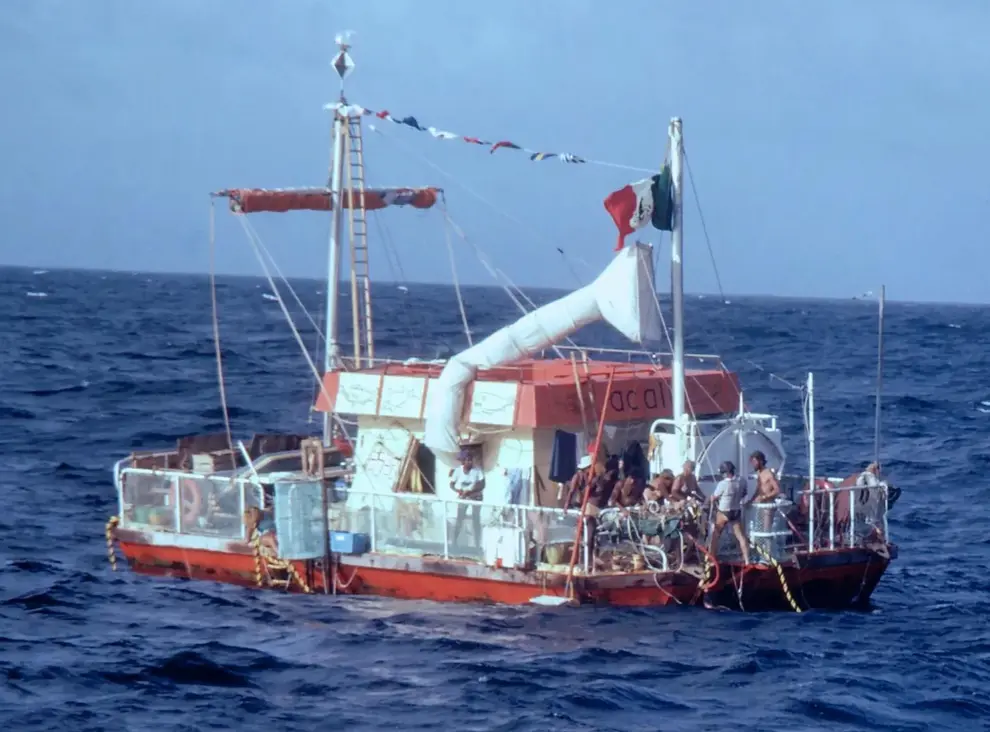
In 1973, anthropologist Santiago Genovés and his unwitting test subjects––four men and six women with varying ethnicities, faiths, political beliefs, and backgrounds from across the globe––drifted across the Atlantic for three months on a raft as part of his sociological study into human aggression and sexuality. But this was far from a social experiment. Genovés was a madman playing God.
First, he filled the raft with sexually attractive young people, plied them with alcohol, and encouraged them to fight and fornicate. Then, after nearly getting his test subjects killed twice, he staged a mutiny, resulting in a plot to murder him. Ladies and gentlemen, welcome to the crazy story of the Acali Experiment. Nicknamed the Sex Raft by the media, the experiment would become the blueprint for all the Reality TV shows we know and love today.
SANTIAGO GENOVÉS
Born in Spain in 1923, Mexican anthropologist Santiago Genovés took inspiration for his experiment from two sources. Firstly, he had been a crew member on Norwegian ethnohistorian Thor Heyerdahl’s Ra (1969) and Ra II (1970) expeditions to prove that ancient Egyptians could have crossed the Atlantic on papyrus boats.
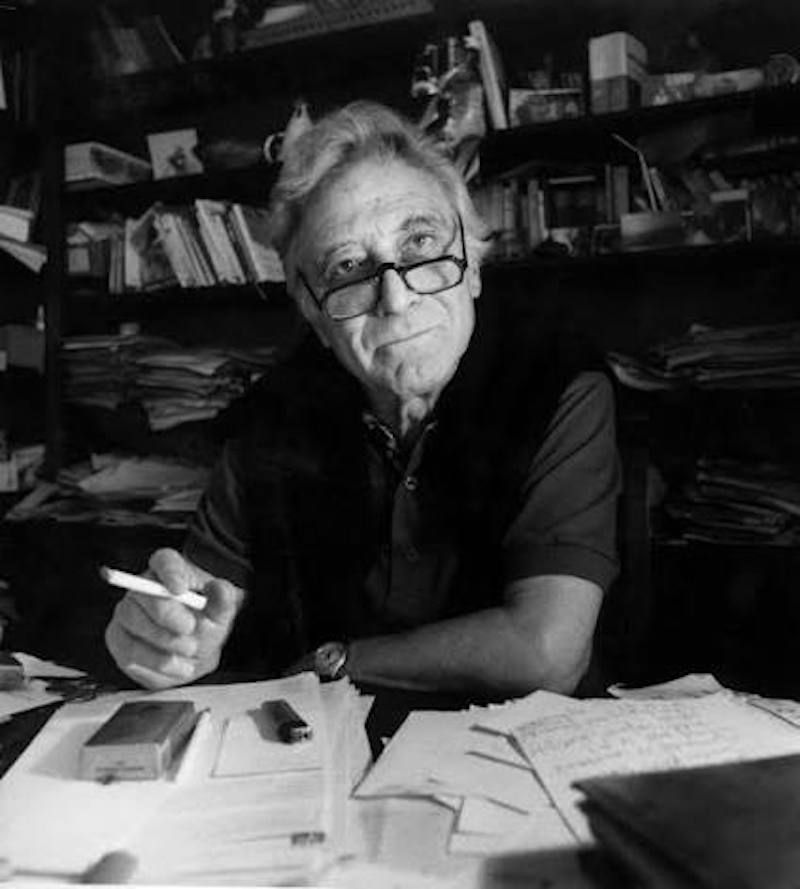
Famed adventurer and ethnographer Heyerdahl also wanted to demonstrate how a disparate, multinational seven-man crew could live and work together under the extremely challenging conditions of a boat made of paper crossing the Atlantic. However, even though Genovés was a willing and able team member, the experiences led him to believe the exact opposite from Heyerdahl. He was more fascinated with the tension he witnessed between the Ra crew and felt that further studies of human behavior under stressful conditions were justified.
Then, on November 10th, 1972, Santiago Genovés was a passenger on a plane that was hijacked on its way to Cuba. Whereas most people would panic, Genovés saw the hijacking as a “too good to be true” opportunity! Indeed, he later wrote: “I was lucky enough to be hijacked on a plane to Cuba,” which should have been a red flag for any future test subjects. For Genovés, it seems, was a sadist with a God Complex.
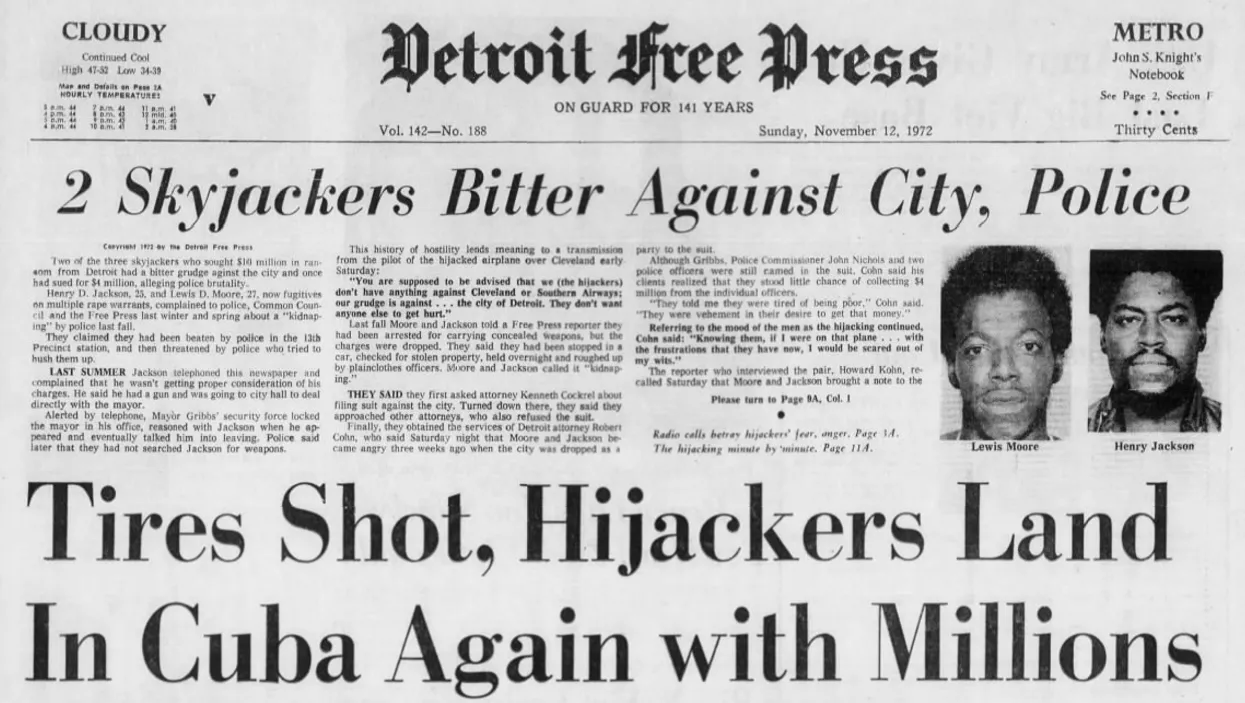
Even though the hijackers had threatened to crash the plane into a nuclear reactor unless they received $10 million, the hijacking of Southern Airways Flight 49 ended with no fatalities. Throughout the harrowing ordeal, Genovés remained calm. His scientific mind was quietly observing how his fellow passengers’ behaviors differed dramatically during and after the hijacking, and was determined to find out why...
To Genovés, this auspicious airborne encounter was what he’d been looking for: Proof positive that human beings sleepwalked through life and only truly revealed their authentic selves during seriously dangerous circumstances. Then, he had an epiphany on how and where he could study people to prove his unorthodox hypothesis. Remember, this was the early 1970s, and only a year after ordinary members of society were made prison guards and turned on their prisoner peers in the famously depraved Stanford Prison Experiment.
With Heyerdahl’s perilous Ra crossings in mind, Genovés quickly hit upon the perfect laboratory for his investigations. He would conduct his social experiment aboard a cramped, claustrophobic, isolated, inescapable raft set adrift in the middle of the ocean. Save for jumping overboard, his test subjects would have nowhere to go, and nothing but sharks and fish for company. Thus, the 1973 Peace Project or Acali Experiment was born.
THE CREW
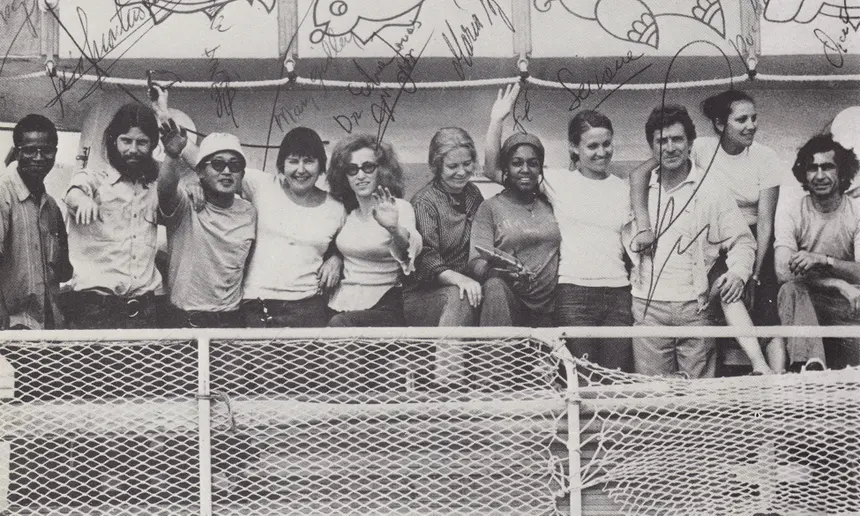
Genovés’ ambitious plan was for himself and ten others––four men and six women––to drift on a raft from the Canary Islands off the north-west African coast all the way to Mexico using trade winds and currents. He took out classified ads in newspapers around the world and, with financial help from the Mexican government and a Mexican TV station, traveled the globe to personally interview participants for his study on aggression and sexuality.
He carefully chose his crew based on the following criteria: “1. Married and parents, or involved in a relationship — that is, people who had something to lose, who were not coming to find adventure or fame. 2. Of a distinct nationality. 3. As a group, able to meet the requirements of the raft. That is, we needed one sea professional, a doctor, a radio operator, a frogman, a photographer, an expert in sea pollution, etc.”
Thousands of candidates volunteered to accompany Santiago Genovés and survive for months in the cramped 4x4 meter cabin as the raft crossed the ocean. Eventually, the scientist whittled down the male crew members to Uruguayan anthropologist and former student of Genovés José María Montero Pérez (34); Greek Cypriot radio operator Charles Anthony (37); and Japanese cameraman Eisuke Yamaki (29). Last but not least was God-fearing Angolan Catholic priest Bernardo Bongo (29), who was celibate.
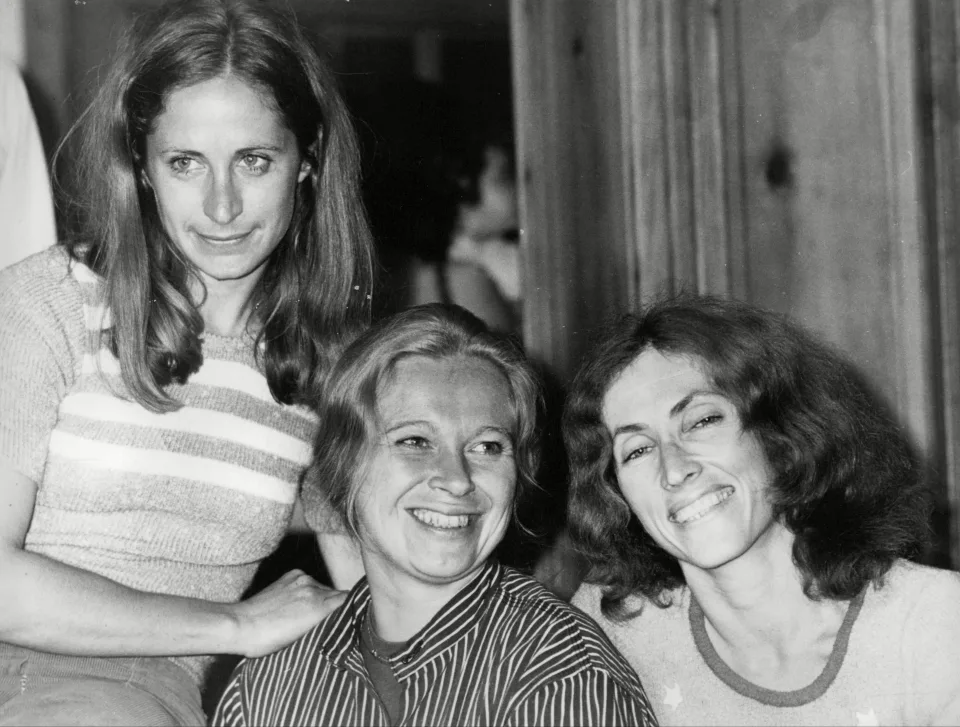
The female contingent was made up of French sea pollution-studying scuba diver, Servane Zanotti (32); Algerian pollution expert Rachida Mazani (23); US intermediate navigator Mary Gidley (36); US radio operator Fé Evangelina Seymour (23); Czechoslovakian resident of Israel, Doctor Edna Jonas (32) and Swedish captain of the expedition, Maria Björnstam (30) a blonde bombshell who was the world’s first female maritime captain. Genovés wrote: “I have selected participants who are sexually attractive and placed among them a Catholic priest,” he explains. “In order to further create tension.”
What Genovés had kept to himself was that the real purpose of his experiment was to demonstrate his perceived connection between violence and sexuality in monkeys. He’d once written, “Most conflicts are about sexual access to ovulating females,” and hoped his crew of 11 young, sexually attractive humans would regress into a similar, simian state.
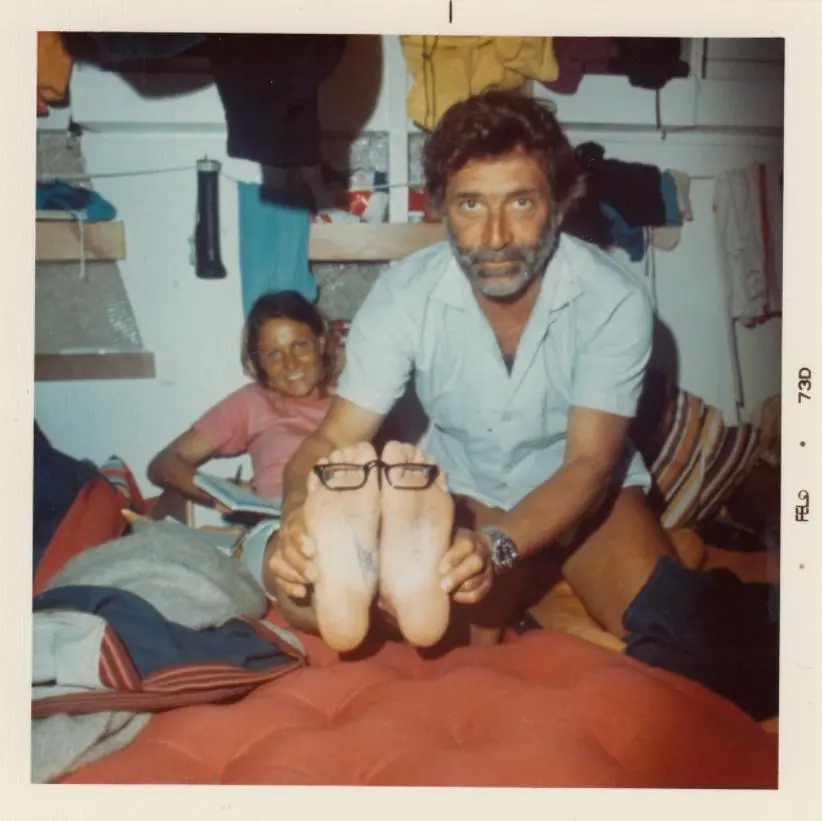
The anthropologist––who had always been obsessed with why people hate each other and fight––set out to discover if violence was innate or learned behavior, whether we could live in harmony, and whether men are hardwired for dominance. But he had even grander motives in planning his fantastic voyage: The lofty question he probed as the Vietnam War waged on in the background was: “Can humankind live without war?” It turns out he was on a one-man, crackpot mission to diagnose and cure the world of violence once and for all. Yet for all his good intentions, Genovés was a masochist and the very last person who should have been in charge of such an experiment.
His requirements for those he let onto the raft extended far beyond the practical needs required for a trans-Atlantic raft crossing. The bearded 50-year-old agent provocateur had chosen ten multi-ethnic younger people from different nationalities, religions, and diverse social backgrounds who––after throwing off the shackles of polite society and being thrown in at the dangerous deep end––would be separated by language, political beliefs, and personal attitudes. Genovés, you see, loved nothing more than pushing people’s buttons to get a reaction.
Much like Reality TV producers, he had cherry-picked the crew for maximum aggression. In short, he wanted to create strife and sexual tension to cause explosive reactions. For example, to spur political conflict, he’d purposefully pitted a Jewish doctor against an Arab. To hike racial tension, he pitted a white American against an African American as she retraced the fateful voyage of her enslaved ancestors. Then, he would light the blue touchpaper, sit back, and hope for fireworks, all the while recording the results in notebooks and on 16mm film.
THE HOUSE ON WATER
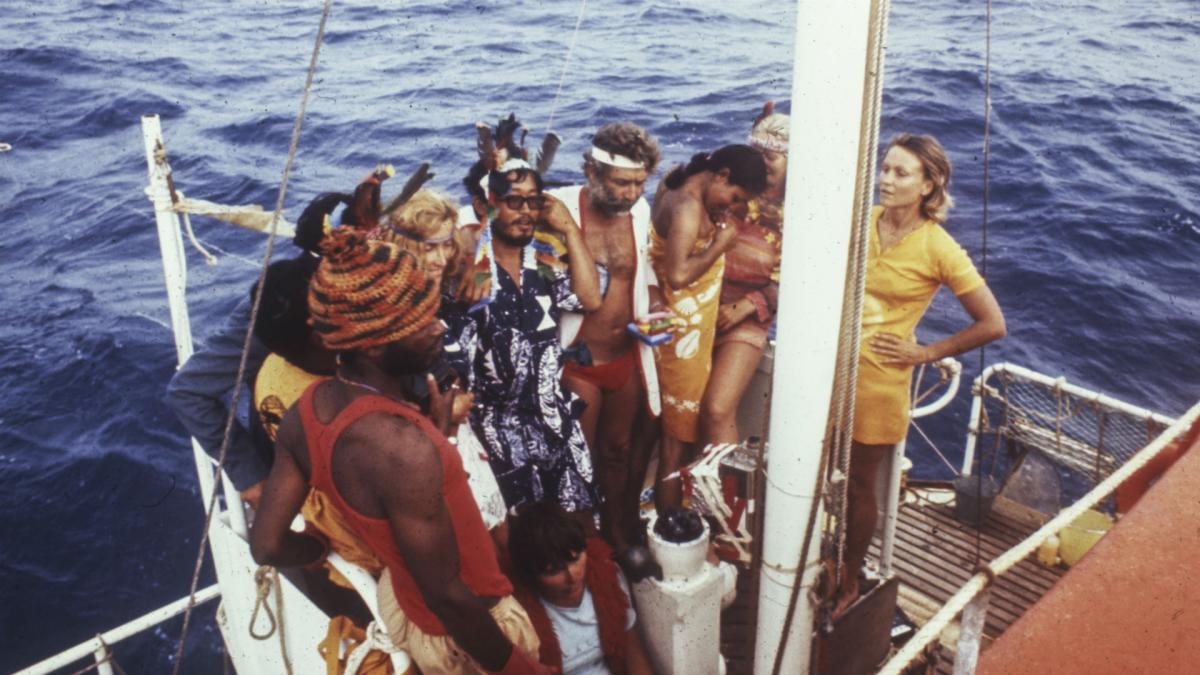
The name of the raft, Acali, comes from the Nahuatl Aztec or Mexicano language meaning "the house on the water." But this floating tin can was anything but a house. The roof of the cramped cabin was so low it was impossible to stand up. Every aspect of the living quarters had been designed to minimize privacy and heighten sexual conflict, not that there was room for anyone to actually make love... unless they wanted to put on a show in front of the others.
All meals were communal. The bath was the ocean. The toilet was a hole perched above the waves. Books, magazines, and radios for news or music were forbidden. The participants slept side by side, boy-girl, boy-girl. And just like the best and most controversial Reality TV shows the world over, Genovés made sure that substantial amounts of alcohol were available for the entire duration of their Bacchanalian odyssey.
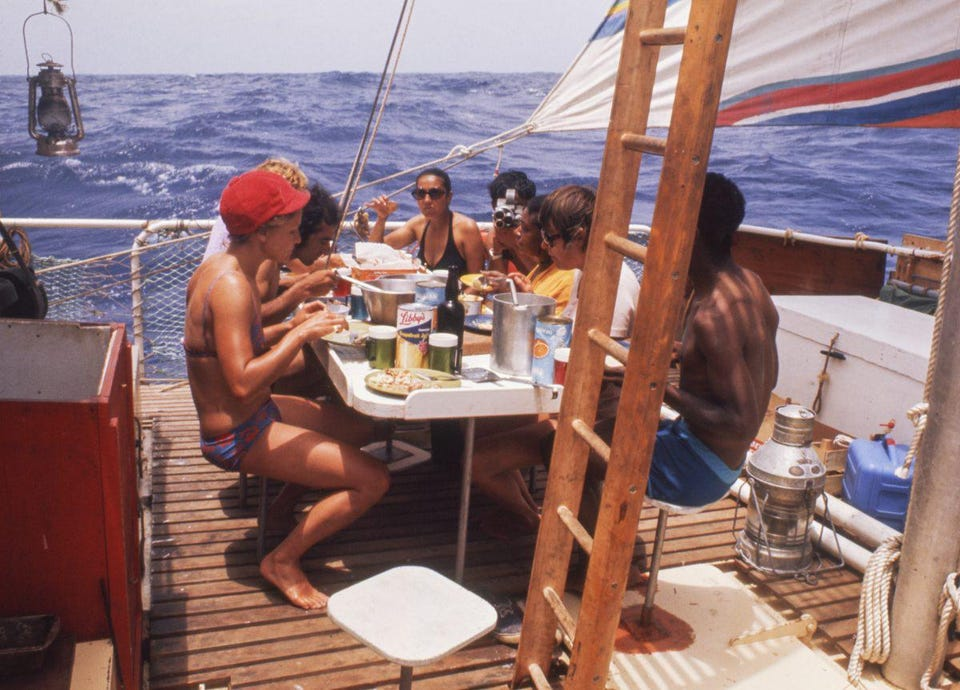
The Acali had no engines. This meant they would set off, use the trade winds, and hope for the best sailing towards the Caribbean… but Genovés sent the raft into the Atlantic just in time for hurricane season. Luckily, the 12x7 meter raft had been designed by an expert marine engineer and assembled by the best British boat builders to be unsinkable. This fact was likely due to Genovés' experience aboard Heyerdahl’s 1969 Ra 1 expedition, which sank in shark-infested Caribbean waters after 54 days, before being rescued by a passing yacht.
Genovés knew the Acali would be sailing into danger but trusted that the science justified all risks. “I believe that in a dangerous situation, people will act on their instincts, and I will be able to study them,” he wrote. When challenged about the dangers of his upcoming experiment, he dismissively stated: “The most anti-ethical thing I know is the fact that a man dies every twenty seconds at the hand of another man in an act of violence. To discover and investigate these things, it is necessary to be more flexible concerning our concepts of what professional ethics are. The problem concerns our survival.”
HE PUT THE WOMEN IN CHARGE
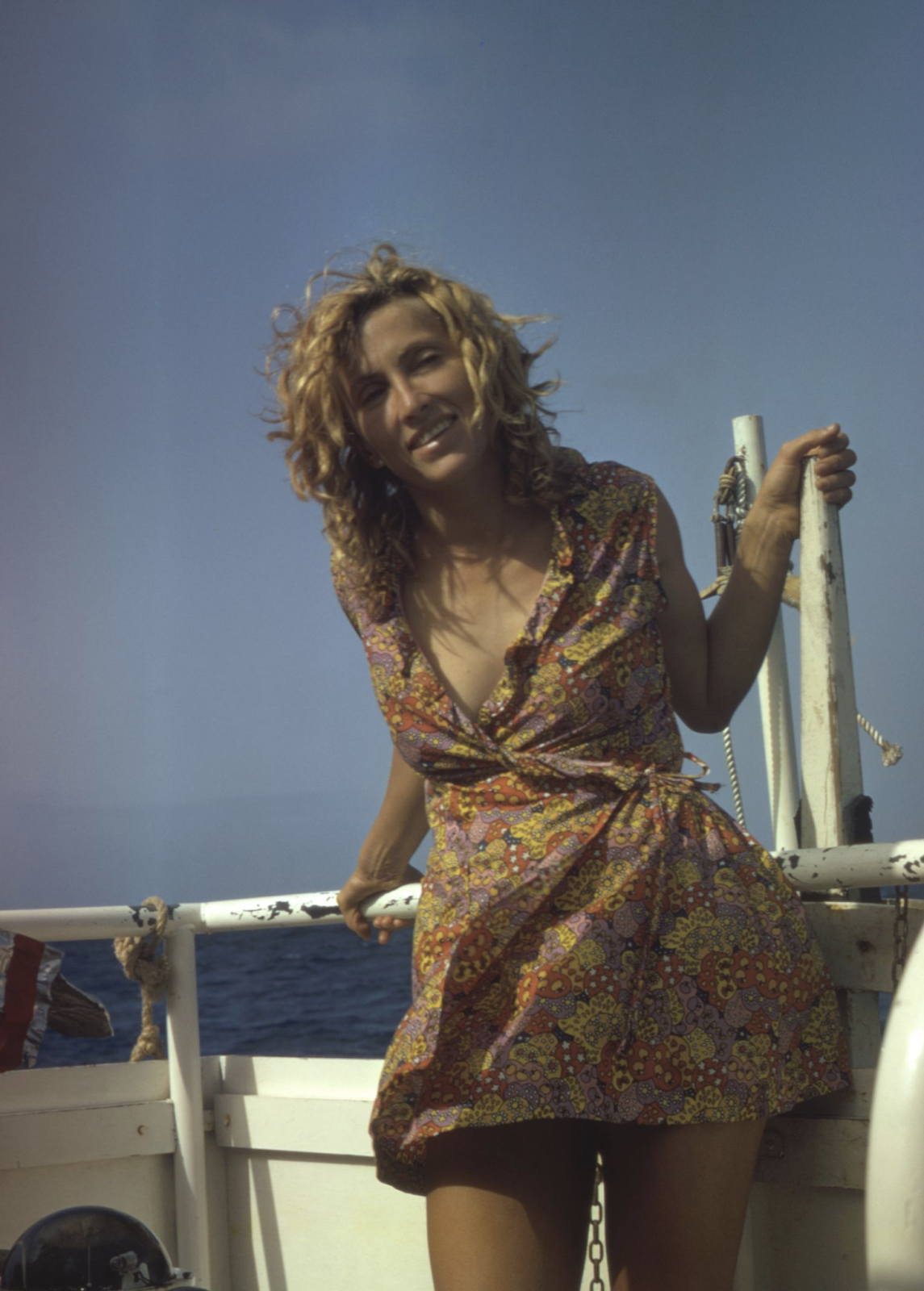
Genovés purported to believe in gender equality, but to further stir up animosity and upheaval, he handed the most powerful positions to women. The raft was to be captained by Maria Björnstam while Edna Reves (pictured) performed the role of ship’s doctor. Next, he assigned all the menial tasks to men. “I wonder if having women in power will lead to less violence or more … maybe men will become more frustrated when women are in charge and try to take over power,” mused the certifiable maniac.
Instead of picking each participant based on their merits, Genovés had carried out “extensive medical, sociological, psychiatric, and psychological profiles” on his crewmembers. His records note whether their personalities were, for example, authoritarian, intolerant, or infantile. It was all a recipe for an unmitigated seabound disaster… but just not in the way Santiago had hoped. The scientist’s most important task would be getting his ragtag many sea mates across the Atlantic Ocean without killing everyone on board.
SETTING SAIL
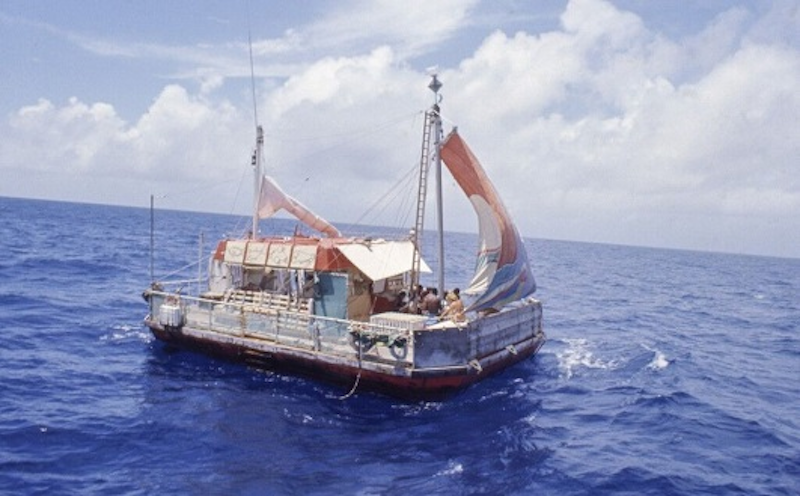
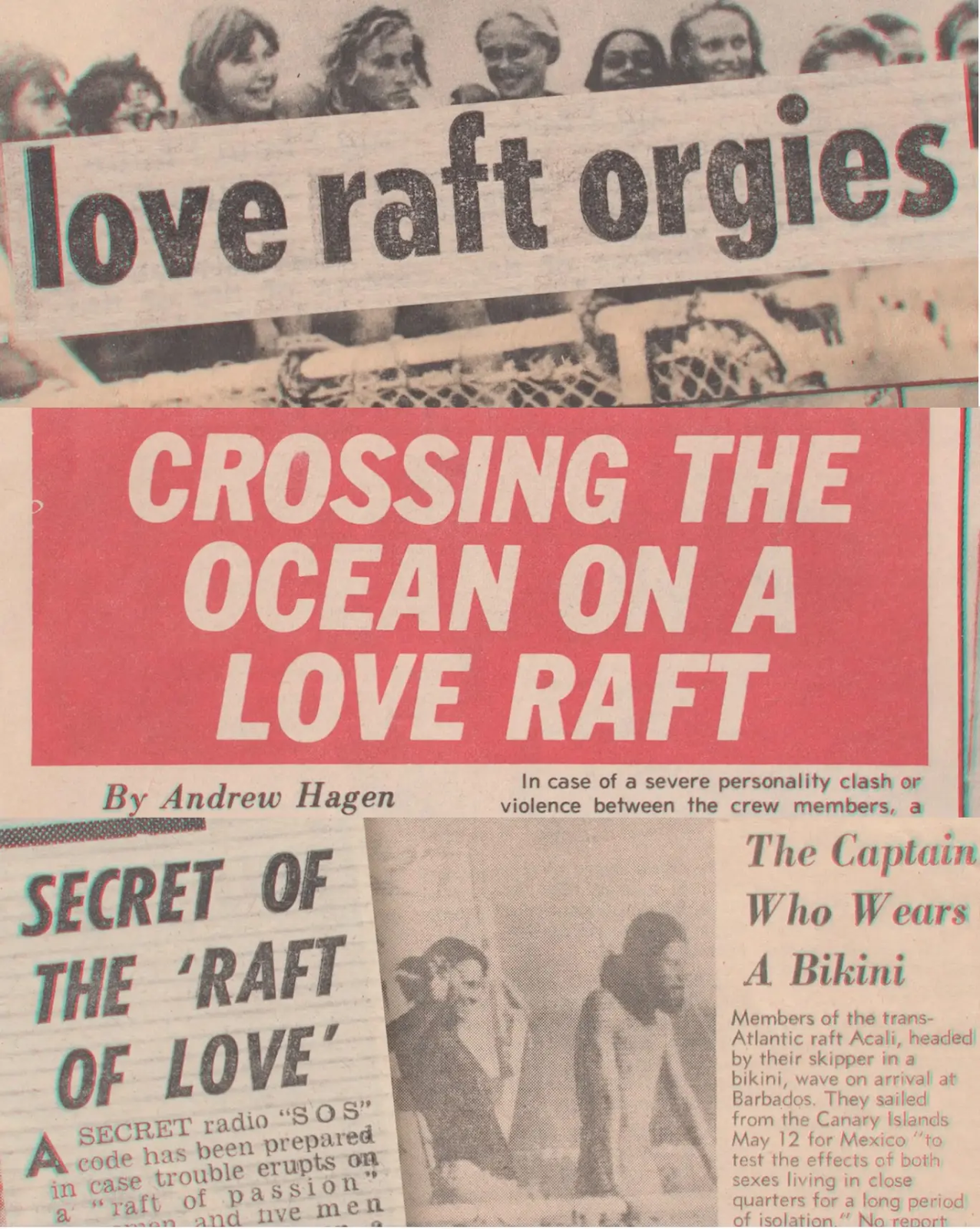
On May 12th, 1973, the Acali set sail from Las Palmas, Spain, to a great deal of media attention. Much to Genovés’ chagrin, in response to the scantily clad male and female crewmembers, the raft was almost immediately nicknamed ‘The Sex Raft’ by the world’s press. Indeed, 80% of news articles about the experiment at the time referenced sexual conduct aboard the craft. But with his sexy sirens in place, he hoped the women would dash his male sailors on the rocks.
Armed with a plethora of questionnaires to try to match displays of aggression with sexual activity, he soon subjected his gang of human guinea pigs to a barrage of 46 questionnaires. The questions depended on such deranged pseudoscience variables as menstrual cycles and phases of the moon or the height of the waves which buffeted the craft. Tests were repeated weekly as he yearned to discover how human beings could one day live in peace. Genovés believed putting his test subjects through hell to promote aggression would help him find a cure for violence, but his plan utterly backfired.
Instead of creating a watery Lord of the Flies situation, the crew got on well. The atmosphere on board was one of unity, cohesion, joviality, and helpfulness; a microcosm of how society should work and the opposite of everything––the sex, the conflict, and primeval violence––that the mad scientist had hoped for. He was later described as “a master manipulator and capable of Gestapo methods.”
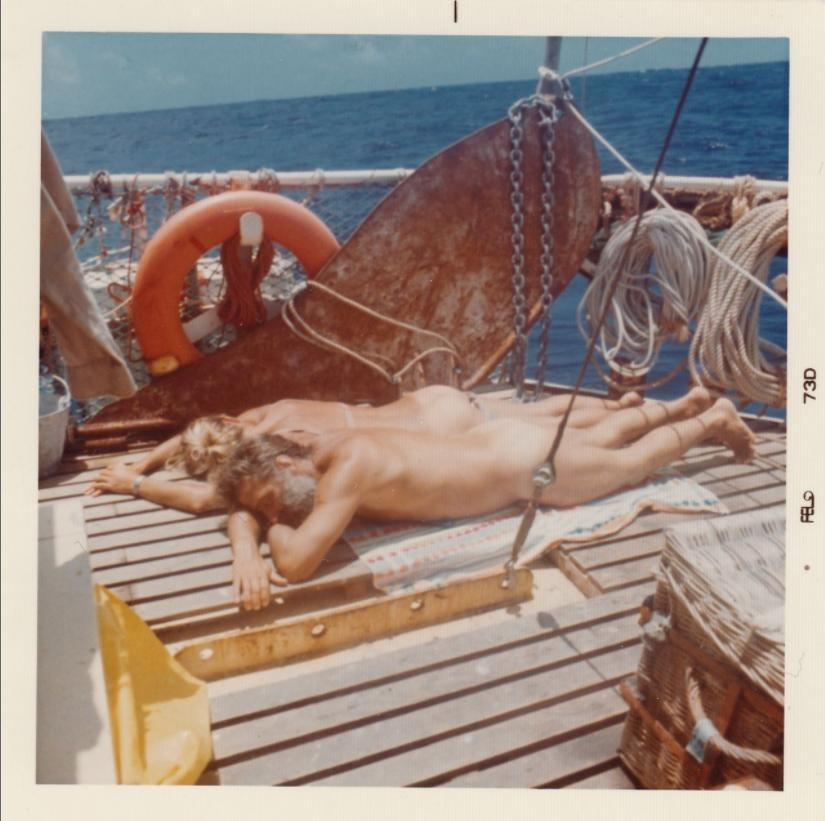
The crew carried out their menial tasks, sang sea shanties, and told stories for entertainment. But then, in the third week adrift at sea, a mixture of cabin fever and the doldrums set in. Another week passed and––primarily due to boredom––several crewmembers began having sex with each other. Asked how many people they slept with, one participant replied with a laugh: “Many, many... Everybody.” But it was still not the debauched trans-Atlantic orgy Genovés had anticipated, and that the newspapers were reporting.
After seven long, torrid weeks drifting across the Atlantic, Genovés had lost patience with the comfortable and convivial atmosphere on board. So, he hit upon a dastardly plan to provoke conflict. Just like Reality TV producers do to create tension today, the anthropologist shook things up by reading crew members’ confidential and intimate questionnaire responses aloud to all and sundry by revealing who fancied and who annoyed whom.
Hell-bent on creating as much tension as possible; next, he plied his motley crew with alcohol and created a relaxed, party-like atmosphere. Then, he countenanced a game of truth or dare, including questions such as “Who would you most want to have sex with?” “How often do you masturbate?” and “Who would you want to kick off the raft?” With his last question, he'd just invented Reality TV show contestants putting their fellow housemates up for eviction. It's a good job they didn't make anyone walk the plank!
At first, his escapades only bore low-hanging fruit. Insults flew around more regularly, there were several childish water-throwing incidents, and Fé Evangelina Seymour’s perception of racial prejudice grew. Yet, despite his best efforts at provocation, save for a few “furtive couplings,” the entire voyage saw little sex and zero acts of violence. That is, apart from the frenzied bludgeoning of a small shark in which one crew member wielded an ax above their head, before delivering the coup de grâce, extracting the shark’s heart and holding it up to the camera.
The shark incident was the only act of physical or imagined violence that occurred until Genovés put the lives of everybody on board at risk. Not only had the anthropologist displayed a reckless disregard for his crew’s physical and emotional well-being, but he had also deliberately underplayed the many risks involved in a trans-Atlantic crossing. As a result, any animosity and bile the crew did feel were directed towards the man who had brought them together. Swedish sea captain, Maria Björnstam, hated him more than anyone… and with good reason.
MUTINY ON THE ACALI
When the Acali entered the Caribbean Sea, warnings of an approaching hurricane came crackling over the ship’s radio. Upon learning of the severe and impending storm, Captain Maria––as any sea captain in their right mind should––immediately recommended they pull into a port to seek shelter and sit out the storm.
Fearing that making land for shelter would mean the end of his experiment, Genovés instigated a one-man mutiny and wrestled control of the raft from the bamboozled crew. While he’d been radically forward-looking and progressive in giving the most influential roles to women, now his macho, misogynist behavior came to the fore. Though the hurricane missed them, Maria later called Genovés’s mutinous act of sedition “punishable by death” according to ancient maritime laws.
After nearly killing them in the hurricane incident, the crew now recognized that Genovés was the most serious threat to their safety. Things came to a head a few nights later when the crew seriously considered murdering him. One idea was to push him overboard into the watery deep to drown or be picked off by sharks. Another murderous plan involved injecting him with a lethal dose of Dr. Reves' medications via a syringe.
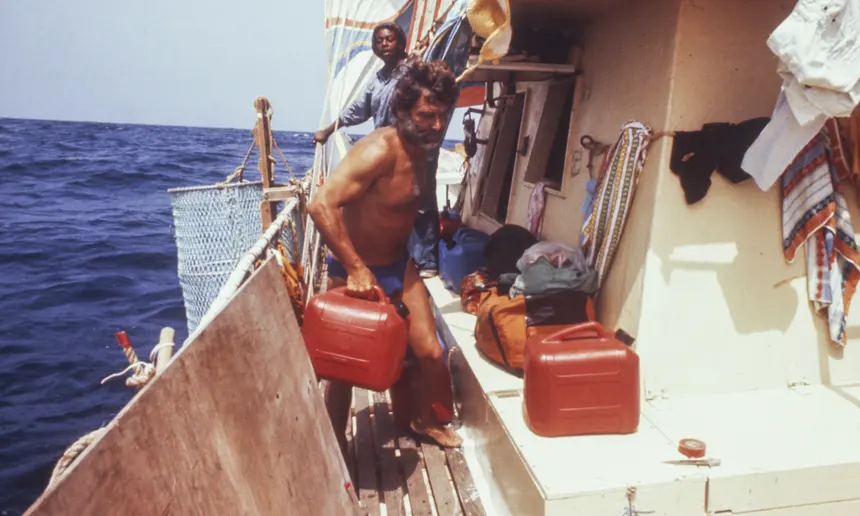
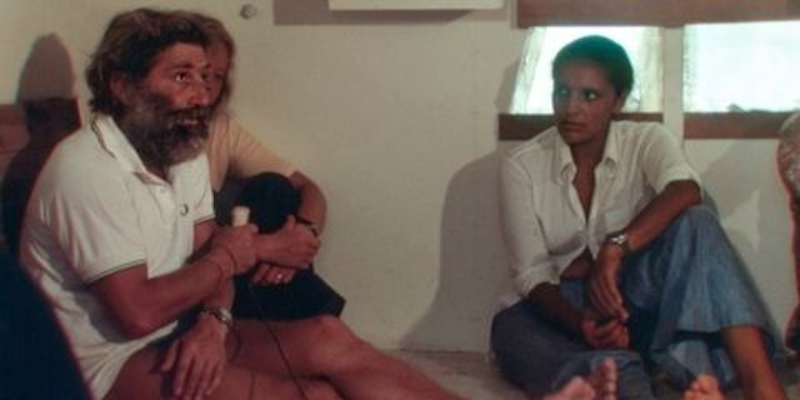
Fé Evangelina Seymour (pictured above on deck with Genovés) recalled the crew discussing everybody placing their hands on a knife [or syringe] so they could “plunge it into him, so everybody was guilty. We would wrap him in a sheet, carry him over the railing and drop him.” Japanese cameraman Eisuke Yamaki––who had been “volunteered” to push Genovés overboard––later admitted, “I’m happy that no one was killed." He went on to call their decision not to murder him “a significant collective accomplishment,” which took all their resolve.
The crew’s best-laid murderous plans ended when a giant container ship––horns blaring but unable to alter its course––appeared right in front of them. As the leviathan bore down on the tiny raft, the mutinous, new Captain Genovés panicked at the ship’s wheel. Seconds away from disaster, Maria took the rudder to steer the tiny craft away from the large freighter in a frightening near-miss, and the most dangerous event they had experienced… all caused by Genovés’ blowhard incompetence
In wrestling back control, Maria heroically re-emerged as the captain, symbolically castrating this macho man with a messiah complex. With his power unceremoniously taken from him, Santiago withdrew from the group and became increasingly defeated and depressed. Lying below deck, listening to everyone, he found himself crying for the first time since childhood. This was followed by an epiphany, as evidenced by his diary: “Only one has shown any kind of aggression, and that is me, a man trying to control everyone else, including himself.” Like Quint from Jaws, Genovés had sailed his crew into unimaginable danger and the only thing he found at the end of his odyssey was his own heart of darkness.
Without Genovés’ interfering ways, the crew went from strength to strength as a cohesive, cooperative, and happy unit. Finally, after an unimaginable 101 days at sea––not counting a single rushed stopover for supplies in Barbados––the Acali washed up on the shores of Cozumel, Mexico. They were tired and sunburnt, but the only blood spilled belonged to fish and sharks. The crew was surprised at the raft’s reputation as The Sex Raft as the majority of the sexual shenanigans took place in the imagination and apocryphal stories of the journalists, desperately trying to sell newspapers.
As for Genovés, he set foot ashore to find that his peers of 20 years at the National Autonomous University of Mexico had disavowed him and his study while he was at sea. Instead of descending into a primitive group of craven bloodthirsty, sexualized savages as he'd hoped, the group had come together to overcome their problems (mainly caused by Genovés himself) using courage, common sense, compassion, decency, and diplomacy. After stepping onto terra firma after her three-month voyage, French scuba diver Servane Zanotti stated: “I could have gone for another three.”
While some crew members would readily have signed up, a sequel or second season of Sex Raft was never commissioned, and the tale slipped into the mists of time. But, amazingly, the crew did see each other again 45 years later.
THE SEX RAFT REUNION

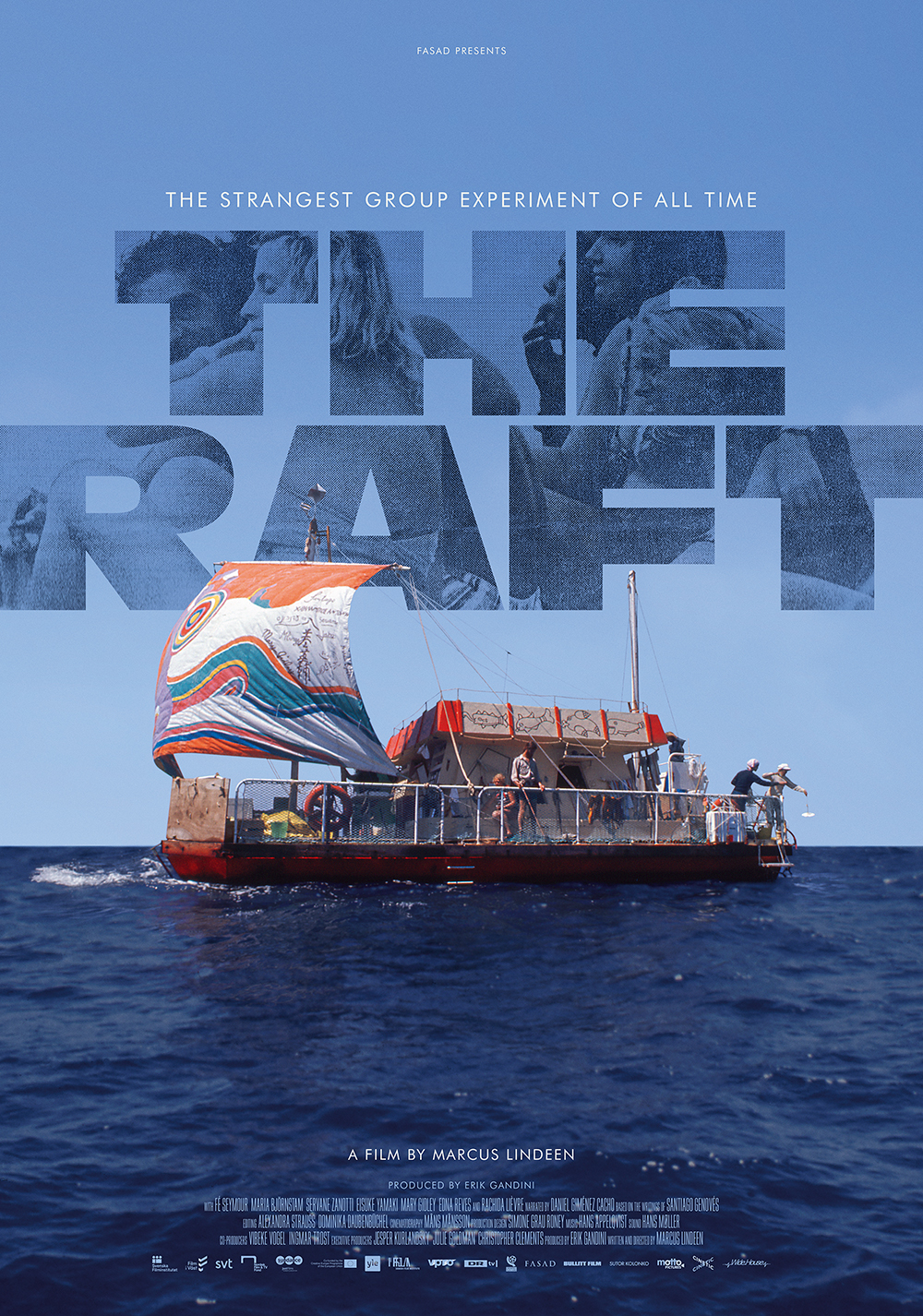
In 2018, Swedish documentary maker Marcus Lindeen tracked down six remaining Sex Raft survivors. He brought Mary Gidley, Edna Reves, Fé Seymour, Eisuke Yamaki, Maria Björnstam, and Servane Zanotti together on a 1:1 scale replica of the Acali on a Swedish soundstage to reminisce about their voyage and the results are astonishing. Mixing testimonies with archival 16mm film shot aboard the Acali, and dramatic reconstructions, The Raft (2018) brings this crazy, fascinating story to a whole new generation.
Santiago Genovés set out to end violence by placing a group of young people in a confined space to bring out the worst in them in the hope that they would fight and f**k. He failed. Genovés died in 2013, but his crackpot experiment unwittingly wrote the rules for many of today’s Reality TV shows. In a way, he was the father of Big Brother, Survivor, Love Island, The Bachelor, and a slew of other shows.
Genovés’ experiment didn’t end human violence, but it seems the answer was staring him in the face all along: The only way we humans can overcome war and violence is by working together to overcome our differences… perhaps by letting women lead the way!
Marcus Lindeen's fascinating documentary The Raft is available to watch on here on Amazon Prime.