
When virtual care solutions aren’t built into EHRs, workflows break down.


You remember the patients who slipped through the cracks — those who couldn't make the drive, take time off work, or walk through your clinic doors without feeling exposed. The sheer distance, logistics, and stigma created barriers that no amount of clinical expertise could overcome.
Telehealth has dismantled many of these barriers. However, many providers still struggle to use these capabilities because their tools are fragmented. When virtual care solutions aren't built into electronic health records (EHRs), workflows break down.
You shouldn’t have to forgo offering telehealth services — or suffer through administrative headaches — because of your software. Here's how integrated telehealth bridges the gap between patient access and practice efficiency.
As mental health provider and private practice owner Kristin Trick explains, "Telehealth has cemented its role in modern healthcare. Your practice’s EHR should be a reliable channel for your delivery of remote services."
"Telehealth has cemented its role in modern healthcare. Your practice’s EHR should be a reliable channel for your delivery of remote services."
What are the benefits of telehealth for psychiatry practices?
While telehealth has several benefits, its impact on psychiatry practices is distinct:
1. Breaks down geographical and logistical barriers
Rural Medicare beneficiaries saw a 425% surge in telehealth visits for mental health between 2010 and 2017. Patients finally had access to board-certified psychiatrists without driving hours each way.
Telehealth allows you to reach communities that have been psychiatrically underserved for decades, including correctional facilities, nursing homes, schools, and rural areas. You eliminate the biggest barrier to care when your patient can attend their follow-up appointment from the comfort of their living room or during a lunch break.
2. Reduces stigma around psychiatric treatment
A study of adult patients who received clinic services between 2020 and 2023 showed that telehealth services (phone and video calls) reduced no-show rates by 50% compared to in-person visits.
Practices that use Tebra’s telehealth feature often see 98% patient satisfaction rates for video visits. This happens when patients feel safe, comfortable, and in control of their environment during vulnerable conversations.
3. Improves treatment continuity
Integrated e-prescribing capabilities ensure that patients can access the right medication immediately. You can efficiently adjust dosages, address side effects, and send orders to your patient's pharmacy without switching tabs.
This directly improves medication adherence, especially among those with serious mental illness. A 2025 study of patients prescribed antipsychotics found that at least 50% didn’t take their medication as prescribed. However, researchers found that consistent telephonic follow-ups led to increased medication adherence for up to 2 years after discharge.


How telehealth platforms integrate with psychiatry EHR systems
To realize the benefits of telehealth, your EHR needs to be able to do more than open a video call. Here's what's required:
Standalone vs. integrated telehealth in psychiatry EHRs
| Feature | Standalone telehealth | EHR-integrated telehealth |
| Documentation | Manual entry into a separate EHR | Auto-documented in the patient record, personalized templates |
| Scheduling | Separate calendar systems | Unified scheduling platform, automated appointment reminders |
| Billing | Manual code entry and claims | Automated telehealth coding/claims, updates on approvals or denials |
| Patient portal | Limited or no integration | Seamless pre/post-visit access, capability for patients to upload or e-sign documents |
| Compliance | Separate consent workflows | Built-in HIPAA safeguards, inclusion of a business associate agreement (BAA) |
| Interoperability | Data silos between systems | Connected labs, pharmacies, health information exchanges (HIEs) |
| Provider efficiency | Duplicate data entry required | Single workflow, no re-entry, opportunity for multiple providers to store records and appointments within the same system |
| Support and training | Separate vendor relationships | Unified support and onboarding, access to customer service through chat, phone, or email |
Clinical documentation based on real-time data
Poor integrations force you to waste time on administrative tasks. For example, you might spend another hour at work after finishing your last session just to complete notes.
Integrated telehealth changes that equation. The system automatically captures session duration, timestamps, and provider attestations during the visit. This allows you to focus on capturing mental status exams, risk assessments, and treatment plan updates in real-time without double documentation.
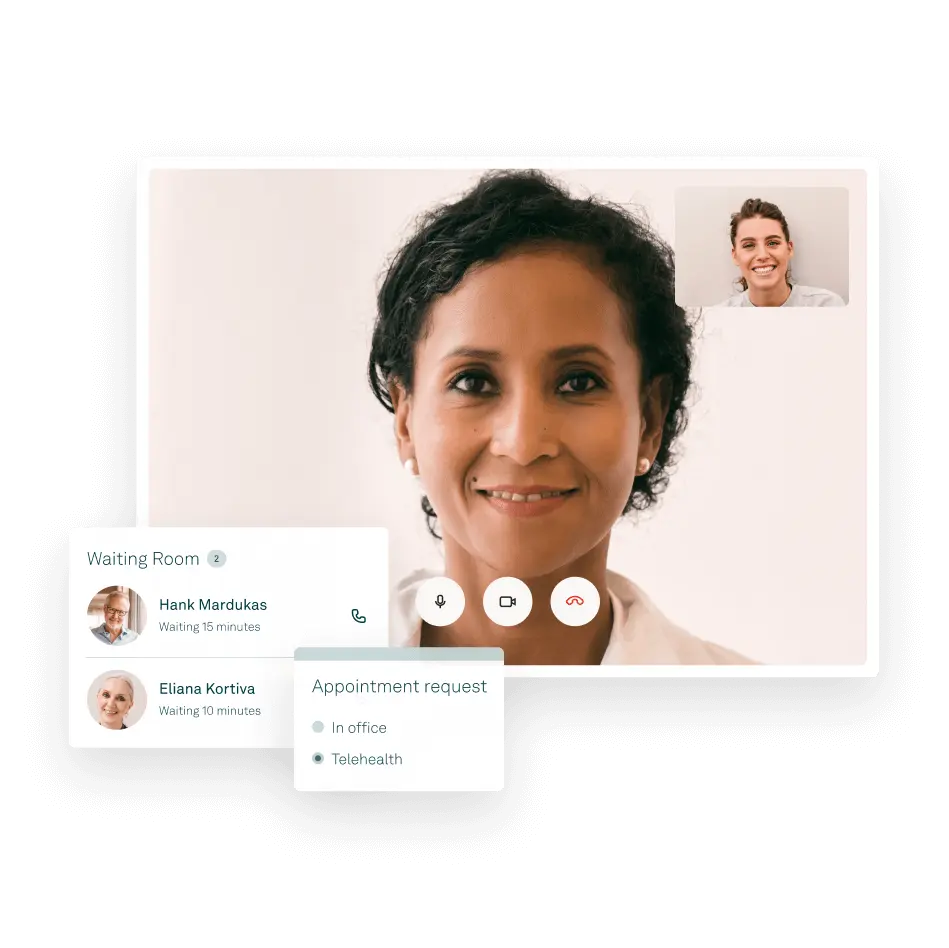
Integrated scheduling, billing, and administrative processes
Tebra also found that 72% of providers identified billing and invoicing integrations as critical features for their EHRs. An integrated platform handles the entire lifecycle of the visit in one place:
- Claims submission directly through your EHR
- Suggested CPT codes and telehealth modifiers
- Documentation formats designed to appease payors
- Digital intake forms flowing into encounter notes
- Insurance verification and payment processing
- Autopopulated patient and administrative information
HIPAA-compliant patient portals
Security in psychiatry is non-negotiable. Platforms must offer end-to-end encryption to protect every video session, message, and data point. For instance, certified platforms like Tebra maintain 100% HIPAA and HITRUST compliance, which means the security infrastructure meets healthcare standards.
Patient portals extend care beyond the appointment by offering secure messaging, access to medication lists, and privacy consent forms that can be completed before the visit begins.
How to overcome telehealth integration challenges in psychiatry
Ensuring your EHR seamlessly integrates with telehealth capabilities requires looking at 3 specific areas.
1. Integration and interoperability gaps
A recent Tebra survey found that 69% of providers face interoperability issues with their EHRs. As a result, data is siloed and everything requires a manual workaround.
Because psychiatric health documentation requires specialized formats, generic platforms often fall short. Instead, like Tebra's, your platform should be ONC-certified and specifically designed for psychiatric practitioners to ensure you get a compliant system out of the box.
What Our Customers Are Saying


2. Privacy, security, and regulatory complexity
Patient conversations carry legal obligations beyond standard medical documentation. Adhering to guidelines from entities like the American Psychiatric Association and the National Institute of Mental Health, robust EHRs ensure that remote care meets the same clinical and ethical standards as in-person visits.
Platforms must be HIPAA-compliant, like Tebra, to give you full control over your data, encryption, and access controls. Simultaneously, patients must go through clear consent processes before their virtual visits begin.
3. Impact on workflows and overall adoption
If an EHR is not intuitive, staff will struggle to adopt it. Tebra found that 41% of providers say staff training is a major challenge while their current EHR. To avoid wasting your investment, choose a psychology-specific EHR platform that offers:
- Comprehensive training on virtual processes before go-live
- Customizable templates that match your psychiatric specialty
- Incremental implementation with dedicated support
What does the future of telehealth look like for psychiatry practices?
Telehealth has given rise to virtual and hybrid care models that weren’t possible previously. You no longer have to convince patients to enter your practice doors for onsite treatment in order to provide high-quality care.
To support this shift long term, prioritize platforms that either have telehealth features built in rather than bolted on. Doing so is the most effective way to connect with the patients who need it the most.
Ready to learn more about how Tebra's all-in-one EHR+ can support your practice? Book a demo today.
Frequently asked questions
- Calculate your potential EHR savings in minutes: Answer a few quick questions, and we’ll estimate your savings on software, staff time, and billing costs.
- Top 10 benefits of telehealth for private practices: Patients increasingly value convenience alongside quality care — and telehealth delivers both.
- How to choose the best telehealth software for your practice: Discover key features, compare top HIPAA-compliant platforms, and get expert tips to select the ideal telehealth software for your private practice.