-
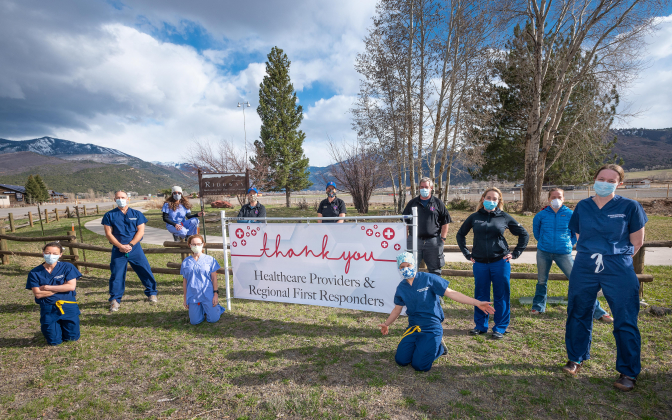
Healthcare providers and first responders Avery MacKenzie, Drew Yeowell, Kerstin May-Michelich, Alexis Garza, Kim Mitchell, Ruth Stewart, Greg Noland, Katie Hughes, Sara Forrest, Rebekah Stewart and Katy Majors-Foley stand in Ridgway by the banner installed by a group of medical professionals' families recognizing their work. Photo courtesy Jeff Dunbar
Every day before Avery MacKenzie leaves for work, she steels herself for the emotional challenges of her upcoming shift. This usually involves a lot of coffee.
Once she is sufficiently caffeinated, she kisses her husband, her toddler, and her preschooler goodbye, climbs into her car and drives away from the quarantined safety of her home in Ridgway — and out into the pandemic.
MacKenzie, an emergency room physician at Montrose Memorial Hospital, is one of the many medical professionals in Ouray County who are on the front lines of battling COVID-19.
She usually listens to medical podcasts during the 30-minute drive from Ridgway to Montrose to keep abreast of the most recent COVID-19 developments. The Sneffels Range recedes in her rear-view mirror. She sips more coffee. The miles tick by, and her mind ticks through all of the new protocols she will encounter when she arrives at work.
Someone will take her temperature. She will have to self-report if she has any COVID symptoms, and whether she has taken any Tylenol or ibuprofen. Hopefully, the COVID patients who come in during her shift will have mild symptoms and she can send them home to self-isolate. Hopefully, there will be no intubations. Hopefully, there will be enough PPE. Hopefully, this will not be the day that she or one of her colleagues gets exposed to the novel coronavirus.
Before the pandemic, MacKenzie put on her scrubs at home. Now, she wears regular clothes to work. When she gets to the hospital, she puts on all new items – hospital scrubs, a cap, a mask and goggles. Finally, she is ready to see patients.
Montrose Memorial Hospital is a relatively small hospital, with just eight ICU beds. So far, it has not been overwhelmed with coronavirus patients. MacKenzie typically sees just two or three COVID patients per shift, which tells her that Gov. Jared Polis’ stay-at-home orders have been working.
"Some days are hugely busy with really sick patients, and other days we have lower volumes than I would in a normal April or May shift;' she said. "The big challenge is that a lot of the tools we would traditionally use for people in respiratory distress put a lot of health care providers at risk for viral exposure."
The emotional stress that goes along with the COVID-19 outbreak can take many forms for an ER doc like MacKenzie, from figuring out how to take care of very sick patients while also keeping staff safe, to sitting quietly with an elderly patient and helping him decide whether he wants to be intubated and hooked up to a ventilator.
"To have this conversation with someone who is significantly ill and struggling, without family present, is a very heartbreaking situation to be in," MacKenzie said.
She has had equally difficult discussions with her husband, Greg Zimmerman. Back in March, as the shape-shifting menace of the novel coronavirus came into sharper focus, the two of them huddled together to review their advance directives, and quietly talked about whether either would want to go on a ventilator, if it came to that. They even discussed splitting up into separate households for the duration of the pandemic, to protect their kids from exposure.
It all felt a little surreal.
“We made a decision together that I was not going to try to isolate myself from my family, but acknowledged there was a risk if I chose not to,” she said.
When MacKenzie’s shift at the hospital is over, she changes out of all her scrubs. She vigorously washes her face, neck, hands and forearms with soap and warm water. She sets her mask aside to be recycled in a machine MMH just acquired that can reprocess N95 masks up to 20 times. She leaves her designated hospital shoes at the hospital, in their designated place. She wipes down her cellphone and anything else she’s brought to work.
Then, she gets back in her car and drives home. The Sneffels Range grows larger in her windshield. She listens to music, or the news, or nothing at all. The miles tick by, and she ticks through the events of the day. She wonders how the patients she treated in the ER are faring. She carefully reviews all of the protocols she wi ll follow to keep her family safe when she arrives at home.
She'll go inside, take off her travel clothes and put them into the washing machine, wipe down her phone again, wash her hands again, take a shower. Then, at last, she'll give her husband and her kids a hug.
There will be walks, and bike rides, and homeschooling, and scavenger hunts in the warm spring sunshine. In the evening, if MacKenzie’s not on night shift, she’ll step outside with her family to join in Ridgway’s 8 o’clock howl. Once the kids are tucked in, she and her husband might binge-watch a few episodes of Tiger King.
So far, for MacKenzie and her family at least, it’s all working out OK — in a surreal way.
“People are dying, and it’s hard to see anything good when that is what you are staring at,” she said. “But there are some good things. My kids have never gone so long without being sick; they are not interacting with other kids at preschool, and I am a lot less of a vector for bringing things home than I probably used to be.”
In the medical field, there are some good things, too. People are washing their hands more often and telemedicine restrictions have fallen away.
"Patients who have difficulties with mobility can access doctors like never before, which is super positive," MacKenzie said.
"Also, there are people whose jobs are incredibly important, and we as a community didn't fully recognize them until now," she reflected. "People who work in grocery stores and environmental services. Preschool teachers and elementary teachers should be paid a million dollars a year. These people deserve our respect."
Meanwhile, at Ridgway Family Dentistry
Dr. Michael Thomas nods at the outsized bottle of hand sanitizer on his desk.
"We are finally able to buy it by the gallon," he says with relief. "We have got it on every desk, in every treatment room. When patients first walk in, they have to use it. They usually use it when they walk out, too. And we are using it all the time throughout the day."
Dentists spend their days in close proximity to patients’ mouths, so they have to be obsessively careful in this new era of the novel coronavirus – particularly during procedures that may aerosolize respiratory droplets, dispersing them through the air.
Frequent hand sanitizing is just one line of defense Thomas has added to his practice since re-opening after a mandatory nationwide shut-down of dentist offices that began in mid-March.
There are also new protocols like pre-treatment and post-treatment patient screenings, a virtual waiting room (aka the parking lot), and layers and layers of PPE: N95 respiratory masks covered by surgical masks covered by face shields with disposable plastic visors; head coverings and long lab coats that are gathered at the sleeves and all the way up to the neck; and disposable gowns for aerosolizing procedures.
The patients have to wear masks too, right up until the time they open wide. There has been only one “anti-masker” so far who complained about this rule.
“Other than that, people seem extremely grateful for what we have done and what we continue to do for their personal well-being and safety,” Thomas said.
After each patient, Thomas and his assistants don new surgical masks. At the end of day, they put their N95 respirators in brown paper lunch bags and let them sit for 72 hours before reusing them, a system developed in hospitals to prolong use of the scarce PPE.
"Nothing we wear during the day clothes, scrubs, shoes - none of that stuff is worn home," Thomas said. "We launder all our stuff that is reusable on site. It's a lot to adapt to."
On days when Thomas has conducted a lot of aerosol-producing procedures, he showers as soon as he gets home. Then he and his wife, Darcy, who also works in the practice, head out for a bike ride or a walk, eat a healthy dinner, and get plenty of sleep to keep their immune systems in good shape.
Coming back to work after the six-week closure "was very st ressful for everybody at first," Thomas admitted. "The first week, having all this stuff was a bit of a challenge. Like anything new, you are just not used to it. We felt very restricted by all the stuff we had on, but found the second week got easier, and this week everybody is getting into more of a routine."
Grateful community members have been helping out with PPE at Thomas’s practice. Woodworkers and emergency medical technicians have donated extra N95 masks that they had at home. Thomas and his assistants wear face shields with disposable plastic visors manufactured on a 3D printer by Log Hill resident Donna Clark.
Thomas has found some other silver linings in this novel situation, as well, recalling the days of the HIV scare in the ‘80s and ‘90s.
“Certain PPE requirements were put in place then that seemed very invasive to us, but ultimately they became the standard, and we would never go back,” he said. “I have a hunch that a lot of us will stay with some of these new procedures, too, as an added level of precaution.”
Just up the road at Mountain Medical …
Dr. Joel Gates is wrapping up a long, chaotic, doozy of a day. He’s got a standing date to head out for a run with his daughters after work.
“It has been a real lifesaver for clearing the mind and letting the day go,” he said.
Gates and his daughters spend a lot of time together throughout the day as well. Both Hadassah and Adli, a college sophomore and high school senior, respectively, have been helping their dad out at the Ridgway Mountain Medical Clinic as coronavirus screening assistants since their schools shut down. The extra time with his nearly-grown.
The extra time with his nearly-grown daughters is a gift to Gates that helps him get through this challenging time.
“It’s toughest on them,” he said. “Our senior, Adli, feels robbed of her milestones. And Hadassah has really struggled with moving back home. Online college is not the same as in person. It’s a real challenge.”
Other than having both girls at home, Gates says his family life has changed the most over the past few months "in laying off contact with others, fearing we would be the vector. We are cloistered at home." Gates' wife Leah is the only one who heads out into the community to run errands for the family.
Like Dr. Thomas down the street, Gates has had to scramble over the past few months to secure enough PPE for his staff, and to adapt his practice to the new challenges of the coronavirus – like being the only testing center in Ouray County.
Nevertheless, Gates says, “I feel like it is an incredible honor to serve the community in a time of stress, fear and need. I have been privileged to participate for our community at this time. That is the biggest take-home about this time. It is an honor to be here for these people. For our community.”