
When we started Abacus, one thing we were acutely aware of was that most people outside of China weren't familiar with Chinese tech companies. As we were writing for a global audience, we had to account for that. Equally though, as an outlet focused on Chinese tech, it felt repetitive and patronizing to keep writing things like "WeChat, a messaging app used by millions of people for everything from payment to food deliver..."
Our solution was a series of explainers embedded into stories as widgets. Clicking or tapping on the widget displays a short, one-line explanation of the app, company or person; you can then tap again to see a full, article-length explainer.
We were really proud of these explainers, but there wasn't really a great way to access them beyond the widgets in stories. We did have an index, but it was a basic list. It wasn't organized by topic, by timeliness or prominence, just by when we published the story.
We thought we could do better with this and make it an actual page that a reader would like to see. And readers were going there; our stats showed that the index page was getting decent traffic, but few clicks through from there. So why not improve it and make it a destination in its own right?
Welcome to China Tech City.
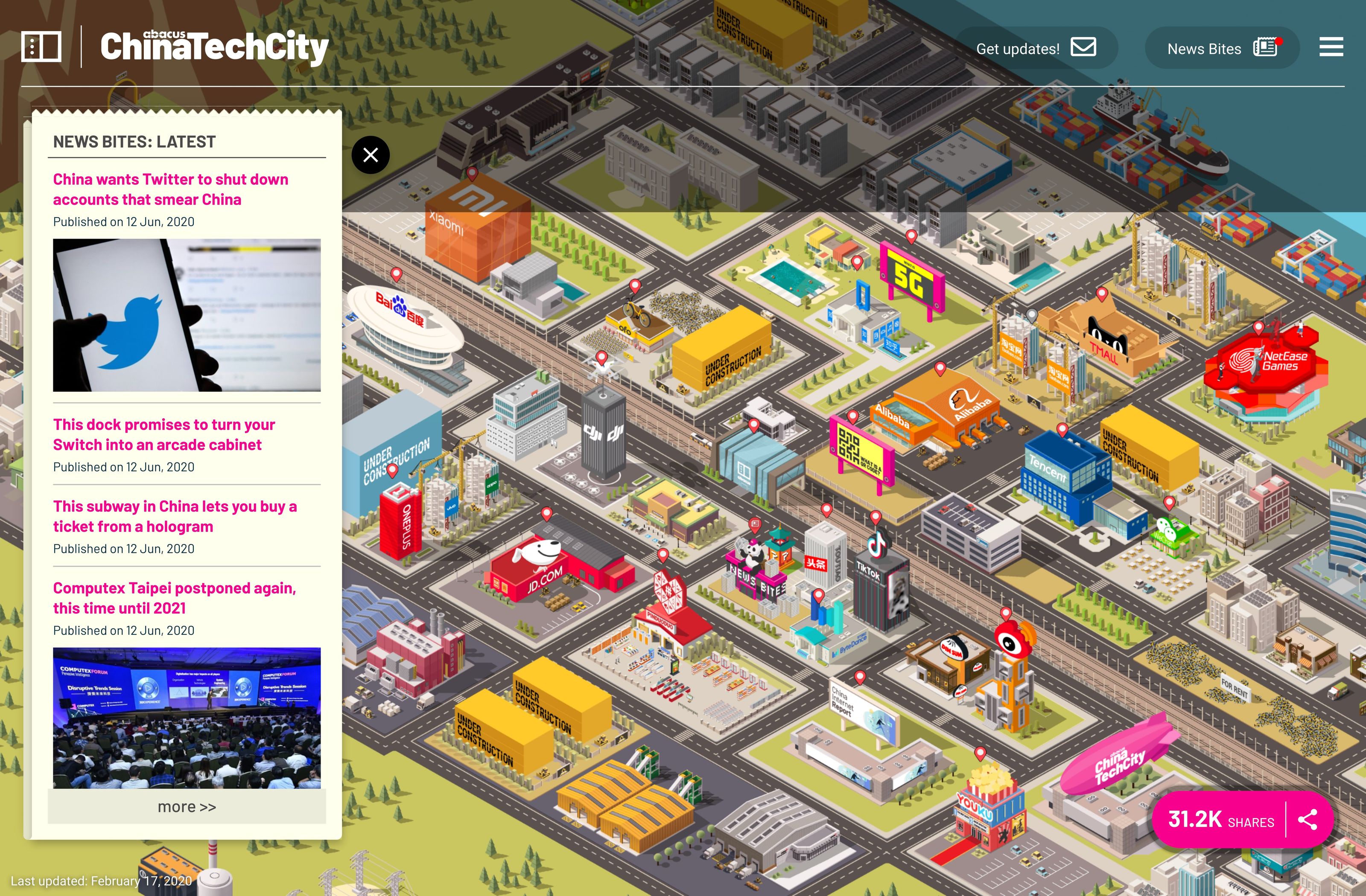
China Tech City was a map that you could tap and drag around filled with cartoon-ish buildings representing different Chinese tech companies. The buildings were broadly based on the companies: online shopping site JD.com was a warehouse with boxes and delivery trucks, drone maker DJI has drones parked outside, battle royale specialist NetEase had a battle arena on the roof.
Each one was a company we'd covered in an explainer.. Tapping on a building would bring up a profile with key information, a quick summary and a list of our stories about that company, as well as a link to the full explainer.
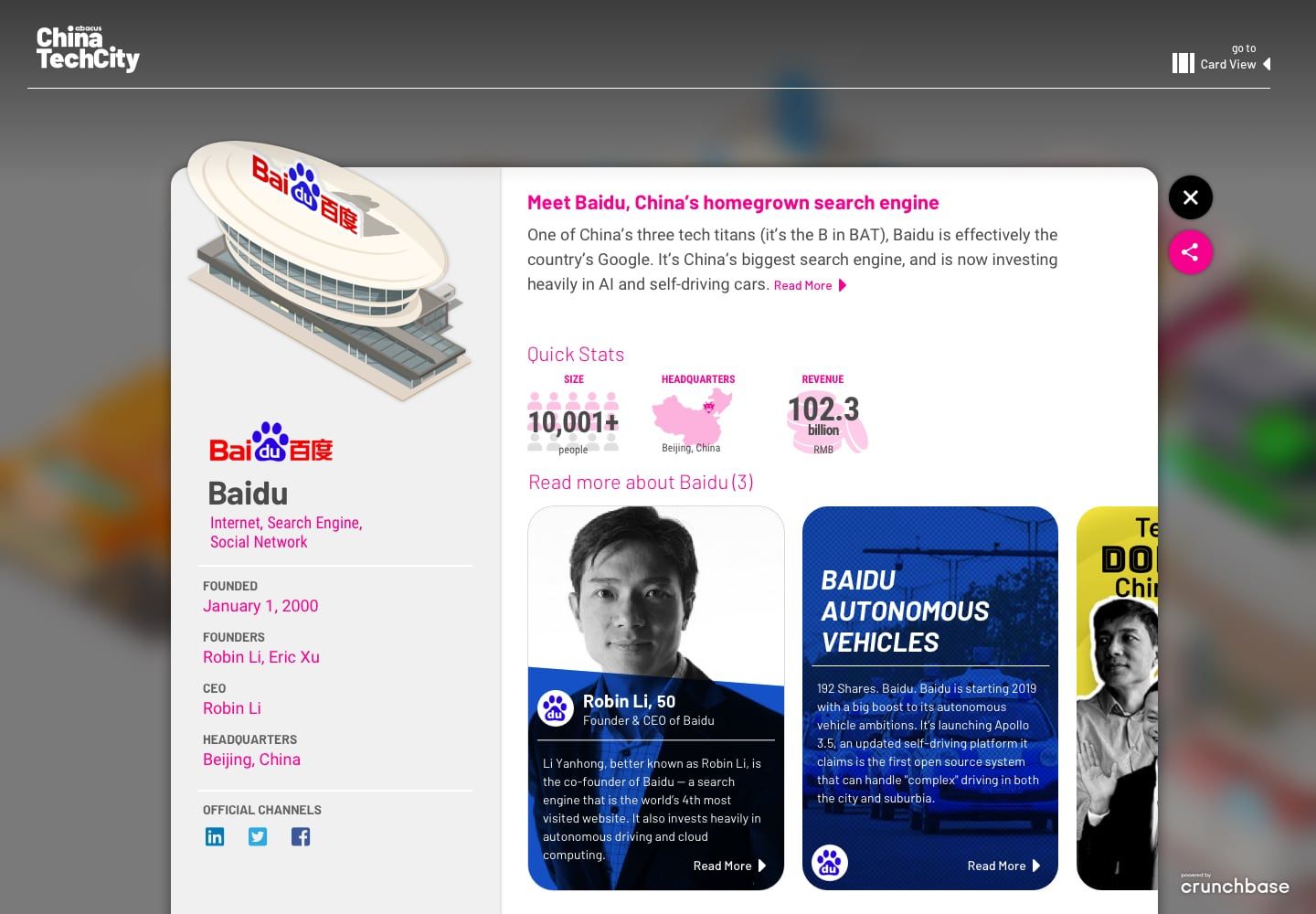
We played around with the idea of little profile cards like this for a while, but it took us some time to figure out the theming that tied it together. It could have been a simple page like a homepage, so we could manually curate the sections. But that didn't feel right. Abacus was meant to be more playful and inventive than our parent publication. And we had a real problem with metrics; our page views per user were low. We wanted to find something more interesting, something that might tempt people to explore and read more than one profile.
The solution came from one of my favorite TV shows of that time, Silicon Valley.
I love this intro. It's just ten seconds long, but it's packed with tiny references and jokes. The Facebook sign moves over the Oculus and WhatsApp buildings, representing Facebook's purchases. Apple's new headquarters, the spaceship-like Apple Park, is under construction. The prominent Yahoo sign shrinks, while the small Alibaba sign on the same building grows and eventually dwarfs Yahoo.
We wanted to leverage that same sort of humor as we scaled and grew the city. One of the great things about Abacus was how closely we worked with the Product team that designed and built China Tech City. We told them what buildings were prominent, which should be near each other, and our roadmap for what we were planning to add in the future.
The many buildings that were under construction wasn't any sort of reference or commentary to China's building boom; they were the companies we were going to add next to the map because we knew we were working on explainers for them.
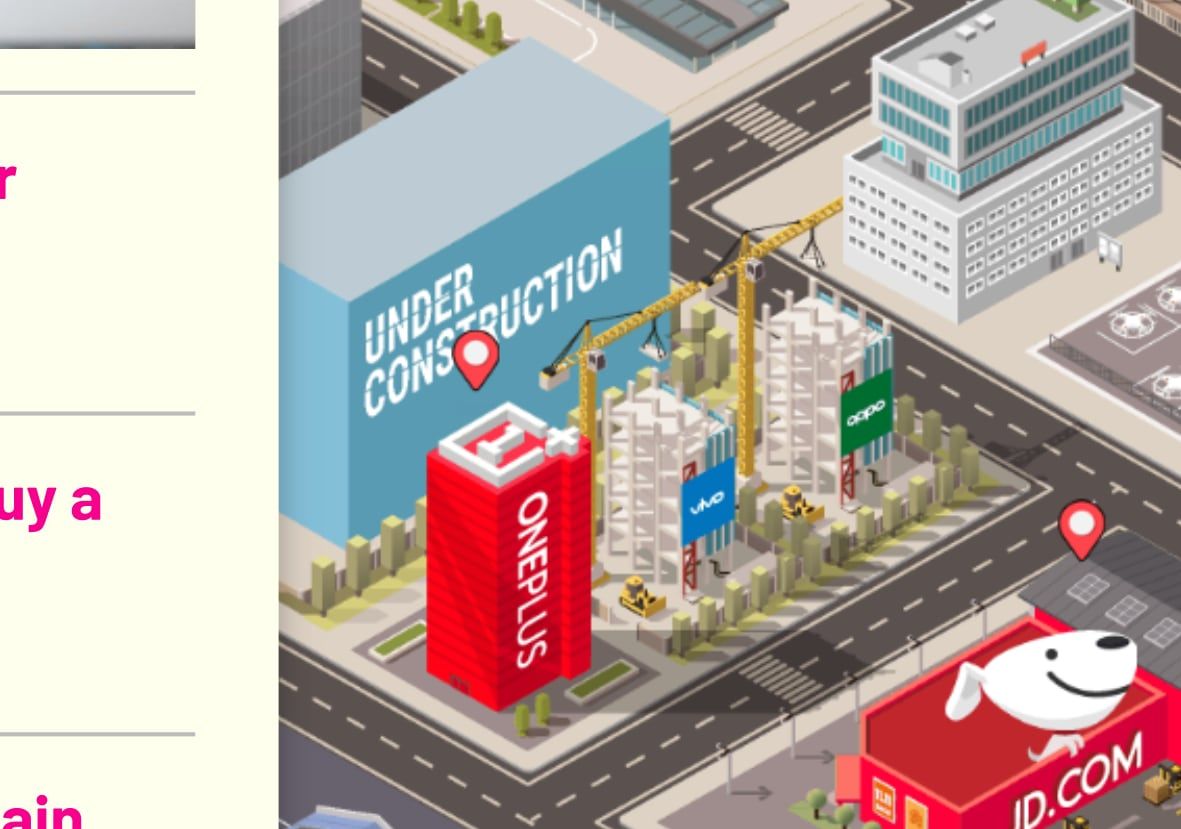
This is one of my favorite little references. Oppo, Vivo and OnePlus were increasingly growing in profile around the world. But what most people didn't realize was that the three smartphone companies, ostensibly competitors, were actually sub-brands of the same wider company, BBK Electronics. We were going to reflect this on the map: the OnePlus, Vivo and Oppo towers were all going to stand side-by-side on the same block, with a much larger building behind them representing their parent company, BBK.
The OnePlus explainer was the only one we'd published by the time the first version of China Tech City went live, so that was the only completed building on the map. The other three -- Vivo, Oppo and BBK -- were scheduled to arrive in the next update to China Tech City.
But there was to be no update. The first version of China Tech City's map was also the final version.
Unfortunately, just before launch, upper management pulled support for the initiative and re-tasked the team working on it to shift to other projects. We'd already sunk a lot of time, effort and marketing behind China Tech City, but without updates to a city that was expressly designed to be filled in with regular updates, it felt dead on arrival.
As much as I regret that China Tech City never got a chance to shine, I am extremely grateful to our excellent product team for building it in the first place. They took a swing to try to build something unique instead of settling for something basic, and that's a rare attitude in our industry.