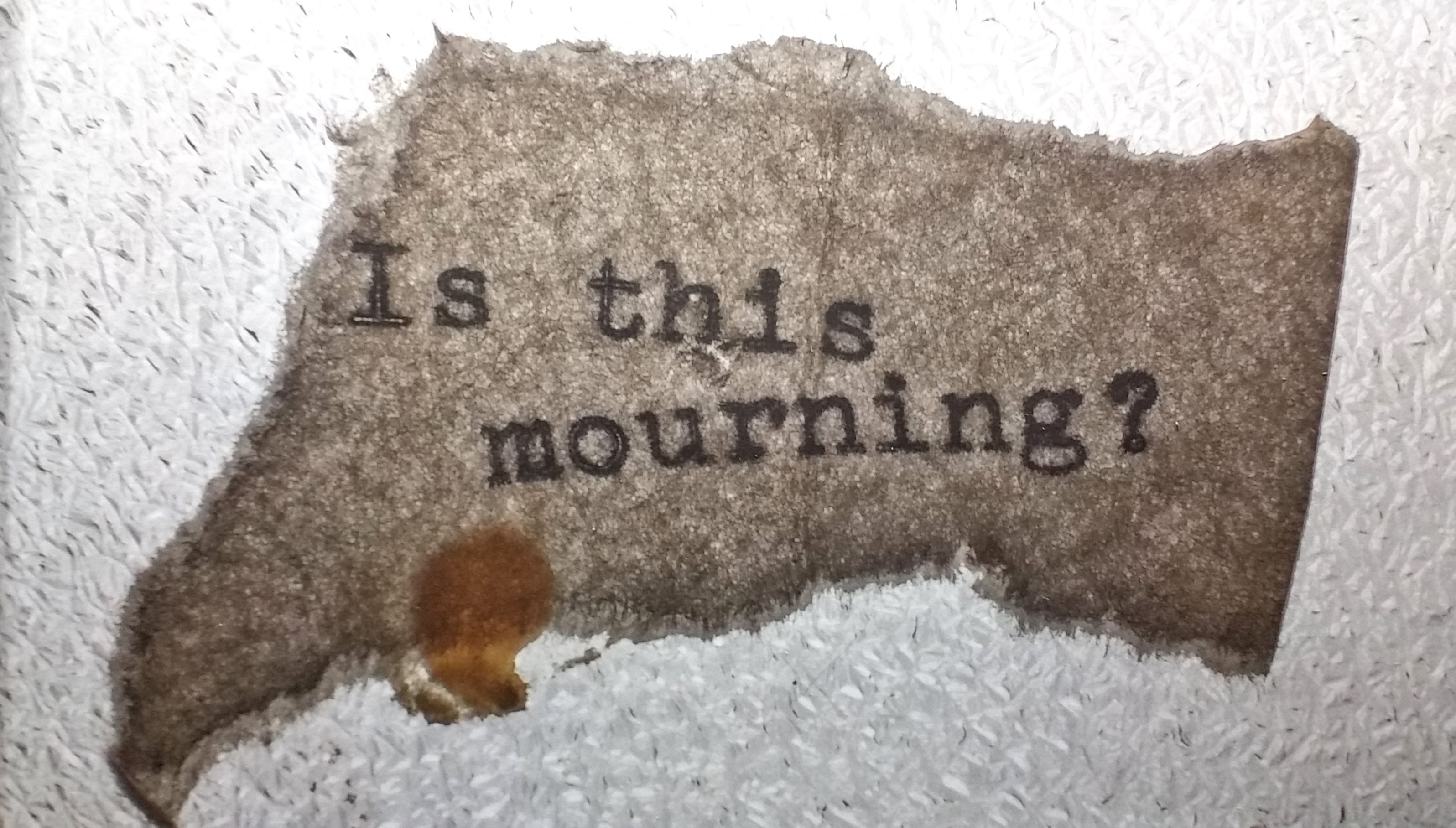
My good friend, author Stephen T. Vessels, called me on the phone one day and told me about a friendof his named Ian Wood (Note to library cataloguers: this Ian Wood is not the professor of early Medieval studies) who had written a book that needed reviewing. Stephen wasn’t sure what to call it. He said it was a combination artist’s book, photographic book, and was rather conceptual. He felt that if anyone could locate a suitable reviewer for it, it would be me. Or maybe I could review it myself? As a former Fine Arts and Photography Librarian who has worked with Artists Books and the artists who create them, I knew firsthand the trials and tribulations of locating persons to review these kinds of materials. I said I would be happy to look at it.
Awhile later I received a package from Mr. Wood, containing a copy of his book, words on torn paper: Specificity. The accompanying letter was rather apologetic. Wood called the book “an odd beast,” and wrote that it was “part photography, part monograph, part artist’s book and maybe a bit of a memoir.”
Thumbing through it, I could see readily the difficulty in classifying it: photographs of torn pieces of paper with words typed on them, arranged in manners that resembled 3D assemblages, some suspended in mid-air, some teetering by string. The typewritten words seemed to reflect feelings, fears and acute consciousness of specific words that characterized the creative, emotional state of the artist. I found myself becoming intrigued and surprised. The images raised a number of questions for me. To what extent were these works premeditated? Surely the feelings were not. There seemed to be planning in the writing of the fragments, and in the composition of the images. What processes had been involved, selecting suitable environments in which to photograph these works? How much spontaneity had there been in the creation of the typewritten fragments? Did spontaneity matter? What was the context of the range of emotions reflected? And what methodology had been employed to assign specific words to the torn pieces of paper?
In an afterword the artist states that “words on torn paper: Specificity began as an act of desperation, expressed by a simple idea: ‘words on torn paper: just once a day. . . . So, I resolved to create one small thing, every day, for as long as it felt necessary to do so.” There are 90 images in the book, so we may assume that they were produced in approximately 90 days, after which the artist decided to turn them into a book, which then involved considerable further thought and design. In a December 2 interview by Chloe Mcfeters, Wood states that he posted images on Tumblr, Twitter and Facebook, which gave him a sense of completion. He said he fought the urge to edit his work, and further ancillary material at the back of the book clarifies that no images were deleted.
The book is very thought-provoking. Each image is accompanied by the list of ingredients — what one might call the recipe — for its creation. In the image on page 128, a paper fragment afloat in the yolk of a broken egg states: “JUST WHEN I THOUGHT I WAS SAFE.” The annotation on the opposite page reads:
Safe
August 20, 2015
Torn paper, text, Kirkland Signature
Organic egg (Grade AA Large),
Recurrence of anxiety after a respite
words on torn paper: Specificity is a very different kind of book that belongs on every thinking and creative person’s coffee table, or in their artist studio or library. It is a work of art, and a work of many works of art, drawn from days of pain, introspection and the need to create. It is more than an artist’s book, it is a barometer in these times when creativity and creative minds are assailed and minimized on a daily basis. If I were Mr. Wood, I would give talks about his creative process in art classes, literature classes, and psychology classes. If you have trouble finding something for a person who has everything, words on torn paper: Specificity is an excellent choice.