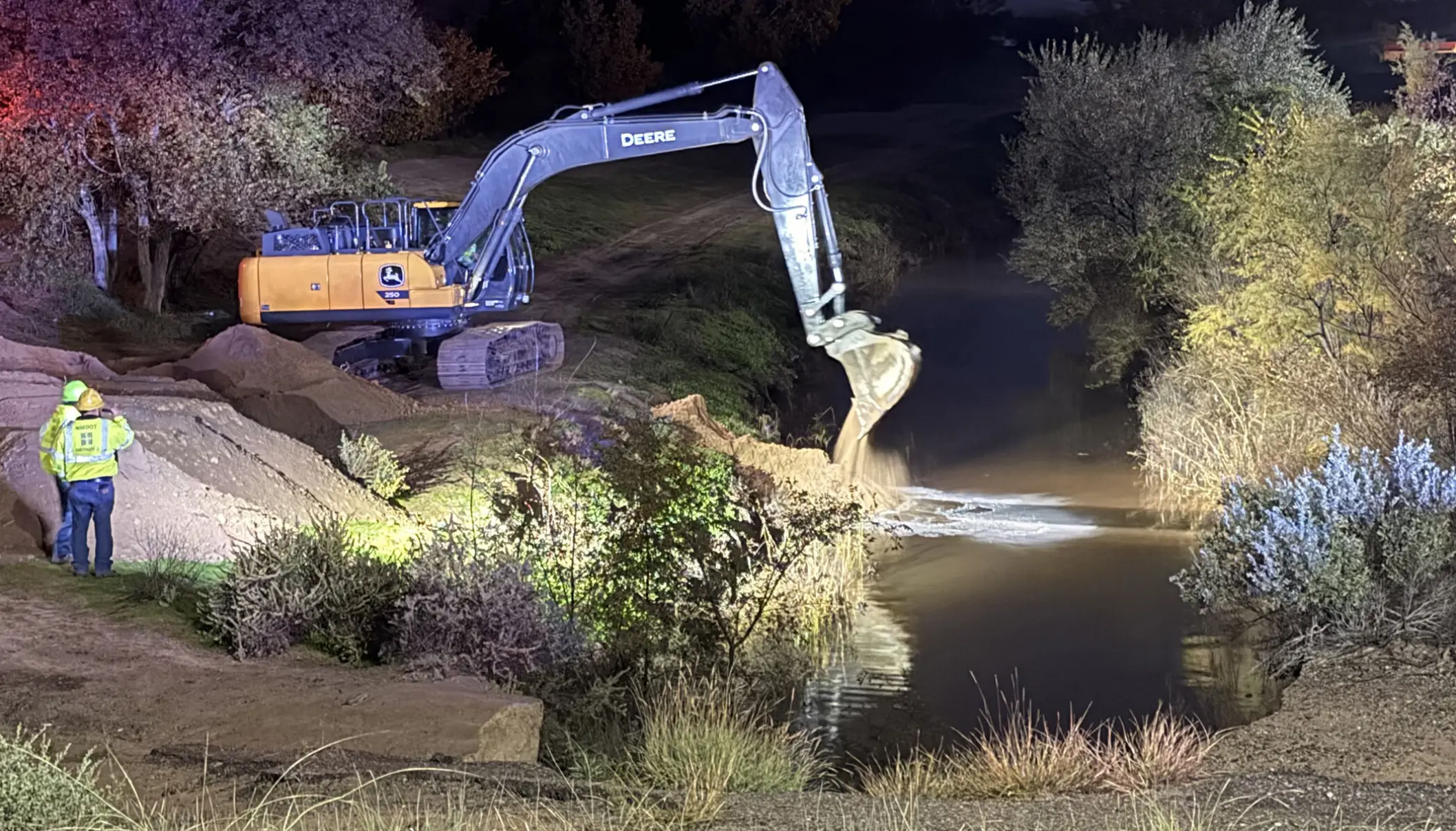
Access has been fully restored following an intense, round-the-clock push to resolve the river bridge closure over a single weekend.
Residents were worried, business owners were frightened, first responders were scrambling and elected officials were diligently working on a quick solution.
When the Rio Grande bridge between Belen and Rio Communities was closed Thursday evening, panic set in. More than 15,000 motorists use the bridge every day.
Shortly after 6 p.m., Thursday, Nov. 5, the New Mexico Department of Transportation issued an alert advising motorists that N.M. 309 in Belen, more commonly known as East River Road, was closed at the bridge across the Rio Grande “due to concerns involving conditions near the roadway and bridge.”
Local officials say erosion damage on the north side of the bridge along with a rusted, collapsed culvert exposed utility lines. The recent large amount of water flow in the river could have also been the cause of the collapse. The large amount of water and the break of the culvert caused a large sink hole.
When asked about the damage and repairs, Kimberly Gallegos, the public information officer for New Mexico Department of Transportation, wrote in an email Tuesday afternoon, “NMDOT is currently evaluating potential repair options, including the possibility of proceeding under an emergency authorization to expedite the process. However, there are administrative requirements and necessary documentation that must be completed before moving forward.
“At this time, the specific scope of repairs and anticipated timeline have not been determined. We will provide additional information as soon as a repair plan and schedule are established.”
Jason Casuga, the chief engineer and CEO of the MRGCD, said the N.M. 309/E. River Road crosses the district’s San Juan Feeder before it intersects with N.M. 47.
“There is a pipe underground that exists for us to go under (the road) that’s eroded. Like the Los Lunas situation, the infrastructure — the road, bridge and the pipe — is NMDOT’s,” Casuga said.
Regardless who was supposed to maintain what, the bridge closure threw a logistical monkey wrench into the regular commute for thousands of Valencia County residents and necessitated quick adjustments to bus routes for Belen Consolidated Schools.
Belen Superintendent Lawrence Sanchez said buses used N.M. 346 in Bosque to cross the river to pick up students Friday morning.
The bridge reopened Saturday afternoon, restoring community access after a coordinated response involving city, county and state partners. NMDOT has been working to repair the culvert and fill the sinkhole.
During Monday’s council meeting in Rio Communities, Councilor Lawrence Gordon commended Fire Chief Andrew Tabet for managing non-stop communications across various responding agencies, alongside public works, police and fire personnel who reported for duty through the weekend to expedite the repair process.
Mayor Joshua Ramsell and Gordon also credited state Sen. Josh Sanchez with playing a critical role in pressing the Department of Transportation to accelerate its timeline. Initial forecasts had indicated a potentially longer shutdown before state and local partners intervened.
“We’re happy to see the bridge open and have access for the community,” Mayor Ramsell stated, expressing gratitude to municipal crews and outside partners.
Council discussions then shifted to the actual work, where city equipment, materials and labor had been deployed under a previously approved emergency and disaster declaration.
Councilor Matthew Marquez raised concerns regarding fiscal compliance, questioning whether sending municipal crews and assets to work on property not owned by the city could trigger an anti-donation violation under state law.
“Do we have a plan on getting those funds back so we’re not going back into an anti-donation issue where the city’s putting money and equipment into a project that ... is somebody else’s property?” Marquez asked.
City Manager Marty Moore assured the council the work carries no anti-donation conflict, clarifying that the affected ditches sit on land belonging to state political subdivisions or state agencies, which permits cooperative public assistance.
Moore confirmed that strict administrative protocols were enacted from the outset to document every expenditure.
“I gave specific direction to our public works director to make sure that every load of dirt that left our yard and went over there, any piece of equipment, any individual that was doing work, that that was all being documented,” Moore said.
With photographic documentation and inventory logs in hand, the city is partnering with Tabet, serving as emergency manager, to assemble and submit formal assessment packages to county officials.
Moore estimated that final submittals to the county and state will take about two to three weeks to compile. Once reviewed, those filings will form the basis of the city’s formal reimbursement claims.
“The short answer is yes, we kept the records,” Moore said. “We’re going to be asking for reimbursement.”
Moore said
DOT is actively evaluating the structural damage, repair costs and restoration timelines.
Local leaders plan to continue pressing state officials for formal updates while developing long-term contingency plans for future extreme events.