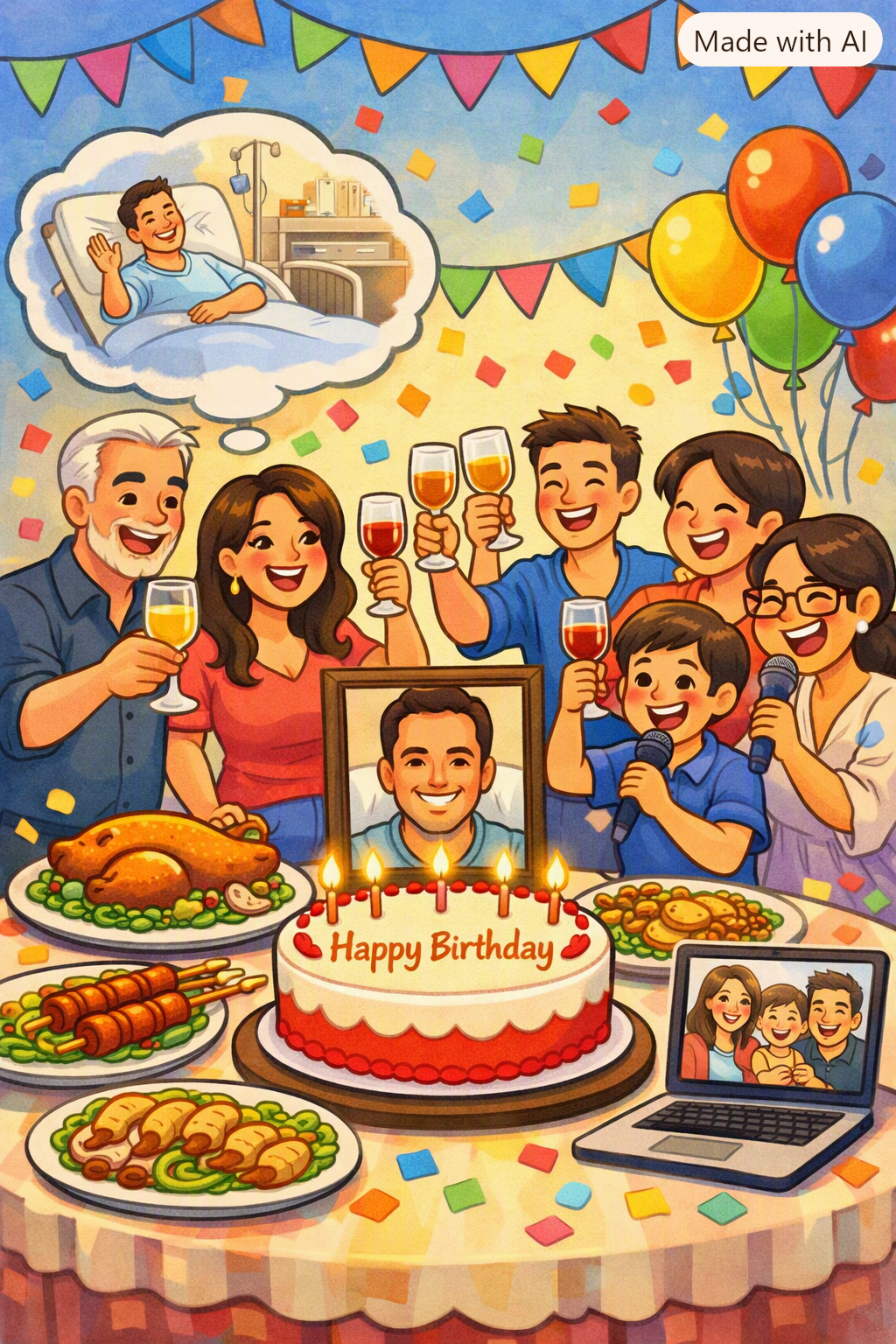
It started with a cake and candles.
It was my son’s 39th birthday, though Drew was nowhere in sight. In fact, he was nearly 12,000 kilometers away in a Los Angeles hospital where he couldn’t be reached. But that’s a whole other story. Today’s story is that we threw him a party anyway. Which says something about an aspect of Philippine culture I have come to adore.
I still remember the first time I experienced it. That was 20 years ago when my Filipino then-girlfriend-now-wife and I, not yet married, were living on separate continents. So, her call on my birthday wasn’t too surprising. What utterly shocked me, though, was that she made it with a dozen-or-more friends and relatives, most of whom I’d never met.
“Happy Birthday!” they screamed from what was obviously a riotous party. Then, after putting their wishes to music, they blew out the candles and gobbled up my cake.
I was astounded. And touched beyond all measure. “Gosh,” I stammered, “you did this for me?”
“Of course,” my future wife cheerfully replied, “because it’s your birthday.”
And that was my introduction to something I now hold dear: the Philippine penchant for celebrating someone’s existence rather than merely their physical presence.
Let me explain.
In Bisaya, Ivy’s native language, the common way of asking “when’s your birthday” is kanus-a ka na tawo? Which literally means “when did you become a person?” That may not sound like much. If you think about it, though, it conveys a subtle quality: equal or more emphasis on one’s being as on the date of their arrival.
Which fits right in with another strong Filipino value: the focus on family and community. In America it’s all about me, myself, and I. Or, if you’re lucky enough to have admiring friends: thee, thyself, and thy. Thus, observing someone’s birthday is about giving them a walloping good time; at a minimum, their presence is required.
In the Philippines, it’s different. A birthday doesn’t just commemorate an individual’s entry into the world but celebrates that being’s ongoing personhood—sometimes even after death—as an integral part of a family and community.
“In many Asian countries, including the Philippines,” one Filipino mom living abroad wrote in a blog called Moms Inspiring Moms, “people value community and sharing blessings. A birthday is not only about one person but also about the people who support and love them.”
The post was inspired, Karen Santos explained, by a question from her six-year-old daughter: why were faraway relatives in the Philippines celebrating her birthday?
“It’s a way of saying thank you for another year of life and for the people who are part of that life,” Santos wrote. “Sharing a meal together is…a way to spread happiness.”
Which certainly describes how I felt singing “Happy Birthday” to a faraway son who couldn’t hear me. And blowing out candles on a cake bearing his name. And especially giving a speech in his honor at a table filled with family and friends.
“Drew doesn’t know about this,” I said of my beloved son who no one there had ever met. “And if he did,” I continued, raising a glass, “I’m not sure what he would think.”
I definitely know what I think, however; that this is a grand and caring custom. And that a culture encouraging and supporting it is lovely indeed. So lovely, in fact, that we may soon expand the practice.
“Gues what?” I recently told my adult daughter—Drew’s sister—who lives with her husband and little girl in Portland, Oregon, where she had me on a speakerphone. “We threw a birthday party for your brother, and he wasn’t even there!”
“Wow,” she said, “really? Oh, Dad, that’s so cool!”
Suddenly, there was a rustling from somewhere behind her. “Hey,” my son-in-law put in, chuckling from a distance. “I have a birthday coming up; can you do the same for me?”
And so, it shall be. You’re all invited.
__________________
David Haldane is an award-winning American journalist, author, and radio broadcaster with homes in Southern California and Northern Mindanao. His latest book is Dark Skies: Tales of Turbulence in Paradise. This column appears weekly in The Manila Times.
