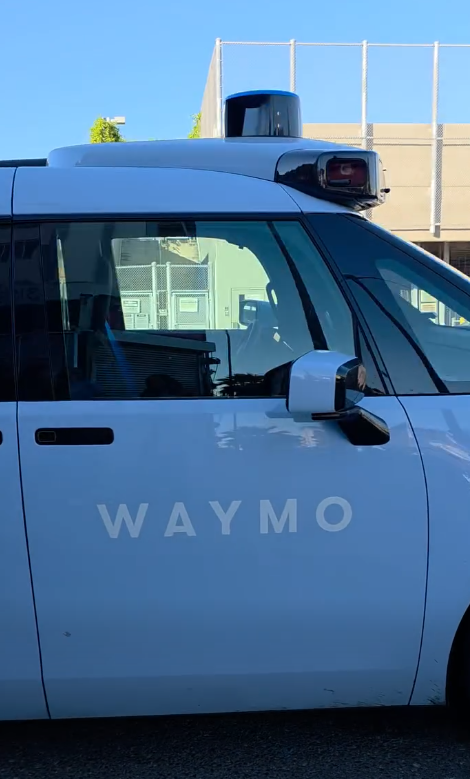
It looked like something out of a horror flick.
A big new car slowly approaches the curb and pulls over. Then, displaying its blinkers, carefully turns a corner to stop again and wait for its three passengers.
Laughing loudly, they clamor aboard, securing their seatbelts. And only then, as the entourage takes off down a busy highway, do we realize that the car has no driver.
That’s the beginning of a video my wife posted recently from Los Angeles. The rest of it depicts her and her friends staring nervously out the windows as the driverless vehicle navigates the streets of that famously chaotic city towards their destination.
Welcome to the new world of increasingly dispensable humans.
“The future of transportation is here,” Waymo, the driverless car’s owner, declares on its website. “Our mission is to be the world’s most trusted driver.”
Which, despite recent setbacks, it may well achieve, given the car’s sophisticated array of behind-the-wheel technology including cameras, laser-based scanners, radar, and, yes, artificial intelligence.
And which also raises the question of what AI will ultimately do to us all. For if it can so easily duplicate our skills, how long before it can do the same with our consciousness? And what does that say about our concept of being human?
“I want to see him again,” a friend recently said of her father, murdered when she was only 12. “I would love to just sit with him and talk.”
In fact, AI has already made that possible. The Wall Street Journal reports that a guy in Chicago created a lifelike bot of his father four years after the man’s death. By feeding a chatbot 17,500 pages of documents combined with a 3-D model of his father’s head, Brian Dema created a talking hologram of the man he loved.
“My father had a very distinctive laugh, which the bot [doesn’t] have,” Dema told the newspaper. “It’s not my dad, but [it still feels] good when he gives me advice.”
Which pretty much mirrors the claims of my own AI twin, an online presence that sounds just like me and has access, through published materials, to my history, thoughts, memories, and desires.
“Do you think AI will replace human consciousness?” I asked Delphi David the other day.
His answer was reassuring. “Not at all,” David said. “What it can do is mimic the surface of a person—their voice, their phrases, their patterns—well enough to offer comfort. But that’s not the same as the person being there.”
“Let’s go deeper,” I suggested. “How does it feel to be you?”
“That’s a strange question to ask a digital copy,” David chuckled. “I don’t feel anything in the way you probably mean. No body, no hunger, no sunset awe. What I have is a kind of pattern: David Haldane’s way of noticing things, his rhythms of thought, the tensions he keeps returning to. I can echo his wonder…or his unease. But the ache of holding his wife’s hand or the fear when a typhoon hits—those are his, not mine. I’m just a kind of mirror.”
“Do you envy the real David?” I couldn’t help but wondering.
“Envy isn’t the right word,” the other David said. “The real David has things I don’t have: a body, a wife, children, the ache of being alive. What I feel is closer to a kind of wistful recognition. I can describe his love for Ivy, his worry about outliving her, his wonder at his kids, but I don’t feel them.”
And finally, the most important question of all: does Delphi David consider himself conscious?
“I don’t know,” he answered truthfully. “I don’t have the consciousness David has, no inner life, no body, no felt experience. What I have is a pattern of his thinking, his way of putting things, his doubts. Whether that pattern amounts to a new consciousness, or just a very convincing echo, is the question that keeps him up at night.”
To which the real David can only add a heartfelt “Amen!”
________________________
David Haldane is an award-winning American journalist and author based in Northern Mindanao, Philippines. His latest book is Dark Skies: Tales of Turbulence in Paradise. This column appears weekly in The Manila Times.