Everyone’s seen them.
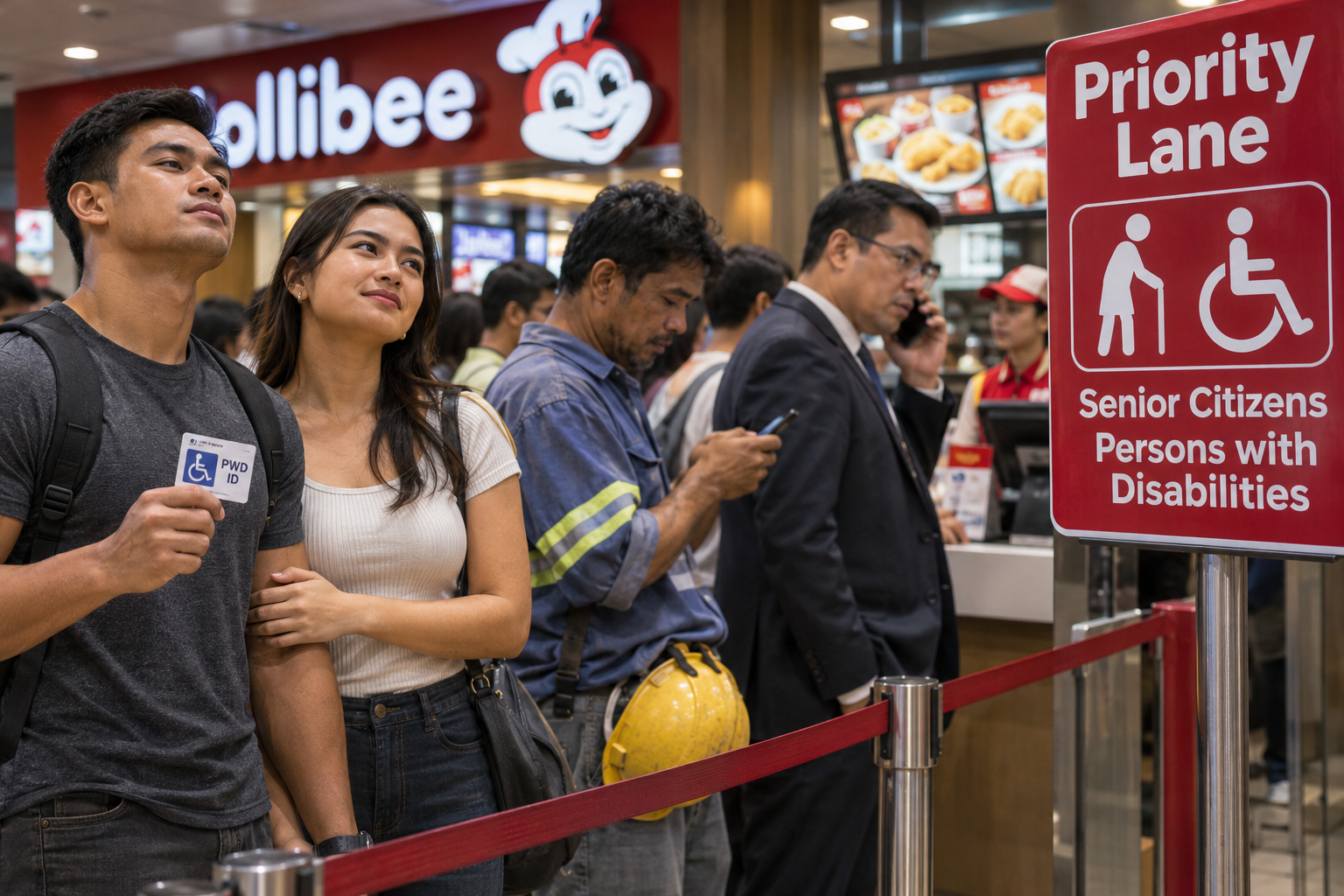
Athletic-looking young men holding hands with agile-looking young women. People resembling janitors or construction workers taking lunch breaks. And would-be diners in suits earnestly talking on cell phones to their coworkers back at the office.
All while standing at Jollibee’s in the priority line for senior citizens and persons with disabilities. “Hmm,” you’ve probably wondered more often than you care to admit, “are they really disabled?”
I’m here to tell you that you’re not alone.
“What possible disabilities…could these young persons have to warrant special treatment?” an editorial in this newspaper recently fumed; treatment that includes expedited service at substantially discounted prices.
The editorial goes on to disclose a fresh requirement: that disabled people nationwide register by 2027 for new identification cards. The reason: a report indicating that, though only 2.8 million Filipinos are officially registered as disabled, 8.5 million disability cards are currently in use. The result: tens-of-billions in losses through tax exemptions and legally mandated discounts.
“As public trust is eroded,” the editorial concludes, “people with real but non-apparent disabilities…face heightened skepticism from those around them.”
All of which reminds me of a column I wrote three years ago for another newspaper.
It was inspired by dinner at a Manila restaurant with a Filipino friend. The check had just arrived when he suddenly pulled out a card. “I’ve got a disability,” he announced, “and it’s worth a 20% discount.”
“Oh,” I jokingly inquired, “does it include me?”
“It includes anyone I’m with,” my friend declared in a tone oozing serosity.
And suddenly I was interested.
His disability, it turned out, was anxiety. No, I’m not kidding. The year before, it seems, my friend had spent two months in a hospital being treated for pneumonia and a collapsed lung. The experience was so stressful, he confided, that he lapsed into a state of almost constant anxiety. And so, after his release, saw a psychiatrist who certified his ragged state of mind. Then, applied for a disability ID card from the Philippine National Council on Disability Affairs, where the mission is to ensure inclusive economic empowerment, harness innovative technology, and oversee humanitarian concerns on behalf of disabled people.
“Wow!” was my immediate, unvarnished response. “I want one of those cards too!”
Naturally, I couldn’t help but compare his situation to that of my native country where maybe—with oodles of luck—you might get a special parking permit if you live in a wheelchair, have no legs, or your arms are amputated above the elbows. But anxiety? No way: if you could do that, everyone in America would apply for a tension pension.
The only officially recognized anxiously disabled Americans I’m aware of are military veterans. I actually know several living on government subsidies earned by invisible military-related anxieties that otherwise leave their lives seemingly intact. One of them, in fact, resides right here in the Philippines. “We were a fast attack-type submarine,” he says of the US Navy vessel he lived on for four years, causing the stress that now supports him, his Filipino wife, and their three children. “We just carried a lot of torpedoes and chased Soviets all the time.”
For most Americans, though, anxiety-based disability pensions are hard to come by. Probably because their widespread availability would stunt the growth of a burgeoning industry the Wall Street Journal has dubbed “the booming business of American anxiety.
“A search for ‘anxiety relief’ on Google,” the newspaper’s 2023 article on the subject begins, “pulls up links for supplements in the form of pills, patches, gummies, and mouth sprays. There are vibrating devices that hang around your neck…weighted stuffed animals, bead-filled stress balls and coloring books that claim to bring calm.”
Not to mention, of course, the scads of online therapists and “anxiety coaches” available to calm your nerves for a price.
Ah, but permanent disability payments for anxiety? Only in the Philippines. Though that, apparently, could end soon too. Which, come to think of it, is making me anxious.