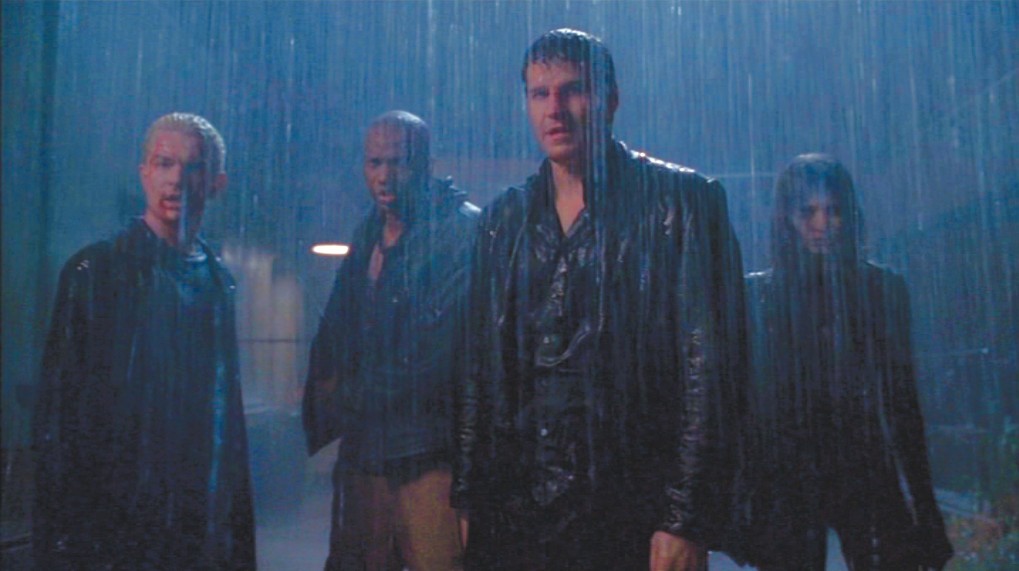
Critics, scholars, and other creative types ponder the 20th anniversary of the great Buffy spinoff.
It was twenty years ago that the brooding vampire with a soul, scared off by Buffy’s mom, hightailed it out of Sunnydale and set up shop as a gumshoe in the world’s ultimate noir city: Los Angeles, literally the City of Angels. Angel — a Buffy the Vampire Slayer spinoff — ran for five seasons, left us on the precipice of an epic battle between good (team Angel) and evil (armies of hell), and ended on our hero’s now-famous last words, “Let’s go to work.” Fade to black.
Angel is widely recognized as the darker of the two shows, even by its creators, Joss Whedon and David Greenwalt. Buffy was all teen/young-adult angst; Angel navigated the challenges of adulthood, though as any fan of the episode “Normal Again” can tell you, Buffy could get pretty damn dark.
I’d never want to have to choose between the two, but that doesn’t mean I can’t ask other people to do it.
Additional context, for those who aren’t Angel literate or just have bad memories:
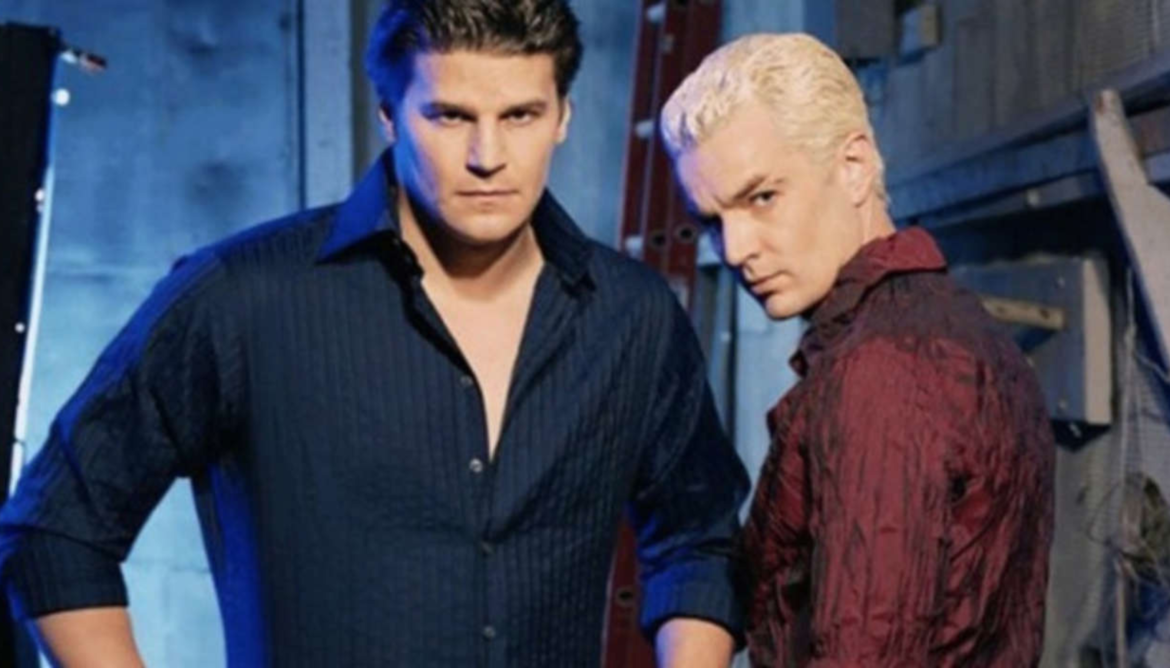
Angel (David Boreanaz) was Buffy’s love interest on the first three seasons of the original show. A legendarily vicious creature of the night, he one day tortured and killed a young gypsy woman whose clan retaliated by cursing him with a soul, imbuing him with guilt for every single act of evil he has ever committed— and trust us, there are a lot. Spike (James Marsters), Buffy’s subsequent love interest, also starts out as a twisted, sadistic vamp, but ultimate chooses to have his soul restored, out of devotion to Buffy. In the Whedeonverse, huge debate rage over who should have gotten the girl: Angel or Spike. This is what is known as “shipping.”
Connor (Vincent Kartheiser, aka Pete Campbell in Mad Men), who joined the show in season three, is Angel’s human son by Darla — a fellow vampire who stakes herself to death upon giving birth to the boy. Talk about postpartum depression. Many Angel fans despise the character, especially because of his brief but thoroughly ill-conceived relationship with another Buffy alum, which brings us to our fourth and final point of context:
Cordelia Chase (Charisma Carpenter): Oh, fair Cordelia! A delightfully solipsistic mean girl in Buffy who once defended Marie Antoinette for giving peasants cake, Cordelia grows up in Angel. She too develops a conscience (more through maturation than anything supernatural, though those headaches help), falls in love with Angel but sleeps with Connor (admittedly possessed at the time by Jasmine, the Blessed Devourer), and eventually becomes a goddess who literally floats . . . oh, never mind. I personally would rank it as among the worst examples of character development in the history of television, but apparently not everyone agrees (see below).
So, let’s get to work.
Note: answers are occasionally edited for length.
Eric Deggans (NPR TV critic): Tough question to answer, because I don’t like a lot of TV shows which have featured vampires, even though I love vampires. Why? Because, too often, the shows get caught up in over-romanticizing the undead or over-horrifying them. I’d say, of course, that Buffy the Vampire Slayer was the best TV show to include vampires, because the show’s writers did a great job of reinventing the vampire mythos for nineties TV. But that show wasn’t really about the vampires . . . . So my favorite vampire-centered TV show is HBO’s True Blood, mostly because its early seasons captured the balance of sensuality, horror, and absurdity that every great vampire story must straddle. It also featured perhaps my favorite TV vampire of all, Alexander Skarsgard’s brutal yet vulnerable Eric Northman.
Melanie McFarland (Salon TV critic): Into each generation an era-defining vampire show or two is born, so the answer to this question is likely to be all over the map. For me it’s Buffy the Vampire Slayer — obviously — and I suspect that may be true for a number of critics around my age. I know several women who point to Buffy as one of the reasons they decided to become critics. It still holds up as a story of the metamorphosis from adolescence into adulthood and the exhilaration and terror that comes with moving toward independence and embracing one’s personal power. And few other series featured such memorable character archetypes — the shy nerd who grows into a dark wizard, the nice boy who hides a wolf inside, the average friend who feels left behind but keeps his supernatural friends human, and the Slayer herself, a young woman tangled up in the knotted ties between destiny and choice.
Alan Sepinwall (Rolling Stone chief TV critic): Buffy the Vampire Slayer is the best TV vampire show of all time, one of the best shows about adolescence of all time, one of the best TV dramas of all time, full stop. It was smart and funny and sad and empathetic and understood how to use genre tropes as a metaphor for universal emotions better than any sci-fi or fantasy show has done before or since.
Deborah Overstreet (coeditor, Watcher Junior: The Undergraduate Journal of the Whedon Studies Association, and associate professor of English Education, University of Maine at Farmington): Angel, obviously. Angel is the greatest TV vampire of all time in part because he fulfills all the classic vampire tropes. The fact that he’s also the main vampire in two of the best TV series (of any genre) doesn’t hurt his case.
Ellen O’Neill (creative director, The Paley Center for Media): Buffy is the I Ching of vampire TV series. Buffy is the sum of all wisdom. Buffy is the answer to any question. I find the series Angel to be deeper, richer, ultimately the more satisfying experience — perhaps because it is fully in the grown-up world, perhaps because Boreanaz in that role is very sexy — but for “greatest” accolade, I have to go with Buffy.
Brenna Wardell (coeditor, Watcher Junior: The Undergraduate Journal of Whedon Studies, and assistant professor, University of North Alabama): Buffy the Vampire Slayer, given its various portraits of the vampire figure as sexy, tortured, voracious, penitent, destructive, etc.

Joyce Millman (former TV critic, Salon and the San Francisco Examiner): Vampires. I don’t see the appeal of zombies. I’m not a fan of The Walking Dead. I prefer more nuanced and “human” villains. There’s a Blondie song called “Die Young, Stay Pretty” which applies here. Why would you want to look at a lumbering, rotting zombie when you could be looking at Angel or Spike?
Wardell: Vampires, because they can be portrayed as witty, seductive, and multilayered. While some recent programs do create more three-dimensional portraits of zombies (particularly iZombie), I rarely find the zombie figure as emotionally or intellectually compelling as the vampire.
Deggans: Vampires, for sure. Because vampires are something like the superheroes of the horror world — youthful, immortal, endowed with great power and usually very alluring. They’re also a walking parable about the folly of hoping to cheat death and the true cost of an everlasting life (damnation, the blood thirst, the inability to tolerate sunlight, and an often-hideous real form, for starters). They were alluring monsters invented in a time long ago when life was much shorter and more brutal; now, they are a reflection of and constant warning about the pursuit of youth in our modern culture.
McFarland: Vampires, no question. They can be reasoned with to a degree, and some of them might even like a person enough to be on their side. Having said that, in a fight the zombies would eventually be victorious. This has been proven by science!
Sepinwall: Vampires have individual personalities. Zombies shuffle around and groan. No contest.
O’Neill: Vampires. I like the combination of intelligence and the idea of life giving blood, even perverted, to the act of eating flesh.
Overstreet: Vampires. Of course. Zombies are inherently boring. They either shamble around or go tearing around depending on if they’re “fast zombies” or “slow zombies.” In any zombie series, the zombies are incidental. Any kind of natural disaster could fill in. The show is about the non-zombie characters. Zombies could be replaced by aliens in any show and it