
Our Material Matters series is taking a look at earthquake-strengthening costs and implications in a series of articles
The Structural Engineering Society president says “reasonable progress” is being made nationwide in getting buildings strengthened, while the Construction Minister says the game of “pass the parcel” on earthquake strengthening is coming due.
A BusinessDesk analysis found 24% of the buildings on an earthquake-prone register have been taken off the list, often years ahead of the deadline set by the Government.
This means the buildings have either been strengthened, demolished, or replaced by a new building.
Structural Engineering Society president Nic Brooke said the numbers represented “reasonable progress”.
“‘Good is obviously a subjective term, but the register as it exists currently, came into being about seven years ago … and the intent of the process was to drive gradual improvement of New Zealand's building stock, rather than to look to fix everything overnight or in a short period of time.”
The national earthquake-prone building register is managed by the Ministry of Business Innovation and Employment (MBIE) but territorial authorities, such as councils, are responsible for keeping the list of such buildings in their area updated after legislation was introduced in 2017.
Depending on the circumstances, once a building is listed as earthquake-prone then its owners have between 7.5 and 35 years to strengthen, redevelop, or demolish the building.
The first deadlines from the 2017 changes to earthquake rules were due to come up in 2025, but earlier this year the Government announced it would extend those deadlines while it reviewed the system around earthquake-prone buildings.
In an interview with BusinessDesk, Building and Construction Minister Chris Penk said he extended the deadlines to avoid the emergence of ghost towns and a hollowed-out business district in places such as Wellington city.
“Those deadlines simply weren’t going to be met,” Penk said.
With the extension, all non-lapsed earthquake-prone building remediation deadlines have been automatically extended by four years and could be pushed out by an additional two years.
“It’s a little bit like the game of pass the parcel. The music’s stopped and we’re about to unwrap a huge tsunami of buildings that are simply non-compliant, can’t be inhabited and we’re going to end up with ghost towns and even more derelict buildings in the likes of Wellington than we do now,” Penk said.
The demands of earthquake strengthening are significant for places with levels of high seismic risk, such as the capital, or smaller centres in rural areas.
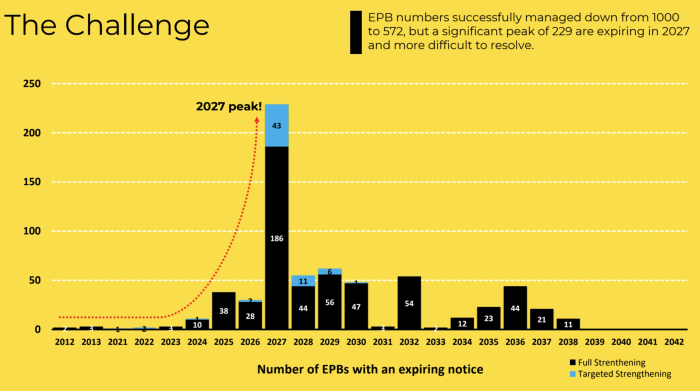
At the end of last year, Wellington City Council released data showing the city’s property owners were heading for a financial crunch with earthquake-strengthening deadlines expiring on a number of buildings in 2027.
According to a briefing to Wellington city councillors, there were 572 buildings on the earthquake-prone registry in Wellington and 300 of those had deadlines due to expire by the end of 2027.
Of that total, 229 had notices that would expire in 2027 alone.
What does an earthquake rating mean?
The New Building Standard (NBS) forms the basis of standards used to measure earthquake strengthening.
Essentially an existing structure must be able to meet at least 34% of the earthquake building resistance standards that a new one must be built to meet.
These NBS standards are frozen in time in July 2017, when the earthquake-prone building regime came into being.
Brooke said one mistake often made in looking at the ratings was to think a low NBS rating meant a building was at imminent risk of collapse if an earthquake took place.
Instead, what the rating meant was the building was at greater risk of earthquake damage than a new building.
“The system overall is not looking to identify buildings as imminently dangerous or problematic to be in day-to-day.
“It's really saying that, relative to a new building they are more risky, but that doesn't mean that they're a death trap waiting to happen.”
Why some councils struggle
Most of the buildings that have been removed from the register were added to it in 2018 and 2019 and taken off ahead of their deadlines in 2033 and 2034.
A BusinessDesk analysis of the earthquake-prone building register revealed large differences in the progress made between different regions on earthquake strengthening, with Christchurch and Tauranga city councils the standouts in terms of the progress they have made.
Christchurch City Council head of building consenting Steffan Thomas said he was not sure what the authority had done differently to other councils to take a higher number of buildings off the register.
“It might just be the situation post-earthquake that has led to more being resolved.”
Tauranga City Council (TCC) general manager regulatory and compliance Sarah Omundsen said earlier council policies had given it a head start when it came to fixing earthquake-prone buildings.
The Tauranga Earthquake Prone Building Policy was passed in March 2006 and focused on fixing buildings constructed before 1976 that were below 33% of building code standards.
“With this policy in place, we took a proactive approach and began assessing commercial and industrial buildings from 2008,” Omundsen said.
“This effectively gave us an eight-year head start before the Building (Earthquake‐prone Buildings) Amendment Act was passed in May 2016.”
Omundsen wrote that it is difficult to accurately predict when the remaining buildings on the register might be taken off.
“Assessing earthquake-prone buildings is a complex process, as each building comes with its own unique set of circumstances.”
According to MBIE, the Bay of Plenty region is a medium-risk zone. That means priority buildings need to be fixed in 12.5 years and non-priority locations have 25 years.
Priority buildings are those in areas of the country with medium or high levels of seismic activity where owners have been given half the time to strengthen their buildings.
They include schools and hospitals, but also buildings along important transport corridors.
The shortened deadlines are there because of the role these buildings might play during an emergency.
While some councils such as TCC have made good progress, other councils and building owners are struggling with the demands of earthquake strengthening.
An analysis of the earthquake-prone building register revealed that of those taken off the register, less than a quarter, 23%, were “priority” buildings.
Within that number, 13 territorial authorities around NZ have failed to remove a single priority building from the register since the legislation was introduced.
Reassessing the danger
Government agencies have recently been pushing back on the idea that a low NBS rating means a building is not safe to inhabit.
In MBIE’s seismic risk guidance for buildings, released in 2022, the report’s writers noted a low NBS still meant the risk to life was low.
The report said the risk of dying in an earthquake-prone building with a score below 34% NBS was 1 in 40,000-100,000, while the fatality risk of driving a car in NZ was 1 in 20,000.
“While a low rating does indicate a heightened life safety risk in the event that a significant earthquake occurs, it does not mean that the building is imminently dangerous,” MBIE’s report said.
“In most cases, occupancy can be continued while mitigation work is planned and designed, and in some cases even while works are being carried out.”
A review of the earthquake-prone building regime by MBIE in 2021 also made it clear the strengthening of old buildings was something the country aimed to achieve over a long period of time, with 2068 as the ultimate deadline.

So, it is in this context Brooke believes reasonable progress has been made on earthquake strengthening.
“The definition [of an earthquake-prone building] itself really is intended to identify the most vulnerable buildings in the country, in terms of vulnerability to earthquakes, and then really to identify those as targets over a long period of time to progressively have their capacities increase such that they come off that register.”
Pass the parcel
There have been warnings in the past the current earthquake regime might end with deadlines simply being extended and no earthquake-strengthening work done.
During a presentation to the Auckland Structural Group in 2018, a year after the earthquake-prone building regulations were introduced, Auckland Council’s Patrick Cummuskey said there was a danger as the years passed the same thing would happen as had occurred many times in the past: some earthquake buildings would be strengthened, but others would simply have their deadlines rolled over to the next decade.
“Thirty years ago we had buildings identified as earthquake-prone and we’ve come to the end of that timeframe and still they’re earthquake-prone and now they’ve been given another 35 years,” Cummuskey said.
“Exactly the same thing keeps happening. I mean each time we’re going to have a certain number of buildings which get demolished, some which get upgraded, and then the remainder: timeframe starts again.”
Brooke said he understood the point of that argument around the danger of continually extending deadlines, but it had to be compared to what would happen if deadlines were not extended.
“Would the Government be coming along and prosecuting building owners and fining them large amounts of money and/or tearing down buildings because they've not been strengthened?”
Brooke questioned whether fines and demolitions would be “productive”, especially where older heritage buildings were involved.
His other counterpoint to criticism of extending deadlines was whether it would be a good thing to force strengthening in places where the economics did not justify it.
Brooke questioned whether it was realistic to tear down most of the main streets in small town NZ, or levy fines to drive building owners in the regions “out of existence”.
Both of these would be the result of enforcing the previous earthquake-strengthening deadlines, he said.
“Realistically, extending the timeframes was probably the only outcome that could eventuate.”
Read more in the Material Matters series here.