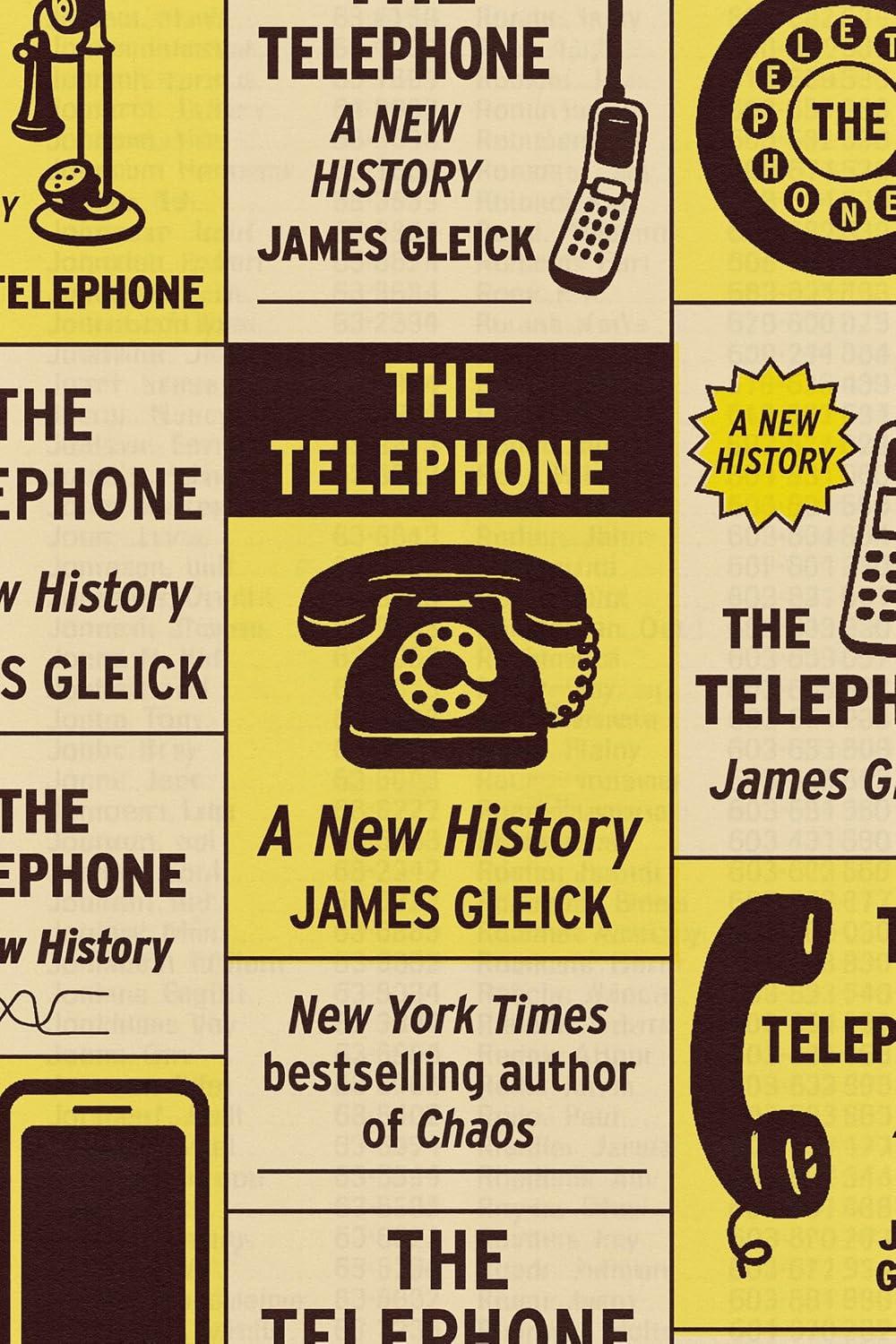
The Telephone: A New History by James Gleick. Farrar, Straus and Giroux, 2026. 544 pages.Buy on Bookshop.org
FOR HIS NEAR-COMPREHENSIVE new history of the telephone, the umbilical cord and pocket portal of our information age, science writer James Gleick opens with a fire that ignited just after midnight on Thursday, February 27, 1975, in an aging switching center on New York’s Second Avenue. Telephone service failed across 300 blocks of Lower Manhattan:
Washington Square and Tompkins Square, Gramercy Park to the north, Peter Cooper Village and Stuyvesant Town to the east, and a half dozen Lower East Side housing projects. New York University, Beth Israel Medical Center, and New York Eye and Ear Infirmary were among the institutions cut off from the world. NYU alone had 2,500 telephone numbers, many shared by multiple students and staff. The hospitals found themselves unable to reach families of patients in crisis or patients ready for release.
This epic outage spurs reflection: what would modern life be without phones? Fifty years later, that question feels antique, beyond naive. The phone has entrenched itself more deeply into public and private life, and its development only confirms the cliché about how much history can teach and how little we learn. Reading The Telephone: A New History during today’s artificial intelligence rivalries gives you more than pause, not just for the narrative’s historical rhyming but also for how many of the same injustices, instances of tomfoolery, happy accidents, and deliberate roadblocks littered the telephone’s path. AT&T throttled innovations like the fax, the answering machine, and even the Picturephone as it built its robber baron empire, gaming the courts with expensive lawyering. You could call the phone the “American Invention,” a symbol of how the lack of major land wars on this continent facilitated the development of a powerful gadget whose connectivity sucks up the entire globe and leads to less, not more, equity, justice, and democracy.
Gleick, a Pulitzer and National Book Award finalist for his 1987 debut book Chaos: Making a New Science, an account of nonlinear systems, has since written the inviting biographies Genius: The Life and Science of Richard Feynman (1992) and Isaac Newton (2003), and explained the onrushing future in books like Faster: The Acceleration of Just About Everything (1999) and Time Travel: A History (2016). His quotable style conveys an authority with big ideas that makes lesser writers curse in the night. And yet, by the end of this new book, you’re ready for the Big Drama: how Steve Jobs turns the “telephone” into a portable information machine with a hundred thousand times the computing power (millions by some measures) of the computers that took us to the moon, at a sliver of the cost. It’s an everyday device that would’ve been unthinkable just a generation ago, yet Gleick leaves this transformation hanging. Though the sweep of his history approaches the epic, these recent developments get only a few summary paragraphs, and Jobs a single mention. The intricate story Gleick tells has largely been told before, albeit in less elegant form. But Apple’s transformative moment, which turned Alexander Graham Bell into a footnote, goes unreckoned.
For the goals he sets for himself, Gleick succeeds: “How does a technology, an invention, a machine, change the people who adopt it? Can it be said to alter modes of living or reshape society? Could social scientists investigate such questions in a way that journalists could not, or would not?” Starting with the 1975 fire, which came just two years before the 1977 blackout that raised questions about electricity itself, Gleick formulates his thesis: “No one had felt the absence of telephones before they existed, and at first hardly anyone understood what they might be good for. Much that seems obvious in retrospect had to be learned by people feeling their way toward the future.”
As both a student and servant of history, Gleick happily avoids the great man theory that elevates Bell and his assistant Thomas Augustus Watson, since so many ideas converged in the 1870s to make their breakthrough as lucky as any other’s. Johann Philipp Reis, in Germany, built a working model of the telephone more than a decade before Bell. Another inventor, Elisha Gray, saw the ferment along the telegraph wires as infrastructure: his manufacturing firm became Western Electric, in which Western Union took a controlling stake. (Western Union itself began in Rochester, New York, in 1851 as the New York and Mississippi Valley Printing Telegraph Company, taking its famous name in 1856.) Western Union went on to build a rival phone network using Gray’s and Thomas Edison’s patents, then sold it to Bell in 1879 and quit the business, pocketing 20 percent of Bell’s phone rentals for the life of the patents. What Bell secured first was the patent, alongside a larger idea: the wider network that phones needed to thrive.
As Gleick untangles the Bell myth, the echoes reverberate down to today’s lightning transformations. The period between 1880 and 1900 was so rich in invention, with so many hands contributing to the results, that Bell’s only defense was a rush to market, followed by endless lawsuits. His successors helped turn his venture into a reigning empire, fighting off regional upstarts for the next 80 years to become the world’s biggest legal, or “natural,” monopoly (lawyers coin the most slippery slogans). Suspiciously, Bell patented the telephone before he had proof of concept: noise problems daunted engineers for its first few decades until braided copper wires delivered on Bell’s promise. Just as newspapers in the 1990s dismissed the upstart internet, so Western Union’s president pooh-poohed the new contraption as an “electrical toy.” Once the telephone took off, the company never recovered.
If the telephone is defined as a device that uses electricity to convey sound along wires, then Reis certainly beat Bell to it: he had demonstrated his “Telephon” before the Physical Society of Frankfurt as early as 1861. Fifteen years later, Elisha Gray filed a caveat for transmitting vocal sounds telegraphically on the same day—February 14, 1876—that Bell filed his patent application. Bell’s patent detailed the power of speech itself, transmission of the human voice, transcending the telegraph’s alphabetic code. After decades of halting, expensive refinement, Bell’s formulation triumphed, if messily. “Perhaps,” Gleick suggests, “the telephone was not so much invented as discovered,” with much the same happenstance and collective effort that strung still pictures together to imitate life. That the telephone and the motion picture arose in parallel goes unnoticed by Gleick.
Gleick’s history proves invaluable for its global reach. In the United States, the inertia toward monopoly led to a freestanding corporation, the Bell Telephone Company (incorporated in 1877), while Britain simply parked the new system in its postal service, as an extension of the mail. It was just another public utility, after all. In Norway, some early telephones worked like radio broadcasts: people picked up phones to hear the news, the weather, and such. And British figures like chemist Michael Faraday and mathematician James Clerk Maxwell did more than Bell to shape the telephone as a modern idea: a network of callers and answerers. Albert Einstein displayed their portraits alongside Isaac Newton’s in his office.
“The first so-called long line,” Gleick writes, “between Boston and New York went into service on March 27, 1884. Philadelphia, Washington, and Albany soon followed.” By the turn of the century, New York City listed 200,000 telephones, according to Gleick. Everybody felt the Manifest Destiny metaphor at work. Users began to experience what we now call the network effect, and what Gleick calls “the essence of the company’s business model: every new subscriber adds value for every other.”
Gleick’s own value-added includes a preponderance of detail and contemporaneous quotes about the strange ordinariness of the new gadget’s uses. Mark Twain noticed “another kind of listening: ‘that queerest of all the queer things in this world—a conversation with only one end to it.’” In “a literal repetition of laying out the railroads,” AT&T’s founding president Theodore Vail envisioned long distance as the system’s moneymaker. “Survey crews and line gangs headed westward on a cross-country adventure,” Gleick reports, with women suddenly assigned a new profession: the operator who connected lines from a central hub. In 1915, Bell and Watson, all self-congratulation and pluck, joined President Woodrow Wilson for the first transcontinental call between San Francisco and New York.
The advertising slogan “Making a Neighborhood of a Nation” cast the technology as both friendly and cringey, nationalistic in ways that made Europeans blanch. Predictably, Guglielmo Marconi’s wireless telegraph, operational in 1899, only hardened AT&T’s resolve: voices hummed through wires—that fact seemed fated, inviolable. Back then, the “wireless telephone” was unimaginable. Thus, the radio came to complement the telephone, and a fresh term emerged: mass media.
By the late 1950s, the United States had sprouted more telephones than the rest of the world combined: over 60 million. The Soviet Union had one million patchy connections, mostly for party elites. Africa and Asia sported a mere seven million between them. So history and technology conspired: two World Wars stripped the great imperialist nations of their infrastructure while Americans gabbed on the “horn,” built interstate highways, and remodeled Japan and (parts of) Europe in their own image. Even basic product design didn’t start evolving until the Princess phone appeared, alongside Barbie, in 1959.
By 1948, Bell Laboratories had cranked out the era’s most inventive confections, including transistors, analog-to-digital conversion, and the atoms of the new age: digital bits. The lab was a notoriously freewheeling, eccentric place where all kinds of minds tinkered and dabbled toward often aimless results. This indeterminacy proved invaluable.
Gleick’s story suggests an acute sensitivity to cultural adaptation. He traces how the technology reified prevailing gender binaries (the new profession of “operator” came packaged as female precisely because of its low-skill status). He shows how a public utility could sneak past the Sherman Act for so long by “leasing” its product to users, preventing unauthorized equipment from joining Bell’s network. And he follows the new dramatic ironies the telephone created onstage and in film, tensions that conveyed the device’s many competing registers. Gleick carries a bag bulging with quotes both quippy and wise:
The noises of the first telephone conversations echo differently in my ear from those of today. They were nocturnal noises. No muse announces them. The night from which they came was the one that precedes every true birth. And the voice that slumbered in those instruments was a newborn voice.
—Walter Benjamin, 1938
What kind of civilization is it that would take telephones into its privacy so that it could be got at any time, night and day, by anyone with the wit to think of a few numbers and vileness to do nothing but sigh into its drain when that awful, vulnerable idiot answers it.
—Dorothy Parker, 1941
Marshall McLuhan noted that the phone was never a background gadget, the way the radio or the television can be. Its clangorous ring often jolted people at inconvenient moments, “engag[ing] them forcibly.” “With the telephone,” McLuhan wrote in Understanding Media (1964), “there occurs the extension of ear and voice that is a kind of extra sensory perception.”
Gleick’s richest chapter details the phone’s appearance as a literary device. He quotes liberally from that diamond-hard ironist Muriel Spark, who worked for British intelligence during World War II. Her 1959 novel Memento Mori centers on anonymous phone calls from a voice that simply says, “Remember you must die.”
But Gleick skips many examples of the telephone as a dramatic engine. In Sorry, Wrong Number (1948), the Oscar-nominated Barbara Stanwyck plays a bedridden heiress who overhears a murder plot on a crossed line and spends the film working the wires to save herself. Seventy-odd years later, the same confined, all-voice trick drives Antoine Fuqua’s Netflix film The Guilty (2021), in which Jake Gyllenhaal portrays a demoted LAPD cop riding out a punishment shift on the 911 dispatch desk during an outbreak of wildfires. He never leaves the call center: the entire film captures him on headsets trying to talk a woman (Riley Keough, voice only) out of what sounds like a car abduction on the freeway. Once wireless phones went mainstream in the late 1990s, as the evolution of this filmic setup demonstrates, the voice conquered the device.
Gleick’s coverage of pop music references to the telephone slights too many rock songs. He chooses the most obvious examples: Glenn Miller’s 1940 hit “Pennsylvania 6-5000,” the literal phone number of the hotel where Miller and his orchestra played, and “The Telephone Hour,” a song from the quaint 1960 anti-rock musical Bye Bye Birdie. But rock music has advanced phone imagery apace: in “Memphis, Tennessee” (1959), Chuck Berry begs (and flirts with) the operator to fix his broken family, and the Marvelettes’ “Beechwood 4-5789” (1962) makes the lover’s exchange ring in the head like a bell. This conceit gets tweaked by Wilson Pickett’s “634-5789 (Soulsville, U.S.A.)” (1966), a rhythmic abstraction as obsessively catchy as the feeling it summons up. By 1968, Glen Campbell had turned Jimmy Webb’s pole-climbing “Wichita Lineman” into a romantic wanderer who hears his lover “singing in the wire.”
More people remember Steely Dan’s gay-coded hit “Rikki Don’t Lose That Number” (1974), but “No Guilt” (1982) by the Waitresses yields one of rock’s great throwaway lines as its female narrator checks her long-distance bill: “I told them I don’t even know anybody in Toronto!” And the Replacements’ “Answering Machine” (1984) evokes the popular new cassette-recording gizmo as estranging, far worse than any busy signal.
After all its lively reportage, The Telephone: A New History ends by waving vaguely at how much has changed. Confoundingly, Gleick hurries past the telephone’s suspenseful current moment, as its pivot from relaying voices to transmitting faces and film now seems dated. In just the past five years, large language models have transformed the device from a gossip mill into an interstellar spyglass mapping parallel realities—and this latest mutation barely hints at its future. Bell’s “telephone” has turned into a quotidian wormhole, yet Gleick’s treatment of this transformation comes with a shrug—a conceptual anticlimax. The author’s sturdy voice delivers a stream of innovations in a way most eighth graders can grasp. But he sidesteps how his 150-year saga collapses under the avalanching future we call the present day. His “telephone”—an instrument for vocal conversation—overleaps itself hourly; what baffles our grandparents is the magical console that commands drones and streams cat high jinks with effortless efficiency.