A new biography of Garry Trudeau offers a wealth of detail but fails to come to grips with the limits of his comic strip’s satire.
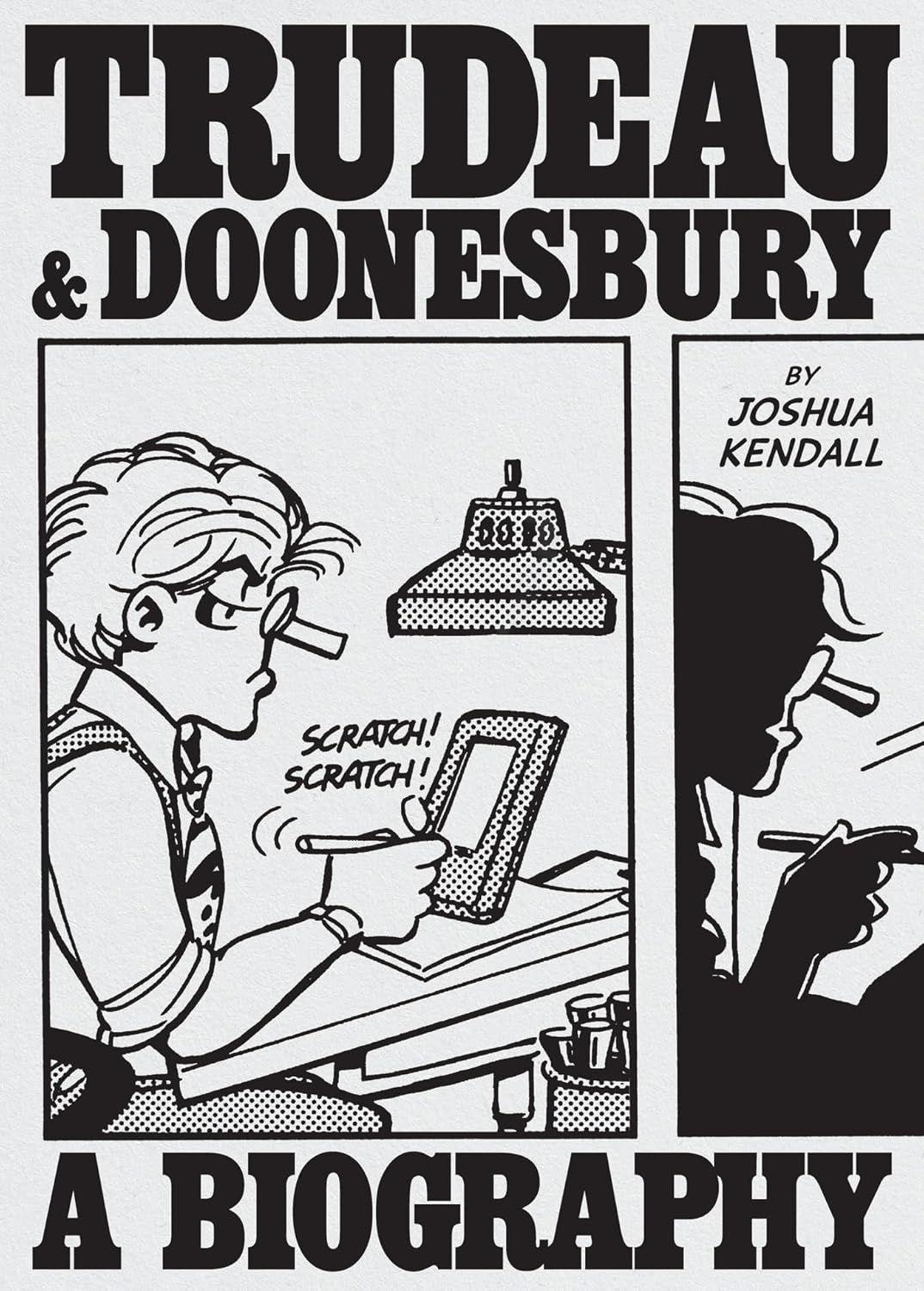
Trudeau & Doonesbury: A Biography by Joshua Kendall. Harry N. Abrams, 2026. 352 pages.Buy on Bookshop.org
GARRY TRUDEAU ARRIVED in the daily funny pages in 1970 with rock and roll’s moral clarity in his ears: a refusal to accept the consoling lies of the establishment, a willingness to make older readers uncomfortable, and an instinctive grasp of form and content. Like Jimi Hendrix overturning the national anthem at Woodstock, Trudeau inverted the comic strip itself: a form designed to provide morning comfort became a delivery system for outrage, generational confrontation, and the fury of someone young enough to face the draft lottery but privileged enough to escape it. Joshua Kendall’s new authorized biography, Trudeau & Doonesbury, documents this achievement with thoroughness and affection, but it sidesteps the harder question Trudeau (and rock and roll) now faces: what happens when a revolutionary form gets absorbed into the machine it set out to demolish?
The parallel to rock and roll reaches beyond aesthetics. Rock’s first wave gave us Elvis Presley and Little Richard, and then came the Beatles, who in their heyday carried strong subversive currents. But rock quickly faced the same gravitational pull toward respectability. The Beatles went from Hamburg’s Reeperbahn to The Ed Sullivan Show; Trudeau went from campus dailies to 1,400 newspapers and 60 million readers at his 2004 peak. And like rock, Doonesbury possessed an ear sharp enough to gall even its supposed allies. Most DC speechwriters considered it a victory if Trudeau simply left their bosses alone. The strip had teeth. For nearly five decades, he sustained a velocity that conventional journalism—bound by objectivity protocols—could never match. When newspapers hesitated to probe George W. Bush’s National Guard service, Trudeau simply posted a $10,000 bounty on his website for proof of this service, ridiculing both Bush’s privilege and journalists’ incompetence.
Yet both movements ultimately demonstrated the same paradox: once you reach 60 million people, you have already compromised the message that got you there. The system you once railed against now awards you Super Bowl halftime shows and royal knighthoods.
To understand Trudeau’s particular wrath, Kendall traces his development back to Yale in 1966—the last all-male graduating class before coeducation, and the first to face the draft lottery since World War II. It was a pressure cooker of privilege and dread, and Trudeau sat on its fault lines. Like a lot of his generational peers, his low lottery number—27—made his prospects for Vietnam ominous. He famously drew a self-portrait wearing an army helmet emblazoned with that number, driven by the same calculation that prompted the young John Kerry in 1971 to ask the US Senate, “How do you ask a man to be the last man to die for a mistake?” That same year,, the Pentagon Papers capsized the Defense Department’s propaganda.
Trudeau’s helmeted self-portrait, reproduced in Kendall’s biography, reveals something crucial about his method: he conveyed policy in personal terms through visual epigrams. The helmet spelled dread; you knew the numbers pointed at doom. Many young Americans had already written anti-war editorials and burned their draft cards, and the cartoon stayed lodged in the public mind.
When Trudeau received a medical deferment and accepted national syndication in October 1970, he brought that antiestablishment energy with him. But he also carried a visceral sense of moral duty to the peers who couldn’t escape that immoral war. His strip started fighting these “received” ideas about right and wrong through a series of characters in a new kind of coming-of-age cartoon saga: for example, the famous “Guilty! Guilty, guilty, guilty!!” strip of 1973—where his fictional radio pundit Mark Slackmeyer denounced Richard Nixon’s attorney general John Mitchell before his trial—resulted in over a dozen newspapers dropping the strip. Trudeau’s implicit argument was direct: why wait for the court when the corruption bonks you on the head? This was satire as moral judgment, delivered before legal judgment could reach the same conclusion.
Doonesbury’s Slackmeyer came out as gay in 1976. It seems almost quaint now (and then again, not) that Slackmeyer paralleled rock stars like Lou Reed and Elton John, who felt comfortable enough in their own professional spaces to proclaim their queerness with pride. But this was the very first gay character in comics, and dozens of newspapers simply dropped the strip. Their editorial boards deemed it inappropriate for family reading, as if sexual orientation were inherently salacious. Trudeau refused to apologize or put his character back in the closet. He accepted the economic cost of moral clarity. Not content to be absorbed into the system, Trudeau gladly risked loss of distribution for the sake of truth-telling.
Where rock music had created a safe harbor—concert halls and records—for its misfits and outsiders, Trudeau depended on daily newspapers to carry his work. He relied on mass distribution, which meant he needed editors, which meant he needed to negotiate constantly with the very forces trying to silence him.
Compare Trudeau’s challenge with Charles M. Schulz’s Peanuts (1950 –2000), the dominant strip of the era. Charlie Brown strode the same pages as a beloved figure across all demographics, politically neutered and emotionally resonant; after all, Charlie Brown had annual Halloween and Christmas TV specials. Charlie remains a boy—small, hapless, perpetually eight years old—over the strip’s entire 50-year run. Time does not touch him, and his neurotic purview grows annoyingly static. Readers watch their own children grow old while Charlie Brown stays frozen, trapped in nostalgia.
Schulz was a technical genius—Kendall even compares him to Dickens—but the biographer misses a crucial point: Schulz showed how comics could move beyond gag strips into visual abstraction. The “blah blah blah” of the adults off-screen, Schroeder’s philosophical monologues, conceptual props and scenarios suggesting psychological states—Trudeau twisted these innovations with a new flair. But where Schulz used that vocabulary to create a timeless world of perpetual childhood, Trudeau used it to create an evolving timeline: a wry rock sensibility negotiating with the world into adulthood.
In Peanuts, the adult world feels incomprehensible, their speech reduced to onomatopoeia. In Doonesbury, the adult world tilts hypocritical and borderline psychotic, the source of colossal betrayal and moral rot. When Trudeau deployed abstract visual cues to depict presidents—Reagan as an empty brain, Bush Sr. as a “point of light,” Trump as a sentient toupee—he pointed Schulz’s abstractions at a new target: that power is often visually represented by its absence, by the void where thought should live.
The most radical move of Trudeau’s career was his 1983–84 sabbatical. Upon his return, he chose to let his characters age in real time. We watched Mike Doonesbury trade his “bleeding-heart” Yale roots for a Manhattan ad agency, eventually selling tobacco to teenagers and Ronald Reagan to Black voters (echoes of Don Henley’s “Deadhead sticker on a Cadillac”). Through Mike and his cohort, Trudeau documented the Great Boomer Compromise as it was happening, with important exceptions. After walking out on a stifling marriage in 1970, Joanie Caucus evolved from a radicalized runaway into the strip’s ethical anchor, aging from a daycare founder into a political operative and grandmother. Paradoxically, aging his characters achieved a formal rebellion against the comic strip form itself. The citizens of Doonesbury got old, tired, cynical, and successful in ways that sometimes betrayed their younger selves—a Dickensian choice that allowed serialized characters to accumulate a cultural history.
If Mike represented the political sell-out, Mark Slackmeyer represented something more urgent: the moral witness to governmental impunity. Originally a campus radical and DJ at Walden College’s radio station, Mark came out in 1976, a move that became a watershed moment for the funny pages. But the 1980s deepened the crisis. As the Reagan administration ignored the burgeoning threat of AIDS—the president refused to even speak the word in public, and homophobic legislatures debated whether infected people deserved treatment—Trudeau used Mark to bear witness. While Bible-thumpers attacked the “morality” of the afflicted, treating AIDS patients as deserving of their fate, Trudeau faced the grim realities of suffering and death. One 1985 panel still grates: Mark stands at a closed-casket funeral for a lover, his face a hollow, blank mask of exhaustion. The caption: “I’m just so tired of being brave.”
This elevates satire into something new, to a place where the funny pages just never ventured: loss and agony. And it appeared every morning in the newspaper, alongside the weather and the horoscope, forcing readers—whether they wanted to or not—to confront the reality they were otherwise managing to avoid. As a documenter of moral neglect, Trudeau assumed an alternative kind of authority: he named what the president would not. By the mid-1980s, his daily cartoon carried at least as much weight as Reagan’s silence. And Trudeau’s insight had the muscular power of simplicity: a character’s exhaustion, drawn precisely, told more truth about the AIDS crisis than any mortality statistic could. Emotion isn’t the opposite of journalism; it’s the only way to make people feel what policy destroys.
At the same time, Trudeau had a blast with the Reagan crew’s verbal acrobatics. A strip in 1987 has an official barking to a congressional hearing, “We didn’t ‘mislead’ Congress, son. We merely sought to ROSEATE the scenario!” During the George W. Bush era, and on through the post-9/11 years, Trudeau’s satire grew broader and even more barbed. When he offered that bounty for proof of Bush’s military service, he wasn’t just being a cartoonist; he was also functioning as a one-man PAC, a crowdsourced journalist operating in a newspaper format. It’s here that Kendall’s term “investigative cartoonist” makes some sense, though the moniker oddly overstates the case. Trudeau wasn’t uncovering anything; he was amplifying what political journalists had already reported. But by weaponizing the comic strip—by turning it into a platform for direct political activism—he blurred the line between satire and straight-up advocacy.
When B. D.—the strip’s resident conservative and permanent helmet-wearer—lost his leg in Iraq, 35 years of character history freighted the injury. This wasn’t a policy abstraction; it was a friend’s tragedy. Trudeau became a fixture on Ward 57 of Walter Reed hospital, interviewing veterans and their families, detailing their trials and the government’s responses. Following B. D.’s journey through PTSD, Trudeau earned the title “archangel of Walter Reed” from the military establishment itself.
But here’s the paradox Kendall fails to articulate: Trudeau opposed the Iraq War vehemently, yet his humane treatment of its victims earned him establishment gratitude. When you become a “humanist,” you often lose your “teeth.” The military appreciated Trudeau’s compassion for wounded soldiers even as they pursued policies that kept wounding them. They could separate the caricaturist of their commanders from the chronicler of their suffering. They used his moral clarity about individual pain as cover for endless wars.
Kendall’s biography unearths private letters, unpublished drafts, and moments when Trudeau pushed the news forward. But it suffers from the double-edged quality of its access. Because Trudeau opened his archives, Kendall acquires a built-in bias even as he interviews detractors. Even the interviewees Trudeau most excoriated ask him for signed strips.
Moreover, Kendall barely addresses his subject’s aesthetic deficiencies. Trudeau’s voice and point of view leap off the page when even his draftsmanship seems limited. (Scholar Kerry Soper once noted that Trudeau is “a satirist of limited ability as a draftsman but of extensive, sustained determination as a commentator.”) Trudeau himself acknowledged this limitation, but Kendall doesn’t dig into the tension. Is Doonesbury “art” or “journalism in drag”? Can it be both? Should it be?
Trudeau emerges from Kendall’s account as a decent, preppy white male from a broken home who led his characters through progressive awakenings in more or less the order they appeared in the culture: feminism (Joanie Caucus), gay liberation (Mark Slackmeyer), veteran’s rights (B. D.). It’s a curriculum vitae of progressive positions, dutifully illustrated through comic panels. But unlike George Carlin, who deconstructed language itself with increasing skepticism, or Harry Shearer, who still uses deluxe impersonations to mock the media’s structural dishonesty, Trudeau remained a moralist. He believed the system could or at least should work, even as he mocked the people breaking it. For all his bite, he remained wedded to the idea that satire could shame the powerful into doing better. He believed in satire’s power, which is to say he believed in a kind of idealism that the daily newspaper industry was built to exploit.
Yes, later cartoonists like Matt Groening (Life in Hell, 1977–2012; The Simpsons, 1989– ) perforated hypocrisy in nonpolitical terms, and David Rees (Get Your War On, 2001–09) boosted political snark with an intrepid cynicism. Max Cannon’s Red Meat (1989– ) remains, however, the most rock and roll strip: impish nihilism that could never imagine itself anywhere but on the web (and that SNL can barely aim at anymore).
In 2014, Trudeau stepped away from his daily grind to work on HBO’s Alpha House, and most papers carried reruns of his greatest hits. He still writes a Sunday strip. Mike’s daughter Alex entered the cast, while the Duke (a play on gonzo journalist Hunter S. Thompson) lived long past his writerly role model to serve as as the proconsul of an Iraqi city. Like Donald Trump, the Duke acts like a monument to the Great American Grift. By the time Trudeau reached the Trump era, satire entered a predicament that made exaggeration almost impotent. Even late-night comics weary of ridiculing Trump, and logic simply vaporizes in the face of his daily harangues. Trudeau’s solution treated Trump as monstrous subtext—an unstable virus distorting his characters’ daily lives rather than a target for direct parody. It was a graceful retreat, but it also admitted defeat.
Doonesbury has long since been warehoused and canonized: a 2010 retrospective, a USB flash drive of 15,000 strips in 2020. The strip survives, not as a living thing, but rather as an archive in reruns. Digital preservation prevents Doonesbury from disappearing once newspapers finally vanish. Trudeau also put out five collections on wounded warriors and channeled most of the profits to charity. The first, The Long Road Home: One Step at a Time, released in 2005, featured a foreword by Senator John McCain.
Trudeau & Doonesbury skates around a devastating irony: Trudeau mastered the daily comic strip just as it entered terminal decline. He proved that the form could matter, that it could carry moral weight, that it could move readers to tears and anger and action. As Garry Wills once noted, “Trudeau has reflected on politics at a depth and with a breadth no one else has achieved.” And he proved it during that delicate moment in the 2010s when social media was ballooning and people had started paying less attention to print journalism. His greatest achievement—turning a comic strip into a work of moral reportage—traced the form’s irrelevance. The newspapers that once published him perished around him, and his characters watched the world scroll past. Could Doonesbury have thrived on TikTok or Instagram? And does that question even matter?
Kendall’s biography documents Trudeau’s achievement with admirable thoroughness, but the unspoken question lies in how much contextual immediacy matters to the Doonesbury experience. Reading Trudeau’s Elliot Richardson cartoon—in which the attorney general reassures his wife that their allowances haven’t decreased—at the time the events depicted were actually happening feels different from encountering it 50 years later, when many readers might wonder who Richardson is. Doonesbury functioned as a real-time witness to real people’s choices. Yet much of the cartoon’s righteous anger, while historically justified, rings differently now—not because Trudeau got it wrong but because the political world has moved so far beyond the reach of satire. Trudeau shamed the powerful. But the powerful long ago learned that shame was optional, that outrage could be monetized, and that scandal plays like reality TV content.