
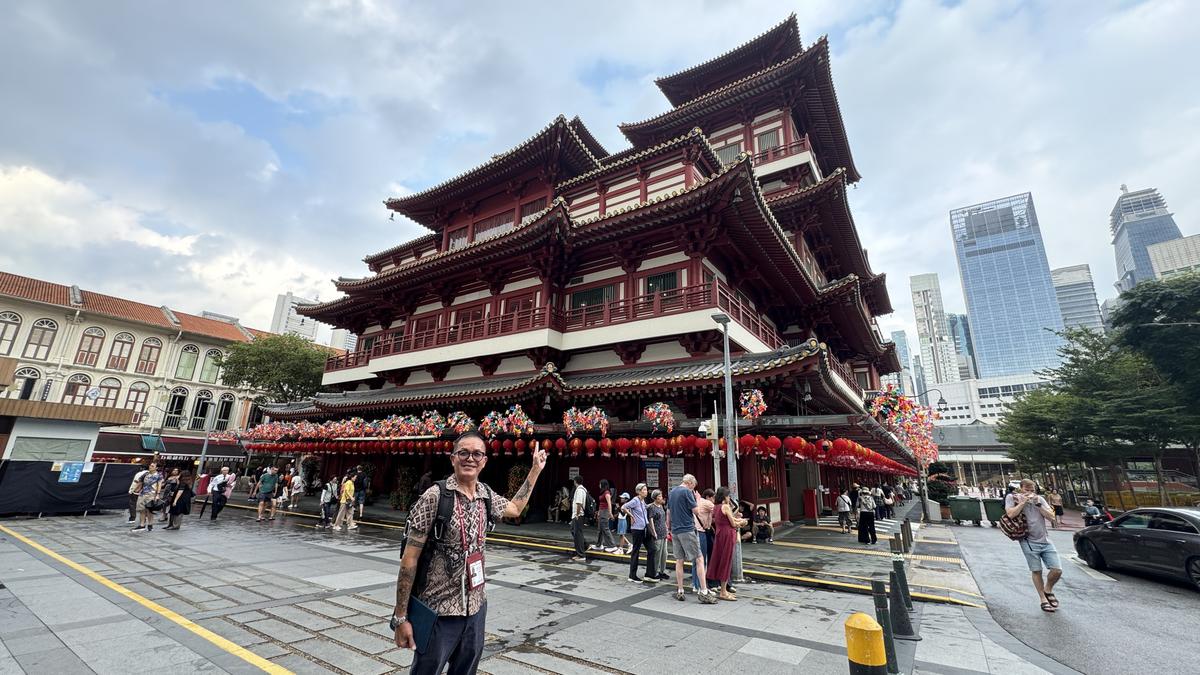
Streams of sweat are pouring down my back. Soon, they are joined by giant drops of rain. I’ve accepted a last-minute invitation from my hotel, Amara Singapore, to join Alvin Chiong’s Chinatown Unmasked tour, and Singapore being Singapore, humidity is off the charts, with a bonus thunderstorm. I will be walking for about three hours with a former gang member, seeing a different side of Singapore. We get off to a good start. Alvin takes me straight to Tong Heng for a diamond-shaped egg tart. I’ve only ever eaten the round ones, so I savour the still warm, crumbly pastry. Tong Heng started as a Cantonese tea and confectionery house in Smith Street in the 1930s, branching into different shaped egg tarts in the 1960s. It moved to South Bridge Road in the 1980s and is run by the fourth-generation descendants of Fong Chee Heng.
Alvin is an open book as we walk and talk. After a tough childhood and early exposure to drugs, he was drawn into gang life. He had several stints in prison and, along the way, lost his wife and sons. After several stretches in rehab and halfway houses, he turned his life around, eventually remarrying his former wife and reconciling with his boys. He’s a licensed Singapore Tourism Board guide, a Singapore Anti-Narcotics Association peer leader and as a Singapore Prison Service volunteer case officer, helps former inmates reintegrate. People from his old neighbourhood who once came to Alvin looking for drugs now turn to him for help. “After a few years, they noticed the change,” he says. “They now come to me asking to help people in bad shape.”
Alvin sees parallels between his early life and the underground secret societies and crime networks that formed among early Chinese immigrant workers seeking brotherhood and identity. “I came from a broken family and had domestic violence at home. My mum left us. Because of a lot of issues, I got bullied a lot. I joined the bigger boys. I thought they could protect me.” We walk by some of the historic Chinese clan association buildings on Ann Siang Road, often with intricate tiled entries. The clans often formed based on shared surnames or dialects, and helped new arrivals with cultural, housing, religious and social support.
Street art abounds in this area and Alvin knows the folklore that inspired it. Ikan Todak by Tobyato is a tribute to Hang Nadim, a boy who bravely built a barricade from banana palm stems to save Tanjong Pagar villagers from a vicious swordfish attack. Unfortunately, he was later executed because the rulers were afraid of his intelligence. This story of the sea in Chinatown makes sense when Alvin tells me much of the area is on reclaimed land. Tanjong Pagar (cape of stakes) takes its name from the banana barricade, while Bukit Merah (Red Hill) is named after Hang Nadim’s blood. Alvin points up to the Pinnacle@Duxton, a seven-building public housing complex with a panoramic 50th floor sky garden accessible for $6.50, cheaper than many tourist attractions.
I’m surprised to learn the iconic Buddha Tooth Relic Temple, where I often visit to light incense, was only built in 2007. The temple takes its name from what Buddhists regard as the left canine tooth of Buddha, which was recovered from his funeral pyre in Kushinagar, India and displayed on the temple’s grounds. The Buddha Tooth Relic is housed in a giant stupa (dome) made from 320kg of gold. Located opposite Maxwell Food Centre, the Tang-styled Chinese Buddhist temple cost more than $80 million to establish. It houses two museums and a hidden basement vegetarian restaurant, Lian Xin, offering affordable meals.
Singapore’s oldest Chinese temple, Thian Hock Keng, encompasses Buddhism, Taoism, ancestral worship and Confucianism. Its main deity is Mazu, Goddess of the Seas, but there is also a shrine devoted to Guanyin/Quan Yin, Goddess of Mercy. Outside is the fantastically detailed 44m heritage mural by acclaimed local artist Yip Yew Chong. Strolling through Ang Siang Hill Park, Alvin points out heritage nutmeg and cinnamon trees. With limited schooling, Alvin admits it was a slog towards becoming a tour guide in 2023. “I didn’t know my Singapore at all to be honest, so I started to learn about my own country at the age of 52,” he says. “I had to learn about the development of my country, the future development plans, sustainability plans, water plans, festivals, the region, food, Michelin, everything. I had to train myself to become a walking encyclopaedia of Singapore. It was most challenging because I am not very tech savvy with computers.” As Alvin and I part company, I reckon I’ve lost a kilo in sweat but have gained so much new knowledge.
+ Sue Yeap was a guest of Amara Singapore and Singapore Airlines. They have not influenced this story, or read it before publication.
fact file
Chinatown Unmasked costs $131 for a solo tour, $60 per person for two to three people, and $49 per person for four or more. Morning or afternoon sessions can be booked with the Amara concierge singapore.amarahotels.com tongheng.com.sg buddhatoothrelictemple.org.sg chinatown.sg/history-of-chinatown visitsingapore.com