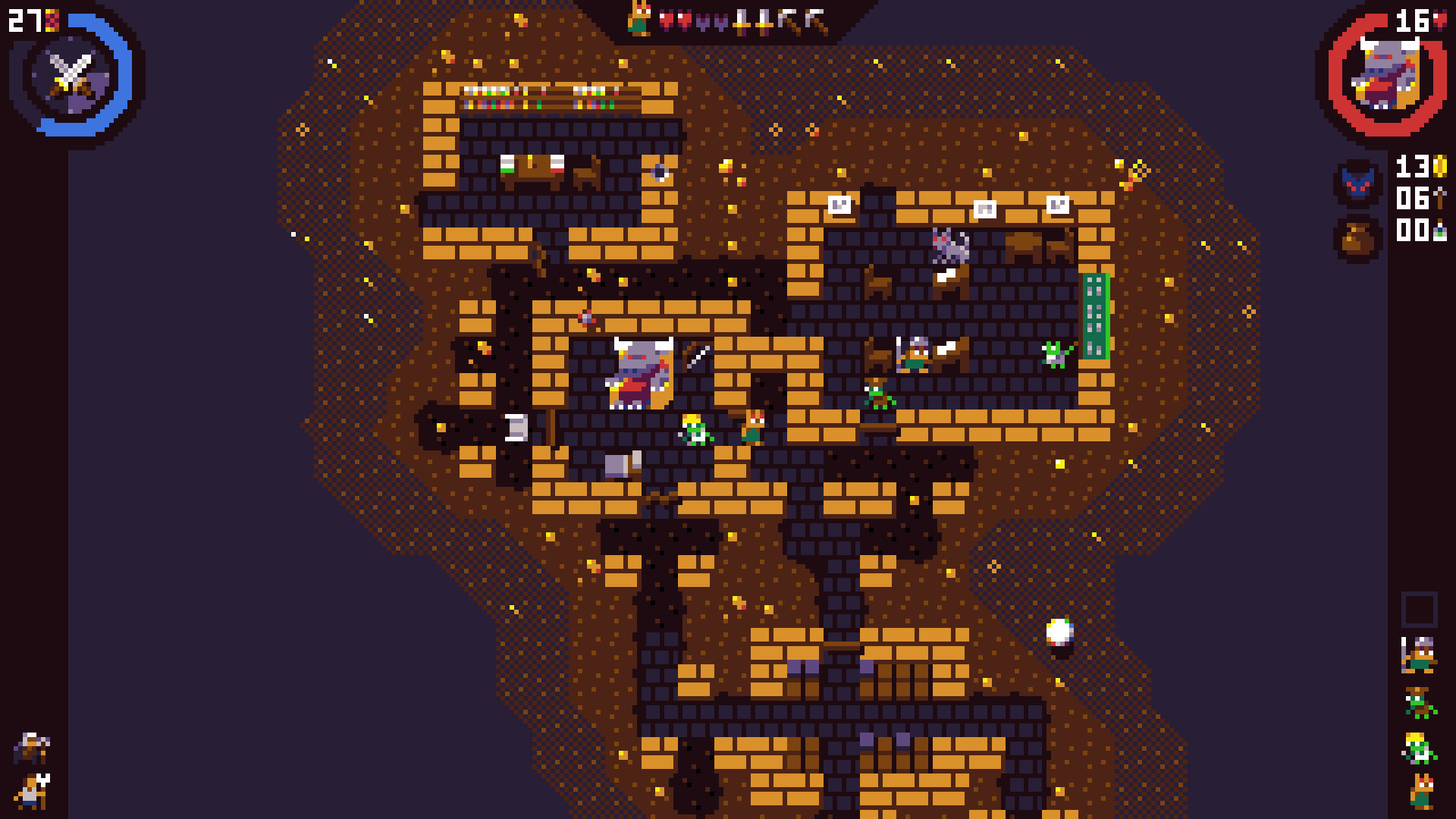
Go to the Steam page for Shotgun King: The Final Checkmate, which made a splash as the winner of the 50th Ludum Dare game jam, and you might note the distinctive name of its developer: Punkcake Délicieux. Click on their name and you’ll learn that Shotgun King is their first Steam release, with a Dungeon Keeper-esque game called The Wratch’s Den still forthcoming.

You will, in other words, see a story of sudden success. At the time of this writing, Shotgun King has over a thousand reviews, and it’s gotten write-ups on various game sites (including Fanbyte) on the strength of a deviously clever concept: chess, except your side only has a king piece that wields a shotgun.
What you won’t see is that Punkcake has been at this a while, subsisting on a Patreon built around the impressive feat of pumping out one new game per month. In that series, Shotgun King is the ninth. The Wratch’s Den was the third. Released in August 2021, it was previously the one that got the most traction before Shotgun King blew up on just about every possible front, from other jam participants to Twitter spectators to Twitch streamers.
Batter
Punkcake Délicieux is a trio, consisting of French developers Benjamin Soulé and Rémy Devaux as well as Spanish chiptune composer Pentadrangle. Each game has one main developer, while the other provides feedback. But unlike the larger Dutch group Sokpop, whose Patreon inspired them, the duties aren’t rotated. Most of the games actually come from Benjamin, whose backlog of ideas and prototypes dates back decades — he co-founded studio co-op Motion-Twin in 2002 before going solo in 2012, rising to prominence on the indie development scene around the Pico-8 “fantasy console.” (Motion-Twin’s own breakout hit would come in 2017, when they launched the early access version of Dead Cells.)
The engine that runs every Punkcake game, though, is all Rémy. They’ve made two of the ten Punkcake games, primarily handling promotion and community management and Discord calls with people who want to know about the team’s blistering pace. They tell me that the answer, as many of the answers seem to, goes back to Pico-8, which serves as the basis for Punkcake’s proprietary SUGAR engine.
Both are built on the idea of creation within defined constraints; Pico-8 games are meant to be small, with 16 colors and a small resolution that fits into a png file “cartridge.” They’re easy to share and easy to learn relative to the byzantine output of most game engines, made from built-in tools designed to streamline development while still supporting a variety of styles and mechanics. Most famously, the original version of Celeste was made for Pico-8.
The SUGAR engine is meant to retain that ethos while making the constraints more malleable. “I wanted to have a workflow that was similar to what I had with Pico-8, but for making bigger games,” Rémy explains. With SUGAR, you can set things like the resolution and controls at the outset, while using up to 256 colors (though no Punkcake game to date has actually used that many colors). And then, of course, there’s the greatest constraint of all: the Patreon selling point of producing one new game per month.
Syrup
The team’s name neatly summarizes their approach to development. The SUGAR engine, Rémy says, is named as such because they planned to go for a candy-colored style. The “punk” part, then, brings to mind a style of fast, unfiltered DIY expression: “We want to do whatever we want. We don’t necessarily want to make the best or most successful games, but we want to make things that are interesting to us,” they say. “And the games definitely aren’t going to be perfect because we’re going to make them so fast.” Hence, pancakes.
“Délicieux” came from one of Rémy’s prior Pico-8 games, Mushroom Délicieux, where you’re in a forest getting higher and higher on the mushrooms you eat to survive. Benjamin had wanted a second word for the team’s title, and it was more distinctive than “studio” or “co-op” or something to that effect. “And you know,” Rémy says, “because we’re like, it also represents the fact that we’re French. So why not?”
The two developers share similar sensibilities, to say the least. “There was already a sense of it,” Rémy says. “Because we knew each other’s games, and so we knew what each other were capable of.” Benjamin was the one who reached out via Twitter. They both lived in the same region of France, and he thought they should try a game jam together; the SUGAR engine had piqued Benjamin’s interest.
They worked on separate projects, since technically the jam was meant to be an online affair rather than an in-person one. Together, though, they could more readily talk through ideas and establish the working relationship that would eventually serve them under Punkcake Délicieux.
After just one game, the duo became a trio: composer Pentadrangle had worked with Benjamin before on games like Voidrun, and while they initially only asked him to make the music for Metavaxx, he was down for the long haul. He’s part of the development process, too, providing feedback for all the games. With his chiptune work most prominently featured in last year’s Cyber Shadow, Pentadrangle’s music is a natural fit for the Punkcake aesthetic.
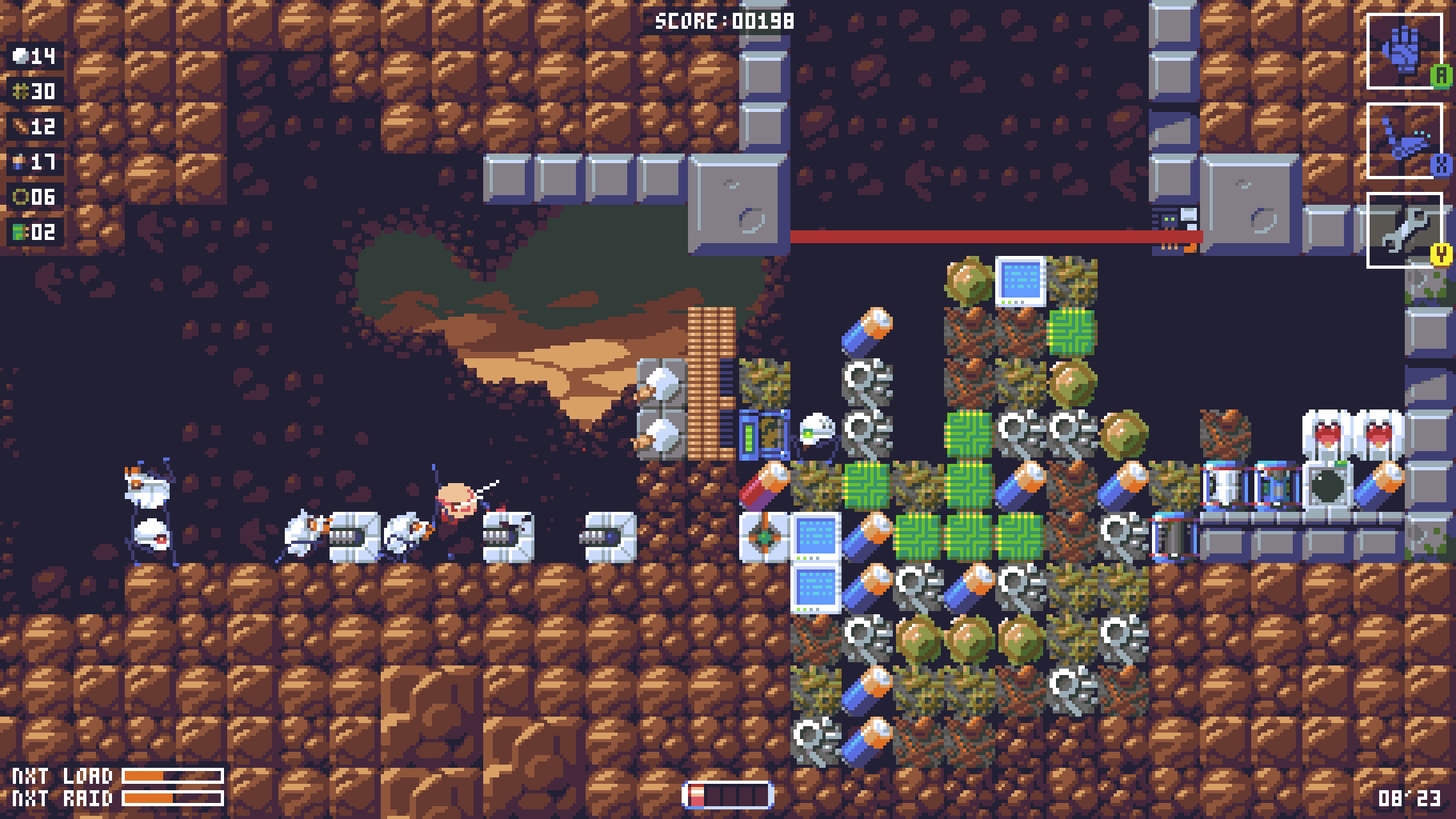
And it’s an easy style to spot: bouncy, colorful, and polished. Favoring pick-up-and-play mechanics, their growing catalog could populate an arcade on its own. Like Shotgun King, many of their games are novel twists on classic concepts: the scrolling shooter Metavaxx asks you to consider where you shoot by leaving numbered hints like Minesweeper, while Scavenger of Duomini drops a match-3 falling block game in the middle of tower defense.
Serving Size
Admittedly, the cheerful, clean aesthetic is not what comes to mind when thinking of the otherwise messy and jagged ethos of punk. But, then, what’s more punk than subsisting on a smaller, passionate audience with products that don’t readily fit into the dominant cultural space? Rather than Steam, Itch is Punkcake’s preferred platform. Their games go up on that service without a hitch, without the labyrinth of approvals and mandatory betas that will eventually and hopefully get you on Valve’s storefront.
It’s why The Wratch’s Den didn’t make its intended Steam release date at the end of 2021, nor did it make the delayed target of early 2022. The game had gotten some attention from prominent streamers and YouTubers, but it had also been out for a while at that point. “We didn’t know it would actually get any traction at all on Steam,” Rémy says. “And you know, putting things on Steam is a lot of work as well. It’s very time consuming.”
Time and time again, the Patreon had to take priority. The platform appealed to them because it offered a certain level of freedom, while providing a steadier income than would crossing their fingers and hoping for games to sell; they already had something of an audience among other developers. But the schedule can be grueling, especially at the once-per-month frequency they target in order to hold potentially fickle internet interests.
“We do try to run the beginnings by everyone in the team,” Rémy explains. “We try to talk a lot and we do a call every Monday, too, to see where everyone’s at and what their availability is.” From there, things progress however they may; both Benjamin and Pentadrangle have family obligations to balance, and Pentadrangle has an outside job. Even with the bump from Shotgun King, the Patreon isn’t as lucrative as it could be; as of this writing, they’ve just hit their first goal for the equivalent of a single full-time job in France. (“The other two of us,” the Punkcake page’s text wryly states, “will have to wait a bit more we imagine.”)
In some ways, though, the deadline is beneficial. Rémy notes that they cannot endlessly iterate on a game and make it “a huge mess” when it has to be delivered by a certain date before moving on to the next one. It’s partially why the games take the forms they do, riffing on concepts we’re already familiar with; it takes time to create a tutorial, so a Punkcake game should be easy enough to grasp simply by playing it.
Plus, the deadline isn’t totally set in stone. “If there’s something that we really want, we’ll push back the deadline rather than cut off what we want to do,” Rémy says. But delays accumulate. Shotgun King was actually meant to give them some breathing room in that regard, with the quick turnaround of a game jam providing an even tighter deadline to solidify an idea.
Of course, that was before the game took off.
Kitchen Time
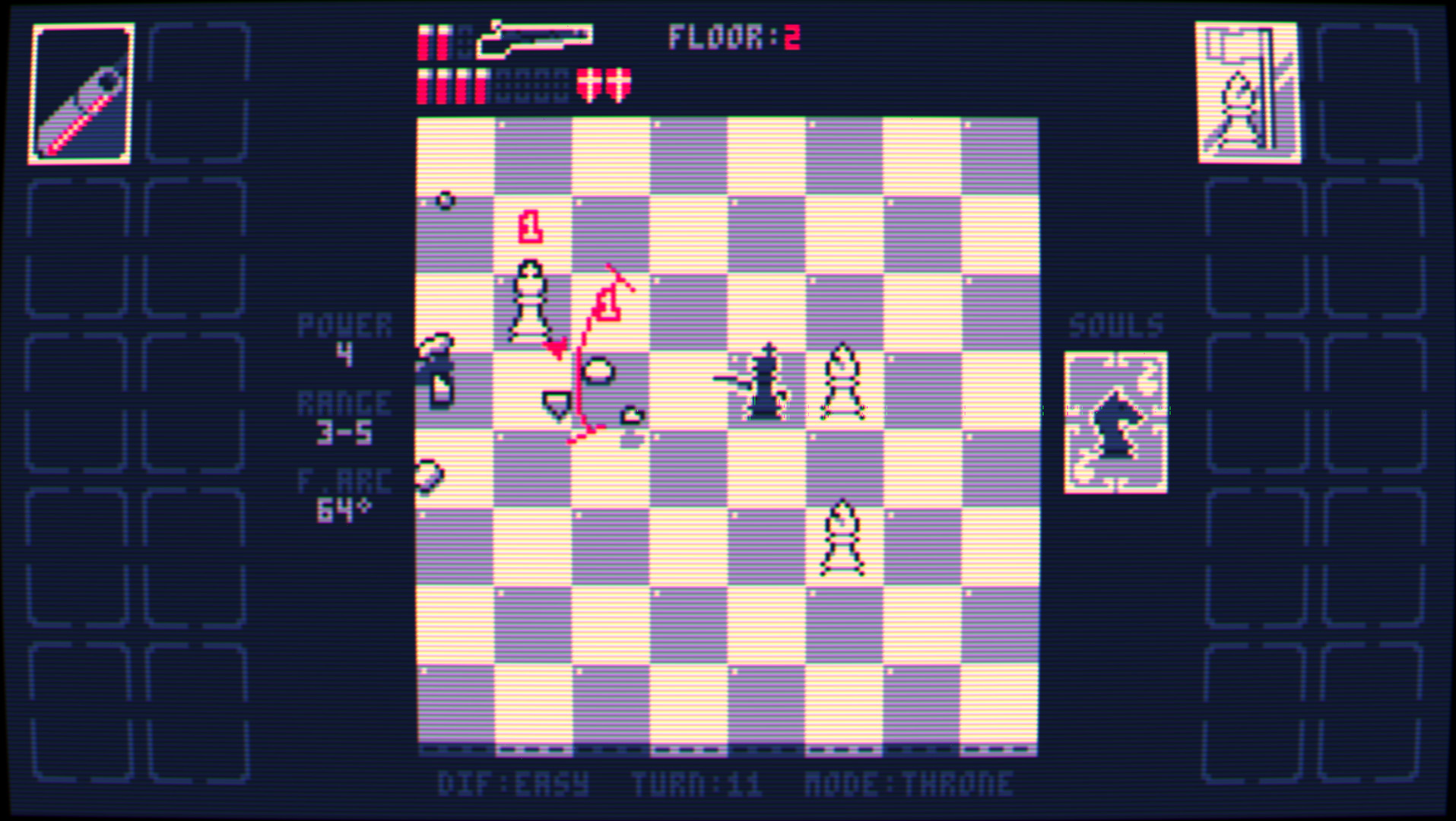
The theme for the 50th Ludum Dare game jam was to delay the inevitable. “We took the theme to be about delaying your demise, basically,” Rémy laughs. “And that really quickly inspired chess to Benjamin, probably because he’s not very good at it.” The result, with your shotgun-toting king choosing modifiers as he progresses from one checkered floor to the next, isn’t exactly chess, but it’s also much more than a recognizable paintjob — the enemy knights must move in an L-shape, and the bishops must move diagonally.
Other participants loved it. “The first gameplay GIF that Benjamin posted got 20k likes in the end,” Rémy says. “I’ve never seen that personally.” They’d already planned to polish the free jam version made in 72 hours into an expanded, rebalanced release for purchase, but they couldn’t let the newfound momentum go to waste. They needed to use it to get the game to the widest possible audience, which meant going through the same channels they’d started to navigate with The Wratch’s Den and make Shotgun King their first release on Steam.
The various hoops of getting on Steam in the first place meant that Shotgun King didn’t hit the service until three weeks after the Itch version, but the momentum held. The premium version became far and away their biggest hit, and it makes for a full circle effort on Punkcake’s part since a game jam was what initially brought them together. Like the black king wheeling out his royal shotgun, you’ve got to throw out some of the rules to move forward.
Full Steam Ahead
Certainly there are lessons they’ve learned along the way, but Punkcake hasn’t come out the other side of Shotgun King with an exact blueprint. With the jam version functioning like a demo, it was the first game where they released an earlier prototype, and they hope to try that again soon. But it’s all a learning process, a moving target they were fortunate enough to hit this time around. “It very much is a shot in the dark,” Rémy says. “There are things that work better. Usually we do get some success with the colorful graphics but, interestingly enough, that’s not at all the case with Shotgun King.”
Next time, who’s to say? The Patreon has already changed a bit over the course of Punkcake’s lifespan, abandoning a poll to vote for next month’s game concept (now, paying more gets you the soundtrack). “It turned out that finding three interesting game ideas that we actually wanted to work on was really annoying, actually,” Rémy laughs. The last game made from the poll was Rush for the Ages, which went through several troublesome iterations to create a Civilization-esque game in miniature. It turned out well, but without a poll, they might have had the freedom to scrap what wasn’t working or change the concept more drastically; Scavenger of Duomini originally did not even have the tower defense element that came to define it.
Punkcake has hopes for where to go from here, even if Shotgun King sent a lot of them into a flurry. The best way to combat the delay, Rémy imagines, is to collaborate with others at some point, functioning as a publisher for a developer they could pick to make a Punkcake-style game. Until then, though, they have no interest in slowing down, or swapping to another format like a longer game. They’re happy doing one per month, and their latest, a bullet-hell gauntlet called Ecstatic where you play as a mechanical spider, is out now. “I was supposed to make the 10th game,” Rémy says, “but actually Benjamin is also making that one because tweaking Shotgun King just took all of my time. I’ll probably be making the 11th.”