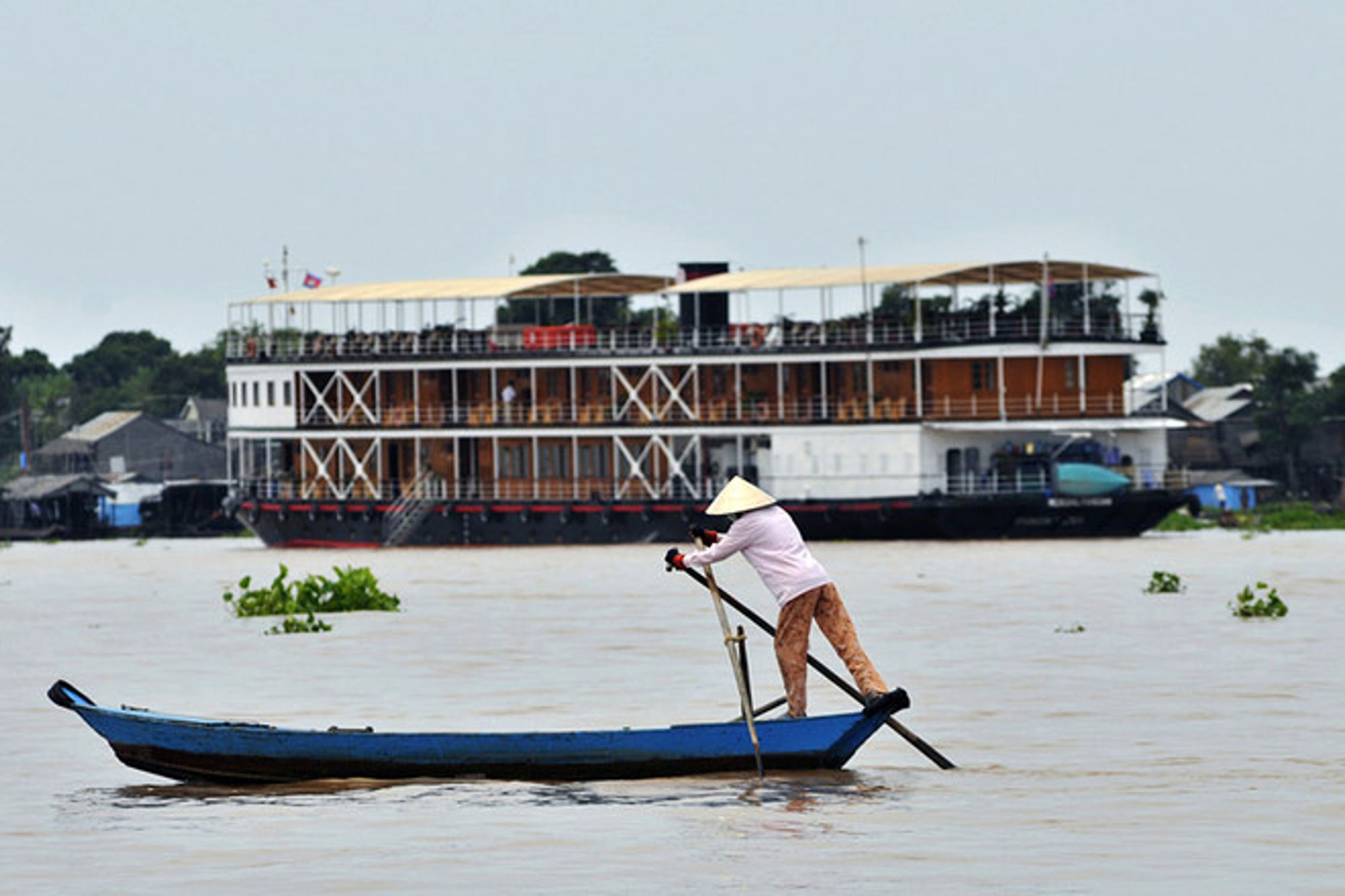
With a gin and tonic in hand, I settle into a comfortable rattan sofa on the deck of the Orient Pandaw, a 55-meter-long replica of a colonial paddle steamer that carries up to 60 passengers.
We're traveling to the Cambodian city of Siem Reap from the Mekong delta near Ho Chi Minh City, with stops in the border town of Chau Doc and the capital Phnom Penh in between.
Once aboard, there's no rush to catch flights or security lines to shuffle through, no stuffy rides along bumpy roads and no bags to lug from stop to stop. Instead, there's a lovely river breeze, staff attending to my every whim and fascinating scenery to behold.
"River cruising is the most gentle and interesting way to see a country. And there is always something to see -- river traffic, sights on the banks" like golden stupas bathed in the early light, says Geoff Becque, a 66-year-old retiree from the U.K. who's cruised the Yangtze and Nile rivers. He's also made three trips up the Irrawaddy in Myanmar, allowing him to see what he calls "the real Burma.
On a river cruise, the waterway is the destination. And in a bustling world that's all a-Twitter, it's the ultimate way to slow down. As one passenger confided to me on my Mekong cruise, "Everything is so fast -- that's why I'm on a boat at the moment."
Of course, you should bring along insect repellent, a wide-brimmed hat, sunblock and comfy shoes for the excursions. Smart casual is the usual dress code for dinner. Playing cards, an iPod, that novel you keep meaning to read and good company are useful ideas, too.
Bear in mind, also, that a river is a force of nature. Sometimes things happen. Even a luxury vessel like the Road to Mandalay isn't immune to getting stuck in shallow water for a spell. And my Pandaw cruise got caught in a sudden big storm in Cambodia, briefly stranding passengers in the rain on a sandbank, where they had gathered for a barbecue sunset dinner.
The Chao Phraya, Thailand
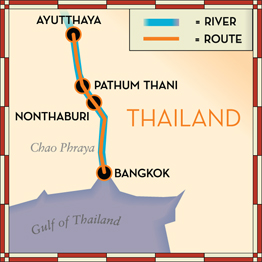
Before the Manohra Song was refitted as a deluxe cruiser, it was a typical 20-meter barge that ferried rice for decades up and down the Chao Phraya river.
Now, the century-old vessel boasts Asian art and four air-conditioned staterooms, each with a bathroom, as well as a small lounge, dining area and a forward sun deck. The boat's decks and walls feature teak and mahogany. Most weeks, it plies the Chao Phraya between Bangkok and Ayutthaya, the capital of Siam from 1350 to 1767, noted today for its canals and temple ruins. It's a three-day, two-night, 200-kilometer round trip.
On deck, stewards appear with hot tea and pastries or other snacks at appropriate times. (They also know when to leave guests alone.)
Below deck, the boat's smartly designed split-level cabins open off a short, narrow hallway. You enter on the room's middle level, which has a small sofa that's perfect for snuggling up with a good book. One level down there's a private bathroom (the water pressure isn't great, and the toilet flush is so weak that you're delicately asked to place used toilet paper in a trash basket); on the upper level there's a queen-size bed covered in clean, crisp white linens.
As we motored upriver and left the congestion of Bangkok, the city's tall buildings gave way to shorter dwellings and river traffic lightened. The Chao Phraya, just 365 kilometers long, rises from Thailand's northern highlands and weaves a course through the country's fertile central plain to the Gulf of Thailand. Along its length slow-moving barges loaded with rice and other commodities head for container ships waiting in the gulf.
Excursions on this cruise go to standard tourist sites, including Bangkok's Royal Barges National Museum and Temple of Dawn (Wat Arun) and Ayutthaya's royal summer palace (Bang Pa-In). But getting to them from the river provides a perspective that would be missed from land. For instance, as we stepped back onto the Song from the barges museum and headed upstream, it was easy to imagine a royal procession coming our way, with its drums pounding, men rowing and the long exquisitely ornamented craft gliding in formation.
And you don't feel touristy because you aren't put into a group. Each party on this cruise (whether a couple or a solo traveler) is assigned a complimentary personal guide, driver and car (a Mercedes, with cool towels and water bottles). So, on a walk through the crumbling 15th-century ruins of Wat Phra Si Sanphet in Ayutthaya, I decided to skip a scheduled elephant ride so I could linger and take photographs at my own pace.
On the second night, we moored at Wat Niwet Thammaprawat, where we caught glimpses of the summer palace grounds, lit for the evening, across the river. On a stroll along the sidewalk outside the wat, I saw young monks sitting on the steps by the river chatting surreptitiously on their cell phones.
Dinner was a white-linen, fine-china and crystal-glass affair, with either well-prepared Western or toned-down Thai -- if you like it hot, ask in advance.
Go between November and the end of February when the weather is dry and the breeze cool. Traveling from June to October leaves you more exposed to rain. April and May are scorchers, which doesn't matter on the boat but does on the excursions. And if you can, book cabin No. 2 or No. 3, in the middle of the boat; large picture windows in the rooms are perfectly positioned for gazing out as you lie in bed. The other two cabins aren't as nice: The bed in No. 1 is further from the window and the engine noise in cabin No. 4, which is also oddly shaped, can get annoying.
The fare includes meals, excursions and non-alcoholic drinks. (Alcohol costs extra and isn't cheap; a local beer costs about $8.)
Manohra Cruises
The trip: Bangkok to Ayutthaya and back over three days and two nights.
The fare: About $2,000 for two in a cabin or the entire boat for $6,000.
66-2-477-0770; www.manohracruises.com
The Irrawaddy, Myanmar
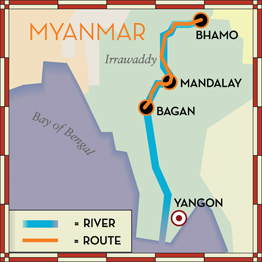
As early as the sixth century, ancestors of the Burmese were using the Irrawaddy river, which runs through the center of Myanmar, to gain power in the region through trade and transport. Later, the river became a key economic tool of British interests, who set up trading ports along its shores.
Today, the Irrawaddy is still the country's most important commercial waterway. From its source in the remote, mountainous region of northern Myanmar, it flows more than 2,100 kilometers south and empties in the Andaman Sea, transporting rice, teak logs and other goods from the nation's heartlands to Yangon, formerly called Rangoon, for export.
Cyclone Nargis -- a category 4 storm that ripped through the Irrawaddy delta region and pummeled Yangon in May 2008 -- damaged the Road to Mandalay. The 102-meter-long vessel doesn't operate in the affected areas, but had been on its way to Yangon for maintenance when the storm hit.
Now, after a year-long refurbishment in Myanmar, the boat is nearly ready again for passengers -- it can carry up to 82 -- and is scheduled to make its first voyage Aug. 26. In addition to a swimming pool, a small "beauty" room for spa treatments, and fitness area, its popular 18 state cabins will be bigger than before (23 square meters) and sport flat-screen televisions. And the vessel, originally built in Germany in the mid-1960s to cruise the Rhine, will have more Asian design touches than before, including fabrics from the Thai silk company Jim Thompson.
The boat travels between Mandalay and the central city of Bagan, where more than 2,500 Buddhist monuments built between the 10th and 14th centuries pepper a vast plain. Trips of three, four, seven, and 11 nights are offered -- the longest includes a tour further north to Bhamo, a few kilometers from the China border, that has a stop at Katha, where George Orwell served as a colonial policeman in the 1920s and set his novel "Burmese Days," as well as a morning sail through a steep gorge with verdant mountains.
Helen Burgess, who lives near Cambridge, England, took a three-night voyage on the Road to Mandalay in late 2005 with her husband, Keith. "I had traveled in Burma in 1985 and one of the things I most remember was long and uncomfortable journeys by train and bus, something that I would not like to repeat." By contrast, the cruise was so enjoyable that a longer one might have been preferable.
"The itinerary was quite busy and so a few days of doing nothing but watch the beautiful scenery go by would have been welcome," says Ms. Burgess.
The company behind the Road to Mandalay also runs the well-known Eastern & Oriental Express luxury train from Singapore to Bangkok. The boat fare includes excursions, daily meals, basic beverages and economy-class flights to Mandalay and back from Yangon, home to the country's biggest international airport. Alcoholic drinks are extra.
Orient-Express Hotels, Trains & Cruises
The trip: Mandalay to Bagan and back over eight days.
(Other itineraries and lengths of stay, from three to 11 nights, are available.)
The fare: $10,100 for two in a state cabin; other options include the slightly smaller deluxe cabins at $7,640 and the Governor's Suite for $14,140.
65-6395-0678; www.orient-express.com/web/rtm/roadtomandalay.jsp
The Mekong, Vietnam and Cambodia
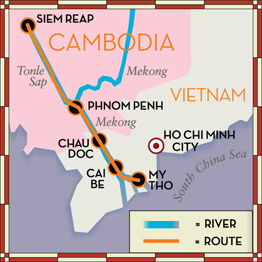
From the barren Tibetan highlands, the Mekong river rumbles south through China's Yunnan province and winds its way along the Myanmar, Laos and Thai borders. Then it powers through Laos, Cambodia and Vietnam before emptying in the South China Sea. At 4,350 kilometers, it is the seventh longest river in Asia and, arguably, Southeast Asia's most important natural resource.
Dams built along the upper parts of the river by China in recent decades have wreaked havoc on the river's flow, lowering water levels and damaging its ecology. Still, the river's fertile delta region -- called cuu long or nine dragons in Vietnamese -- is one of the world's largest producers of rice.
Though steep descents and swift rapids make the upper reaches of the Mekong difficult to navigate, its lower part in Cambodia and Vietnam is a gentle ride. It is this section of the river that I travel on the Orient Pandaw, a Pandaw Cruises boat.
Pandaw operates six boats in Asia with a seventh under construction. They ply the Mekong and the Irrawaddy as well as rivers on Borneo, and from later this year, in India. All the boats are built from a late-19th-century design of a paddle steamer operated by the Irrawaddy Flotilla Co. that was once a common sight in Burma. The boats carried everything from tamarind to rice to elephants -- and people.
In the mid-1990s, Paul Strachan found a 1947 version of the steamer called the Pandaw, originally part of the Flotilla fleet, in Mandalay. It was ferrying locals and goods, but badly in need of restoration. He had it repaired and launched Pandaw Cruises on the Irrawaddy. Mr. Strachan's company has gone on to make six replicas, each one hand-finished. Two of those boats, the Tonle Pandaw and the Mekong Pandaw, now ply the Mekong. (The Orient Pandaw has just been moved to Borneo.)
On a Pandaw "steamer" -- the four deck-high boats are actually engine-powered -- there is no mistaking it: You are on a river boat. There are the knob-end metal light switches, an old-fashioned horn that blows before departures and the polished brass and teak throughout. Each of the 30-odd state rooms -- Pandaw boats can carry about 60 passengers -- has a ship-like efficiency that displays more river-boat charisma than five-star hotel lavishness. Still, the navy blue bedding and wood walls and floors make it cozy.
On the Orient Pandaw, the sun deck on top -- shaded by a cheerful yellow awning -- is so inviting that it's tempting to skip some of the land excursions, which some passengers did on my trip. Lounge chairs with navy blue cushions face the shore, so you can enjoy a drink and watch the banks as you coast by. Comfortable rattan sofas take up the deck's middle space, a perfect spot for reading.
Next time, though, I'll make sure the boat I'm on has plenty of indoor common space, as the Mekong Pandaw and Tonle Pandaw do. Unlike the Orient Pandaw, both have a saloon bar, a large indoor area with comfortable sofas where you can read or socialize in air-conditioned comfort yet still see outside.
I boarded at My Tho, a trading hub west of Ho Chi Minh City. As we headed toward Cambodia, one of our first stops was the town of Cai Be, where we visited floating markets, local rice-paper makers, an elegant historic residence known as the An Kiet house and An Binh, an incongruous French-Gothic church.
The next day, we stopped at Chau Doc, a pleasant Vietnamese delta town where we walked through a bustling market and were pedaled around on rickshaws. We also visited a Muslim neighborhood inhabited by the Cham, a group that traces back to the Champa kingdom that ruled the area centuries ago.
During the early part of the trip, the Mekong delta was so vast I couldn't see land. But as we neared Cambodia, the river narrowed and the shores drew nearer, affording glimpses of local life, like kids playing in the water and cattle cooling off in the mud.
Unfortunately I had to disembark in Phnom Penh and missed the rest of the cruise up to Siem Reap and Angkor Wat. I now regret not clearing my schedule -- three days on the Mekong is not enough.
Pandaw Cruises
The trip: Ho Chi Minh City to Siem Reap over seven nights
The fare: $5,137 for two in a main-deck room during peak (high-water) season, from October to March. The shorter trip from Ho Chi Minh City to Phnom Penh in peak season costs $2,640 for a couple. The fare covers meals, bus transportation, excursions and some alcoholic drinks such as local beer and basic cocktails.
44-131-514-1035; www.pandaw.com
The Yangtze, China
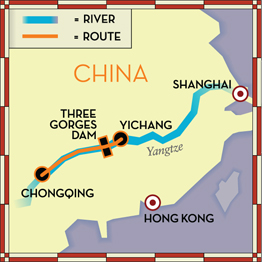
No one calls this mighty river the Yangtze in China -- that's a Western moniker that most likely came from the name of an ancient fief of Yang. In Mandarin, it's called the Chang Jiang (long river) or Da Jiang (great river).
At 6,300 kilometers, it is the third longest river in the world and certainly the most important in China. From the Tibetan plateau to its mouth on the East China Sea, it cuts across 10 provinces as it moves east-northeast to Shanghai. Its basin is China's great granary and nearly 30% of the country's 1.3 billion population live there.
Now it's also home to the Three Gorges Dam, the largest such structure in the world. It blocks the Yangtze to create a reservoir that has submerged large areas of the Qutang, Wu and Xilang gorges in central China and generates hydroelectric power for Shanghai and other cities. It's supposed to stem flooding downstream, but because it has displaced more than one million residents, the dam has generated considerable controversy.
That hasn't hampered river tourism on the Yangtze, however; it was already well-established thanks to the beauty of the Three Gorges area, notable for its steep, sheer slopes of limestone rocks. The man-made and natural attractions still appeal, even after the dam was completed, but unfortunately many of the so-called "luxury" cruises on the river are closer to three-star experiences -- with 300-plus passengers at a time.
Enter the MS Yangzi Explorer: In August 2008, Sanctuary Retreats, which is owned by luxury travel company Abercrombie & Kent, teamed up with Orient Royal Cruise to launch the 124-passenger boat. The 91.5-meter-long vessel has all the bells and whistles of a five-star hotel, including a fitness center, espresso bar, hairdresser, business center, library and spa, and service to match: The shipboard staff-to-guest ratio is one-to-one. There's also a theater for movies and stage productions, a 24-hour medical clinic and Internet access throughout the boat.
Accommodations vary between McMansion-like master suites that measure 110 square meters and spacious 31-square-meter deluxe cabins. All feature private balconies -- you can watch the scenery dressed in a bathrobe if you like -- 24-hour room service, a large flat-panel television and video on demand.
The cruise offers upstream trips (four nights) from Yichang to Chongqing, or downstream (three nights) from Chongqing to Yichang. Both itineraries make three excursions at Fengdu, a village with an elaborate Daoist temple, or the remote village of Wanzhou (depending on the weather and water levels), as well as a visit to the scenic area of Shennong Stream for rides in local longboats and the Three Gorges Dam Project. If you don't want to get off at all, there's plenty to do: On-board activities are mostly educational and cover silk embroidery, mahjong, calligraphy, tai chi, tea appreciation and dumpling making.
"As long as you are game for slow, calm travel, it's a great way to go," says Elise Schulte, a retired marketing consultant who lives in Florida and New York. She took the cruise with her husband, Fred.
Though the voyage takes place upriver to the west of the dam, the boat also goes through a series of locks -- gated enclosures where the level of the water can be changed to raise or lower boats from one level to another -- to get to and from Yichang, which is east of the Three Gorges dam. It takes three to four hours to get through all the locks, a surreal walled-in experience made more so by the lack of any visible humans operating them. (Engineers are in a nearby control tower monitoring ship progress by camera.)
The best time to take this cruise is either in the spring, for the flowers, or the autumn, for the turning leaves. It's hot and humid in the summer and in winter the cruise doesn't operate. If you can, book a cabin or suite on the Wu or Qutang decks to get the best views. Included in the price are accommodation, excursions, meals and most drinks at meals, including local wine and beer.
Sanctuary Retreats
The trip: Chongqing to Yichang over three nights (or the reverse over four nights for the same price)
The fare: $3,900 for two during peak season (April 30 to May 31; Sept. 10 to Oct. 29) in a Wu Deck deluxe cabin (prices for other cabins and decks vary).
852-3179-5900; www.sanctuaryretreats.com/cruises
Changing Currents
A look at trips on other Asian waterways, from rivers to bays to oceans.
Indochina Sails
See Vietnam's picturesque Halong Bay from luxurious newly built wooden junks where the cabins are fitted out with marble bathrooms and big picture windows. A three-day, two-night sail through this Unesco World Heritage site costs about $1,200 to $1,500.
Luang Say
Explore the scenic mountainous stretches of the Mekong river between Luang Prabang, Laos, and northern Thailand in a 34-meter river barge. Two-day, one-night packages range from about $250 to $400 a person, double occupancy.
www.asian-oasis.com/luang.html
The Oberoi MV Vrinda
Enjoy Oberoi levels of service on a four-day journey in India through the backwaters of Kerala. You'll get all the amenities you'd expect from the luxe hotelier, like king-size beds and DVD players for $1,900 a cabin, double-occupancy.
The Sepik Spirit
Want to get wild? The winding Sepik river in Papua New Guinea has jungle, tribes and exotic wood carvings. Take the Sepik Spirit, which has panoramic front windows, can navigate shallow water, and offers six-day tours from Port Moresby for about $3,000 a person.
The Silolona
Don't miss spotting a few Komodo dragons from this private yacht as you explore the islands of eastern Indonesia. The fully air-conditioned, traditional gaff-rig Phinisi -- a wooden sailboat -- sleeps 10 in three master suites and two guest suites and comes with a full crew and PADI diving instructor.
The price: $94,500 a week.
Tui Tai
Sail through the Fiji islands in style on this luxury yacht, where the beds feature 800-count Egyptian cotton sheets. The rate for a five-day "adventure" -- $3,300 to $6,800 a person, double-occupancy, depending on the cabin you book -- is all-inclusive of meals, drinks and activities, including scuba diving, snorkeling and kayaking.
Article also appears on WSJ website: https://www.wsj.com/articles/SB124031855776938967