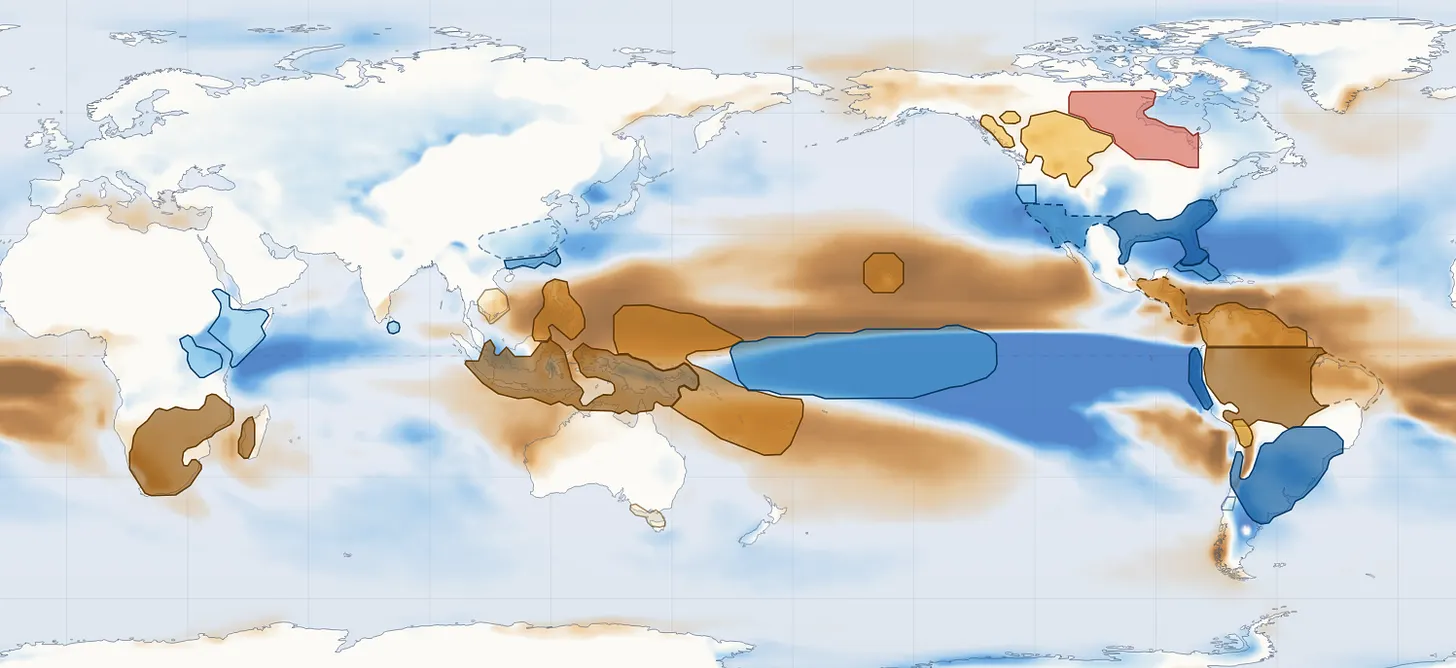
Are you ready for this?
You’re not. No one is.
Welcome to the year 2027:
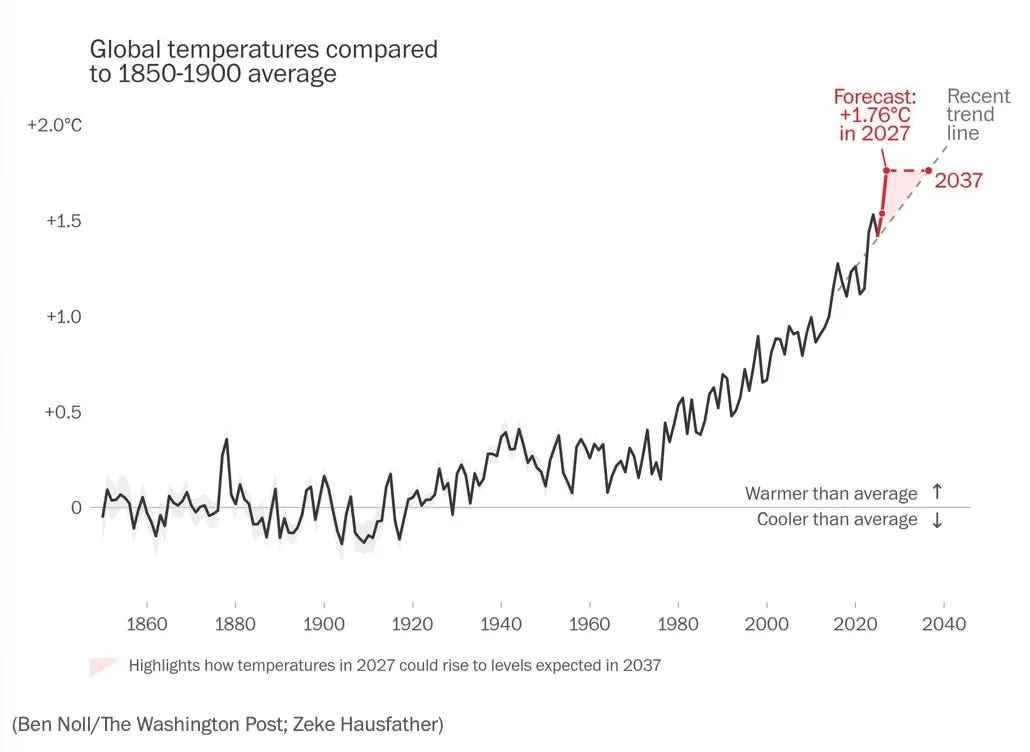
Global temperatures could rise to 1.8 degrees C, a level of warming not expected for another decade.
40 to 50% increase in extremely hot days
Central America, South and Southeast Asia, and much of Australia will face drought and wildfires.
The western U.S. can expect torrential rain, severe flooding, and the possibility of a series of atmospheric-river megastorms that would turn California’s Central Valley into an inland sea.
Global precipitation will increase significantly, perhaps as much as 20%, so expect lots of major flood events
The global impact may top $10 trillion in economic losses by 2032.
This historic El Niño will upend normal global precipitation patterns. Dry regions will flood, and wet regions will be dry.
Heat waves will become heat storms blanketing much of the planet. Expect a million or more heat-related deaths. If we don’t prepare, it could be several million deaths from heat alone.
Extreme heat turns manageable health conditions like diabetes, high blood pressure, or heart disease into deadly ones.
Exposure to high temperatures exacerbates and increases mortality rates in 90% of the existing global causes of death.
—The World Health Organization.
Do not blame El Niño
El Niños are part of a natural cycle that’s been around for thousands of years. They redistribute existing heat. They do not add heat to the climate system, like burning fossil fuels do.
Over 90% of the heat trapped by our staggering amounts of CO2 emissions (40 billion tons a year!) ends up in the oceans.
If the oceans didn’t soak up all that excess heat, we would have dealt with global warming a long time ago. Otherwise, we’d be living in a Mad Max dystopia of 3 degrees C, where much of the planet would be unlivable.
Need-to-Know: An historic event:
No El Niño of any strength has ever occurred when the oceans are already so hot, and air temperatures are so high.
This Super El Niño will draw enough heat from the oceans to likely make 2026 the hottest year on record. And then 2027 will break that record by a wide margin.
Need-to-Know: This Godzilla of El Niños may be 90% stronger than any other
The current “Godzilla of El Niños” is expected to be more than 90% stronger than any previous Super El Niño.
In other words, a historic event.
The enormous amount of heat El Niño is releasing will severely disrupt weather patterns.
The global average temperature could jump from 1.5 degrees C to as high as 1.8 degrees C —a level not expected until the mid-2030s.
El Niño events have steadily worsened because each one pushes global temperatures to new record highs. That reduces the planet’s snow and ice cover, causes more wildfires, expands deserts and drylands, and makes the oceans even hotter, triggering a series of self-amplifying feedbacks.
Need-to-Know: A $10+ trillion impact
Previous studies of immediate and persistent or longer-term impacts of previous El Niños found multi-trillion-dollar impacts. For example, Peru and Indonesia experienced a 10% reduction in their GDPs, following the 1997-98 Super El Nino.
The overall impact of this Godzilla of El Niños is expected to top $10 trillion in economic losses by 2032, according to Justin Mankin, a climate researcher at Dartmouth College in New Hampshire.
The Global South will be hit hardest.

Need-to-Know: Prepare for the worst.
The UK government recently urged all citizens to stock emergency supplies: water, canned food, and battery-powered equipment, etc. Residents are encouraged to prepare for three days without electricity or water services. France, Ireland, and the Netherlands have similar recommendations.
Here’s the UK Be Ready website.
And a one-page be disaster-ready flyer from the Canadian Red Cross.
Sadly, this is something we all have to take seriously.
Until next time. Be well.
Stephen