“It’s not thousands, it’s not hundreds of thousands, or millions of lives that are at risk – it’s billions of lives that are at risk,” if we fail to tackle climate change and preserve nature.
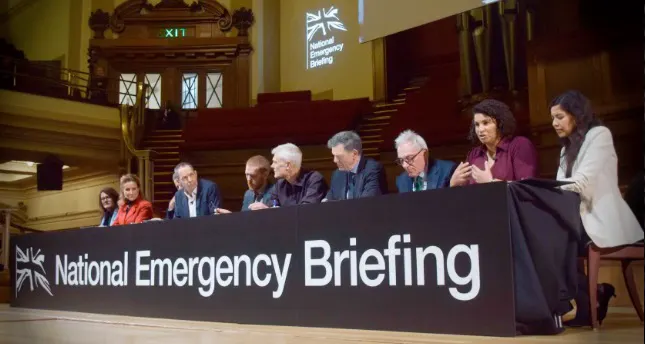
That’s a statement from the first National Emergency Briefing held in London, UK, at the end of November 2025. Ten experts warned of the risks posed by climate change and biodiversity decline.
Starvation, economic collapse, civil unrest, and wars are just some of the risks we face, they warn.
“We risk sliding into a state of permanent crisis management.”
We know how to prevent this grim future; we’re simply not taking these risks seriously.
British actress Olivia Williams, who attended the event, summed up our current moment:
“People are listening and watching numpties on Instagram and not listening to these people who’ve devoted their lives to studying what is actually happening.”
Our choice is between “deep, rapid, and fair decarbonization of modern society”, or more talk and delay leading to a “revolutionary style change that will be both chaotic and violent,” said Kevin Anderson, professor of energy and climate change at the University of Manchester.
Billionaires are funding climate-denying misinformation.
“They do it because they don’t want people to act collectively; they want people to feel powerless,” said one of 1,250 invitation-only attendees, who included politicians and leaders from business, culture, faith, sport, and the media.
Inaccurate, unreliable information about climate change is being “widely disseminated” with the intention of “obstructing and delaying climate action”, according to new research by the International Panel on the Information Environment, an independent and global science organization involving 450 experts. (It’s akin to the IPCC.)
Governments are failing to fully inform or engage the public about the risks of climate change and the decline of nature.
“I’m scared for my own life and future. And I’m absolutely terrified for that of my son. And you should be, too.”
Hugh Montgomery at University College London, a doctor who has studied the health impacts of climate change.
Here’s a 1-minute video overview
The 10-minute presentations from each speaker covering a wide range of topics are available here.
The presentations are well worth a look; I learned a lot. It’s a remarkable effort that should have received far more attention—especially after last summer’s extreme heat in the UK, Europe, and the US (hottest summer ever).
If you want to go further, their website has lots of resources.
Until next time. Be well.
Stephen