
There is no precedent for continuous uptake of foreign particles into the human body that does not result in some adverse health effects.
— Rolf Halden, Director, Environmental Health Engineering, Arizona State University.
Micro and nanoplastic particles and fibers are everywhere. Every person likely has billions of micro and nanoplastic particles (MNPs) circulating in their blood or deposited in their organs. MNPs are found in soil, water, air, plants, and animals.
MNPs exhibit an enormous variety of sizes, shapes, and compositions. As many as 16,000 different chemicals are used in more than 100,000 plastic formulations. At least 4,200 plastic chemicals pose a hazard to human health and the environment, according to a recent study in the journal Nature.
It gets worse.
MNPs act like tiny magnets, attracting other chemicals, including toxic compounds, as well as bacteria and viruses.
To be clear, detecting ultra-tiny MNPs has been very challenging, requiring the development of new scientific tools. Even more challenging is assessing the effects of MNPs on living organisms, including humans.
That said, many studies now examine the potential health effects of MNPs.
Need-to-Know: Plastics linked to increases in many diseases
MNPs in our gastrointestinal systems are altering our gut microbiome, making it more acidic, according to a new unpublished study.
This has caused shifts in bacterial composition similar to the changes seen in people suffering from depression and colorectal cancer. Both conditions, along with acid reflux, have doubled since the 1990s, with the biggest relative increase in the 25 to 35-year-old age group.
This study does not prove there is a link between MNPs and these conditions. It proved that MNPs altered our gut microbiome.
Other studies have linked MNPs with lung diseases, liver cirrhosis, and strokes.
Exposure to chemicals linked with MNPs represents the biggest risk to our health, according to The Lancet Countdown on Health and Plastics report.
Early-life exposures to plastics and plastic chemicals are linked to increased risks of miscarriage, prematurity, stillbirth, low birthweight and birth defects of the reproductive organs, neurodevelopmental impairment, impaired lung growth, and childhood cancer.
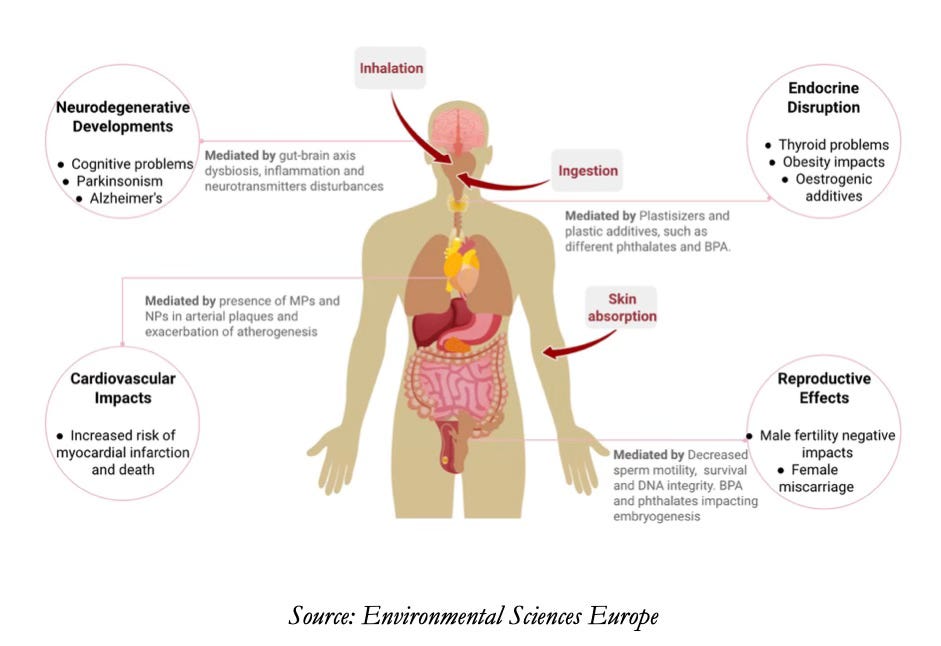
The health of plants and animals is also being impacted by MNPs. some studies indicate that MNPs can thin intestinal tissue, leading to a “leaky gut” that allows bacteria to enter the bloodstream.
MNPs disrupting the gut microbiomes of cattle affect digestion and increase stress-related proteins, according to the first-ever study in cattle.
Agricultural soils contain about 23 times more MNPs than oceans and waterways combined.
Need-to-Know: Plastics are reducing the yields of food crops
MNPs and the chemicals they contain, including phthalates and UV stabilizers, directly impact plant growth. This could be reducing global yields of staple crops such as rice, wheat, and maize by up to 360 million metric tons annually, according to a recent meta-analysis.
Not surprisingly, the fruits and vegetables we eat all contain MNPs. For example, apples and carrots were the most contaminated fruits and vegetables, respectively, with over 100,000 microplastics per gram, according to a 2020 study.
Need-to-Know: How to reduce your exposure
Reducing your exposure to MNPs means reducing your exposure.
Avoid food and drinks stored in plastic or packaged in plastic.
Fresh food is generally lower in MNPs than processed or ultraprocessed foods.
Read Three Easy Ways to Protect Yourself from Plastic Pollution
It’s worth reflecting on Halden’s statement at the top of this post:
Even if we don’t yet know the precise health impacts of MNPs on us, it would be a miracle if there were none, given the amount entering our bodies.
Until next time. Be well.
Stephen