Global Overview
Investment in clean energy topped $2.3 trillion last year and outpaced investments in fossil-fuel supply for a second consecutive year. (A trillion anything is hard to get your head around. Try this: A trillion seconds is 31,689 years. (Probably didn’t help.))
Need-to-Know: Clean energy surpassed coal to become the largest source of electricity globally in 2025. (Yes!!)
Solar and wind have become the default source of new power generation because they are cheaper and faster to build.
U.S.A.
Contrary to some headlines, U.S. clean-energy investment hit a record $378 billion in 2025, up 3.5%, largely driven by economics.
Need-to-Know: Electricity from solar with battery storage is cheaper than from a gas plant
Unsubsidized solar and wind projects cost less than nearly all fossil-fuel projects, according to Lazard’s latest levelized-cost-of-energy analysis. (Caution: Energy nerd zone.)
For example, the median cost of utility-scale solar with storage (i.e., batteries) is $0.09 per kWh, compared to widely used natural gas peaker plants at $0.20 per kWh.
Solar’s lower cost and speed of installation have made solar the largest source of new U.S. electricity-generating capacity added each month for the past 27 months. (Psst! Don’t tell Trump!)
Europe
In the European Union, wind and solar generated a record 30% of electricity last year—more than coal and gas power for the first time.
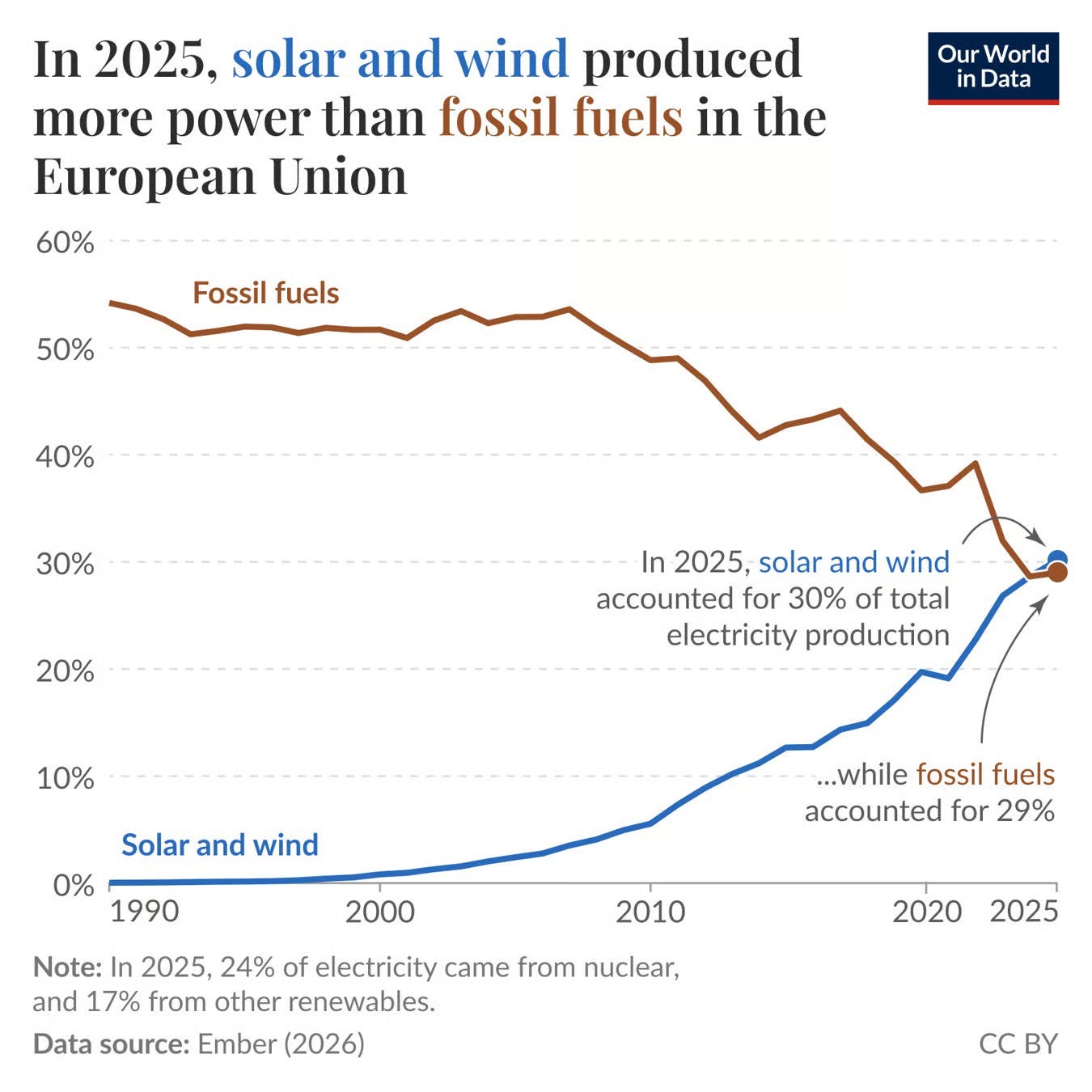
Need-to-Know: The EU produced more electrical power from wind and solar than coal and gas
Without wind and solar, the EU would have spent an additional $160 billion on gas imports from 2022 to 2023. And they’d be spending even more this year, if not for renewables. (For more on this see Break free from the fossil-fuel trap.)
Rest of World
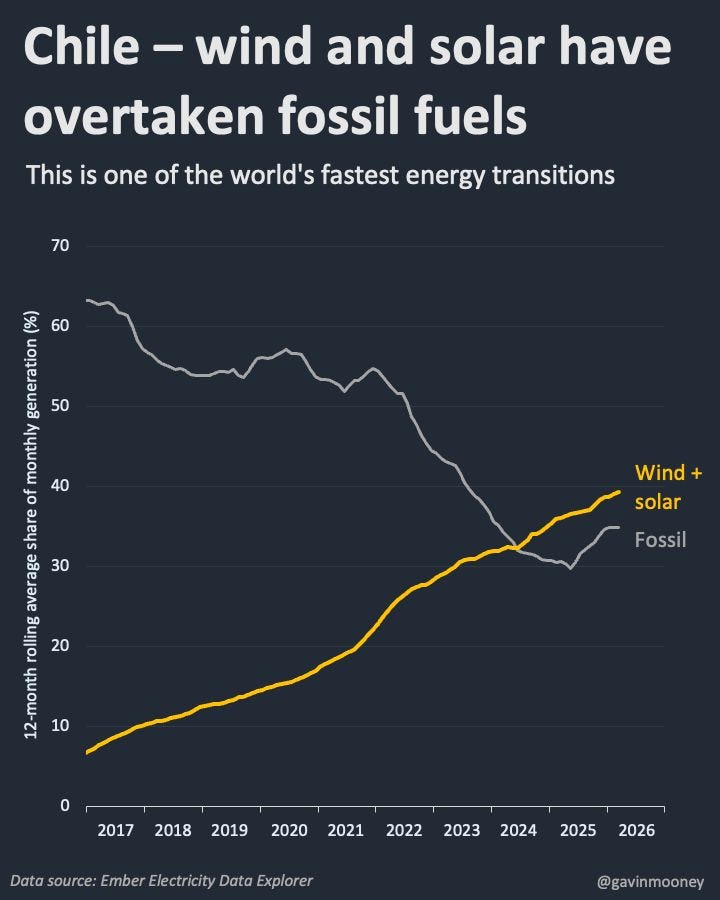
Renewable energy’s growing economic and energy-security advantages are of particular interest to India, Africa, Latin America, and Southeast Asia.
Consider the following view of Michael Liebreich of EcoPragma Capital and founder of BNEF, paraphrased from a recentCleaning Up podcast:
What should we buy?
A million-dollar investment in solar or wind buys an asset that will produce 15 times the energy per dollar over the asset’s lifetime compared to making a one-time million-dollar purchase of gas or oil.
To me, it’s a no-brainer.
India is of particular importance. Low-cost solar, batteries, and EVs are enabling India to develop without the long fossil detour taken by the West and China, avoiding billions of tons of CO2 emissions.
Electric Transportation.
Electric vehicles are the preferred new-vehicle choice in China, the EU, and Norway, with other countries not far behind. In fact, nearly $900 billion was spent last year on electrifying transportation.
Need-to-Know: Electric outsold petrol-vehicle sales in Europe
Europe
EVs, including plug-in hybrid electric sales in Europe, were up 51%, and outselling petrol-vehicle sales for the first time last year, according to the European Automobile Manufacturers’ Association.
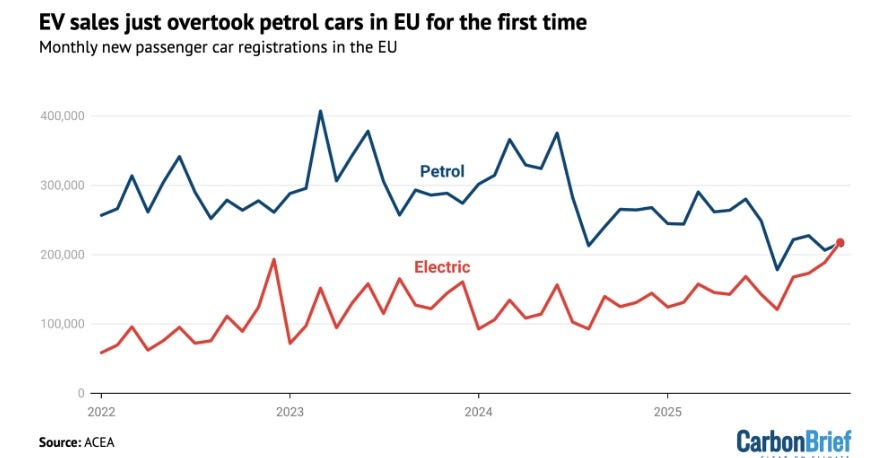
Need-to-Know: High fuel prices accelerate the shift to electric
Petrol and diesel accounted for just 30% of new car sales in the EU from Jan to April this year.
China
About 51% of all new car sales were electric vehicles in 2025.
China is also building electric heavy- and medium-duty trucks and charging infrastructure to replace diesel and LNG-powered trucks.
China’s oil demand declined nearly 5% as a direct result.
This was fun. Right?
Until next time. Be well.
Stephen