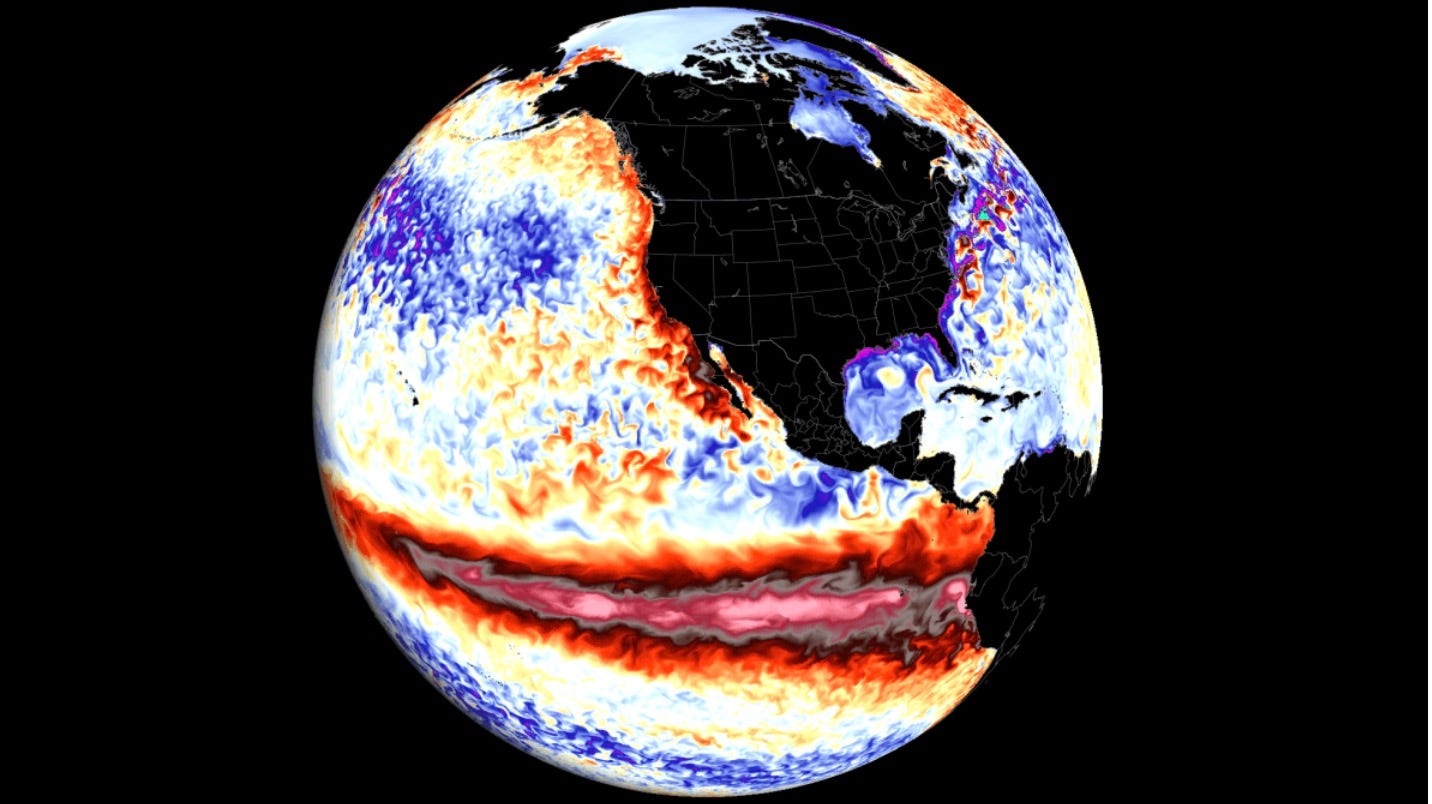
We’re in the cool phase (La Niña) of the ENSO cycle* that will end over the next couple of months. La Niña was supposed to cool global temperatures, but 2025 turned out to be the second- or third-hottest year in 125,000 years. (See: Is This the Year Global Warming Stopped)
Need-to-Know: ENSO is a natural cycle. Global warming is not.
The ENSO cycle now occurs on top of our unnaturally hotter climate.
Imagine our climate is like a burner on your stove with a dial that goes from 0 to 4 degrees C of global heating:
Global warming turned the stove-burner dial to 1.6 degrees C in 2024.
La Niña (the cool phase) turned the dial down to 1.45 degrees C in 2025.
El Niño (the warm phase) could turn the dial to 1.7 degrees C or higher in 2027.
Need-to-Know: “Every tenth of a degree matters!!”
That’s a direct quote from dozens of climate scientists I’ve talked to over the years. The impacts of global warming get exponentially worse with every tenth-of-a-degree rise.
Climate scientists are pretty exasperated that this isn’t getting through to our leaders.
Share Need to Know by Stephen Leahy
Need-to-Know: Hottest winter in 131 years in the US West.
Both ENSO phases significantly impact our weather. The impacts vary based on geography. For example, during this La Niña, the eastern US and Canada had a cool winter, while the western US/Canada had the hottest winter in 131 years.
Need-to-Know: It will be hot this year, even hotter next year
A Super El Niño is likely to start up in June or July, with impacts felt in late summer or early autumn.
Most places will be hotter, in what is already likely to be a record or near-record hot year. 2027 is virtually certain to be the new hottest year ever.
Here’s why this is happening.
Earth’s climate is a heat-energy distribution system. We’ve added a tremendous amount of heat to the atmosphere from the 40-odd billion tons of carbon pollution we pump out every year. The heat-energy in the climate system is rapidly increasing because carbon molecules from 60 years ago (or longer) are still adding heat.
Need-to-Know: The Colossal-Heat-Monster Kraken is waking
The oceans are a key component of the climate system. They’ve been soaking up much of the excess heat energy our emissions produce. I called this the Colossal-Heat-Monster Kraken in 2023 before the last strong El Niño.
A few short months from now, El Niño will release the Colossal-Heat-Monster Kraken. And it will be released on top of our overheated climate.
This will supercharge heat waves and storms/flooding around the planet next fall/winter.
Here’s Jeff Berardelli, Chief Meteorologist and Climate Specialist on what’s coming:
And you can bet Earth will experience its hottest days on record coming later in 2026 into 2027. El Niño is one of the biggest climate forces on Earth, and it has a profound impact on worldwide weather because of all the heat released into the atmosphere from the ocean.
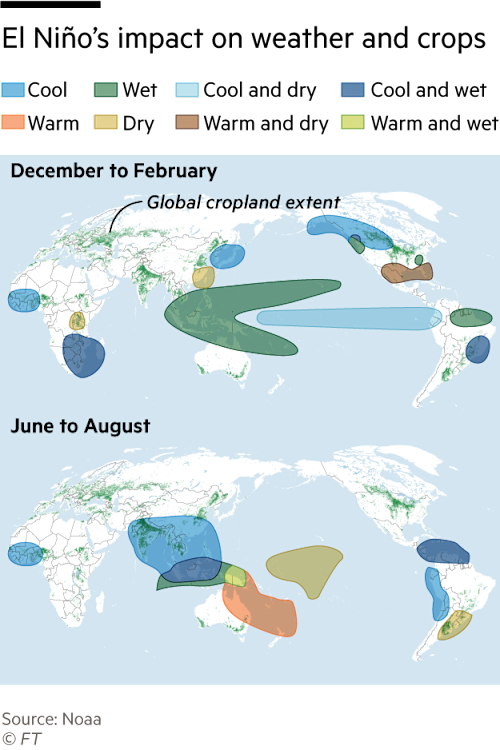
The full impacts are impossible to predict.
However, it’s very likely each of us will experience one or more record-breaking extreme events in the year ahead.
This doesn’t have to keep getting worse.
Need-to-Know: Most people want renewables, not fossil fuels

We can slow down and stop the dangerous overheating of our only home.
A wide majority of people in every country want to slow and eventually stop carbon emissions. That is a fact as many public surveys show i.e. You are not alone. Most people in 77 countries want stronger, faster climate action.
A majority of people of all ages around the world also believe that “it’s our responsibility to leave behind a world that’s safe and livable for future generations.”
Let’s get to it.
Until next time. Be well.
Stephen
* The El Niño–Southern Oscillation (ENSO) cycle is the largest natural climate fluctuation on Earth. The La Nina is the cool phase of the cycle, while El Niño is the warm phase. Each can last a few months to 3 years.