Former England, Lions and Bath star, the ultimate ‘Test match animal’, on his glorious career and why he thinks replacements should be limited in the modern game

GARETH EWAN JONES FOR THE SUNDAY TIMES
How do you define the concept of genius in sport? Surely, as something that cannot be coached or even properly described; something ineffable and natural. And glorious.
Jeremy Guscott, 60, a keen student of rugby after retirement from a brilliant career, and then as an analyst for BBC’s rugby coverage, singles out the brilliant young Springbok fly half Sacha Feinberg– Mngomezulu.
“He is super-special. He is fast, he has physical presence, he is incredibly fit. He has the pace of a winger and he has presence. He can command a game with his boots. He scored a try in the Rugby Championship recently when he kicked the ball from his own half, sprinted up and reached it first.
“Antoine Dupont is back playing again now after injury, but this guy is going to take over from Dupont as the world’s best player. He is phenomenal.”
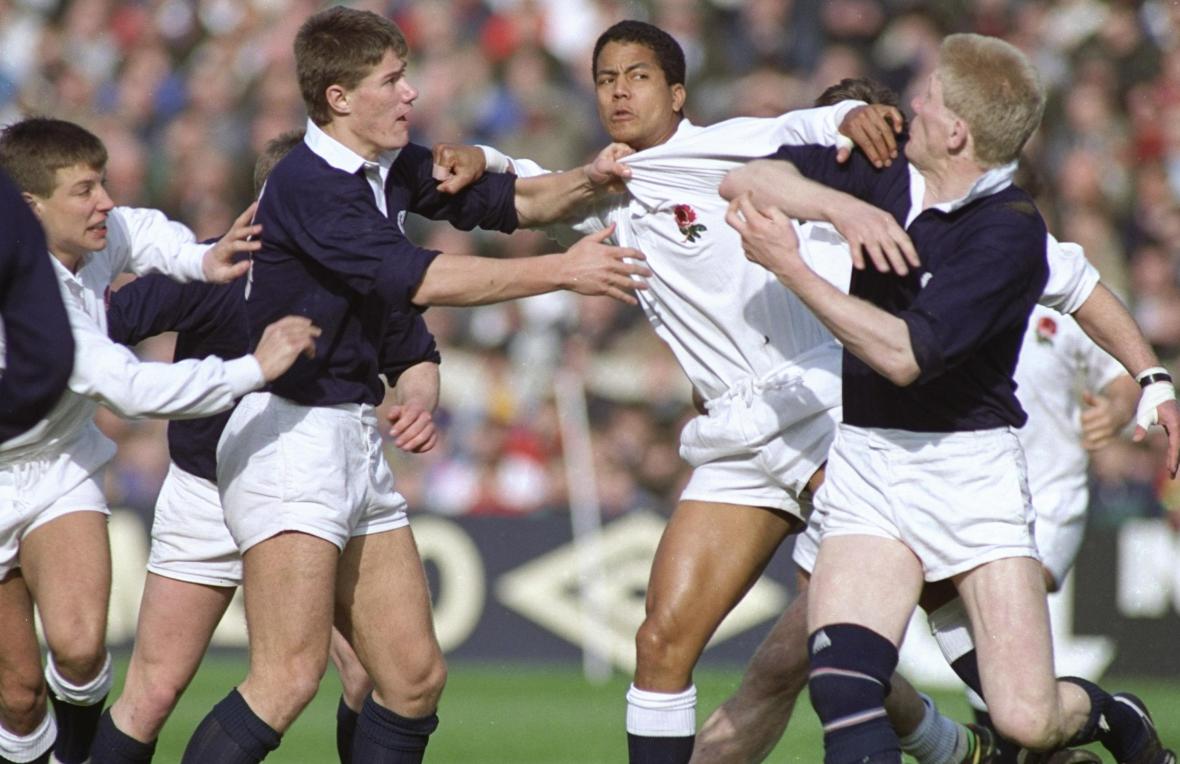
Guscott was unafraid of confrontation, here standing his ground against the Auld Enemy in 1990
DAVID CANNON/ALLSPORT
Has English rugby ever had an equivalent? Of course they have. Guscott is the greatest player on whom I have reported, he was touched by genius. He played so brilliantly for Bath (no club has ever won so much and been so dominant in any era) under Jack Rowell and Stuart Barnes, and for England under Geoff Cooke and Will Carling when grand slams were a regular occurrence; and also, on his three tours in a golden era for the British & Irish Lions.
He was precisely what Ian McGeechan, now Sir Ian, had in mind when he coined his famous phrase to describe the quality of player he wanted for his Lions teams: “The Test match animal.”
For me, Guscott was the ultimate TMA. He turned Tests through individual play at critical times — and that is so rare. And his speed? It was only occasionally that he teamed up at Test level with Barnes, his club captain, as it was usually Rob Andrew who wore the national fly-half jersey. But remember a home match against Scotland at Twickenham in 1993. Barnes was playing and took a high pass from Dewi Morris, so high that it rocked him on to the back foot.
Barnes, though, had speed off the mark: he set off on the break at pace. But as he slowed, approaching traffic, Guscott, coasting along behind the play, came to life. He accelerated as if suddenly engaging rocket power, moving faster than almost anyone I have ever seen move on a rugby field. As Barnes’ momentum died, the ball was handed to the sprinting Guscott, who seemed to accelerate even further before putting Rory Underwood over in the corner.
He is famous for brilliant plays on two separate Lions tours. The first one against the Wallabies in Brisbane in the second Test in 1989, which rescued the team from impending oblivion. The Lions, on the verge of going 2-0 down in the series, launched a late move in desperation. The ball reached Guscott, he took responsibility even though he was in his first few months of Test rugby. He chipped, chased and scored under the posts.
“I can remember everything after I touched down. It was like an old-fashioned tickertape of me as a kid playing for Bath Under-8s. It was all my steps to get there,” he says.
And then another moment of magic, which won the second Test in South Africa in 1997, possibly the hardest game ever played to win the series. Guscott won it with a drop-goal in a frantic, shuddering late play.
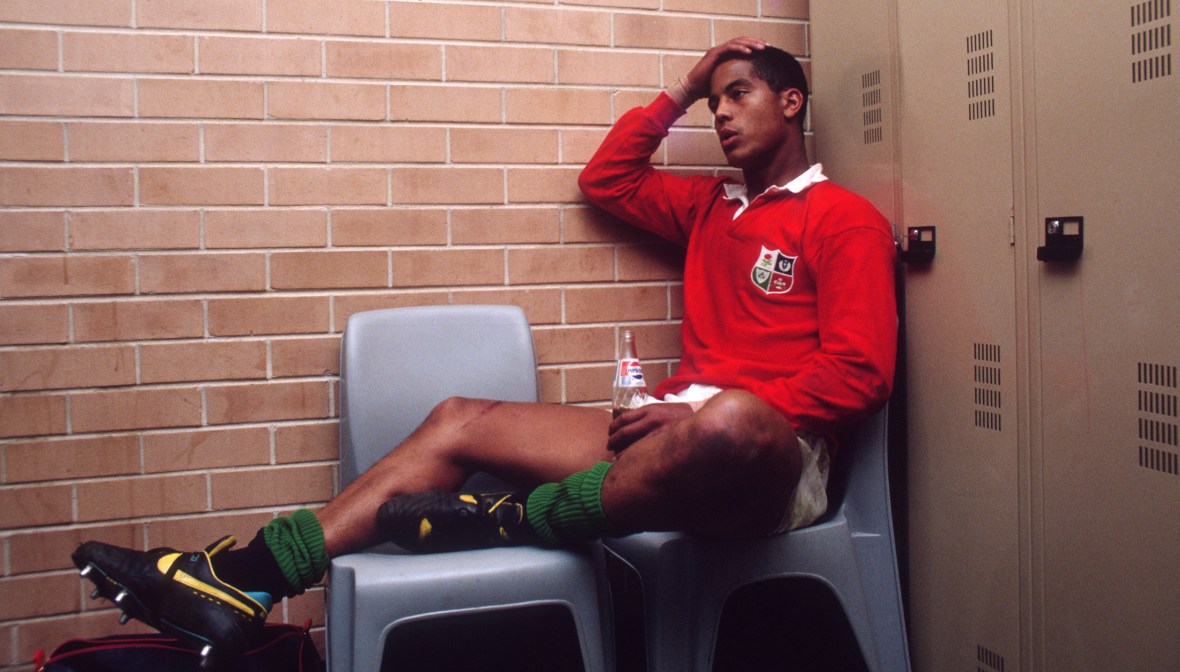
Guscott enjoys some light refreshment after helping guide the Lions to a series victory down under in 1989
MARK LEECH/OFFSIDE VIA GETTY IMAGES
I asked him last week if he had shoved Gregor Townsend, normally the first receiver, out of the way as the ball came back.
“No. The lunatic Gregor had taken the ball into the ruck. When the ball came back to Matt Dawson at scrum half, it was as if he’s looking at me and asking, ‘What the f*** are you doing there?’ ” People suggest that it may have been the greatest moment in Lions history. I was there. It was.
Guscott’s early career was chequered. He was excluded from a school in Bath and had a certain rebellious restlessness about him. He wanted others to know that he considered himself an exceptional player.
So much so that he wound up senior Bath team-mates as he approached his twenties. One day, he made one of the shortest, and yet most significant, journeys of his life. David Trick, the great wing, insisted that Guscott join him in his car for the short journey to Lambridge, where Bath trained.
“I asked Tricky if the boys thought I was arrogant. He told me that they did,” Guscott recalls. All the way to Lambridge, Trick, as a senior player, told Guscott his fortune. Guscott regards the trip as a key career journey.
Famously, Bath’s dressing room was always combustible. “There was a time when I was drunk and it was just me being immature and stupid, and Richard Hill just hit me and knocked me over,” Guscott says. “But that was a Bath thing, right? It didn’t make me think any less of him, and it was dealt with internally. I knew I deserved it, there was no animosity.”
Nor, frankly, was there any unnecessary coaching. What of the modern’s game’s complications, its endless analysing? “I remember [backs coach] Brian Ashton would have a chat with us. So would Jack Rowell. But they would never tell us how to play. It was always a conversation and if someone tells me to do something, forget it. You’re talking to someone who’s suddenly turned deaf.”
He also looked forward to the next game, rather than analysing the previous one.
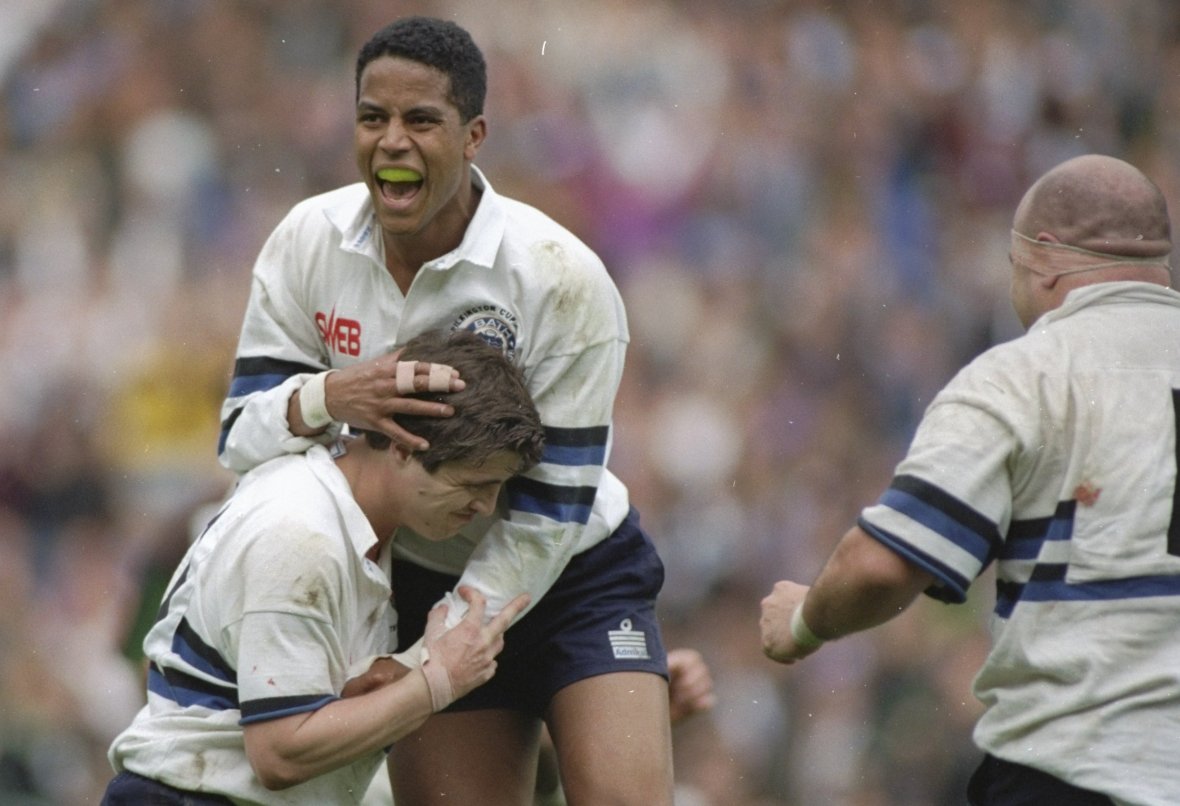
Guscott and Barnes were part of Bath’s glorious era of dominance in the late 1980s and 1990s
“Would I adapt today . . . I think I would adapt. I would just love this professionalism, but it would be my spin on professionalism. I would do everything that was expected of me and more because of that.”
And how would he improve the game? “I’d like to live to see the day that the number of replacements are brought down from eight, maybe to only two or three. The game I watched even as an amateur, and played at international level, was about skill and fitness. You used to have great banter between the forwards, even in a scrum when they were supposed to be pushing, but sometimes found the breath to talk.
“We would see what they were made of in the last 15 minutes when they’ve been breathing out of their backsides. There’s none of that now, because once they start breathing out of their backsides, someone bigger and fitter comes on.
“But I can’t get away from the fact that the modern game throws up epic games of rugby, epic games. There were quarter-finals in the last World Cup which were right up there. England’s game in the semi-final in 2019 in Japan [against New Zealand] was an epic game as well. But let’s just say we can imagine how much better it would be with fewer replacements. I’m totally convinced it would be better.”
Guscott demonstrates a deft touch against France
GABRIEL BOUYS/AFP VIA GETTY IMAGES
And how does he remember the tortuous transition to professionalism, and early life as a professional? In a way, Guscott was ahead of the game as usual in the amateur era. He was going on photoshoots for sports goods firms almost before anyone else. He came a valiant second to the actor Terence Stamp in the best dressed man of the year award and had a commercial savvy.
Was there a profound difference when, with Guscott still at his peak, the game was declared open and professional, this after he had had a stellar a career as an amateur but with benefits?
“Professionalism just made the smile on my face bigger. I just couldn’t believe we were going to get paid to play,” he says. “It was beyond incomprehensible. I thought, wow, someone’s going to pay me to play and train to be better, and for me to do more of what I really, really enjoy.”
Guscott had previously headed towards bricklaying as a potential source of income in the amateur era, and was briefly a bus driver with Badgerline — a fact of which he was reminded by The Shed every time Bath played at Gloucester. But he could not make all the games because he wasn’t given time off. Then, payment came for playing rugby.
His industry over the years has paid off. Guscott decided to leave his role as a BBC pundit when, having not done his prep properly, he had to give the jersey number of a player rather than a name. He turned down a three-year renewal.
Stephen Jones: From Guscott’s drop-goal to battered sausage on sticks – My ten Lions tours
Befriending Guscott and New Zealand hate: Stephen Jones’ 40 years at the Sunday Times
Now, it’s Guscott in the City, as the director, shareholder and co-founder of Vizion, a boutique insurance brokerage. He also helped to found a company called Telematics. “That’s the black box that they put nowadays into a lot of young drivers’ cars to monitor how they’re driving and that is supposed to bring their insurance down,” he says. He is fiercely proud of his three daughters: Imogen, a charted accountant living in California; Holly, a financial planner living in London; and Saskia, who works in event management and also lives in London. His wife, Saz, recently became a doctor of psychology.
Now he is loving Bath’s momentum and attractive play after many years of drought. Recently, we have seen Max Ojomoh playing beautifully for Bath and for England, surging around the place. That took me back a bit. Rugby seemed way less complicated then; and touched by the genius that was Jeremy Guscott.