It is 6am and I am watching dough being kneaded into a little ball, delicately patted into a disc, then toasted on a 1950s Portuguese army-issue paraffin cooker. It is bitterly cold. We are at the 2,650m summit of the Kukenan mountain, a plateau of ancient stone eroded into baroque shapes, that seems either desolate or impossibly beautiful, depending on your mood. The aroma of that breakfast makes me take the latter view.
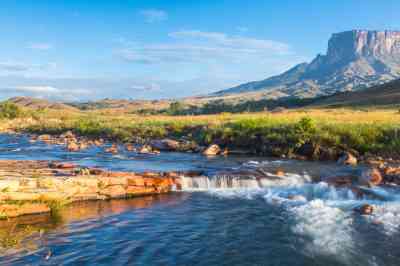
Kukenan is one of almost 100 tabletop mountains, or tepuis, in this remote corner of southern Venezuela, where geological accident laid bare the ancient slabs of the Gondwana continent that once linked modern South America and Africa. A few hundred miles from the equator, their lowlands are now shrouded in jungle, and they are notoriously difficult to reach. Many have still never been climbed.
In late 19th and early 20th centuries, there was fevered speculation as to what might be discovered on these isolated yet seemingly habitable summits. Opposite me, shrouded in wispy white cloud, is the most famous of them all: Mount Roraima. In 1877 the editorial board of The Spectator demanded that someone climb it. “Will no one explore Roraima. . ?” the magazine thundered. The thought was that the mountains might provide a window into a prehistoric world and confirm, or disprove, Darwin’s recently published theory of evolution. Sir Arthur Conan Doyle used the region as the setting for his 1912 novel The Lost World, with its tales of dinosaurs and “ape-men”.
Fast-forward to 2020, and this trip has been a reminder of how, once again, swathes of Venezuela seem forgotten by time. The country’s economic collapse, one of the most precipitous in modern history, is bad enough in Caracas. Travel outside and it is extreme.
Our journey begun in Puerto Ordaz, the nearest city to the mountains with a functioning commercial airport, but still 300 miles from our first camp. The former industrial hub has emptied of people and is suffering chronic shortages, especially of fuel. The average wait to fill up with petrol was two days.
As we set off across the vast Bolivar state towards Brazil, on a road begun by the 1950s dictator Marcos Pérez Jiménez using prison labour, it seemed that we were heading back to that era. All mobile phone coverage ended within two hours of Puerto Ordaz. The tarmac became riddled with potholes.
We stopped for lunch at a restaurant known simply as “Km 25”. In a raucous wild west atmosphere we were served fried fish and rice, washed down with whisky (imported from Brazil and with ingredients that included “ethanol” and “caramel”). At the next table were about 20 armed men; “security” we were told, for a nearby freelance goldmine. Brutal mafia-style law enforcement is the norm in these towns. I asked the restaurant owner, Yoli, how she would prefer to be paid. “Dollars, darling . . . or gold”, she said. The bolivar, Venezuela’s official currency, wasn’t welcome. I settled up in dollars. The customer after me paid in gold flakes.
We continued. A journey that a decade ago would have taken eight hours took 14, owing to the bad roads. By the time we reached the indigenous hamlet of Paratepuy, everything was entirely dark, except the panorama of stars above us. The town had a generator but, apparently, no fuel.
The climb itself was three strenuous days of ascent, much of it through thick forest but worth every step. At the top, we spent two days exploring our alien surroundings, bathing in crystal-clear streams fringed by pink quartz sand. There were carnivorous plants, miniature frogs and primitive ferns that appeared like prototypes for the more advanced versions on Planet Earth below.
Before we began our descent, I received a satellite message. In Caracas, Nicolás Maduro had blocked his rival for the presidency, Juan Guaidó, from entering parliament. Another MP, sympathetic to the regime, had taken his place. By some accounts, the country now had three men claiming to be president. “What do you make of that?” I asked one of our indigenous guides. “Oh, don’t ask me about politics,” he said. “That’s another world.”