Like everything surrounding the twice-impeached, four-times-indicted former president, his campaign schedule challenges all the conventional wisdom about winning a presidential primary campaign
AMES, Iowa — Between Donald Trump’s brief fly-in to the Iowa State Fair in August and his Saturday touchdown at the Iowa-Iowa State college football game over the weekend, the former president has spent fewer days in the early caucus state than many of his GOP primary rivals.
But the twice-impeached, four-times-indicted former president has a commanding lead in the polls anyway. Like everything surrounding Trump, his campaign schedule challenges all the conventional wisdom about winning a presidential primary campaign.
In comparison, Florida Gov. Ron DeSantis has made 66 campaign stops here this cycle over 17 days. Former South Carolina Gov. Nikki Haley has held 40 events across 20 days. Sen. Tim Scott has five events scheduled in Iowa just next week, and former entrepreneur Vivek Ramaswamy has been there even more. But none have come close to knocking down Trump’s lead in Iowa polls.
It’s practically cliché for candidates to pick an early nominating state and virtually live there, with the understanding that caucus-goers want to be courted and meet their chosen candidate in person at least once.
The 2008 GOP caucus winner Mike Huckabee pledged to literally “live in Iowa” the month before the election, for example. Sen. Cory Booker slept over at supporters’ homes in Iowa during the 2020 Democratic primary and Marianne Williamson even moved to Des Moines that cycle.
Trump may have spent in person less time in Iowa this cycle, but he’s dominated the events that he has attended. His campaign also noted that that it puts on other events in the state and Trump hosts telerallies for Iowans. “The Trump campaign has put on more Iowa candidate-attended events than the DeSantis campaign,” said Trump spokesman Steven Cheung, a reference to the Never Back Down super PAC that often hosts DeSantis for events rather than his official campaign. “In addition, the President has held numerous tele-rallies and tele-townhalls, engaging with tens of thousands of Iowans.”
A spokesman would not share how many events the campaign has held or how many Trump attended in person—but it's safe to say Trump's personal footprint is dramatically smaller than the normal Iowa frontrunner.
“The trips are short, substance-free photo ops. No town halls, not much in the way of voter persuasion the rest of the candidates are engaged in. That said, he’s Trump. Voters already know what they’re getting,” said David Kochel, a Republican strategist from Iowa. “Maybe it will work, but there’s a reason he’s weaker here in Iowa than in the national polls.”
Trump hasn’t been absent from Iowa, he’s just been for fewer days than his opponents. The former president campaigned in Davenport in March and made several stops around Des Moines in June. He held a rally for more than 1,000 people in Council Bluffs in July and visited a local Dairy Queen afterward. A month later, fairgoers applauded when Trump’s private plane flew over the Iowa State Fair in Des Moines and created a bottleneck in the middle of the fairgrounds to see his brief remarks.
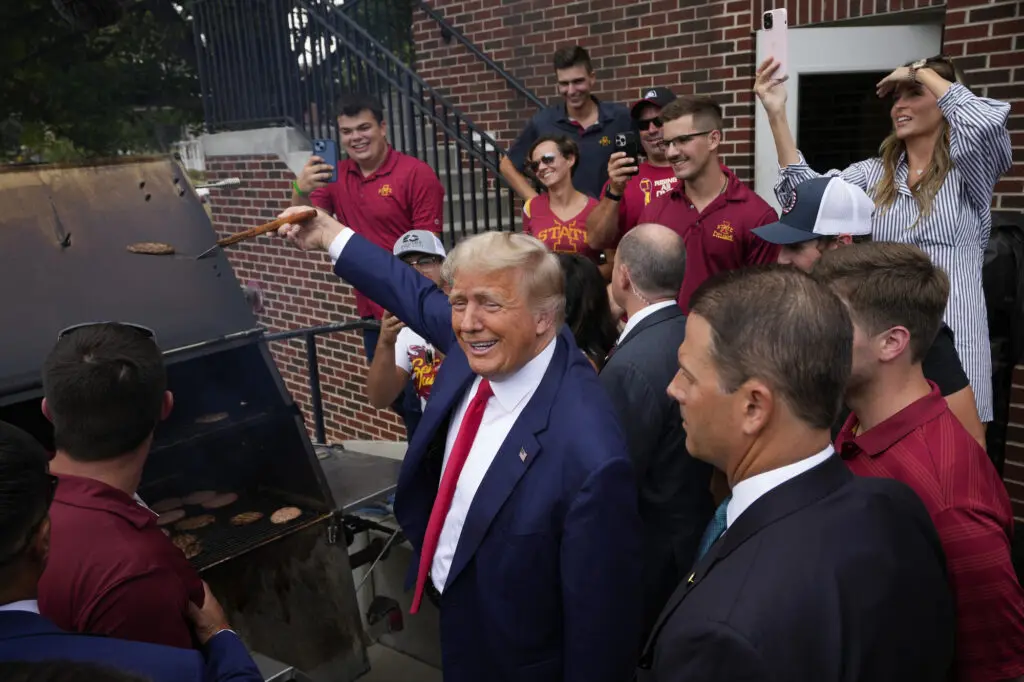
A similar thing happened when Trump arrived by motorcade at Jack Trice Stadium for the Iowa-Iowa State college football game on Saturday. Tailgaters crowded around to catch a glimpse of the former president and watch him toss footballs into the crowd. Inside the stadium, some cheered and others flipped him the bird.
“It’s nice to have him here. He’s my guy,” said Kelly Skinner, a resident of Johnston who waited approximately 45 minutes to see Trump arrive at the stadium. “I’m for him because they don’t want him.”
Still, Iowa has been a more challenging place for Trump compared to the rest of the primary map. He came in second place in the Iowa caucuses during his 2016 campaign. Texas Sen. Ted Cruz won the first-in-the-nation caucuses that year. He’s also picked a high-profile fight with GOP Gov. Kim Reynolds this time around.
Reynolds is neutral in the GOP caucuses but has made several notable appearances with DeSantis this summer, including attending the Iowa-Iowa State football game with him on Saturday.
Despite his second-place finish in the 2016 caucuses, Trump’s campaign outfitted supporters with green “BACK-TO-BACK IOWA CHAMP” T-shirts and drink holders at the Iowa State Fair, seemingly a reference to his 2016 and 2020 general election wins in the deep red state.
Trump’s polling lead in Iowa is also less solid than his lead in national primary surveys and in other states, and some Trump allies have voiced concerns about the strength of his Iowa operation.
“He’s certainly taking a risk. 70% of Iowans are open to someone else and they expect these candidates to earn their vote, not take it for granted. Iowa caucus voters usually decide late and they’ll take all of this into consideration,” Kochel said.
That’s in part due to the nature of the caucus process, where voters’ second choices can be key. Selzer & Co., the polling firm that conducted a survey of the state for The Des Moines Register, NBC News and Mediacom last month, sizes up the field using a “footprint” metric. It measures candidates by who likely caucus goers say is their first choice, their second choice and are otherwise actively considering.
“We get, for that number, a 63% for Donald Trump, 61% for Ron DeSantis, which would say he’s certainly the nearest contender,” said Selzer & Co. President J. Ann Selzer. “It's not a difference of that many percentage points.”
Still, Trump was the first choice of 42% of likely GOP caucus goers in that mid-August poll, while DeSantis was in second place with 19%. Sixty-six percent of Trump supporters say their minds are made up and they could not be persuaded to support another candidate. DeSantis, who previously said he was aiming to win the caucuses, signaled through a campaign official this week that he’d be happy with second place showing.
If the makeup of who goes to caucus changes, though, that could help a Trump opponent.
“The turnout can change dramatically from cycle to cycle. So he could hold on to those current supporters but another candidate could go out and recruit people who, who in our poll said they didn't think it was likely they would be attending a caucus, even though they might have some interest and make a bigger pie,” Selzer said. “President Trump's slice of the pie could stay the same as it is now but in a bigger pie, then it's possible for other candidates to do better.”
Some Iowans who spoke to The Messenger this week said they wouldn’t mind seeing more of Trump, but understand that he’s busy campaigning across the country and handling criminal cases across four jurisdictions.
Tracy Oldnettle, a 47-year-old military veteran and undecided voter who lives in Fort Dodge, said he believes the caucuses are still “up for grabs” because “there’s been a lot of momentum for true change in the way we we govern our country.”
“I think [Trump] already has Iowa to a certain extent. I think that he has been quite distracted by some other movements and whatever factions are fighting against him,” Oldnettle said in an interview after attending a Ramaswamy town hall.
Trump’s E. Jean Carroll defamation civil trial is set to begin the same day as the caucus, while his 2020 election interference case is scheduled for the day before Super Tuesday.
“The United States is a huge country. Iowa’s just a small part of that,” said Paul Becker, a retired credit union CEO from Fort Dodge attended the same Ramaswamy event. He’s undecided on who to caucus for. “We all want him here, and we all want all these people here so we can hear them more.”