Some presidential candidates have gone missing in New Hampshire, the influential first-in-the-nation primary state where Trump has a wide lead.
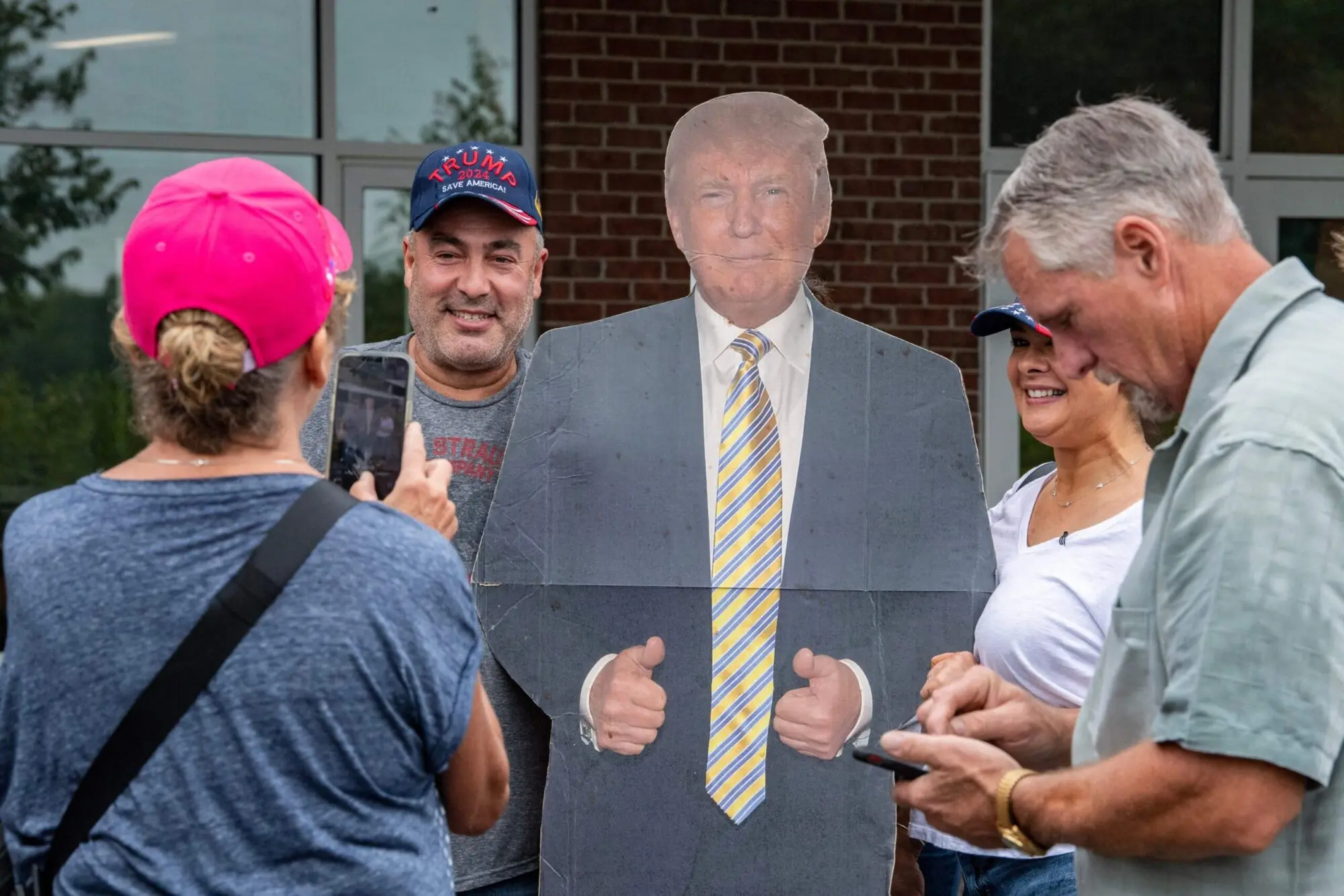
NASHUA, N.H. — The presidential race will descend on New Hampshire’s second-largest city today, when the Republicans running for president speak at a state party gathering and file paperwork to appear on the first-in-the-nation primary ballot.
For a few days, New Hampshire, will at least give the appearance of being a hub of political activity. The day-to-day reality, however, is quite different— and in a state used to being smothered in candidate attention, some voters are left wondering if anyone not named Trump really wants to win.
Mere months before New Hampshire’s influential primary night, many of the campaigns have a lighter footprint than in past cycles, a phenomenon which has become the talk of the political class. Former President Donald Trump has such a strong grip on the party’s small-dollar donor apparatus that his rivals can’t afford to campaign in the traditional way. But if they don’t pull out all the stops, it seems like they’ll have no chance of beating him.
“I've been waiting for someone to try and grab New Hampshire by the throat and say ‘I’m gonna take this primary. I’m gonna get after it,’” said Jim Merrill, a veteran New Hampshire GOP strategist. “At some point, you’ve got to make a decision: Do you want New Hampshire or not?”
Trump is the clear leader in New Hampshire primary polls, even as he faces four indictments and a litany of court dates for his alleged roles in trying to overturn the 2020 election, mishandling classified documents, business fraud and hush money payments to a porn actress.
Regardless of his legal troubles, the former president had 45% of support in a September poll of likely GOP primary voters, conducted by Saint Anselm College. The rest of the crowded field was stuck below 20%.
In an effort to cut into Trump’s lead, many of the presidential hopefuls will gather in Nashua on Friday and Saturday for the New Hampshire state Republican Party’s leadership summit. Many will also swing by the New Hampshire State House, if they haven’t already, to put their names on the primary ballot.
But a quick appearance at a conference and a photo op with the secretary of state is hardly enough to win over New Hampshire voters.
“What's really missing is sort of infrastructure on the ground,” said Dave Carney, a longtime Republican strategist from New Hampshire. "No one expects the candidate here every day, but there doesn’t appear to be organizational effort going on on the ground.”
Campaigns have been quiet about just how many paid staffers and volunteers they have in New Hampshire this cycle. Several didn’t even respond when asked how many events their candidate has attended in the state.
Florida Gov. Ron DeSantis has dedicated much of his time and resources to Iowa, the other early nominating state where Trump appears slightly more vulnerable.
New Hampshire voters have taken notice: DeSantis’s support in New Hampshire has collapsed in recent weeks. DeSantis has a New Hampshire office with full-time staff and more than 100 volunteers, his campaign said, but did not share how many staffers he has on the ground. The Florida governor has attended 23 New Hampshire events and will attend more over the weekend, but that sum is only a third of the 70 events DeSantis has attended in Iowa.
Similarly, Sen. Tim Scott has attended more than 40 events in Iowa, according to his campaign, and just over 15 in New Hampshire. The South Carolina lawmaker has staff based in New Hampshire and has mobilized volunteers throughout the state, but his campaign did not say how many of either.
And even Chris Christie, the former New Jersey governor who is staking his campaign on the New Hampshire primary, is spending less time there than in 2016.
By comparison, Sen. Mitt Romney’s winning primary campaign had a dozen staffers on the ground in New Hampshire in 2012, many of whom were from the state or had ties there, said Merrill, who directed the campaign’s New Hampshire efforts. Romney had hundreds of New Hampshire volunteers by the end of the race.
“It's just a little bit more under the radar this time. There just aren’t as many of the obvious indicators of a campaign apparatus that we've seen before,” Merrill said.
The reason for a lighter New Hampshire footprint is likely due to Trump, said Fergus Cullen, the former chairman of the New Hampshire state Republican Party. For his part, Trump will skip the GOP summit this weekend. He opted to hold his own rally earlier in the week in Wolfeboro instead.
“They're always refighting the last war, and they look at Trump's win in 2016,” Cullen said. “There was no penalty for not campaigning in the traditional way, and so I think a lot of the campaigns said screw that … It's a lot of work. It costs a lot of money, and there's not a lot of evidence that it works.”
Christie held more than 100 events in the lead up to the 2016 New Hampshire primary only to earn 7% of the vote, drop out the next day and endorse Trump weeks later. His campaign says it is conserving resources this time around and finding ways to use the media to reach New Hampshire voters without staffing an office or holding so many events.
“It’s a question of resources. None of the campaigns this cycle have the sort of resources that that campaigns did in 2016 or 2012,” said Alex Conant, who served as communications director for Sen. Marco Rubio's 2016 campaign. “Trump has locked down a lot of the small dollars and none of the leading candidates have shown enough momentum to get major donors excited.”
The traditional New Hampshire ground game may be shrinking, but it’s not extinct. Several GOP political watchers said former South Carolina Gov. Nikki Haley is a standout in the state this year.
“She has genuinely run the most authentic New Hampshire campaign that we're accustomed to seeing here,” Merrill said.
Haley will have held nearly 60 events in New Hampshire by the end of the week, her campaign told The Messenger, with a leadership team stretched across the state’s 10 counties. The effort, along with a TV boost by a pro-Haley super PAC, has helped her move into second place in New Hampshire primary polls.
And businessman Vivek Ramaswamy, who has given millions of dollars to his own campaign, has used those resources to make New Hampshire a priority. He’s attended 72 events in the state and has 309 volunteers, his campaign said.
The presidential campaigns are not absent, despite their smaller presence on the ground, New Hampshire state Republican Party Chair Chris Ager told The Messenger.
“Nobody's AWOL,” Ager said, adding that he respects Trump’s decision to skip the summit. “Campaigns do what they have to do. They're the ones responsible for trying to win, so we respect that.”
Ager has been in touch with each campaign, initially with a guide on how to campaign in the Granite State and more recently with information on the delegate selection process.
But as the primary draws closer, even the literal grassroots seem to be lacking.
“There's just a lot less grassroots campaigning, there's a lot less interaction between regular voters and candidates. And I'm not bemoaning that. I'm not nostalgic about it. I'm just saying it is a fact,” Cullen said. “I'm in the fifth largest largest community in New Hampshire. And aside from a couple of Trump signs that have been up for four to eight years. I am not aware of a single sign in my community for any presidential candidate.”