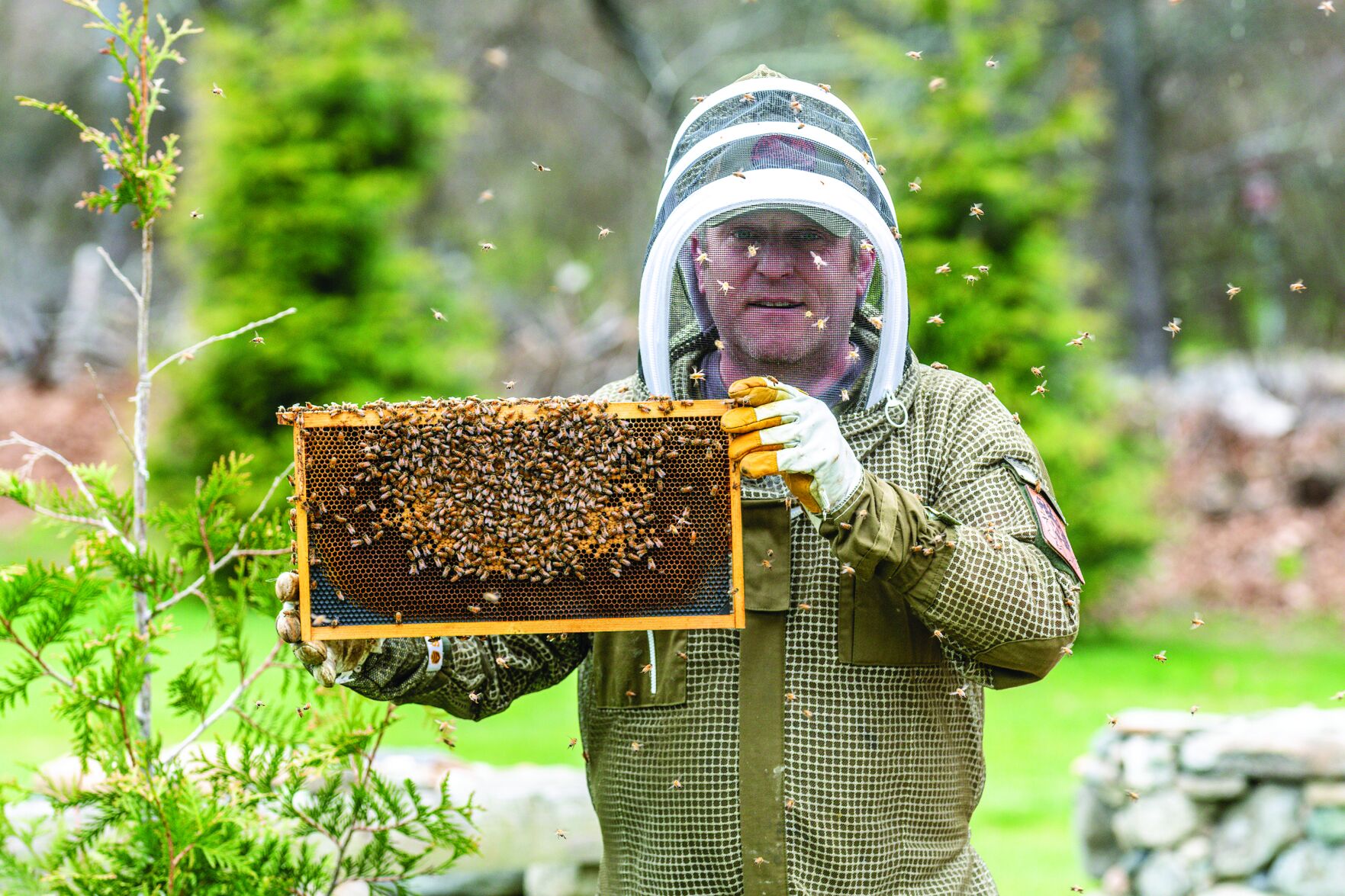
SOUTH KINGSTOWN, R.I. — On a sprawling property just off Tower Hill Road in South Kingstown, Patrick and Lisa McCarthy tend to roughly 40 beehives. By season’s end, they plan to have 60. The bees are a source of income, a pastime, and, most profoundly, a critical lifeline.
Patrick McCarthy is the Rhode Island state leader for Hives for Heroes, a national nonprofit that connects military veterans and first responders to beekeeping as a path toward healing, purpose, and community. The organization was founded in 2018 by Marine veteran Steve Jimenez, who struggled with depression, isolation, and severe PTSD after returning from Operation Enduring Freedom. Jimenez found solace in beekeeping and built a nonprofit around the idea that what helped him could help others.
Today, Hives for Heroes is the largest beekeeping network in the United States, with more than 10,000 veterans and first responders enrolled in every state. The organization manages upward of 80,000 hives nationwide and has stewarded billions of bees through its mentorship programs.
Rhode Island, however, is starting over from scratch.
McCarthy, who is still active in the military with 33 years of service, said the state chapter had been dormant for more than eight years before he stepped in. He and Lisa moved to Rhode Island in 2020, at the height of the pandemic, after he was assigned as a student at the U.S. Naval War College in Newport. When they decided to put down roots in South County, they brought their love of beekeeping with them.
“I assume that leadership role because I recognize a gap,” McCarthy said. “I’m applying my own military leadership philosophy that if you see a gap, it’s your gap to fill.”
The Rhode Island chapter is in what McCarthy calls a rebuild phase. He is working to recruit veterans and first responders across the state, reaching out to populations at Naval Station Newport, the Rhode Island National Guard, and the Quonset Point defense community. So far, the effort has yielded 10 potential new beekeepers, a 150 percent increase in local Hives for Heroes registrations. None of them have bees yet, but all want to learn and are willing to join the network.
The model is built on mentorship. A new participant, referred to within the organization as a “newbie,” is paired with a local beekeeper and guided through an entire season of hands-on work. If the partnership goes well, the newbie receives a nucleus colony of bees to be raised in the mentor’s own yard. McCarthy said his goal is to take a new beekeeper and turn them into a mentor within two years.
There is an ironic twist to his own entry into the Rhode Island chapter. When he and Lisa registered with Hives for Heroes after arriving in the state, the system’s limited categorization system identified McCarthy as a newbie despite his years of experience. The organization paired him with a local mentor couple, John and Patty Grimes. It didn’t take long for the dynamic to flip.
“They call us the mentors,” Lisa McCarthy said with a laugh.
Hives for Heroes operates with what Patrick McCarthy describes as centralized planning and decentralized execution. Steve Jimenez runs the national office out of Texas, and the organization holds 501(c)(3) status. State leaders like McCarthy receive support in the form of promotional materials, T-shirts, and banners, and they can request funding for specific events such as a booth at the Washington County Fair. But at the local level, the work is entirely volunteer-driven.
McCarthy said he does not accept monetary donations. If someone wishes to contribute, he asks them to buy a beehive kit from a supplier and send it to him. The focus, he said, is on the mission and the message.
That mission goes well beyond honey production. McCarthy, who previously participated in the Hives for Heroes chapter at Fort Bragg in North Carolina, said beekeeping offers solace uniquely suited to those who have experienced military service or the pressures of first-responder work. The hobby demands focus and problem-solving. It rewards patience and observation. And for veterans dealing with post-traumatic stress, the hum of a healthy hive can coax the parasympathetic nervous system into respite.