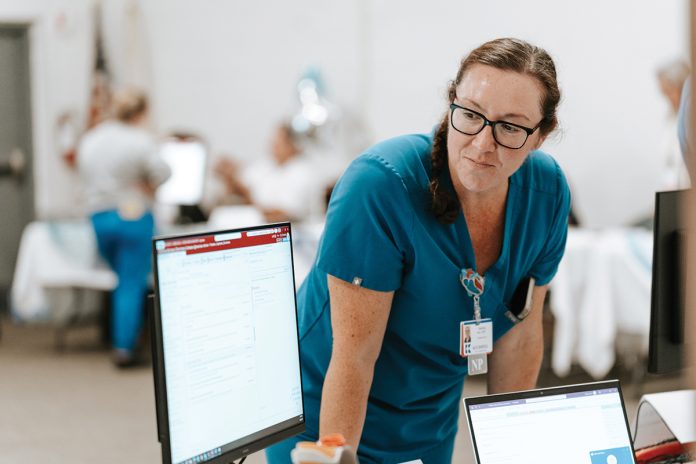
Seven Rhode Island College undergraduates are preparing to sit for the Sphinx assessment, a test that could shape their careers before they graduate. Pass it, and they enter a track toward certification in Epic, the records system Care New England Health System went live with in October 2025, followed by an internship and, if the plan holds, a job.
They are the first cohort of a healthcare technology workforce center that CNE and RIC announced in February, and one answer to a question facing employers statewide: how to staff an industry being rewired around software.
The pressure is global since healthcare information technology spending is projected to grow from roughly $588 billion in 2025 to $707 billion in 2026, a rate of 20.3% a year, according to The Business Research Co.
The picture inside Rhode Island’s hospitals is more complicated. In May, CNE announced it was cutting more than 30 leadership and nonclinical positions, citing an estimated $20 million fiscal 2026 shortfall driven by Medicaid rates, labor and supply costs, and uncompensated care. It is building a technology pipeline while shedding administrative jobs.
Tomas Gregorio, CNE’s senior vice president and chief digital information officer, said electronic health record analyst roles once treated as back-office functions are becoming front-end engineering jobs embedding artificial intelligence support at the point of care. Workforce shortages in healthcare, he said, “are no longer just clinical.”
Gregorio, who has spent 35 years in the field, said healthcare has “always been behind” other sectors. Hospital IT existed largely to support billing until the national electronic health records shift in 2009. Aging infrastructure and heavy regulation have left lasting demand for workers fluent in both technology and the clinical work.
February’s announcement named the target fields: cybersecurity, AI, data analytics and digital health. The immediate crunch is narrower.
“CNE is desperate for more Epic-trained employees,” said Jenifer Giroux, RIC vice president for corporate and external relations.
At Brown University Health, the state’s largest private employer, the same pressure has produced a different structure. Matthew Butler, a year into his job as director of artificial intelligence, has established an AI center of excellence and says the pace of change is itself the workforce problem.
“Rapid progress of models over the last year has changed what’s possible in our day-to-day work,” Butler said. “We need to make sure the workforce can not only keep up but innovate with it.”
The industry shifts week to week, he said: six months ago, the push was to use as many tokens [how AI usage is measured] as possible; now it is to conserve them.
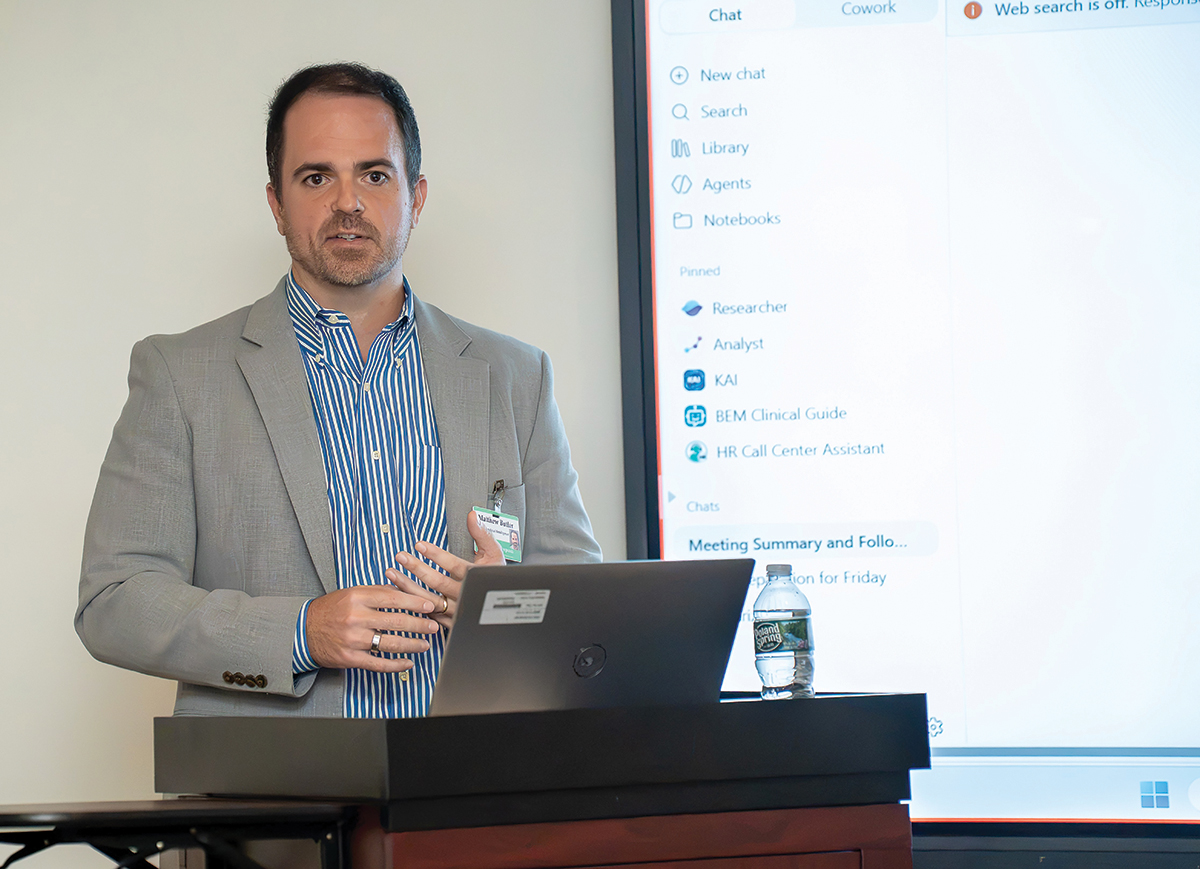
Butler’s team gave employees secure AI access, then went department by department showing uses specific to each: large-data tools for finance and revenue cycle staff, ambient documentation for clinical teams. It has run five or six clinical pilots involving Microsoft Copilot and Epic and offers a four- to six-week curriculum of asynchronous and in-person training.
The gains are in time, not headcount. “Where it might have taken an executive assistant a week to take the minutes and follow-ups after a meeting, they can do it in an hour,” Butler said. “Knowledge workers go from ‘I need two weeks to create a presentation’ to ‘I need a day.’ ” Analysts once building pivot tables, he said, “can now just talk to AI and better interrogate the data.”
His own hiring illustrates the gap. Butler brought on two employees when he arrived, wanting to hire internally but finding no one with AI skills. That is fixable, he said, as the skills can be taught, but institutional knowledge is harder to replace.
Butler has been holding in-person classes for Brown Health employees, providing a welcoming space for questions and experimentation. Those in a department are best placed to know how AI tools can help them most effectively, and the training provides them with the knowledge to apply it.
Ara Millette, Brown University Health’s director of talent acquisition and a registered nurse, has been on the receiving end.
“As the director of talent acquisition, I’ve been a consumer of Matt’s team’s products,” she said.
She attended Butler’s training and now uses the tools daily.
“In human resources, we have thousands of job descriptions across BUH; we have been using that to reformat them into HTML, which used to be a highly manual process,” she said. Her team is “building agents around enabling a team to have access to info more quickly.” In hiring, “we may have 20 or 30 candidates in play for one particular job, so we can synthesize detailed interview feedback into a really clean report.”
WORKFORCE TRAINING
Anyone entering healthcare now needs to be technologically capable, Millette said, though Brown Health recognizes this may not always be the case, and so has invested in training its current workforce, she said.
The system also advises area schools on curriculum, aiming to “lock arms with our local university partners to meet the mark for what our workforce needs,” Millette said. It is in early talks with one school about AI workforce development tied to a grant. Those partnerships have been mostly clinical. Millette, who learned anatomy dissecting cats, called high-fidelity simulation the sharpest change, pointing to a simulated surgical space Brown Health developed with the New England Institute of Technology, in which students operate digitally on the body.
CNE’s approach reaches further upstream. Anchored in RIC’s School of Business and eventually housed within the Institute for Cybersecurity and Emerging Technologies, CNE provides Rhode Island College students with an Epic academic license, with the software and education needed to integrate into nursing and health sciences programs through simulation labs and case studies.
Health systems have traditionally hired workers and then trained them; this moves training into the student years. “We can build [the pipeline] here at RIC and at CNE,” Gregorio said.
Embedding Epic in the undergraduate curriculum will take longer than launching continuing education, Giroux said. The pilot should begin within six months, with CNE pursuing federal Rural Health Digital Funding.
Gregorio frames Epic certification as an opening, not a destination – “just a starting point,” he said, for analytics, cybersecurity and automation.