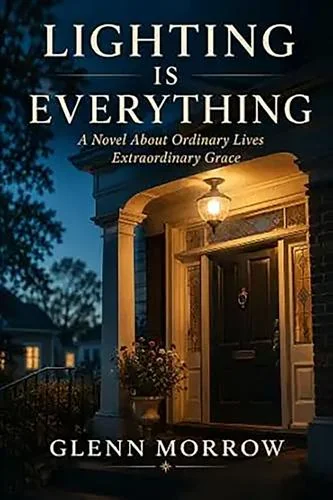
In a literary landscape where conflict usually drives sales, Glenn Morrow’s “Lighting is Everything” chooses decency. Morrow takes a gamble on goodness, and that gamble pays off.
Morrow, 72, came to Rhode Island from Massachusetts and now lives in Saunderstown’s Plum Beach neighborhood with his wife, Deborah, a native Rhode Islander.
Morrow has also become a bit of an historian for his adopted village. In an online essay, Morrow explores Saunderstown’s rich literary history, highlighting figures from Owen Wister — author of the seminal 1902 Western novel “The Virginian” — to the visionary LaFarge family who helped shape the area. Morrow adds to that legacy with his own fiction, including his 2023 novella “The Better Boat,” which follows a boy who learns to sail over one Rhode Island summer.
A former technical writer and editor of Storytelling Magazine, Morrow “resides and replaces lightbulbs in coastal Rhode Island,” according to his publisher. Fitting, given how his latest story begins.
Jerry and Franny, a long-married couple with grown children, discover that someone has mysteriously replaced a burned-out bulb on their porch. They later learn the mystery helper was Tina, a Hollywood location scout hoping to use their home as a movie set.
Soon the couple is confined upstairs while the downstairs fills with cables, cameras, and giant lighting rigs. The crew and homeowners expect the movie’s actors to arrive on set any day, but they never do.
Morrow extensively researched the art of filmmaking and chose to shine a light (pun intended) on hardworking behind-the-scenes crews rather than the industry’s glamorous stars. In fact, neither the characters nor the reader ever finds out who the actors are.
The more the couple learns about the movie’s plot from the crew, the more uncomfortable they become. They set out on a crusade of sorts to stop the filming — at least inside their house — and find strength in their faith and each other. In the end, preserving the peace and sanctity of their home — and a healing longstanding family rift — take center stage.
The writing is this book’s greatest strength. Morrow’s prose is immaculate and diverse, his humor gentle, and his characters deeply relatable. Beneath the comedy, though, Morrow makes a quiet case that what we create matters, and so do all who experience it.
The book is a pleasant, quick read, but the plot does not offer the complexity readers might expect from a full-length novel. While a lighter plot works well for short fiction, readers coming to this novel may crave more depth, more background, or just more time with the characters.
That said, readers will find “Lighting is Everything” both enlightening — true once again to its title — and uplifting. In an age so overrun with conflict, Morrow proves that quiet grace can still prevail.
Q&A with Glenn Morrow
Q: Can you tell me a little bit about how this book came to be?
A: “I started with a couple, Franny and Jerry, and a little mystery. There’s a porch light bulb that mysteriously is replaced. … I decided that it was replaced by Tina, who is the location scout for this Hollywood production. And from there I was off and running. … I wanted to depict a married couple who are of a certain age and are happy and comfortable with each other and not make dysfunction the centerpiece of the narrative because I think there’s enough of that out there in the world already.”
Q: How long have you been publishing your writing?
A: “I’ve published four books. The first one was in 2023 ... I’ve been writing for decades, but it’s been a process of moving from writing that is clever to writing that is heartfelt. And so some of my earlier stuff, which I think is lovely and has wonderful passages in it, I probably wouldn’t want to have published because it’s just too clever. It’s too much about thinking up ingenious things and writing fancy prose, which I can do a pretty good job with, but that’s not ultimately what we want from a book. We want a book that moves us, a book that tells us something about the world and how to live in it.”
Q: I understand that you had to learn a lot about actual movie sets for this. Tell me a little bit about that.
A: “I am no expert on movies or moviemaking … I learned an awful lot off of the internet. There are many, many, many chat rooms and videos where people who are actually making movies discuss techniques and approaches and technology and such. And I went on there and I asked the questions, and I eavesdropped on other people asking questions.”
Q: How do you feel about infusing faith into what you write?
A: “I’m a practicing Catholic. I have absolutely no interest in proselytizing or making some grand declaration of faith … My characters in this book and some others are people who derive some strength and some purpose, some clarity from faith. And I think that’s a good thing. And it’s not a book in which anything happens because of some divine intervention. That’s not a place I would tend to go. But yeah, it’s a book that says having beliefs strengthens people and aids them in the difficult task of dealing with life. Jerry and his conflict with his son, Philip, is kind of an example of that. Jerry goes to church and hears a sermon, and the sermon kind of pushes him in the direction of, in a subtle way, not in a heavy-handed way I hope, of realizing how he has failed his son and why there’s a rift between him and his son.”
Q: How long have you been here in Rhode Island?
A: “In this house, seven years. But my wife is a native Rhode Islander. And so we’ve been married for 20 years and together maybe 25 … I’m a Rhode Island transplant, and converts to Rhode Island are perhaps the worst. So I can tell you to turn left where there used to be a Benny’s — that sort of thing.”
Q: Do you have anything in the works currently?
A: “I’m always writing … No promises on this, but it’s called ‘Summer,’ and it’s about an 11-year-old girl who is shipped off to her aunt and uncle’s for the summer and is not happy about it. And she meets her aunt and uncle and her two twin boy cousins who she barely knows, and they transform her life in positive ways.”
Q: Is there anything that you might want potential readers to know about this book?
A: “I want people to know that it’s funny, that there’s a lot of humor in it … The ultimate image of the book is the porch light that calls the kid home at sunset. And the book is a calling home, I think, in an emotional sense, to reconcile fathers and sons, to call us all home from our isolation and to say there’s a place of love there.”
“Lighting is Everything” by Glenn Morrow is available at Wakefield Books, Island Books in Middletown, and online.
‘Between the Lines’ is a monthly book review column from freelance reporter Stephanie Bernaba.